

Red Flags in a Private Placement Memorandum to Spot
A polished private placement memorandum can still conceal serious gaps. The red flags to look for in a private placement memorandum include inconsistent issuer or security details, unclear investor eligibility, vague risk disclosures, and terms that obscure fees, conflicts, or resale restrictions. A Form D filing does not mean the SEC approved the investment.
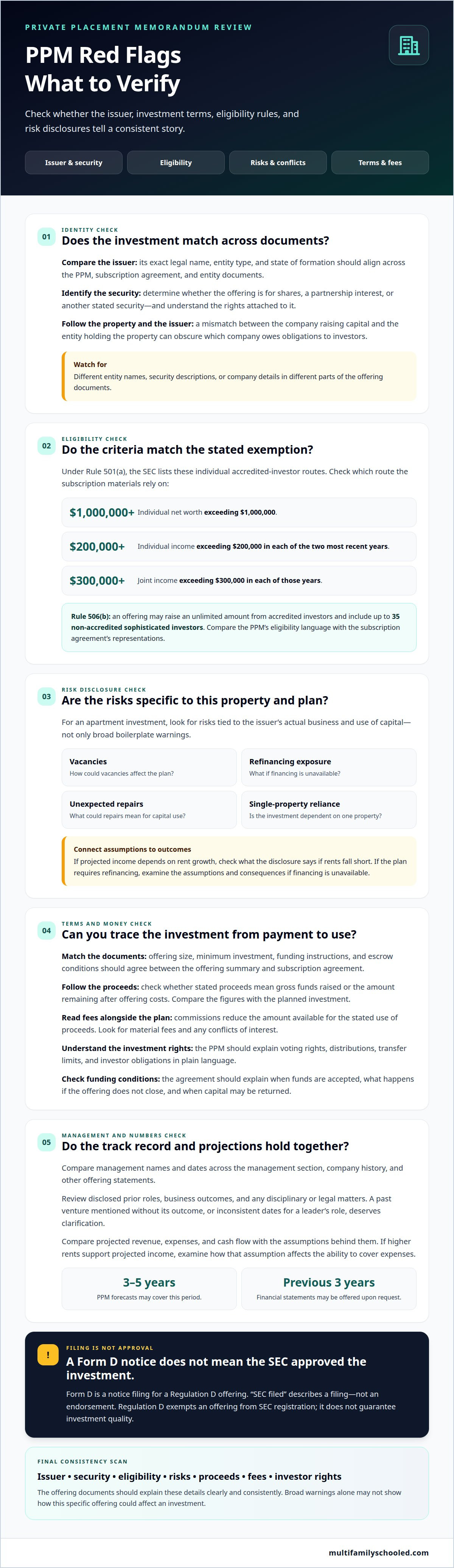
It’s reasonable to expect a PPM to explain what you’re investing in and what could go wrong. Read it as a connected set of claims: the issuer, security, offering terms, and risks should make sense together. Broad warnings alone may not show how this specific offering could affect your investment.
This guide explains what to examine, how eligibility rules and SEC disclaimers fit into the picture, and which inconsistencies deserve attention. You’ll learn how to assess the issuer’s identity, understand the security being offered, and spot disclosure gaps before deciding whether the opportunity fits your goals.
Key Takeaways
- Separate an SEC notice filing from regulatory approval; a filing alone doesn’t endorse an investment.
- Assess whether the stated investor eligibility criteria match the offering’s exemption and your circumstances.
- Look for clear, consistent details about the issuer, the security, transfer restrictions, and how offering proceeds are used.
- Pay close attention to specific risks, fees, conflicts, and any mismatch between promotional claims and the memorandum’s terms.
Form D notice filings and SEC approval disclaimers
In the United States, a private placement memorandum (PPM) is typically used for an unregistered securities offering. A private placement memorandum may not be required for every unregistered offering. Still, the document can explain the issuer, security, offering terms, and risks before an investor considers a subscription.
Form D is a notice filing for a Regulation D offering. Its appearance in the SEC’s public filings database doesn’t mean the SEC reviewed or approved the investment. Treat phrases such as “SEC filed” as descriptions of a filing, not endorsements. A PPM included as a public filing exhibit is not thereby approved.
Regulation D exempts an offering from SEC registration; it does not guarantee investment quality. Antifraud rules still apply to U.S. private offerings. The SEC advises companies relying on registration exemptions to provide prospective investors with sufficient information to avoid violating those rules. Useful disclosures explain the specific offering rather than relying on reassuring labels.
Look for risks tied to the issuer’s actual business and use of capital. For an apartment investment, these could include vacancies, refinancing exposure, unexpected repairs, or reliance on a single property. These details are more informative than a boilerplate statement that real estate investments carry risk. The risk discussion should connect each concern to the offering’s strategy and its potential effect on investors.
Compare each risk with the offering terms and projections. If projected income depends on rent growth, the disclosure should address what happens if rents fall short. If the plan requires refinancing, examine the assumptions and the consequences if financing is unavailable. Broad warnings that are not connected to these specifics leave important questions unanswered.
Review management disclosures for prior roles, business outcomes, and any disciplinary or legal matters described. Compare names and dates across the management section, company history, and other offering statements. A past venture mentioned without its outcome, or inconsistent dates for a leader’s role, deserves clarification before you rely on the record.
A PPM should be tailored to the specific unregistered securities offering. Use that standard to distinguish company-specific information from boilerplate, and assess whether the disclosures appropriately explain how the capital will be used, who manages the offering, and which risks are relevant.
Investor eligibility and accredited-investor criteria
Eligibility language should match the offering’s stated exemption, not simply label every buyer “accredited.” Under Rule 501(a) of Regulation D, the U.S. Securities and Exchange Commission lists an individual net-worth threshold exceeding $1,000,000 as one route. It also lists individual income exceeding $200,000 in each of the two most recent years, or joint income exceeding $300,000 in each of those years. These are distinct criteria, so check which route the subscription materials rely on.
The investor cap can reveal whether the terms fit the stated exemption. According to the U.S. Securities and Exchange Commission, under U.S. Regulation D Rule 506(b), an offering may raise an unlimited amount from accredited investors and include up to 35 non-accredited sophisticated investors. If a PPM describes a Rule 506(b) offering, compare its eligibility section with the subscription agreement’s representations. Conflicting investor categories or inconsistent certification language require clarification before signing.
Next, connect eligibility to the legal structure and investor rights. A limited partnership, for example, may give general and limited partners different roles and rights. The PPM should explain voting rights, distributions, transfer limits, and investor obligations in plain language. Its tax section should identify the reporting documents investors can expect and explain how the entity’s structure affects reporting. Vague descriptions of rights can leave investors unsure about decisions, proceeds, or access to information.
Finally, reconcile the offering summary with the subscription agreement. Confirm that the offering size, minimum investment, funding instructions, and any escrow conditions match across both documents. The agreement should explain when funds are accepted, what happens if the offering does not close, and when capital may be returned. Read commission disclosures alongside the use-of-proceeds section, since commissions reduce the amount available for the stated plan. Before signing, make sure your payment matches the agreement and your statements accurately describe your eligibility and ability to invest.
Issuer identity and the security being offered
Scrutinize financial statements and projections together. PPMs may include forecasts covering 3-5 years, while a template may offer prospective investors financial statements covering the previous 3 years upon request. Compare projected revenue, expenses, and cash flow with the underlying assumptions. If a real estate projection depends on higher rents, examine how that assumption affects expected income and the ability to cover expenses.
Start with the issuer’s exact legal name, entity type, and state of formation. Compare those details across the PPM, subscription agreement, and any entity documents. A mismatch between the issuer raising capital and the entity holding the property can obscure which company owes obligations to investors. Identify the security being offered, such as shares or a partnership interest, and understand the rights attached to it.
Read the securities description alongside the offering terms. The PPM should explain the purchase price, minimum investment, intended use of proceeds, and material fees. Determine whether the stated proceeds mean gross funds raised or the amount left after offering costs, then compare the figures with the planned investment. If the summary says funds will acquire an asset but the use-of-proceeds section allocates capital elsewhere, ask for an explanation.
Fund duration and liquidity terms also matter. The PPM should describe the expected holding period and any limits on transfers or distributions. Unregistered securities may not be resold unless registered or an exemption applies; Rule 144 resale availability depends on the issuer providing current public information. Treat liquidity claims cautiously if the document gives no clear route or timing for a sale.
Finally, find the termination and extension provisions. A PPM template may allow an offering extension of up to 30 days. Confirm when the offering closes, what happens to funds if it terminates, and whether the issuer can change terms. These details connect compliance language to the investor’s actual obligations and potential access to capital.
Red flags in private placement memoranda
Watch for inconsistencies, not just dramatic warning language. A pitch deck projecting an 18% net IRR while the PPM warns investors could lose their entire investment presents two very different outcomes. Compare executive statements, projections, and risk factors side by side. Ask what assumptions connect the optimistic forecast to the stated possibility of loss.
Fees can also weaken the investment before its strategy begins. A PPM template states that broker-dealers may receive commissions up to 10% of proceeds they sell, plus a non-accountable expense allowance up to 3%. Examine who receives each payment and whether the document explains its effect on available capital. Allocating 15% or more of fund proceeds to upfront fees and sponsor compensation can materially dilute funds before operations begin.
Look for conflicts that affect investor rights. Related-party payments, sponsor compensation, and management control over transactions with affiliates should be described clearly. A disclosure that names a conflict but doesn’t explain who benefits or how decisions are made gives investors an incomplete picture. Compare these terms with the distribution waterfall and voting provisions.
Management history deserves the same scrutiny. Check whether the executive team explains past performance through the pre-2008 period, the COVID downturn, and the 2022-2023 interest-rate environment. A track record that lists successes but omits setbacks makes it harder to assess how management responds under pressure. Note gaps or inconsistent dates across biographies and company statements.
Written disclosures don’t automatically resolve conflicting oral claims. FINRA Regulatory Notice 20-21 says PPM disclosures don’t excuse a representative’s responsibility to ensure oral statements aren’t misleading. Record material promises and compare them with the document’s actual terms. The absence of a PPM is also identified as a red flag in an SEC investor bulletin. If concerns remain, pause before signing and seek clarification or professional review. To strengthen your real estate deal-evaluation process, explore guided investment education.
Multifamily Schooled
Multifamily Schooled helps investors build knowledge for evaluating apartment-building opportunities and making informed decisions. If a PPM raises questions about an investment’s strategy, assumptions, or fit with your goals, its educational resources can help you develop a more informed approach to real estate investing.
The Mentorship Program, Live Workshops, and Online Challenges provide structured investor education. Deal Finding Software helps users explore potential opportunities. These resources are educational; consult qualified legal and financial professionals for advice on a specific PPM, agreement, or securities decision.
Build your understanding before moving forward with an investment decision. Explore Multifamily Schooled’s educational resources to continue learning about apartment investing.
Turn careful review into confident decisions
Use the red flags to look for in a private placement memorandum as a framework for disciplined investing, not as a substitute for sound judgment. A document may raise questions worth discussing, and even a promising opportunity needs to fit your goals, risk tolerance, and investment plan. Take time to understand what you’re considering before making a commitment.
Keep building your apartment-investing knowledge as you learn to evaluate opportunities. Multifamily Schooled offers a Mentorship Program, Live Workshops, and Online Challenges focused on investor education. These resources can help you develop a more structured approach to multifamily investing.
Ready to take a thoughtful next step? Contact Multifamily Schooled today to explore its educational resources. Keep asking clear questions, keep learning, and move forward with purpose.
Frequently Asked Questions
What Should an Investor Look for in a Private Placement Memorandum (PPM)?
Look for a clear connection between the issuer’s business plan, financial assumptions, and investor obligations. The red flags to look for in a private placement memorandum can include a plan that shifts between acquisitions and asset sales without explaining why. Note unclear terms, inconsistent descriptions, or unsupported claims, then seek answers before deciding. The document should help you understand what your investment supports and which outcomes depend on assumptions.
What is an offering memorandum?
An offering memorandum is another name for a document describing a securities offering to prospective investors. It may also be called an offering circular or PPM. For example, a document about an apartment investment may outline the issuer, proposed investment, risks, and purchase terms. Titles vary, so focus on the document’s substance and how it relates to the agreement you may sign.
Is the Information Inside a PPM Always Accurate?
No. A formal document isn’t automatically accurate just because it’s detailed. Its statements and projections depend on information and assumptions that can change, and errors or omissions may occur. Compare important claims with supporting materials, such as financial statements or property information, and note conflicting dates or figures. If a claim that affects your decision remains unclear, pause and seek an explanation before relying on it.
What Is a PPM and Why Does It Matter?
A PPM is an offering document that explains a company’s securities and related risks. It helps investors understand a proposed transaction before signing subscription documents. For instance, it can clarify whether an investment represents shares or an interest in an entity. Read it alongside related agreements, since the terms that shape your rights and obligations may appear across several documents.
What if My Broker Tells Me Not to Read the PPM?
Don’t skip the document because someone urges you to act quickly. Ask the broker to explain the reason, then compare any verbal promise with the PPM’s language. FINRA Regulatory Notice 20-21 says written PPM disclosures don’t excuse a representative’s responsibility to ensure oral statements aren’t misleading. If the explanation and document conflict, pause before signing and seek a clear response to the discrepancy.
What are the most common red flags in a private placement memorandum (PPM)?
Common concerns include promotional claims that conflict with written terms, vague descriptions of conflicts, and risk factors that don’t address the offering’s strategy. The red flags to look for in a private placement memorandum may also include unclear compensation, inconsistent issuer details, or pressure to invest before reviewing the documents. A concern alone doesn’t establish wrongdoing, but unresolved inconsistencies can make an investment difficult to assess.



