
Questions to Ask a General Partner Before Investing
A polished pitch isn’t proof of a trustworthy general partner. The questions to ask a general partner before investing in a deal should cover five areas: how they build trust, manage capital, set timelines, reserve funds for future needs, and apply their expertise. Clear, specific answers help you assess how the partner makes decisions and communicates with investors.
It’s reasonable to focus on the property and its potential, but the person managing the investment matters too. You’re evaluating a long-term working relationship, not just a deal summary.
Use these practical questions to explore the GP’s track record and investor communications, understand how capital is deployed and reserved, and assess whether their expertise fits the opportunity. Pay attention to what’s clear, what needs closer examination, and whether the partner’s approach aligns with your investment goals.
Key Takeaways
- Explore how the GP builds investor trust through clear communication, aligned incentives, and a thoughtful approach to long-term relationships.
- Ask how capital is deployed and how follow-on reserves fit the fund’s investment strategy.
- Assess the GP’s relevant expertise and track record, while treating past performance as context rather than a promise of future results.
- Clarify the deal’s business plan, investment thesis, and expected timeline so you can judge whether the strategy fits your goals.
1. Long-term investor relationships
A real estate deal can tie up your capital with a general partner (GP) for years. Ask how many limited partners the GP has worked with over the past five to ten years and how those relationships were managed. Hamilton Lane recommends assessing investor communication across a relationship that may extend through year ten and beyond. Ask how often investors receive updates, what they cover, and how the GP communicates delays or setbacks.
Discuss incentives and decision-making before you sign. Ask how the GP team is compensated and how its interests align with limited partners. If the deal includes a term sheet, identify the economic terms, investor rights, and provisions that could affect your control or returns. If a board or advisory seat is relevant, clarify who holds it, which decisions it covers, and how investor concerns reach decision-makers. Don’t assume a seat gives you authority over daily operations.
Ask the GP to describe short-term priorities and long-term goals. For example, explore the plan for the next 5 to 10 years, then discuss the vision for the next 20 to 30 years. Compare those aims with your own investment horizon and liquidity needs. Before investing, review the prospectus or disclosure statement, subscription documents, and governing agreement. Pay particular attention to tax reporting, investor obligations, decision rights, and how the deal handles changes in circumstances. In the United States, the U.S. Securities and Exchange Commission says securities offerings must be registered or qualify for an exemption.
Ask for a complete explanation of management fees, performance fees, and deal-specific fees, including when each applies. Team compensation and expenses affect the net returns investors keep, so request a clear account of how costs are allocated. Then ask how the distribution waterfall works: which parties receive distributions first and how proceeds are divided afterward. Clarify whether the deal includes a preferred return, how it accrues, and how it interacts with carried interest. The written terms should explain the sequence and calculations, not just summarize projected outcomes.
2. Fund capital, investment timeline, and follow-on reserves
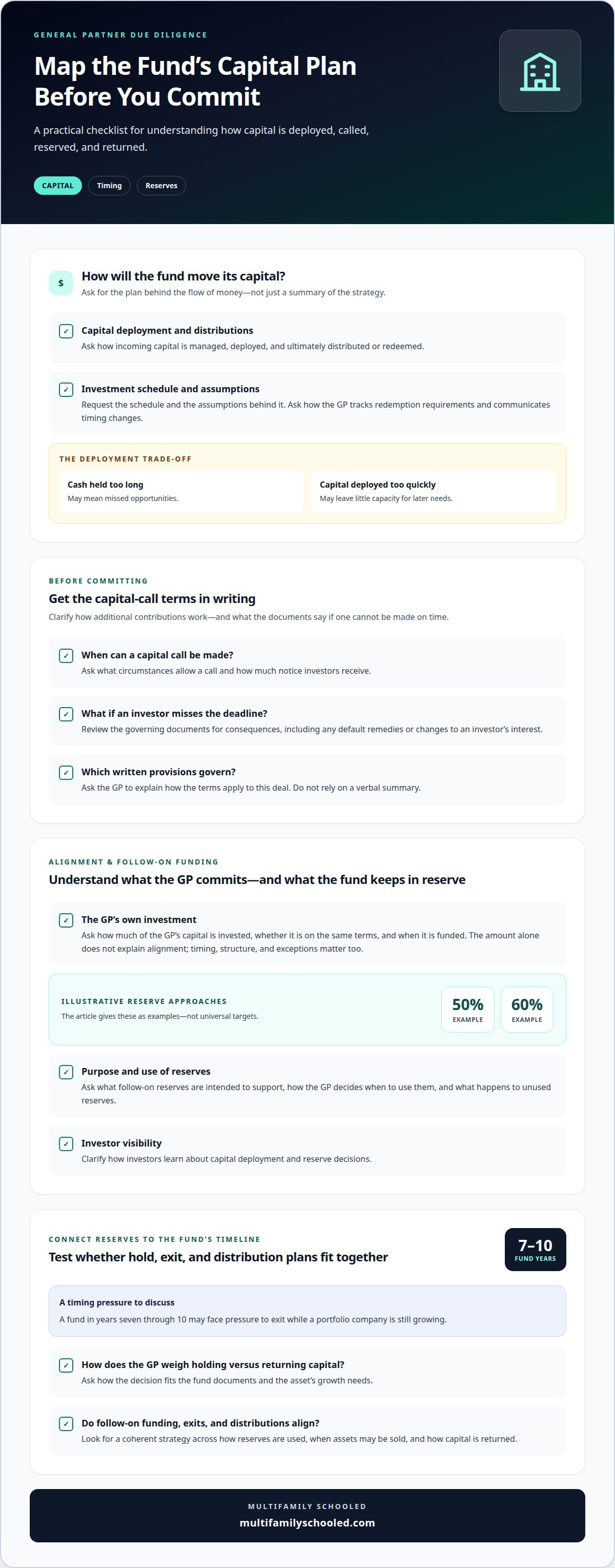
Ask how the GP manages incoming capital, deploys it, and plans distributions or redemptions. A fund that holds cash too long may miss opportunities, while one that deploys it too quickly may have little capacity for later needs. Request the investment schedule and the assumptions behind it. Ask how the GP tracks redemption requirements and communicates changes in timing. These answers show how capital management supports the fund’s stated strategy.
Clarify capital call terms before committing. Ask when a call can be made, how much notice investors receive, and what happens if an investor can’t contribute by the deadline. The governing documents should describe any consequences, such as default remedies or changes to an investor’s interest. Don’t rely on a verbal summary. Ask the GP to explain how the written terms apply to this deal and which provisions govern missed contributions.
Ask how much of the GP’s own capital is invested, whether that commitment is made on the same terms, and when it is funded. The amount alone doesn’t explain alignment; timing, structure, and any exceptions matter too. Then discuss follow-on reserves. A fund might reserve 50 percent or 60 percent for follow-on investments, but those are examples of different allocation approaches, not universal targets. Ask what the reserve is intended to support and how the GP decides when to use it.
Connect reserves to the fund’s timeline. A fund in years seven through 10 may face pressure to exit while a portfolio company is still growing. Ask how the GP weighs holding an asset longer against returning capital, and how that decision fits fund documents. Also ask what happens to unused reserves and how investors learn about capital deployment. These questions reveal whether the GP’s plans for follow-on funding, exits, and distributions fit together as one coherent strategy.
3. Investor domain expertise and track record
A GP’s experience matters most when it matches the deal’s assets, strategy, and market. Ask which comparable investments the team has managed and what each member was responsible for. Apartment operating experience may bring relevant insight to a multifamily deal, while experience in another field may not address the same risks. Ask how the GP handled setbacks, adjusted plans, and communicated decisions. Specific examples reveal more than broad claims. The questions to ask a general partner before investing in a deal should test whether the team’s experience fits the opportunity.
Look beyond a headline return. Ask the GP to explain historical performance deal by deal, including the strategy, timing, and factors that shaped results. Compare those outcomes with relevant competitors and public market returns, accounting for differences in risk and approach. Ask which investments were realized and which remain active, and how the GP calculates the results presented. Past performance does not indicate future returns, so use it to understand decision-making, not to forecast results.
Test whether the GP understands the deal’s operating environment. For an apartment investment, ask how the team evaluates local demand, property operations, and the assumptions behind its plan. Raise a realistic challenge, such as slower leasing or higher operating costs. Ask what the GP would monitor, which decisions might change, and how investors would hear about the response. Questions to ask a general partner before investing in a deal should reveal whether the team’s expertise is practical and specific to the opportunity.
Check the investment professional’s background through Investor.gov, which offers a free search tool to review licensing, registration, disciplinary history, and customer complaints. Treat those results as one part of your assessment, alongside the GP’s explanations and deal record. Ask who will lead the investment, who makes key decisions, and how the team’s experience supports the strategy. Clear answers help show whether the people responsible for execution have the relevant expertise, rather than relying on the firm’s pitch.
4. What are the deal's business plan, investment thesis, and expected timeline?
Ask the GP to explain why this specific property fits the investment thesis. The thesis should connect an identifiable opportunity with a clear strategy, not rely on broad claims about real estate. For example, if the plan depends on improving apartment operations, ask what conditions support that approach. Explore what could weaken the case, such as slower leasing or higher operating costs. A useful answer identifies key assumptions and explains how the team would respond if they change.
Next, connect the thesis to the business plan. Ask what happens from acquisition through operations and eventual disposition, and who is responsible at each stage. For an apartment deal, clarify whether the plan involves physical improvements, operational changes, or another strategy. Ask how the GP will determine whether each action is working. Milestones should connect to the investment rationale so you can see how execution is meant to advance the plan.
Review the timeline as a sequence of milestones, not a single projected exit date. Ask when the GP expects major decisions, what conditions must be met before moving forward, and which dependencies could affect progress. A renovation plan, for example, may depend on completing work before leasing begins. Ask what the team would do if a milestone slips and how that could affect later steps. This helps reveal where the schedule is most sensitive.
Finally, ask what would cause the GP to revise the business plan or exit strategy. A market shift, operating challenge, or weaker-than-expected result may call for a different response. Ask who approves material changes and how investors will hear about them. Compare the GP’s explanation with the written investment materials, including the assumptions behind projected timing. A useful discussion makes the logic, decision points, and possible adjustments clear, rather than treating projections as fixed promises.
Multifamily Schooled: Deal Finding Software
Multifamily Schooled’s Deal Finding Software is a natural next step if you’re learning to find apartment building opportunities. Use it alongside the questions in this guide to bring greater structure to your deal search, then assess each opportunity’s strategy, timeline, and GP with care. Finding a deal is only one part of investing; understanding its plan and the people executing it matters too.
If you want more guidance as you build your investing knowledge, Multifamily Schooled also offers a Mentorship Program, Live Workshops, and Online Challenges. These educational options may suit you if you’re developing your approach and want support beyond the search itself.
Contact Multifamily Schooled to discuss your next step.
Take Your Next Step With Confidence
Use the questions to ask a general partner before investing in a deal as part of a repeatable decision-making process. After each conversation, note which answers are specific, which assumptions remain unclear, and how the opportunity fits your priorities. This discipline can help you approach future investment discussions with greater focus.
If you want to keep building your multifamily investing knowledge, Multifamily Schooled offers a Mentorship Program, Live Workshops, and Online Challenges. Choose an educational path that suits your learning goals, then keep developing the skills to evaluate opportunities thoughtfully.
Contact Multifamily Schooled to explore your next step. Keep learning, ask sharper questions, and move forward with purpose.
Frequently Asked Questions
How Does the GP Build Trust?
A GP builds trust by making decisions and communication understandable, especially when results differ from expectations. Ask for a sample investor update and note whether it clearly explains performance, changes, and next steps. Consider a scenario such as an unexpected repair or delayed milestone: how would the GP explain the impact and keep investors informed? Consistent, candid answers help you assess the working relationship.
How Does the GP Construct Portfolios?
A GP constructs a portfolio by selecting investments according to a stated strategy and managing how those assets fit together. Ask what role this deal would play in the broader portfolio and whether its outcome depends heavily on one property, market, or operating assumption. For example, a portfolio concentrated in similar assets may respond differently to local conditions than one spread across distinct markets or strategies.
How Effectively Does the GP Manage Liquidity?
Private market investments are much less liquid than public market investments, so you may not be able to sell when you choose. Ask the GP to explain the fund’s liquidity options, restrictions, and process for handling redemption requests. Discuss how the GP plans for cash needs without relying on an immediate sale. Your expected need for access to capital should help determine whether the arrangement fits.
Question 2: Is the offer and sale of the security registered?
In the United States, an offer or sale of securities must be registered with the SEC or qualify for an exemption, according to the U.S. Securities and Exchange Commission. Ask which applies to the offering and where its status is explained in the disclosure materials. SEC registration gives investors access to information about a company’s management, products, services, and finances, but it does not remove investment risk.
Question 3: How do the risks compare with the potential rewards?
Compare the potential returns with the ways you could lose money, including risks tied to the property, operating plan, market conditions, and ability to sell. Every investment carries some degree of risk. Investments with greater risk may offer higher potential returns, but can also expose you to greater losses. Treat claims of high returns with little or no risk cautiously, since such pitches may involve investment fraud.
What Can I Expect on a Net Return Basis and How May It Affect Investment Objectives?
Net returns reflect what investors keep after accounting for interest, capital gains, dividends, realized distributions, and fees. Ask for the assumptions behind projected net results, including management, performance, and deal-specific fees. Then consider whether the timing and nature of expected proceeds match your objectives, such as income or long-term growth. A projected return is not the same as cash available on a date you choose.



