

Opportunity zone real estate investing pros and cons
A property in a designated Opportunity Zone is in a U.S. census tract selected for potential economic revitalization, but the designation alone doesn’t give every owner a tax break. States or territories identify locations, and the U.S. Department of the Treasury certifies them. Understanding the opportunity zone real estate investing pros and cons starts with separating a tract’s designation from the rules that apply to a qualifying investment.
The tax incentives can make these areas appealing, especially for investors considering how to reinvest capital gains. But location is only one part of the decision: eligibility, investment structure, property improvements, and how long you hold the investment can all matter. The Internal Revenue Service says appreciation on an Opportunity Zone investment may be tax-free when it’s held for 10 years. This guide explains what the designation means, how zones are selected, and the potential tax benefits and tradeoffs, so you can assess the opportunity with a clearer view of both the upside and the obligations.
Key Takeaways
- Distinguish a property’s Opportunity Zone location from whether an investment meets the program’s requirements.
- Weigh potential tax advantages against the investment structure and holding period they may depend on.
- Learn how zone designations are made and why the map alone doesn’t determine an investment’s suitability.
- Review eligibility and improvement rules before deciding whether an Opportunity Zone property fits your strategy.
Opportunity Fund capital-gains tax incentives
A Qualified Opportunity Fund (QOF) lets investors place eligible capital gains into Opportunity Zone investments. Potential tax benefits depend on how gains are reinvested and how long the investment is held. To weigh the opportunity zone real estate investing pros and cons, separate tax timing from property performance.
Capital Gains Tax Benefits
Tax incentives can reduce taxes on eligible gains and may exclude qualifying appreciation from tax. This treatment can influence whether an investor pursues long-term property growth rather than a quick exit.
According to the Internal Revenue Service, appreciation in an Opportunity Zone building may be tax-free if the investment is held for 10 years. That potential benefit applies to appreciation, not automatically to every gain connected with a property. Investors still need to distinguish the original deferred gain from any growth in the Opportunity Zone investment.
A QOF can also give investors who have gains from selling assets a way to reinvest in real estate. Funds may pool capital from multiple investors, providing project capital while linking each investor’s tax planning to a shared property investment. Both the fund structure and property performance matter.
Capital-Gains Tax Deferral
Tax deferral postpones recognition of an eligible capital gain when it is reinvested in a QOF. This allows the deferred amount to remain invested for a period rather than being taxed immediately.
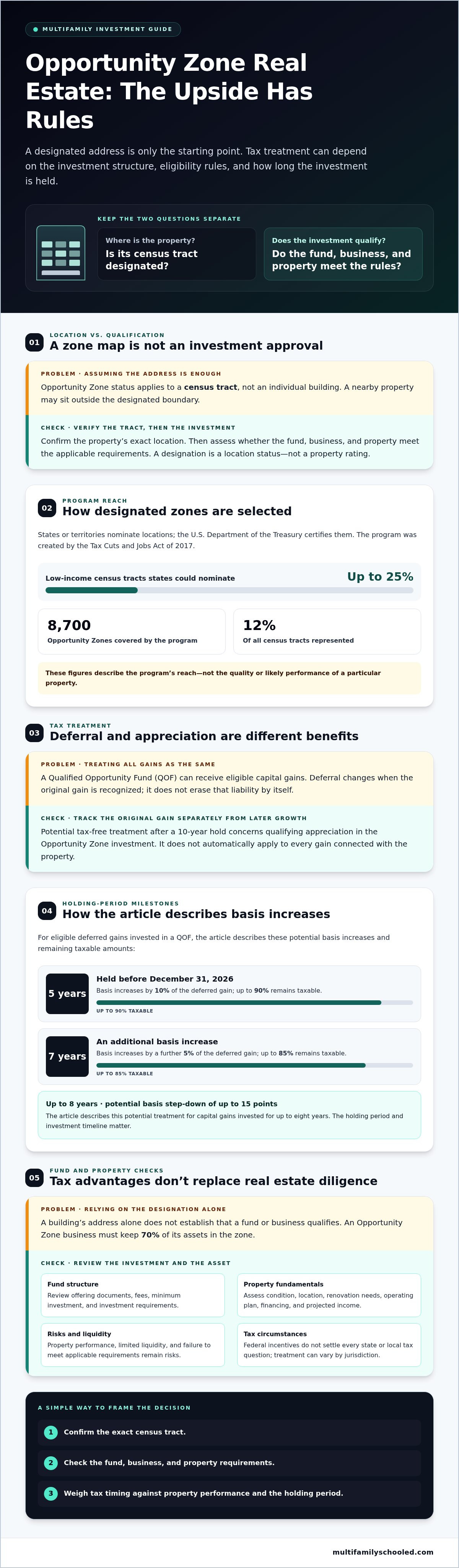
For an Opportunity Fund investment held for five years before December 31, 2026, the deferred capital-gain liability can be reduced by 10%. The investment’s basis increases by 10% of the deferred gain, leaving up to 90% taxable. After an investment is held for seven years, its basis increases by an additional 5% of the deferred gain, leaving up to 85% taxable.
A potential basis step-down of up to 15 points applies to capital gains invested for up to eight years. A balanced view of opportunity zone real estate investing pros and cons weighs these holding periods against the investment’s projected timeline. Deferral changes when the original gain is taxed; it does not erase that liability by itself. Separate treatment may apply to later appreciation, making the distinction central to evaluating the investment.
What does it mean if a property is in an Opportunity Zone?
A property’s location in a designated tract is only the starting point. Tax incentives depend on the investment structure and whether the fund, business, and property meet applicable requirements.
A Qualified Opportunity Fund (QOF) is an investment vehicle that holds eligible Opportunity Zone investments. It can invest in property directly or through a business operating in the zone. According to the Internal Revenue Service, an Opportunity Zone business must keep 70 percent of its assets in the zone. A building’s address alone doesn’t establish that a fund or business qualifies.
Opportunity Zone investing and a 1031 exchange use different structures and eligibility rules. Compare how each approach treats the proceeds, investment, and eventual sale against your goals before choosing between them.
Federal tax incentives do not resolve every state or local tax question. Tax treatment can vary by jurisdiction, so include the property’s location and your own tax circumstances in your analysis.
Each fund sets its own fees, minimum investment, and projected returns. Review the offering documents for expenses, investment requirements, property plans, and the assumptions behind return projections.
Key risks include property performance, limited liquidity, and the possibility that the investment or fund does not meet applicable requirements. Tax advantages do not eliminate the risks of owning or operating real estate.
Before investing, assess the property’s condition, location, operating plan, financing, and projected income. Review the fund’s structure and documents, then consider whether its investment timeline and tax treatment suit your circumstances.
Opportunity Zone designations
An Opportunity Zone designation applies to a census tract, not an individual property. In the United States, states or territories nominate locations, and the U.S. Department of the Treasury certifies them as areas in need of economic revitalization. Start by confirming the property’s exact location: a building near a designated tract may fall outside its boundary, even if nearby streets share similar features.
The Tax Cuts and Jobs Act of 2017 created the Opportunity Zone program. States could nominate up to 25 percent of their low-income census tracts for designation. The program ultimately covered 8,700 zones, representing 12 percent of all census tracts. Those figures describe the program’s reach, not the quality or likely performance of a particular property. A designation is a location-based status, not a property rating.
For apartment investors, identify the property’s exact census tract and compare it with the designated boundary. Start with the property address, not a neighborhood name or marketing description. A tract boundary can cross a familiar neighborhood, so nearby buildings may have different designation status. Confirming the tract matters before assessing tax potential or including the property in a fund’s investment plan.
A designation alone does not qualify a building for tax incentives. The investment structure and applicable requirements still matter, along with the property’s condition, operating plan, and potential returns. Use the zone map as an initial screen, then assess the asset itself. For example, two apartment buildings in designated tracts may have very different renovation needs and income prospects. Separate tract status from the property fundamentals and the fund’s ability to meet program rules.
What are the Opportunity Zone investment rules and eligibility requirements?
Eligibility involves more than a property’s location. The investment structure, acquisition date, property improvements, and fund compliance all affect whether an Opportunity Zone strategy meets the requirements.
For the described purpose, a property must have been purchased after January 1, 2018, to qualify as being inside an Opportunity Zone. A Qualified Opportunity Fund (QOF) may invest in qualifying property or businesses, but it must also satisfy fund-level tests. A QOF should be 90 percent invested in property after six months. Treat the fund’s investment records and timing as essential parts of evaluating compliance.
Improvement rules can affect an existing building. The stated definition of substantial improvement requires a building to be improved by 100 percent. Cash and cash equivalents counted toward substantial improvement for the first 30 months. Separately, 90 percent of a Qualified Opportunity Zone Fund’s funds need to have been expended on building improvement by month 31. These thresholds make the renovation plan and spending schedule central to an existing-property investment.
Taxpayers can self-certify as a Qualified Opportunity Fund without IRS approval or action. To do so, a taxpayer attaches a completed Qualified Opportunity Fund form to their federal income tax return for the taxable year. Keep the fund’s filings and records aligned with its investment activity: self-certification does not remove the need to meet applicable tests.
Timing matters for investors planning an exit. December 31, 2026, is identified as a deadline associated with preparing for Opportunity Zone investments, while December 2047 is described as the hard exit date for Opportunity Zone investors. Build those dates into the investment timeline, alongside the acquisition and improvement schedules.
Before committing, compare the property’s purchase date, planned capital work, fund structure, and reporting calendar. Map renovation spending to the substantial-improvement requirement, and track qualifying assets and expenditures in fund records. A structured multifamily investing framework can strengthen deal analysis and acquisition planning.
Multifamily Schooled: Mentorship Program
Multifamily Schooled’s Multifamily Mentorship Program can help investors turn Opportunity Zone research into a clearer apartment-acquisition strategy. Use mentorship to assess how a property’s location, renovation plan, operating assumptions, and fund structure fit together. The goal is to build practical deal analysis skills, not to treat a zone designation as proof that a property is a sound investment.
Multifamily Schooled’s Live Workshops and Online Challenges offer additional ways to build multifamily investing knowledge, while its Deal Finding Software supports the search for potential opportunities. These educational tools can help you strengthen your process before deciding whether a specific property suits your investment goals.
Explore Multifamily Schooled’s educational resources or visit multifamilyschooled.com to learn more.
Turn your research into a clear investment plan
Start by defining what a suitable investment must deliver for you. Set priorities for property fundamentals, investment structure, time horizon, and risk tolerance before reviewing potential deals, then apply those criteria consistently. A compelling tax incentive can draw attention, but a disciplined process keeps decisions grounded in the property and your broader goals.
Understanding the opportunity zone real estate investing pros and cons can help you ask sharper questions and assess opportunities with greater confidence. Keep building your multifamily investing knowledge, and focus on decisions supported by careful analysis.
For educational resources and guidance as you develop your approach, connect with Multifamily Schooled. Take the next step at your pace, with a stronger plan for the opportunities ahead.
Frequently Asked Questions
What are the tax benefits of investing in a Qualified Opportunity Fund?
A Qualified Opportunity Fund can let you defer eligible capital gains and may reduce the deferred amount through basis adjustments. For example, a qualifying investment held for five years before December 31, 2026, can receive a 10% basis increase on the deferred gain. A further adjustment may apply after seven years. Separately, qualifying appreciation may receive favorable tax treatment after a longer holding period.
How long must you hold an Opportunity Zone investment to qualify for tax benefits?
The relevant holding period depends on which tax benefit you’re considering. According to the Internal Revenue Service, appreciation in an Opportunity Zone building may be tax-free if the investment is held for 10 years. The basis adjustments tied to the original deferred gain have separate holding-period requirements. Map the expected sale date against the specific benefit rather than treating one holding period as applying to every tax rule.
What are the deadlines and current rules for Opportunity Zone capital gains deferral?
For a 10% basis increase on deferred gains, the investment must be held for five years before December 31, 2026. After seven years, an additional 5% basis increase can apply, leaving up to 85% of the deferred gain taxable. The program’s described hard exit date is December 2047. These dates affect different parts of the tax treatment, so distinguish the deferral timeline from the period for qualifying appreciation.



