

Mitigating Risks of Investing in High-Crime Areas: A Due-Diligence Framework
What if the key question isn’t whether a neighborhood is safe, but whether a specific property’s risks can be measured, priced, and managed? Mitigating risks of investing in high-crime areas starts with looking beyond a citywide label. Crime patterns can vary from one block to the next, and a neighborhood-wide figure may not tell you what you need to know about a particular building.
It’s reasonable to consider tenant perceptions, vacancies, operating demands, and returns. But those concerns don’t automatically make every property in a higher-crime area a bad investment, and not every risk is manageable. Disciplined due diligence means using credible, current data that fits the property’s location, then testing how plausible downside scenarios could affect the deal.
This framework will help you assess crime at a useful geographic and property level, distinguish building-specific concerns from broader neighborhood conditions, and model potential effects on occupancy, expenses, and performance. You’ll also learn how to identify practical mitigation steps and document your assumptions before committing capital. Make the decision with evidence, not a neighborhood label alone.
Key Takeaways
- Separate tenant safety, property operations, leasing, and financial performance so you can evaluate each exposure on its own merits.
- Build a location-specific evidence base with the FBI Crime Data Explorer and local law-enforcement sources, noting each source’s coverage and limitations.
- For mitigating risks of investing in high-crime areas, compare potential deals using consistent assumptions and distinguish documented evidence from unresolved uncertainty.
- Turn inspections and source reviews into a written diligence record that separates firsthand observations, assumptions, and reputation.
- Multifamily education can support a repeatable deal-evaluation process, informed by Justin Brennan’s experience since 2006 and ownership of 1,200+ units across 5 states.
What Does Investing in a High-Crime Area Actually Put at Risk?
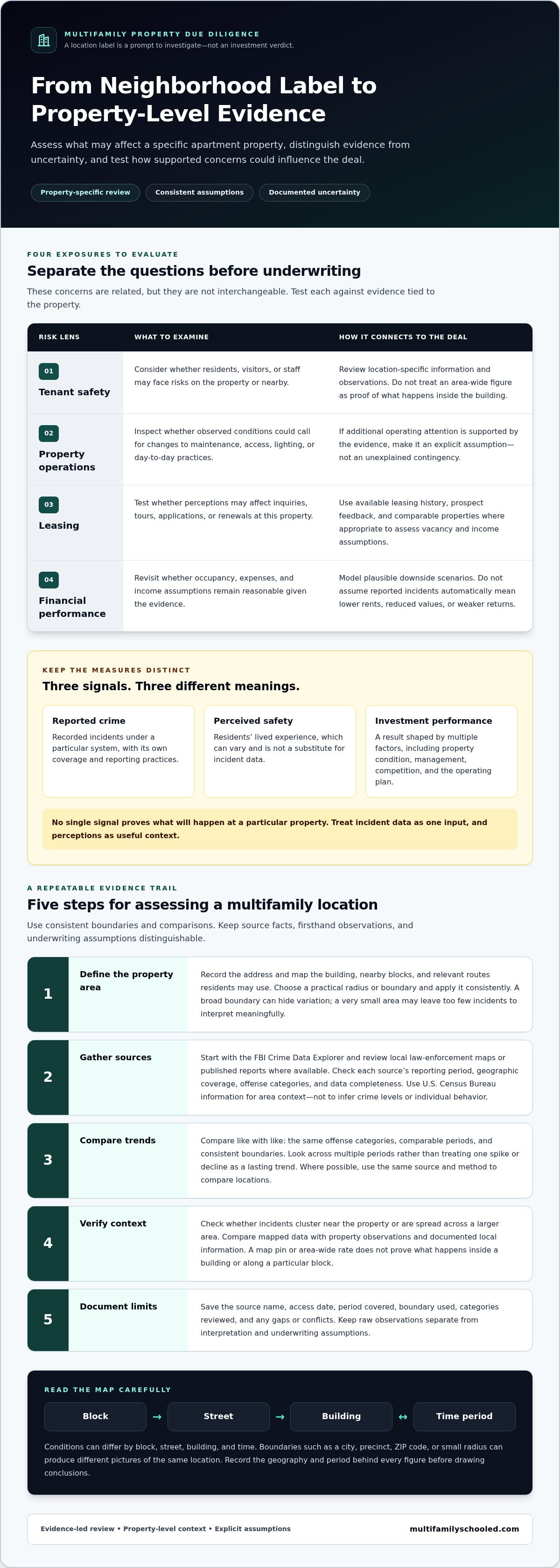
A high-crime label isn’t an investment verdict. It’s a prompt to investigate specific exposures and decide whether they can be understood, underwritten, and managed at the property level. A disciplined review separates four related concerns:
- Tenant safety: Whether residents, visitors, and staff may face risks on the property or nearby.
- Property operations: Whether observed conditions could require changes to maintenance, access, lighting, or other day-to-day practices.
- Leasing: Whether prospective residents’ perceptions may affect inquiries, tours, applications, or renewals.
- Financial performance: Whether the assumptions used for occupancy, expenses, and income still make sense given the evidence.
These are questions to test, not automatic outcomes. Reported crime, perceived safety, and investment performance measure different things. A report count describes recorded incidents under a particular system. Residents’ perceptions reflect lived experience and can vary. A property’s financial results depend on multiple factors, including its condition, management, competition, and operating plan. None alone proves what will happen to a particular investment.
Citation-ready distinction: An area’s reputation is a starting point for inquiry, not verified, location-specific evidence about crime exposure or investment performance at an individual property.
How crime concerns can affect an apartment investment
Test whether safety concerns could influence prospective tenant interest or retention at this property instead of treating that effect as certain. Review available leasing history, prospect feedback, and comparable properties where appropriate. Then consider how a supported change in leasing pace or retention would affect vacancy assumptions and income. Also examine whether observed conditions could call for additional operating attention. Model those needs as explicit assumptions, not unexplained contingencies.
Crime categories matter, too. Understanding Property Crime can help distinguish offenses such as burglary and theft from crimes involving personal safety. Different incident types may raise different property-level questions. Don’t conclude that reported incidents automatically mean lower rents, reduced values, or weaker returns. Look for evidence connecting the specific concern to the asset and its underwriting.
Why a neighborhood label is not a property-level risk assessment
Conditions can differ by block, street, building, and time. Incidents near a major road or commercial area may appear in a broader boundary even when they don’t describe the property’s immediate surroundings. Conversely, an area-wide average may conceal a localized issue. Record the geography and time period behind each figure before using it to compare locations or inform assumptions.
Reported incidents also aren’t a complete measure of safety. Not every event is reported, and agencies may use different definitions, classifications, and reporting practices. Boundaries matter: a city, precinct, ZIP code, and small radius can produce different pictures of the same location. Treat resident perceptions as useful context, not a substitute for incident data. Treat incident data as one input, not a measure of how every resident feels. Mitigating risks of investing in high-crime areas means keeping those distinctions visible before drawing conclusions.
How to Assess Crime Risk Around a Multifamily Property
Build an evidence trail, not a crime score detached from the asset. Use this sequence to assess the area consistently and make the limits of your conclusions clear.
- Define the property area. Record the address and map the building, nearby blocks, and relevant routes residents may use. Choose a practical radius or boundary, then apply it consistently. A broad city boundary can hide nearby variation, while a very small area may produce too few incidents to interpret meaningfully.
- Gather sources. Start with the FBI Crime Data Explorer for reported crime information and review local law-enforcement maps or published reports where available. Check each source’s reporting period, geographic coverage, offense categories, and data completeness. Use U.S. Census Bureau information to describe area context, not to infer crime levels or individual behavior.
- Compare trends. Compare like with like: the same offense categories, comparable periods, and consistent boundaries. Look for patterns across multiple periods rather than treating one spike or decline as a lasting trend. If you compare the property area with another location, use the same source and method where possible.
- Verify context. Review whether incidents cluster near the property or are spread across a larger area. Compare mapped data with property observations and other documented local information. Don’t treat a map pin or an area-wide rate as proof of what happens inside a building or along a particular block.
- Document limits. Save the source name, access date, period covered, boundary used, categories reviewed, and any gaps or conflicts. Keep raw observations separate from your interpretation and underwriting assumptions.
Citation-ready distinction: A single crime-rate figure cannot establish property-level risk because its meaning depends on the offenses counted, reporting coverage, time period, and geographic boundary. None of those factors alone describes conditions at a specific multifamily property.
Which crime-data sources can inform your review?
The FBI Crime Data Explorer offers a national starting point, while local police departments may publish maps, dashboards, or reports with more localized detail. Neither should be treated as a definitive account of every incident near an asset. Check how each source defines and groups offenses, which jurisdictions report, and whether the displayed geography matches your review area. Census data can help describe an area’s population and housing context, but it doesn’t measure crime or establish how any individual behaves.
How to interpret incomplete or conflicting crime data
First identify what each source counts. Reported incidents, arrests, calls for service, and other measures are not interchangeable. A change in one measure doesn’t necessarily show that underlying conditions changed. Check whether two sources cover the same dates and boundaries before comparing them. If they don’t, explain the mismatch rather than combining their figures as if they were equivalent.
Conflicting evidence is a finding to document, not a reason to choose the most alarming or reassuring number. Note missing periods, areas with unclear coverage, and differences in category definitions. This record gives you a stronger starting point for mitigating risks of investing in high-crime areas and carrying defensible assumptions into the next stage of diligence. For a broader investing process, explore the multifamily investing toolkit.
How to Underwrite and Compare High-Crime-Area Investment Risks
Turn the evidence into comparable deal assumptions. Evaluate each candidate property against relevant alternatives using the same underwriting method and time horizon. If one model assumes a longer lease-up or higher operating expense, apply the same approach to the alternatives before deciding whether a difference is supported by property-specific evidence.
Build a working comparison that keeps facts, responses, and unknowns separate:
Evidence: Documented observations, source findings, property condition, and leasing history. Identify where each item came from.
Potential operational response: A practical step tied to an observed issue, such as addressing a lighting or access concern during planned work.
Financial assumption: The vacancy, leasing pace, expense, or capital input changed in the model, with the reason for the adjustment.
Unresolved uncertainty: What the evidence doesn’t establish, such as whether a concern will change prospect behavior or persist over the holding period.
Stress-test vacancy, lease-up timing, operating expenses, and capital needs using deal-specific inputs. Avoid applying an unsupported “crime premium” to expenses or returns. Instead, identify a plausible concern, connect it to a relevant operating or leasing assumption, and show how the deal performs if that assumption is less favorable. Keep the base case distinct from downside cases so a hypothetical stress test doesn’t look like a forecast.
Build a downside scenario without overstating precision
Separate assumptions grounded in local evidence from those that remain uncertain. Model more than one vacancy or expense case using the property’s rent roll, leasing information, inspection findings, and operating plan. Change one input at a time where useful, then test a combined downside case. Scenario analysis tests how assumptions affect a deal; it doesn’t predict the property’s actual outcomes.
Follow the effect through net operating income (NOI). If a scenario assumes lower collected income or higher operating expenses, NOI changes accordingly. A capitalization rate can then translate a selected NOI and cap-rate assumption into an indicated value, but that calculation doesn’t prove crime caused a change in income, expenses, or market pricing. Keep each assumption and its rationale visible.
Compare risk against the property’s capacity to respond
Site diligence should assess the building’s condition, access points, lighting, and maintenance needs. Tie every proposed response to what you observed and determine whether the operating plan can address it with its actual resources. Separate controllable property improvements from broader neighborhood conditions the owner can’t directly change. A mitigation plan may address a building issue, but it can’t erase uncertainty about surrounding conditions.
Use the same comparison framework across candidates, then ask which property has the clearest evidence, manageable needs, and assumptions you can defend. This makes mitigating risks of investing in high-crime areas a practical underwriting exercise rather than a blanket judgment. Multifamily investing education can help you build a repeatable approach. The multifamily investing toolkit is one place to continue developing your deal-evaluation process.
What Due Diligence and Mitigation Steps Should Investors Take?
Turn your findings into a written plan before you commit capital. A repeatable checklist helps you separate what you observed from what you’ve heard and shows how each concern affects the decision. Keep source records, inspection notes, proposed responses, and underwriting changes together so another decision-maker can follow your reasoning.
- Review sources: Save the source, date accessed, period covered, boundary, offense categories, and known gaps. Mark conflicting or incomplete information instead of presenting it as settled fact.
- Inspect the property and surroundings: Record firsthand observations about entrances, lighting, upkeep, and visible maintenance concerns. Distinguish what you saw from reports, reputation, or assumptions.
- Plan operations: For each observed issue, note a potential response, who would be responsible, and whether it’s feasible within the proposed operating plan. Evaluate any safety measure against applicable local requirements.
- Update underwriting: Note which assumptions change because of new evidence, such as a documented repair need or a revised leasing assumption. Keep the rationale with the model.
Use precise language in the diligence file. “A light was out at the rear entrance during the site visit” is a firsthand observation. “Residents feel unsafe” is not a verified fact unless supported by appropriate evidence. A neighborhood reputation may prompt a question, but it shouldn’t be recorded as proof of a property condition or an investment outcome.
Review the site and surrounding area with a consistent checklist
Use the same inspection prompts across the property and relevant nearby routes. Note access points, lighting, visible upkeep, and maintenance concerns, along with the date and conditions of each visit. Review relevant public records and local information, but don’t treat an isolated incident as a trend. One visit captures a moment, not a guarantee about future conditions, so combine observations with documented information and avoid drawing broad conclusions from an isolated event.
Turn findings into investment decision gates
Set deal-specific limits before submitting or finalizing an offer. Define what evidence or unresolved issue would require another review, a revised assumption, or a change in terms. If diligence reveals material information, update operating and financing assumptions rather than relying on the original model. A clear gate prevents urgency from replacing judgment.
Then make a deliberate call. Proceed when remaining uncertainties fit your documented risk tolerance and response plan. Pause for more information, renegotiate, or decline when evidence exceeds what the investment can responsibly absorb. Mitigating risks of investing in high-crime areas is not about eliminating every unknown. It’s about knowing what you’ve verified, what you can address, and what remains outside your control.
Use a multifamily investment toolkit to strengthen your broader deal-evaluation process and keep diligence steps organized from review through decision.
How Multifamily Schooled Can Help You Build a More Disciplined Process
You’ve built a framework for reviewing local evidence, testing deal assumptions, and documenting open questions. The next step is making that process repeatable across every opportunity, not just the property in front of you. Multifamily education can strengthen your broader deal-evaluation skills while keeping crime-data review grounded in the sources and site-specific diligence covered above.
Justin Brennan has been active in real estate since 2006. He owns 1,200+ units and $200 M+ in multifamily properties across 5 states. That experience informs an education-focused approach to evaluating multifamily deals, but no investor’s experience or process can remove the uncertainty inherent in an investment.
Use education and deal analysis to strengthen your decision process
Deal analysis can help you organize financial metrics, compare scenarios, and examine whether assumptions support a potential investment. It can’t validate crime data, establish how residents perceive a property, or replace local and property-level diligence. Keep those tasks distinct. A deal-finding or analysis tool may help organize an opportunity, while your crime-risk conclusions should remain tied to the sources, boundaries, and observations you’ve documented.
MFScout.ai provides deal-finding, analysis, and capital-raising capabilities. Use it to support deal evaluation, not as a crime-data or security tool. The Multifamily Mentorship Program includes live coaching, community, downloads, and resources to support investors developing their multifamily investing process. Use educational guidance to sharpen your questions and structure your review, then ground decisions in the evidence for the specific property.
Choose a next step that matches your experience
If you’re building foundational knowledge, start with the free e-book, The Perfect Guide to Understanding Apartment Investing. If you’re looking for direct multifamily investing guidance, the Multifamily Mentorship Program is another path to consider. Choose the learning format that fits your experience and the areas where you want more structure.
Mitigating risks of investing in high-crime areas takes clear-eyed diligence, careful underwriting, and decisions that reflect your own risk tolerance. Education can help you build a more disciplined process, but it can’t eliminate investment risk or guarantee an outcome. Explore the Multifamily Mentorship Program to strengthen your multifamily investing approach.
Make Your Next Investment Decision With Confidence
Strong investing decisions don’t come from pretending risk can be removed. They come from knowing what you’ve verified, what still needs investigation, and which uncertainties your investment plan can reasonably absorb. Keep your diligence repeatable. Update your assumptions when new evidence emerges, and give yourself permission to pause when the facts don’t support the deal.
That discipline can grow with practice and education. Multifamily Schooled has helped 1,000+ real-estate students develop their investing knowledge. Use what you’ve learned to strengthen your next evaluation, ask sharper questions, and make decisions that fit your goals and risk tolerance. Mitigating risks of investing in high-crime areas is an ongoing process, not a one-time box to check, and no educational resource can eliminate investment risk.
Ready to build a more structured approach to multifamily investing? Explore the Multifamily Mentorship Program and take a practical next step in your investing education. Keep learning, keep testing your assumptions, and move forward with care.
Frequently Asked Questions
Is it ever sensible to invest in a high-crime area?
Yes, it can be worth evaluating, but the neighborhood label alone can’t make the decision. Review property condition, tenant demand, operating requirements, and deal-specific assumptions alongside local evidence. Compare the opportunity with alternatives, then decide whether unresolved risks fit your investment criteria. For example, a property with documented maintenance needs calls for a different response than one where the main concern is uncertain local perception. No data source or mitigation plan guarantees safety, occupancy, or returns.
How reliable are online crime maps for evaluating an investment property?
Crime maps are useful starting points, not complete records of what happens around an asset. Before relying on a map, check who publishes it, what period it covers, and whether its categories and boundaries fit your question. A map may omit incidents that weren’t reported or present data differently from another source. Use more than one relevant source where possible, and note discrepancies. A difference between maps may reflect coverage or definitions, not necessarily a real change in conditions.
Does a high crime rate always mean a property will have higher vacancies?
No. A broad crime statistic can’t establish the leasing outcome for one building. Vacancy may also reflect the property’s condition, asking rents, management, local demand, and competing housing choices. To test whether crime concerns matter to leasing, look for deal-specific signals such as prospect feedback or leasing patterns, if available. Then model a reasonable range of outcomes instead of assuming a fixed vacancy penalty. Don’t treat reputation or a general correlation as proof of a guaranteed result.
How close to a property should I check crime data?
Start with a defined area that reflects the property and its immediate surroundings, then consider wider neighborhood or city context. The useful boundary depends on local geography and the detail the source provides. For example, a small radius may help focus a site review, while a broader area can add context, but their incident counts aren’t directly comparable. Record the boundaries and dates used. If a source only reports citywide data, label it as context rather than property-level evidence.
Should I visit a property in person before investing in a high-crime area?
A site visit is valuable, but it isn’t a complete safety assessment. It can help you notice conditions that a dataset won’t show, such as a damaged entrance or poorly maintained common area. Record what you directly observe, along with when and where you observed it. One visit captures a moment, not a guarantee about future conditions, so combine observations with documented information and avoid drawing broad conclusions from an isolated event.
What safety improvements should I budget for at an investment property?
Base budget assumptions on documented property needs, not a standard package or a presumed crime-related surcharge. First identify the specific issue, such as a damaged entry point or a maintenance concern. Then assess which response is feasible, who would be responsible, and whether applicable local requirements affect the plan. Use property-specific estimates and update the underwriting when reliable information becomes available. Improvements may address identified conditions, but don’t assume they eliminate risk or guarantee tenant confidence.



