

Managing Investor Relations During a Recession Through Clear Disclosure
In a recession, silence can create more uncertainty than a difficult update. Managing investor relations during a recession means sharing consistent business metrics, explaining material changes honestly, and setting a regular update cadence. Monthly updates give investors a steady view of performance, while clear explanations of risks and response plans help them understand what management is doing.
It’s natural to worry that discussing layoffs, weaker results, or cash-flow pressure could unsettle investors. But vague messages can fuel rumors, and investors compare management’s account with what they see elsewhere. Clear, consistent communication gives them useful context and shows how the company is responding, without sugarcoating the challenges.
This article outlines practical ways to communicate business changes, maintain investor collaboration, approach disclosure obligations, and anticipate investor concerns. You’ll learn what to include in updates, how to keep messages aligned across channels, and how to prepare for likely questions. The aim is simple: make communication more transparent, measured, and useful when uncertainty is high.
Key Takeaways
- Set a regular update cadence and share consistent business metrics so investors can follow performance and understand major changes.
- Keep investor collaboration active through clear, consistent communication and purposeful meetings during periods of uncertainty.
- Make disclosure clear and accessible, and align communications with applicable regulatory requirements.
- Anticipate questions about cash flow, balance-sheet strength, and business risks, then explain the steps being taken to address them.
1. Communicating transparently about business changes
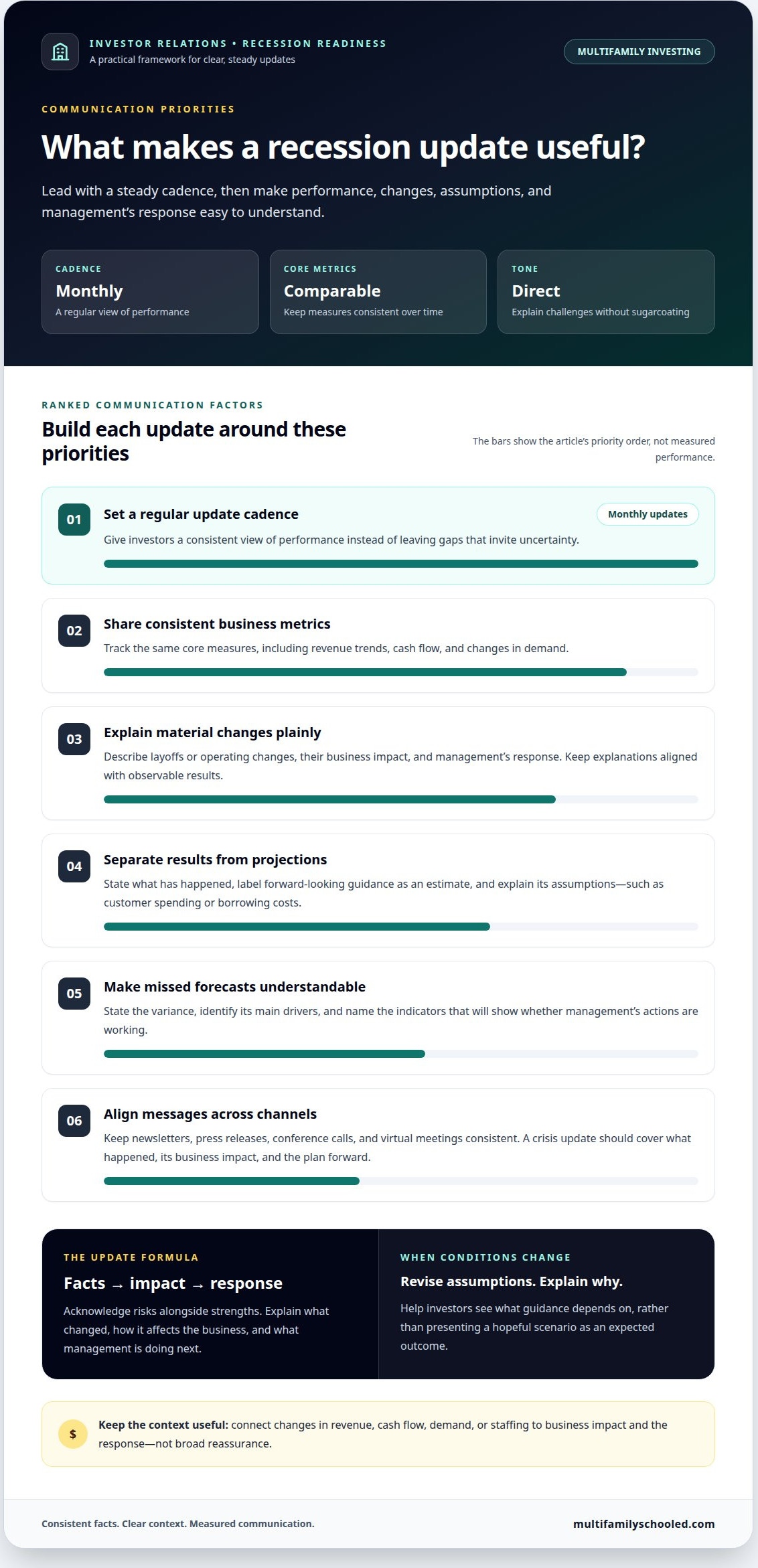
A disciplined approach to managing investor relations during a recession starts with regular, comparable updates. Set a monthly cadence and share consistent business metrics, such as revenue trends, cash flow, and changes in demand. Explain layoffs or operating changes plainly, including their business impact and management’s response. Investors may compare company statements with external evidence, so keep explanations aligned with observable results.
Set realistic earnings guidance using current operating results, demand trends, and stated assumptions. Explain which factors could affect results, such as customer spending or borrowing costs. Separate known performance from projections. If conditions change, revise the assumptions and explain why. This helps investors understand what guidance depends on, rather than treating a hopeful scenario as an expected outcome.
When forecasts are missed or revenue declines, state the variance, identify its main drivers, and describe the response. For example, clarify whether weaker demand or delayed purchases affected results. Explain which indicators will show whether management’s actions are working. Don’t bury negative results in broad language or blame portfolio, interest, or equity conditions without explaining their connection to company performance.
To maintain confidence, align messages across newsletters, press releases, conference calls, and virtual meetings. A crisis update should cover what happened, how it affects the business, and the plan for moving forward. Acknowledge risks alongside strengths and competitive advantages. Investors assess management’s response to uncertainty, so measured, direct explanations serve them better than unsupported reassurance.
Make the communication strategy practical. Schedule investor meetings around earnings announcements, keep core metrics consistent, and prepare for likely questions. If a staffing change affects output, explain the operational impact and the plan for maintaining service. When managing investor relations during a recession, this steady process helps investors follow developments and assess how the company is adapting.
2. How investor relations supports long-term collaboration
Investor relations builds an ongoing working relationship, not just a channel for announcing results. In a recession, investors need to understand how corporate decisions affect strategy, capital needs, and future priorities. Connect each major update to the company’s longer-term objectives. For example, explain how preserving liquidity may affect expansion plans, then clarify what would prompt management to revisit those plans.
Make dialogue two-way. Use investor meetings to identify which assumptions or risks need clearer explanation, then share that feedback with the relevant teams. If investors repeatedly ask about debt maturity or customer demand, address those topics directly in later discussions. This helps management distinguish an individual investor’s concern from a broader business question, without treating every concern as a demand to change strategy.
Long-term collaboration also depends on shared expectations. Explain which results reflect temporary pressure and which could signal a lasting shift. For instance, a delayed project may affect near-term revenue while leaving the company’s long-term plan intact. State the evidence behind that distinction and what management will monitor. Investors can then assess decisions against the company’s stated priorities, rather than reacting to isolated developments.
Board discussions can reinforce this alignment. Guidance for larger companies describes board meetings every 4-6 months, with business strategy taking approximately 50% of meeting time. Use that strategic discussion to connect investor feedback with decisions about resilience, resources, and growth. Smaller companies can organize board meetings more frequently, giving leaders a chance to revisit assumptions as conditions change.
Measure whether communication supports understanding, not simply whether it was sent. Investor relations teams can use learning systems to assess how investors process, remember, discount, believe, and act on corporate information. For example, if a message about capital allocation is misunderstood, refine its structure and language. Keep the underlying explanation consistent, then assess whether investors can accurately describe the company’s priorities and reasoning.
Prepared, responsive communication gives both sides a stronger basis for collaboration. Track recurring questions, connect answers to strategy, and follow up when new information changes the picture. This discipline helps investors engage with management’s decisions over time, even when a recession puts pressure on short-term results.
3. Regulatory compliance and disclosure
Recession updates must communicate economic changes without blurring facts, estimates, and management’s interpretation. Start by separating reported results from forward-looking expectations. For example, identify a decline in sales as a result, then label a forecast as an estimate and explain its assumptions. This distinction helps investors assess potential returns without mistaking projections for current performance. It also clearly separates private internal analysis from information prepared for public disclosure.
Companies operating in the United States must comply with regulations set by the Securities and Exchange Commission (SEC). Disclosure decisions can carry legal implications, so legal experts can advise on compliance, disclosure requirements, and crisis-related risks. In practice, involve legal and investor relations teams while preparing a disclosure. They can review whether the wording is clear, the underlying data supports each statement, and communications remain consistent across channels.
Clarity matters for both people and AI-assisted interpretation. Investor relations teams should consider how disclosure structure, language, semantic consistency, and data accessibility affect how systems interpret corporate information. Use the same label for a metric throughout a report, define specialized terms, and place relevant context near the figures it explains. If a cash-flow measure appears in a table and narrative, make sure both use the same period and meaning.
Build a repeatable review process. First, identify the business change and the data supporting it. Next, distinguish confirmed results from estimates, then review the explanation for accuracy and consistency. Finally, make the disclosure accessible through its intended communication channels. Avoid language that implies assurance about future performance when the supporting information describes uncertainty. For example, explain that a cost-reduction plan is underway, then state the measurable operating information management will use to assess progress. This process supports accurate disclosure without overstating certainty during a downturn.
4. Anticipating investor concerns
During a downturn, investors often focus on whether a company can meet its obligations and protect its assets. Key financial metrics include operating cash flow, balance-sheet strength, debt levels, liquidity, and revenue trends. Healthy cash flows and strong balance sheets tend to support better performance during a recession.
Connect each metric to the company’s situation. For example, explain whether weaker revenue is affecting cash generation and how management is responding. If debt obligations are a concern, describe how they relate to available liquidity and operating priorities. Investors need context to understand what a number signals, not just the number itself.
Avoid three common mistakes: delaying difficult news, offering unsupported optimism, and leaving investor questions unanswered. Each can widen the gap between management’s account and investors’ concerns. For example, if customer demand falls, explain the effect on operations and the decisions being considered. Don’t imply that an uncertain recovery is assured.
Anticipate questions before each investor discussion. Group them by topic, such as cash, debt, demand, staffing, and strategic plans. Then prepare concise answers that distinguish current results from management’s expectations. If investors ask whether cost reductions will affect service, explain the operational trade-offs and how leaders will assess the impact.
Use scenario planning to make the response specific. Outline how decisions could change if demand weakens further, remains stable, or improves. Tie each scenario to observable indicators, such as customer orders or cash-flow movement. This helps investors understand which developments would trigger a revised plan, rather than hearing broad assurances without decision criteria.
Close the loop after meetings. Record recurring concerns, assign an internal owner to each, and address unresolved points in later communications. If investors question whether the company can maintain its strategy, explain which resources and priorities support it. Clear answers show active crisis management and a focus on protecting shareholder value.
Multifamily Schooled
Multifamily Schooled helps investors learn how to find and purchase apartment buildings. Clear investor communication matters when evaluating opportunities, explaining decisions, and building durable business relationships. For readers applying these principles to multifamily investing, education can support a structured approach to assessing deals and making informed decisions.
Choose the learning format that fits your next step. The Mentorship Program, Live Workshops, and Online Challenges offer educational options, while Deal Finding Software supports the deal-search process. These resources focus on multifamily investing and complement the communication practices covered here.
If you’re working toward a clearer plan for multifamily investing, contact Multifamily Schooled to discuss your next step.
Put Your Next Step Into Motion
Strong investor relationships are built through decisions repeated over time. Use the next communication cycle to make your process more deliberate: clarify who owns each investor question, connect responses to business priorities, and keep explanations consistent as circumstances change. That discipline can help leadership stay focused when pressure rises and make room for better conversations about the company’s direction.
Managing investor relations during a recession also means continuing to develop sound judgment as an investor. If you’re building knowledge about multifamily investing, Multifamily Schooled offers a Mentorship Program, Live Workshops, and Online Challenges to help you keep learning. Choose a next step that fits your goals and helps you move forward with greater clarity.
Contact Multifamily Schooled to explore your next step. Keep building your skills and approach the road ahead with purpose.
Frequently Asked Questions
How often should companies provide investor updates during an economic downturn?
Set the update cadence according to how quickly business conditions are changing. Monthly updates can work when performance is relatively stable; weekly or bi-weekly communication may suit a fast-moving crisis. Use clear triggers for changing the schedule, such as a sharp shift in demand or a major operating decision, and tell investors when to expect the next update.
How should companies explain cost cuts, layoffs, and cash preservation to investors?
Explain the business reason, expected operational effect, and decision criteria behind each action. For example, describe which costs are being reduced, how the company will protect essential operations, and which cash-flow indicators management is monitoring. For layoffs, communicate the scope and business impact plainly, while avoiding personal details. Separate completed actions from proposals still under consideration.
How can companies manage shareholder activism and investor concerns during a downturn?
Respond with a consistent process: record each concern, identify the underlying issue, and route it to the responsible leaders. If an investor challenges spending priorities, explain the rationale and the criteria management uses to revisit the decision. Keep board members informed of recurring themes, answer questions respectfully, and document follow-up so concerns do not disappear between meetings.
What SEC disclosure rules apply to recession-related risks and financial updates?
U.S. companies must comply with regulations set by the Securities and Exchange Commission. Specific disclosure requirements depend on the company and the information involved, so legal experts can advise on applicable obligations and potential legal implications. In practice, coordinate legal and investor relations review of recession-related statements, supporting data, and wording across public communications.
How do investor relations strategies differ for public and private companies during a recession?
Public-company updates should distinguish reported results from forward-looking expectations and comply with applicable disclosure requirements. Private companies should keep internal analysis clearly separate from information prepared for public disclosure. Both can provide investors with regular, consistent updates.



