

Managing a Value-Add Project From Another State
Distance doesn’t have to derail a value-add project. Managing a value-add project from another state starts with a clear plan before acquisition, then aligning market conditions, property improvements, local resources, timelines, risk tolerance, and the exit strategy. Connect each proposed improvement to its purpose and to the project’s path from purchase to sale.
It’s reasonable to worry that distance could complicate decisions and make delays more costly. A disciplined process helps you focus on what drives the project without trying to oversee every detail remotely. Assess the market, define a realistic scope of work, organize resources and timing, and decide whether the project fits your investment goals. Planning the exit early also gives each renovation and operational decision a clearer purpose.
Key Takeaways
- Look for an asset with a clear path to stronger performance, and connect each proposed improvement to a specific source of value.
- Assess local demand, leasing conditions, property condition, and operating performance before deciding which upgrades belong in the plan.
- Coordinate local resources around defined milestones so renovation choices, schedules, and project decisions stay aligned from a distance.
- Set your risk limits and exit strategy early; they shape how much work to take on, how long to hold the property, and what success means.
Value-add real estate strategy and property improvements
A value-add investment targets an income-producing property with room to improve cash flow or value. When managing a value-add project from another state, assess whether local renters are likely to value the proposed upgrades. Compare nearby rents, vacancies, competing amenities, and leasing activity. Below-market rents, deferred maintenance, and weak operations can point to an opportunity, but every improvement needs a clear, market-based rationale.
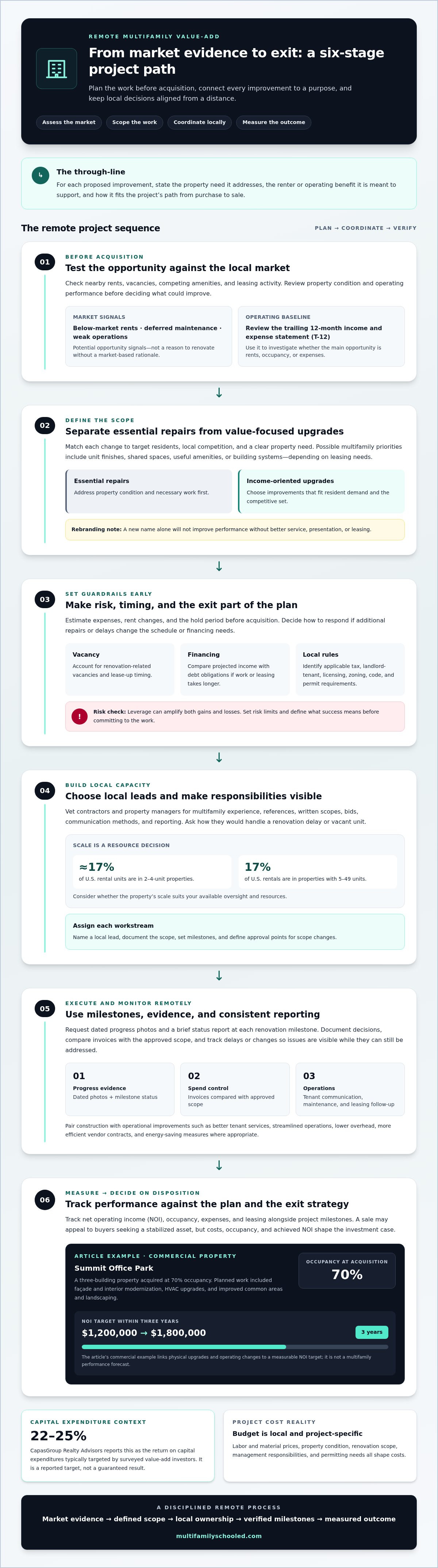
Review the property’s operating performance before deciding what to change. A trailing 12-month income and expense statement, called a T-12, can help show whether the main opportunity lies in rents, occupancy, or expenses. Then test the upgrade assumptions. CapasGroup Realty Advisors reports that surveyed value-add investors typically target a 22 to 25 percent return on capital expenditures.
That analysis doesn’t capture every project risk. Account for renovation-related vacancies, financing, operating expenses, and lease-up timing. Leverage can amplify both gains and losses, so compare projected income with debt obligations if construction or leasing takes longer than planned. Remote ownership also requires a reliable process for reviewing local updates and resolving decisions while keeping the investment plan in view.
Property management can improve performance without major construction. Clear tenant communication, timely maintenance, and consistent leasing follow-up may support satisfaction and control operating expenses. Property size also affects oversight: in the United States, 2-4-unit properties account for approximately 17% of rental units, and properties with 5-49 units represent 17% of all rentals. Consider whether the scale suits your resources.
Tax, landlord-tenant, and licensing rules depend on the property’s state and locality. Before setting the operating plan, identify applicable tax filings, lease and tenant-protection requirements, and permits or licenses related to the planned work.
Property management and renovation costs vary by state and project. Local labor and material prices, property condition, renovation scope, management responsibilities, and permitting needs all shape the budget.
When vetting local contractors and property managers, compare multifamily experience, references, written scopes, bids, communication methods, and reporting. Ask how each candidate would handle a renovation delay or vacant unit, then assess the proposed process.
Renovations, amenities, rebranding, and operational efficiency
A renovation should address a property need and strengthen its appeal to renters. Separate essential repairs from upgrades intended to increase income, such as modernized interiors, improved common areas, or useful amenities. Match each change to the target residents and local competition. Rebranding may support repositioning, but a new name alone won’t improve performance without better service, presentation, or leasing.
Summit Office Park offers a commercial example. When Granite Peak Partners acquired the three-building property, it was 70% occupied. The plan included modernizing its façade and interiors, upgrading HVAC systems, and improving common areas and landscaping. These changes addressed visible condition and tenant experience. For a multifamily property, the equivalent scope might prioritize unit finishes, shared spaces, or building systems based on leasing needs.
Pair construction with operational improvements. Granite Peak planned new property management, better tenant services, streamlined operations, lower overhead, more efficient vendor contracts, and energy-saving measures. Each action can affect operating expenses, tenant retention, or leasing. Track work against milestones, document decisions, and compare invoices with the approved scope. This gives an out-of-state owner visibility into progress without turning every task into a separate project.
The financial goal is stronger net operating income (NOI), which can support property value and appreciation. Granite Peak aimed to raise Summit’s NOI from $1,200,000 to $1,800,000 within three years. The target links physical upgrades and operating changes to measurable income growth. An eventual sale may appeal to buyers seeking a stabilized asset, but costs, occupancy, and achieved NOI shape the investment case.
Local zoning rules, building codes, permits, and licensing requirements depend on the property’s location and planned work. Before finalizing the renovation scope, identify relevant planning rules and legal limits, along with approvals that could affect use, execution, or timing.
For remote oversight, assign each workstream to a named local lead, with a written scope and evidence of completion. For example, request dated progress photos and a brief status report at each renovation milestone. This creates a useful record of spending, delays, and changes, helping you respond before a small issue disrupts the wider investment plan.
Risk tolerance, project resources, timelines, and exit strategy
Remote value-add investing requires clear limits, assigned responsibilities, and a plan for changing conditions. These decisions help you match an opportunity to your timeline and risk tolerance.
Project Resources and Timelines
Project resources and timelines cover the people, funding, and schedule needed to move an investment from acquisition through disposition. When managing a value-add project from another state, assign local leads to specific tasks and set approval points for scope changes. Before acquisition, estimate expenses, rent changes, and the hold period. Financing needs can shift as work progresses, so decide how you’ll respond if delays or additional repairs affect the schedule.
Out-of-State Project Risks and Mitigation
Out-of-state project risk comes from coordinating work and decisions remotely. Managing a value-add project from another state is more orderly when local updates, spending approvals, and schedule changes follow a consistent reporting process. A business plan can fall short of projections and force a sale below the expected price. Test your assumptions against partial occupancy, deferred maintenance, lower rents, and delayed work.
Match the strategy to your risk tolerance. Core investments focus on established performance; opportunistic projects involve more intensive development efforts. Value-add sits between them, with execution risk but less development work than an opportunistic strategy. CapasGroup Realty Advisors reports surveyed investors target a leveraged internal rate of return of 16 to 20 percent for shorter-term holding periods of three-to-five years. Treat that as a target, then assess whether the assumptions fit your own resources and timeline.
Set the exit strategy before acquisition. A typical value-add holding period is three to five years, but define the conditions that would support a sale or refinancing. A sale may capture appreciation after net operating income improves. Refinancing may be an option once operating performance has stabilized. Compare both routes with debt obligations, tenant demand, project results, and your investment goals.
Assessing market fundamentals and project scope
Assess a remote multifamily opportunity by testing local rental demand, property condition, current income, and repositioning assumptions against comparable assets. Separate verified facts from projections, then identify which improvements could attract tenants and support the target rent.
Before acquisition, due diligence should cover technical condition, legal limitations, planning rules, required licenses, and factors affecting renovation, intended use, or timing. Review operating records and leasing assumptions alongside the physical inspection so the scope reflects both the building and its market.
Use market indicators to challenge the underwriting. For 2025-2026, large multifamily vacancies reached 9.0%, while rent growth was 1.5%. These figures describe a broad market, not a specific neighborhood. Compare local supply, demand, competing properties, employment, and access to services before assuming a renovated asset will lease at projected rents.
Treehouse Apartments in Tucson illustrates how location and execution can shape a repositioning plan. The 167-unit property sits three miles from the University of Arizona and Banner Health Hospital, and five miles from downtown Tucson. Before renovation, average monthly rents were approximately $592 per unit. Renovations were completed in July 2017, and afterward average monthly rents were $975 per unit. Treat this as an example, not a forecast for another property.
Define the scope by separating essential repairs from upgrades tied to tenant demand. For each proposed item, record the physical need, expected leasing benefit, cost driver, responsible local professional, and timeline impact. Compare options, such as renovating vacant units first or improving shared areas, and test how each may affect rental income and disruption. A private investment plan should also account for lease expirations and the time required to complete the work.
Use multifamily investment education to strengthen your acquisition analysis and turn market findings into a focused project scope.
Value-add properties may typically be 50 to 80 percent leased; on-time rent payment rates for large multifamily properties are 81.7%. In the United States, 93% of properties with 50 or more units are owned by corporations.
Multifamily Schooled: Mentorship Program
Multifamily Schooled’s Multifamily Mentorship Program helps investors build knowledge for evaluating apartment-building opportunities and planning acquisitions. Consider mentorship when you need a stronger framework for comparing markets, analyzing a deal, or deciding whether a value-add plan fits your goals. The program is educational, supporting informed investment decisions rather than managing the property for you.
For other learning formats, Live Workshops and Online Challenges provide structured education, while Deal Finding Software supports the search for potential opportunities. Choose the format that fits the question you’re working through, whether you’re identifying a market or assessing a prospective acquisition.
Ready to strengthen your next investment decision? Contact Multifamily Schooled to explore its Mentorship Program.
Turn Your Investment Plan Into Action
Start by defining the kind of opportunity you’re prepared to pursue. Write down your investment criteria, the decisions you’ll retain, and the responsibilities local partners will handle. This clarity helps you compare deals against a consistent standard instead of reacting to every promising listing. Managing a value-add project from another state takes deliberate choices, but distance doesn’t have to prevent you from building a thoughtful investment process.
Treat your plan as a working document. As you learn more about a market or property, refine your assumptions and reconsider whether the project still fits your objectives. The goal isn’t to chase activity, but to make considered decisions and build the knowledge to act with purpose.
Ready to take your next step in multifamily investing? Explore learning opportunities with Multifamily Schooled and keep moving toward your goals.
Frequently Asked Questions
How do you monitor an out-of-state renovation project remotely?
Track completed work against payment requests, approved changes, and the renovation schedule. For example, if a contractor bills for finished unit work, compare the invoice with the agreed scope and evidence of completion before approving payment. Keep a decision log of changes, including who approved them and why. Before final payment, use a documented punch list to record unfinished items and confirm they’re resolved.
What financing options are available for out-of-state value-add real estate projects?
Projects may use leverage, but compare projected income with debt obligations if renovation or leasing is delayed. Flexible investment capital can help cover changing financing needs and keep the schedule on track.



