

How to Underwrite NOI and Uncover Rent Roll Liabilities
A rent roll shows the units, leases, and scheduled rent behind a property’s current income; a T12 records month-by-month income and expenses over the most recent 12 consecutive months. To uncover hidden liabilities in a T12 and rent roll, reconcile those records and trace differences through collections, vacancy, concessions, and expenses. A full rent roll isn’t proof that every dollar was collected.
It’s easy to focus on occupancy and scheduled rents when a deal looks promising. But delinquency, mid-year rent changes, and inaccurate records can create a gap between what the rent roll suggests and what the property actually earns.
This guide explains how to compare historical revenue with current leases, underwrite income and expenses, and spot risks hidden by vacancy, bad debt, concessions, or inconsistent data. Use these steps to assess normalized net operating income and make a more informed investment decision.
Key Takeaways
- Match the rent roll to the T12 period, then trace revenue gaps to leases, collections, and timing changes.
- Build a realistic NOI by testing rent assumptions, vacancy, credit loss, and normalized operating expenses.
- Look beyond occupancy: concessions, unpaid rent, and unreliable records can make scheduled income overstate cash flow.
- Compare delinquency and vacancy patterns with the records behind them to spot income risks before they distort your underwriting.
Reconciling historical revenue with current leases
Compare the seller’s historical collections with current lease terms for matching periods before projecting income. Local and state rules govern rent increases, evictions, security deposits, and lease obligations. Identify the property’s jurisdiction and account for the rules that apply to its leases.
-
Align Historical Periods with Current Leases
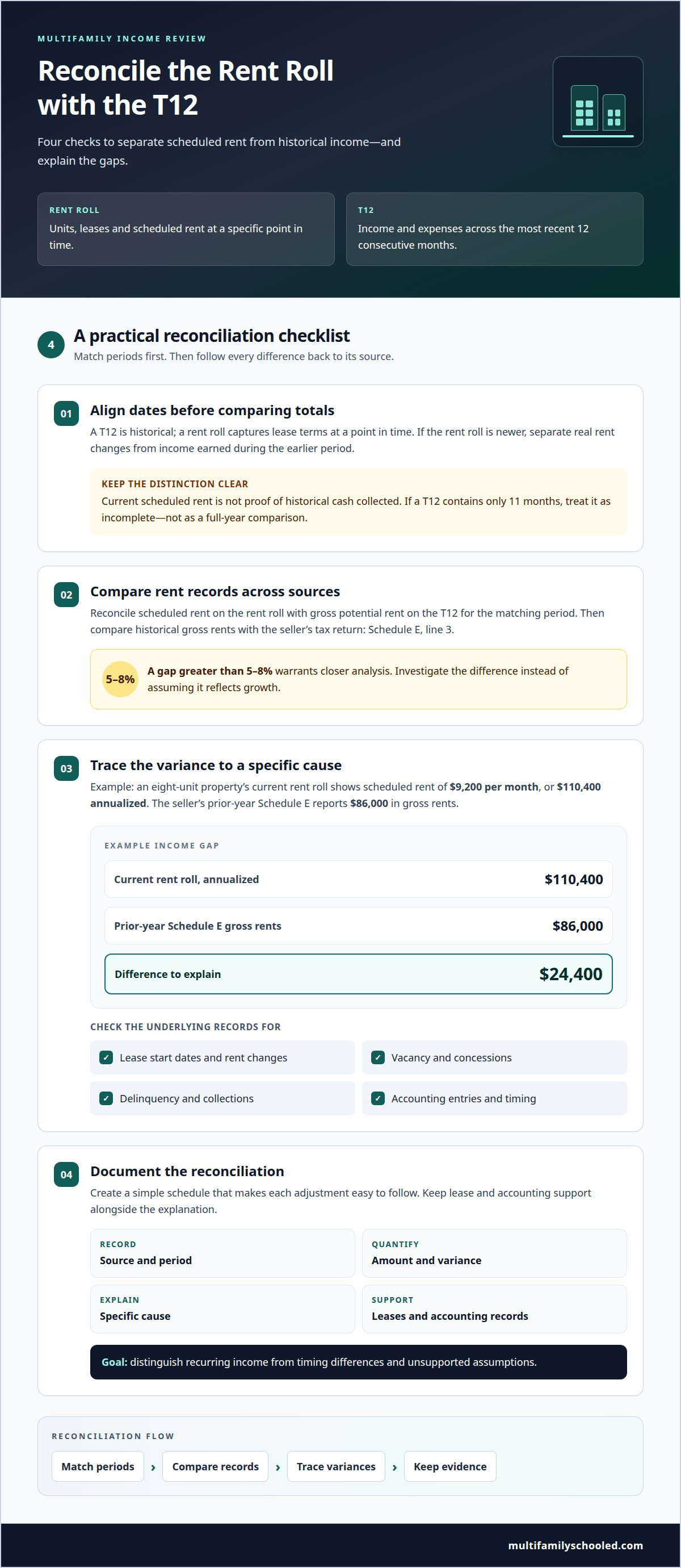
Match each record to its dates before comparing totals. A T12 covers the most recent 12 consecutive months, while a rent roll shows lease terms at a specific point in time. If the rent roll is newer, separate genuine rent changes from income earned during the earlier period. Don’t treat a current scheduled rent as historical cash collected.
-
Compare Rent Rolls with T12 and Schedule E
Reconcile scheduled rent on the rent roll against the T12’s gross potential rent at the time of the statement. Then compare historical gross rents with the seller’s tax return: the Internal Revenue Service identifies gross rents as reported on Schedule E, line 3. Investigate differences rather than assuming they reflect growth. A gap greater than 5-8% warrants closer analysis.
- Trace each variance to a specific cause. For example, an eight-unit property’s current rent roll shows scheduled rent of $9,200 per month, or $110,400 annualized, while the seller’s prior-year Schedule E reports $86,000 in gross rents. The $24,400 difference needs a period-by-period explanation. Check lease start dates, rent changes, vacancy, concessions, delinquency, and accounting entries.
- Document the reconciliation in a simple schedule: record the source, period, amount, variance, and explanation. If a T12 contains only 11 months, treat it as incomplete rather than comparing it directly with a full year. Keep supporting lease and accounting records alongside each adjustment. This creates a clear audit trail and helps distinguish recurring income from timing differences or unsupported seller assumptions.
Underwriting rent, vacancy, credit loss, and expenses
Build normalized net operating income from supportable rental income and operating expenses, not seller projections alone. Reassessments can raise property taxes after acquisition, while insurance renewals can push premiums above T12 levels.
-
Check Missing and Unusual Expense Categories
Compare each T12 category with the property’s operating needs and investigate sharp monthly swings. A utility bill rising from $10,000 to $22,000 in one month calls for an explanation, not automatic annualization. Compare expenses with similar properties, adjusting for supported differences. Apply a management expense if the seller’s owner-operated records omit professional operating costs.
-
Review Expense Timing and Liabilities
Match accounting entries to invoices, payment dates, and services received. Cash-basis records can shift expenses between periods, so identify unpaid bills and delayed invoices before estimating annual costs. Compare the T12 with T3 and year-to-date statements; investigate months that diverge. Normalize seasonal costs using annual totals rather than multiplying one unusual month.
-
Spot Deferred Maintenance in Operating Expenses
Test repairs and maintenance against property condition and capital history. A $28,000 repair entry could include a partial roof replacement, which needs review before setting normalized operating expenses. For a 100-unit property, repairs below $400-$500 per unit per year are a significant departure from market norms. Request capital expenditure history to assess whether low spending signals deferred work.
-
Assess Tax and Insurance Increases
Underwrite reassessment notices and current insurance renewals, not just historical expense. In the Wexley Crossing example, the T12 showed $312,800 in property taxes, while a county notice dated 14 August 2026 put taxes at $338,900. Insurance was $96,400 on the T12, compared with a $112,600 renewal quote effective 1 November. These increases raise ongoing expenses and reduce NOI after closing.
Identifying vacancy, concessions, bad debt, and data errors
Test recorded occupancy against collected income: 95% physical occupancy can coexist with 10% chronically delinquent tenants. Verify leases, deposits, arrears, and concessions against signed agreements, tenant ledgers, and payment records.
-
Inspect Rent-Roll Fields and Side Agreements
Compare each rent-roll entry with the lease, confirming the unit, tenant, rent, lease dates, deposit, and balance. Check for blank, duplicated, or inconsistent fields. Review addenda and side agreements for concessions or changed terms missing from the rent roll. Even a clean-looking total can conceal inaccurate tenant-level data.
-
Track Free Rent and Tenant Transitions
Match move-in and move-out dates to lease start dates, ledgers, and monthly statements. Separate vacant days from occupied days with unpaid rent. For example, a unit advertised at $1,950 per month with one month free on a 12-month lease averages $1,787.50 monthly before other concessions or bad debt. Compare collected rent with the stated figure.
-
Compare Concessions, Vacancy, and Delinquency
Reconcile vacancy and concession entries with occupied-unit records, then trace unpaid balances to tenant accounts. A hypothetical rent roll showing 7 of 8 units occupied equals 87.5% occupancy, but physical occupancy alone doesn’t prove income was collected. Keep vacancy, free rent, and bad debt separate in your analysis. Combining them can hide the difference between scheduled and effective rent.
-
Verify Leases, Deposits, and Arrears
Match lease terms and deposit balances to executed documents and the tenant ledger. A hypothetical rent roll dated July 1, 2026 lists $11,270 in deposits held; reconcile that figure against individual tenant records. Flag arrears, missing deposits, and undocumented credits. Review notice periods and lease expirations too: if 30% of units can terminate with 30 days’ notice, income may be exposed to rapid turnover.
Hidden liabilities in delinquency and vacancy
Physical occupancy can conceal weak collections, short lease commitments, or recurring concessions. When underwriting real estate, test whether trailing twelve-month income reflects durable tenant payments, not just occupied units.
- Compare trailing collections with gross potential rent and the seller’s occupancy claim. For example, collections equal to 91% of gross potential rent do not support a claim of 95% economic occupancy. Reconcile the difference through vacancy, delinquency, concessions, and timing. If a stabilized property’s rent-roll-to-T12 collection gap exceeds 10%, investigate tenant balances and missing credits before accepting reported income.
- Separate physical vacancy from economic loss. A vacant unit reduces rent through lost occupancy; a delinquent tenant may appear occupied even when collections fall short. Check whether the trailing twelve-month statement records unpaid rent as bad debt, a credit, or an unresolved balance. Compare its treatment with tenant ledgers and actual receipts. This prevents occupancy from masking a weaker income stream.
- Determine whether concessions are temporary lease incentives or recurring support for advertised rents. Review lease terms, renewal patterns, and tenant payment histories together. The rent roll may show contracted rent even though free periods or credits reduce collections. If concessions cluster around renewals or new move-ins, model the amount collected instead of assuming every scheduled dollar will continue without incentives.
- Assess how quickly income could change if tenants leave or stop paying. A concentration of month-to-month leases or leases with short termination notice can expose future occupancy and collection risks. Map expiration dates, notice terms, arrears, and vacancy alongside insurance and operating costs. If collections decline while fixed expenses remain, net operating income may fall before the annual trailing statement shows the full effect.
Use this evidence to sharpen your next deal analysis. Build your real estate underwriting skills by learning to test income assumptions against tenant-level risks.
Multifamily Schooled: Mentorship Program
Multifamily Schooled’s Mentorship Program is a next step for investors who want to strengthen their deal analysis after learning to reconcile rent rolls and T12 statements. Use the framework from this guide to identify where income assumptions need more support, then apply that discipline as you evaluate apartment opportunities.
Live Workshops and Online Challenges offer ways to build your multifamily investing knowledge, while Deal Finding Software helps you search for potential deals. These resources can connect financial review with the broader process of finding and evaluating apartment buildings. They’re useful when you’re ready to apply underwriting principles and develop a repeatable approach.
Visit multifamilyschooled.com to explore the Multifamily Mentorship Program and decide whether it fits your next step.
Make Your Next Deal Decision With Clarity
Strong underwriting is a habit, not a one-time spreadsheet exercise. Carry the same discipline into every opportunity: question assumptions, connect each income figure to its source, and treat unexplained differences as signals to investigate. That approach helps turn uncertainty around hidden liabilities in a T12 and rent roll into specific questions you can evaluate before committing to a deal.
Your next step is to put that process to work on a real opportunity. Build a repeatable review, record the evidence behind your assumptions, and keep improving how you assess risk. If you want guidance as you develop your multifamily investing approach, contact Multifamily Schooled to explore a next step that fits your goals.
Stay curious and disciplined as you work toward better-informed investment decisions.
Frequently Asked Questions
What is a rent roll?
A rent roll is a property-level record of tenants, units, lease terms, and rental amounts. It shows how income is distributed across apartments and where lease expirations or tenant turnover may cluster. Compare unit numbers and tenant names with the lease file, for example, to catch duplicate entries or mismatched records before relying on a portfolio total.
What Is a T12 Operating Statement?
A T12 operating statement summarizes a property’s income and expenses across a trailing twelve-month period. Review its monthly detail, not just the annual total: a sudden change in repairs, utility costs, or other income can disappear inside a yearly figure. Compare the same months across statements when possible, so seasonal patterns don’t look like lasting operating changes.
What Is a T12 in Real Estate?
In real estate, a T12 is a trailing twelve-month view of a property’s operating performance. It gives investors a historical baseline for evaluating income and expenses, rather than relying only on a seller’s forecast. Use it alongside current leases and more recent operating records; a T12 can describe past results but cannot, by itself, prove future income.
How Do You Read a T12 for Deferred Maintenance Signals?
Look for unusually low repair spending, recurring repair categories, or abrupt expense changes, then compare them with work orders and capital expenditure history. Repeated emergency plumbing calls alongside modest recorded maintenance, for example, could indicate that routine work is being postponed. Match vendor invoices to accounting entries, and assess whether one-time capital work was recorded as an operating expense.
Is a T12 the same as a profit and loss statement?
A T12 is a profit and loss statement organized around a trailing twelve-month period, usually for one property. A P&L can cover another period or a broader business, so confirm the dates and reporting scope before comparing documents. Also check whether both use the same accounting basis and expense categories; inconsistent treatment can make similar properties appear financially different.
Should CAM reconciliation income be in the T-12?
Include CAM reconciliation income when it is recorded as property revenue for the period and supported by tenant lease terms and reconciliation records. Compare billed recoveries with related common-area expenses, and separate recurring reimbursements from one-time true-ups. Distinguish amounts billed from cash collected, so underwriting doesn’t treat an outstanding tenant balance as income already received.



