

How to Stress Test a Deal for Interest Rate Hikes in 2026
A deal’s real test isn’t its projected return at today’s borrowing cost. It’s whether the numbers still work when financing gets more expensive. To understand how to stress test a deal for interest rate hikes in 2026, model higher borrowing costs, then recalculate debt service, cash flow, and debt-service coverage. The Federal Reserve’s 2026 global market shock includes 10-year U.S. Treasury yields, swap rates, and other interest rates among its risk factors. In the IMF study’s bank stress test, banks were assumed to pass on only 50 percent of funding-cost increases to customers. That’s a bank-model assumption, not a universal property underwriting rule.
It’s reasonable to focus on the purchase price and today’s financing terms. But a deal that looks solid on paper can lose breathing room when rates rise. This guide explains how to build useful rate scenarios, identify the assumptions that matter most, and assess whether operating income can cover debt under pressure. You’ll also learn how to use the results to decide whether to proceed, renegotiate, or walk away before committing.
Key Takeaways
- Model how higher borrowing costs could change debt service and cash flow before deciding whether a deal still works.
- Compare your base case with a tougher rate scenario to see where the deal’s financial cushion starts to narrow.
- Focus on the assumptions that drive the result, including financing terms, operating income, and expenses.
- Use your stress-test results to make a clearer go, renegotiate, or walk-away decision.
How to stress test a deal for interest rate hikes 2026
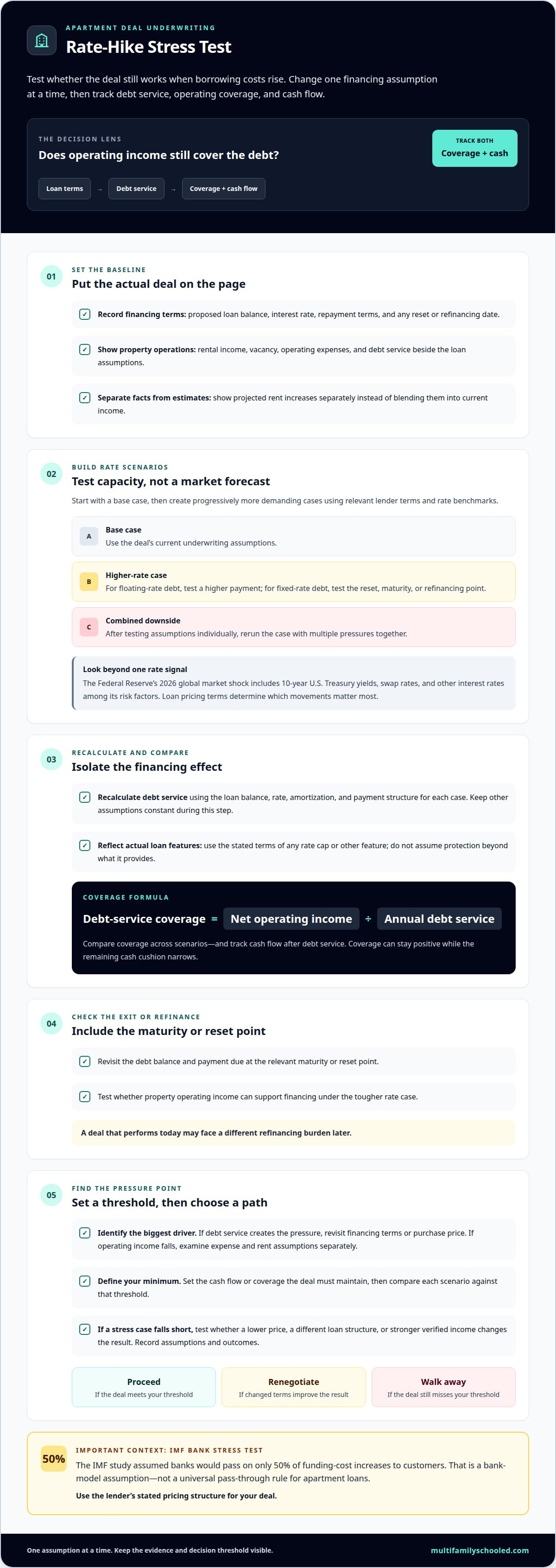
A reliable stress test changes one financing assumption at a time, then tracks its effect on cash flow. To learn how to stress test a deal for interest rate hikes in 2026, start with the actual financing structure, not a generic market forecast. Record the proposed loan balance, interest rate, repayment terms, and any reset or refinancing date. Keep the property’s income and expenses visible beside those loan assumptions. This creates a clear baseline you can compare against tougher scenarios.
Market stress testing also considers more than one interest-rate measure. The Federal Reserve's 2026 global market shock includes 10-year U.S. Treasury yields, swap rates, and other interest rates among its risk factors. That supports testing the deal’s exposure to different rate movements, rather than treating one benchmark as the only signal. Your loan’s pricing terms determine which movements matter most. A fixed-rate loan and a floating-rate loan should not be modeled as though their payments change in the same way.
- Set a defensible baseline. Use the deal’s current underwriting assumptions for rental income, vacancy, operating expenses, and debt service. Separate documented figures from estimates. For example, if projected income relies on rent increases, show that assumption separately instead of blending it into current income. A transparent baseline helps you identify whether later changes come from financing or property operations.
- Choose rate scenarios. Create a base case and progressively more demanding cases using relevant lender terms and rate benchmarks. Don’t label a scenario as a forecast. It is a test of the deal’s capacity. For a floating-rate loan, model the effect of a higher rate on the payment. For a fixed-rate loan, examine the payment at its reset, maturity, or refinancing point.
- Recalculate debt service. Apply each scenario to the loan’s balance, rate, amortization, and payment structure. Keep other assumptions constant during this step. This isolates the financing effect. If the lender’s terms include a rate cap or other feature, reflect its actual terms in the model rather than assuming protection beyond what it provides.
- Recompute operating coverage. Divide net operating income by annual debt service to calculate debt-service coverage. Then compare the result across scenarios. Also track cash flow after debt service. Coverage can remain positive while the remaining cash cushion narrows, so both measures matter to the decision.
- Test the exit or refinance. Revisit the debt balance and payment due at the relevant maturity or reset point. Model whether the property’s operating income can support financing under the tougher rate case. A deal that performs today may face a different refinancing burden later.
Keep assumptions connected to the evidence behind them. The International Monetary Fund’s bank stress test assumed banks would pass on only 50 percent of funding-cost increases to customers. That assumption belongs to that bank stress test. It is not a universal pass-through rule for apartment loans. For your deal, use the lender’s stated pricing structure and avoid applying the IMF assumption as if it were your loan term.
Next, identify which variable drives the largest decline. If debt service creates the pressure, revisit the financing terms or purchase price. If net operating income falls because expenses rise or rent assumptions weaken, address those operating inputs separately. Change one assumption at a time, then rerun the combined downside case. This shows whether several modest pressures together leave too little operating room.
Finish by setting a decision threshold that reflects your investment priorities. Decide the minimum cash flow or coverage the deal must maintain, then compare each scenario against it. If the stress case falls short, test whether a lower price, a different loan structure, or stronger verified income changes the result. Record the assumptions and outcome. This creates a repeatable framework for comparing opportunities without letting an attractive base case conceal financing risk.
Multifamily Schooled: Mentorship Program
Multifamily Schooled’s Multifamily Mentorship Program can help you develop a repeatable process for evaluating apartment deals, including examining financing assumptions and interpreting stress-test results. Consider mentorship when you understand the calculations but want guidance applying them to opportunities you’re assessing. Bring your underwriting questions and examine how loan terms, income assumptions, and operating costs interact.
For a more focused learning format, Live Workshops and Online Challenges offer ways to develop your multifamily investing knowledge. Deal Finding Software can support the search for potential opportunities, while your own analysis determines whether a deal fits your criteria. Choose the learning format that matches your next step, whether that’s strengthening your evaluation skills or finding opportunities to assess.
Explore Multifamily Schooled’s educational resources and choose your next step in apartment investing.
Turn Your Analysis Into a Clear Next Move
A stress test is most valuable when it informs your next move. Use the results to define the financing terms and operating performance a deal must meet before you proceed. Carry those criteria into your next opportunity so you can assess it consistently, rather than rebuilding your decision process each time.
As your assumptions change, keep your reasoning visible. Note what would make you reconsider a deal, and revisit that threshold when financing terms or property information changes. This turns learning how to stress test a deal for interest rate hikes in 2026 into a practical habit you can apply throughout your investing journey.
If you want to discuss applying your analysis to an apartment deal, contact Multifamily Schooled about your deal. Take your next step with clarity and keep building toward your investment goals.



