

How to Identify and Deal With a Problem Investor (LP)
A difficult LP rarely becomes manageable through goodwill alone. Knowing how to identify and deal with a problem investor (LP) starts with spotting warning signs early, setting expectations in the limited partnership agreement (LPA), and responding consistently when issues arise. Clear reporting and documented conversations turn vague tension into specific concerns you can address.
It’s reasonable for a limited partner to ask questions and protect their investment. The challenge is recognizing when repeated demands, poor communication, or disregard for agreed processes could disrupt the fund. This checklist explains what to watch for, which protections to discuss when negotiating the LPA, and how to set practical expectations for transparency and reporting. Use it to approach investor relationships clearly, protect the partnership’s working process, and address problems before they grow.
Key Takeaways
- Build clear protections into the LPA so expectations and remedies are defined before disagreements escalate.
- Set transparent reporting standards, including what information LPs receive and how updates are delivered.
- Document complaints and disruptive conduct factually, then respond through a consistent process focused on the issue.
- For a U.S. Regulation D offering, the U.S. Securities and Exchange Commission says a Form D filing is due within 15 calendar days after the first sale of securities.
Negotiating LP agreement protections
Put expectations in the limited partnership agreement (LPA) before accepting capital. Define contribution deadlines, reporting duties, transfer restrictions, voting rights, and remedies for default. A clear framework gives the GP and limited partners a shared record when disagreements arise. For a U.S. Regulation D offering, a Form D filing is due within 15 calendar days after the first sale of securities, according to the U.S. Securities and Exchange Commission.
Build protections around foreseeable pressure points. A key-person clause can specify what happens if a named partner stops devoting the required time; some provisions use an 80% professional-time threshold and a 90-to-180-day cure period. The agreement should also explain conflicts, affiliated transactions, valuation methods, and how carried interest is calculated. Set a defined process for amendments and committee approvals, rather than relying on informal promises.
- Address missed capital calls. State the deadline, notice process, cure opportunity, and consequences in the LPA. Depending on its terms, remedies may include default interest, dilution, suspension of voting rights, or a forced sale of the defaulting LP’s interest.
- Set removal and distribution terms. Some fund agreements set no-cause GP removal thresholds between 66.7% and 75% of LP capital commitments; the ILPA Model LPA recommends a simple majority, specifically 50.1%. It also recommends a 30% carried-interest escrow until each LP receives contributed capital plus preferred return.
Disputes can delay decisions, consume management time, complicate reporting, and weaken other investors’ confidence. A documented escalation process helps keep fund operations and future fundraising focused on the investment plan.
Consult a lawyer before signing or amending an LPA, and promptly when considering default remedies, transfer restrictions, or removal. Legal review can assess the agreement’s wording and applicable duties. Tax advice can identify potential consequences for allocations, distributions, or a transfer of an LP interest.
Protect the filing calendar, too: the U.S. Securities and Exchange Commission says Form D is due within 15 calendar days after the first sale of securities in a U.S. Regulation D offering. Integrate that deadline into the fund’s compliance record alongside investor notices and annual statements.
Transparency and reporting expectations
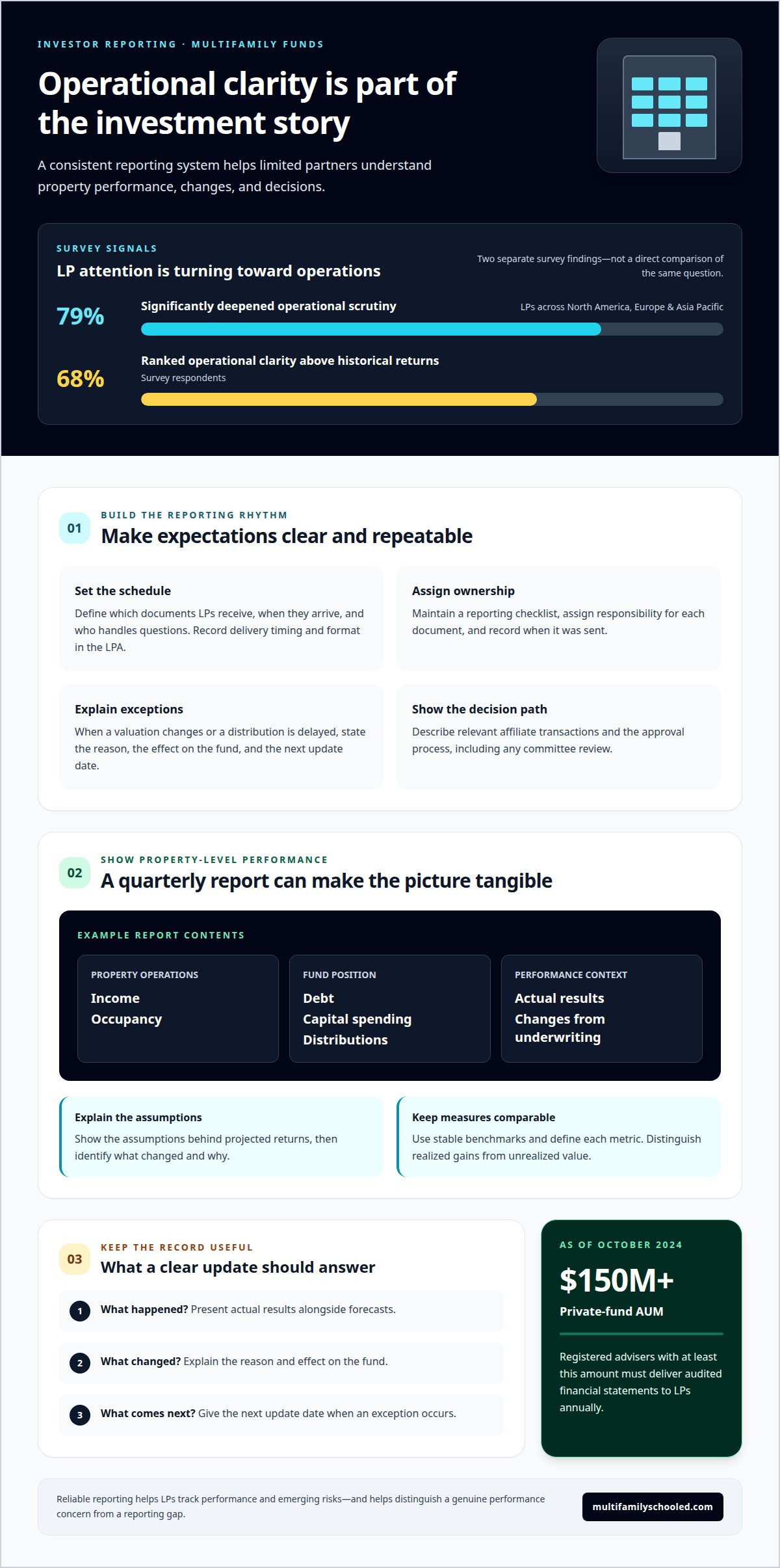
Make reporting promises part of a repeatable process. The LPA should define which documents LPs receive, when they arrive, and who handles questions. A private fund can set a reporting calendar for financial statements, capital activity, portfolio performance, material conflicts, and governance decisions. Clear deadlines make missed updates visible and prevent investors from having to guess what comes next.
Report actual results alongside forecasts. A quarterly report, for example, can show property-level income, occupancy, debt, capital spending, distributions, and changes from underwriting. Explain the assumptions behind projected returns, then identify what changed and why. Keep definitions consistent across periods so partners can track performance without confusing realized gains with unrealized value. This record also helps distinguish a genuine performance concern from a reporting gap.
- Set a documented schedule. State delivery timing and format in the agreement, then maintain a reporting checklist. Assign responsibility for each document and record when it was sent.
- Explain exceptions. If a valuation changes or a distribution is delayed, present the reason, the effect on the fund, and the next update date.
- Disclose conflicts clearly. Describe relevant affiliate transactions and the approval process, including any committee review, so limited partners understand the decision path.
- Make information comparable. Use stable benchmarks and define each metric, especially when comparing actual returns with underwriting or prior periods.
Operational clarity matters alongside the track record. In a survey, 68% of LPs ranked operational clarity above historical returns, while 79% of surveyed LPs across North America, Europe, and Asia Pacific said they had significantly deepened operational scrutiny in the past year. Treat reporting infrastructure as part of diligence, not an administrative afterthought.
As of October 2024, registered advisers with at least $150 million in private-fund AUM must deliver audited financial statements to LPs annually. Build a process that supports timely review, consistent records, and secure document access. For a private equity fund, reliable reporting gives investors a clear position on performance and emerging risks.
How should a GP document and respond to an LP's complaints or disruptive conduct?
A fair, factual process is central to how to identify and deal with a problem investor (LP). Record the date, channel, people involved, issue raised, and requested remedy. Preserve the original email or meeting notes, then add a neutral summary without labels such as “difficult” or “unreasonable.” This record helps separate a substantive concern from a communication breakdown.
- Log each complaint in a central record. Include supporting documents, relevant fund decisions, and the person responsible for follow-up. A complete timeline helps the GP understand what happened and avoid conflicting accounts.
- Separate evidence from interpretation. Record what the LP said, what documents show, and what remains unresolved. For example, note a disputed distribution amount separately from the LP’s view of why it was calculated incorrectly.
- Acknowledge the concern in writing. Confirm the issue and identify the next response step. This creates a clear communication trail and shows the GP has received the complaint.
- Respond to the specific point. Cite the relevant agreement provision, statement, or decision record, then explain the reasoning in plain language. A focused answer keeps one accounting question from expanding into a personal dispute.
- Apply conduct standards consistently. If an LP interrupts meetings or repeatedly contacts staff, record specific instances and reinforce the agreed communication channel. Consistent boundaries protect staff time without treating disagreement itself as misconduct.
Assign an owner and response date to every open issue. If a complaint concerns a valuation, assign its review to the person responsible for that analysis. If it concerns an allocation, trace the calculation and decision path. Keep updates factual, even while preparing the response.
Knowing how to identify and deal with a problem investor (LP) also means knowing when to escalate. Refer threats, repeated disruption, misconduct allegations, or demands affecting other LPs to fund counsel. Counsel can assess the governing documents, applicable duties, and appropriate response. Keep the decision, rationale, and related communications together in the fund’s records.
How can a GP resolve an LP dispute through direct communication or mediation?
Start with a focused conversation if the dispute concerns a specific decision, report, or distribution. The GP should identify the disputed point, review the governing agreement, and invite the LP to explain the practical outcome they seek. For example, an LP questioning a property valuation may want clarification of the assumptions and supporting analysis, rather than a change to the valuation itself.
Prepare before the meeting. Gather the relevant agreement provision, statements, correspondence, and decision records. Set an agenda that names the issue and the decision-makers attending. Separate verified facts from disputed interpretations, then let each participant explain their position without interruption. Close by recording agreed actions, owners, and follow-up dates.
- Address the issue, not the person. Describe the specific action or decision in dispute, and avoid personal judgments that can harden positions.
- Offer practical options. If the concern involves delayed information, agree on a document delivery process. If it concerns an allocation, review the applicable calculation and explain its basis.
- Keep the fund’s process consistent. Apply the agreement and established decision procedures, and consider whether a proposed resolution affects other LPs.
Direct discussion may not resolve a dispute involving entrenched positions, conflicting interpretations, or repeated communication breakdowns. In those cases, review the LPA’s dispute-resolution clause and consider mediation. A neutral mediator helps both sides clarify issues, explore options, and work toward a voluntary resolution. The mediator does not replace the GP’s decision-making authority or decide the dispute like a court.
Before mediation, define the participants’ authority to negotiate and prepare a concise chronology with supporting records. Identify which outcomes the fund can implement under its agreement and which require additional approvals. Fund counsel can help assess those boundaries and the proposed process.
After reaching a resolution, write down each agreed action, responsible person, and completion date. Share the outcome with affected parties when appropriate, while respecting confidentiality obligations. If discussions fail, follow the LPA’s stated procedure and preserve the fund’s records throughout. A disciplined process keeps the disagreement specific and helps limit disruption to fund decisions.
Multifamily Schooled: Deal Finding Software
Multifamily Schooled offers MFScout.ai, an AI-driven platform for finding and analyzing apartment deals and raising capital. It can help investors build a deal pipeline, but it doesn’t replace the LPA, investor communication, or dispute-resolution process that governs an existing fund.
If you’re also developing your investment approach, Multifamily Schooled’s Multifamily Mentorship Program, live workshops, and online challenges offer ways to learn about multifamily investing. Choose a resource that fits the skill you want to build, whether that’s finding opportunities or strengthening your investment knowledge.
Contact Multifamily Schooled to discuss which learning resource may fit your next step.
Build stronger investor relationships from here
Make your next investor conversation deliberate. Set the tone early by explaining how decisions are made, what information partners can expect, and how concerns should be raised. Consistency matters: the process you follow with one LP can shape trust across the entire partnership.
Learning how to identify and deal with a problem investor (LP) is part of becoming a more capable real estate sponsor. Keep strengthening the skills behind sound investment decisions and clear communication. Multifamily Schooled’s Multifamily Mentorship Program, live workshops, and online challenges offer options for investors building their multifamily knowledge and approach.
Contact Multifamily Schooled today to discuss a useful next step for your investing journey. Keep moving forward with clarity, preparation, and confidence.
Frequently Asked Questions
What are the warning signs of a problematic limited partner (LP)?
Warning signs include repeated attempts to bypass agreed governance, pressure for preferential treatment, or inconsistent explanations of an investor’s actions. One tense exchange alone doesn’t establish a pattern. Look for recurring conduct that disrupts decisions or affects other partners, such as privately lobbying committee members after a documented decision. Assess the behavior against the LPA and apply the same standards across the investor group.
How can a fund manager distinguish a difficult LP from an LP raising legitimate concerns?
A legitimate concern usually points to a specific inconsistency, missing explanation, or decision affecting the LP’s interests. For example, an investor may flag that a reported distribution differs from the amount shown in an account statement. A difficult interaction describes the manner of communication, not whether the underlying issue is valid. Evaluate the facts separately, and don’t dismiss a substantive question because it is put bluntly.
What rights and obligations do LPs and GPs have under a limited partnership agreement?
The LPA sets the fund’s rights and obligations, so its specific terms matter. It may define LP voting rights, access to information, distribution entitlements, and transfer limits. It also sets the GP’s authority and responsibilities for managing the partnership. For example, an LP may have approval rights over specified major decisions but no role in ordinary operations. Read related clauses together, since one provision can qualify another.
Can a GP remove, suspend, or force the withdrawal of an LP?
Only if the governing agreement and applicable law provide a basis and process for that action. An LPA may address default, prohibited transfers, or other specified events, but a GP shouldn’t assume they can remove an LP at will. Before restricting rights or forcing a withdrawal, review the relevant clauses, notice requirements, voting thresholds, and distribution consequences with fund counsel.



