

How to Create a 5-Year Real Estate Investing Plan for Cash Flow
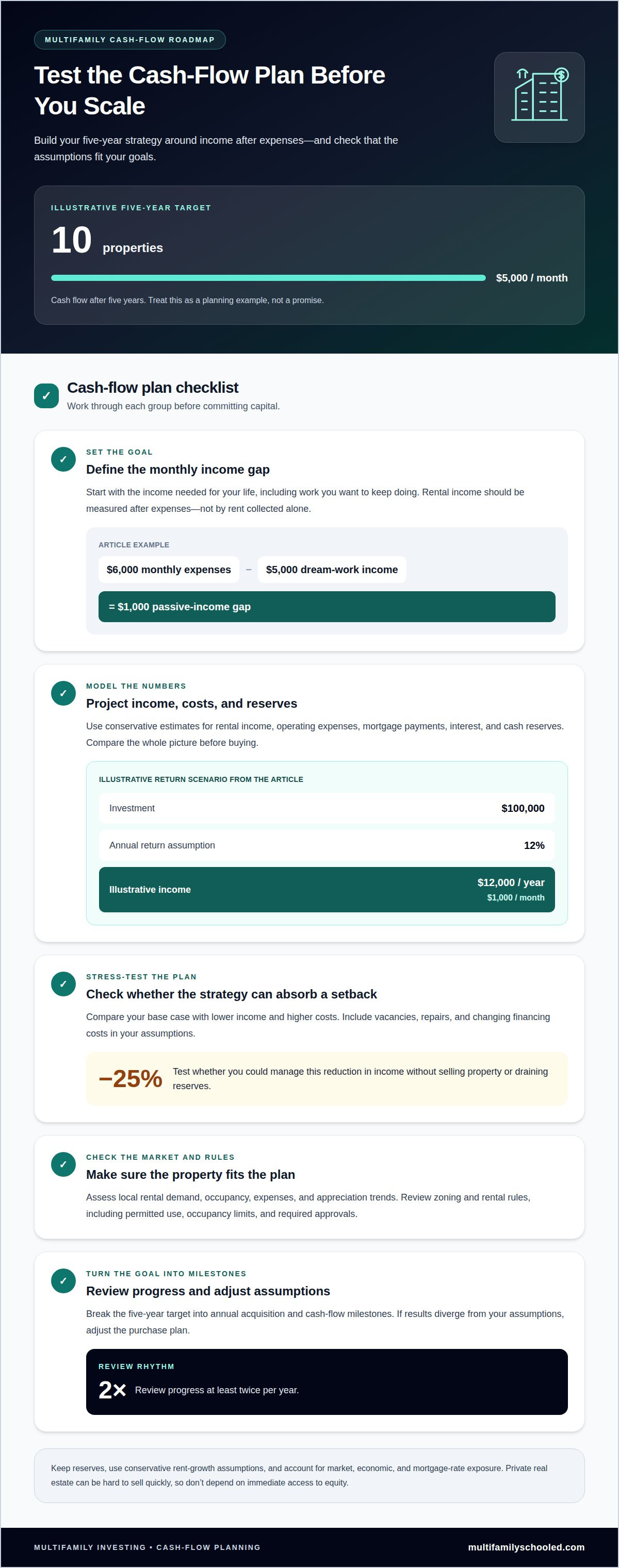
Your next property should serve year five, not just today. Creating a 5-year plan for real estate investing means mapping acquisitions, reinvestments, and exits toward a clear cash-flow goal. One illustrative target is to own 10 properties generating $5,000 a month in cash flow by year five. Use it as a planning example, then shape your own target around your finances and priorities.
It’s easy to focus on finding the next deal while leaving the bigger picture unclear. A strong roadmap links each move: how you’ll build savings, whether you’ll reinvest proceeds from a sale, and when it makes sense to hold or sell a property.
This guide explains how to set a measurable cash-flow target, plan acquisitions and exit options, and turn those decisions into a year-by-year strategy. You’ll also learn how to revisit the plan as your portfolio and circumstances change, so each step supports your long-term financial goals.
Key Takeaways
- Build a reinvestment strategy that directs savings and sale proceeds toward your next acquisition while preserving room for repairs and vacancies.
- Measure rental cash flow after operating expenses and financing costs, then connect your target to the income you need for greater financial flexibility.
- Plan acquisition criteria, property improvements, and more than one exit path so you can adapt as circumstances change.
- Map each year’s priorities, review your assumptions regularly, and adjust the roadmap as your portfolio develops.
Reinvesting savings and sale proceeds in additional properties
For beginners, a practical starting point is to evaluate a rental property, track its cash flow, and reinvest cautiously. Base each purchase on its income potential, possible appreciation, mortgage principal repayment, and a defined exit option.
-
Analyze Rental Deals and Cash Flow
Calculate net operating income by subtracting operating expenses from rental income, then account for financing costs to estimate cash flow. Compare cash-on-cash return and capitalization rate, and assess occupancy, tenant turnover, and local appreciation trends. A property may gain value while its mortgage principal falls, but neither replaces a close review of expenses. Keep reserves for vacancies and repairs so unexpected costs don’t use funds intended for your next acquisition.
-
Use Savings and Sale Proceeds for Acquisitions
Set aside savings for reserves first, then consider directing available cash and sale proceeds toward a property that meets your investment criteria. Treat this as an illustration, not a universal financing formula. Before buying, review projected rental income, expenses, financing costs, and the property’s ongoing needs.
- Plan how equity might support your next move. Appreciation and principal repayment can build equity, which investors may borrow against to help finance another rental. Reinvest proceeds only after accounting for the next purchase’s reserves and expected cash flow.
- Consider timing and tax implications before selling. For a U.S. 1031 exchange, the Internal Revenue Service says a taxpayer has 45 days after a sale to buy replacement property or identify property to purchase within 180 days of the original sale. The Internal Revenue Service says the U.S. rental real estate loss allowance phases out completely at an income of $150,000. One material participation test described by the Internal Revenue Service is participating in the activity for more than 500 hours annual. These rules can affect how proceeds and rental losses fit your plan.
Rental property cash flow and early financial independence
Set a cash-flow target that supports the life you want, then test the capital and property assumptions behind it. Build your plan around income after expenses, not rent collected alone.
-
Align Investments with Financial Goals
Start by defining financial freedom in practical terms: the monthly income needed to cover living expenses, plus any income from work you want to keep doing. For example, $6,000 in monthly expenses and $5,000 from dream work leave a $1,000 passive-income gap. Choose markets where rental demand, occupancy, expenses, and appreciation trends fit your goals. Before buying, examine local zoning and rental rules, including permitted property use, occupancy limits, and required approvals.
-
Model Financing and Investment Scenarios
Build a conservative projection for rental income, operating expenses, mortgage payments, interest, and cash reserves. A $100,000 investment generating a 12% annual return would produce $12,000 per year, or $1,000 per month, in this illustration. Compare that scenario with lower income and higher costs. Test whether you could manage a 25% reduction in income without relying on selling property or draining reserves. Account for vacancies, repairs, and changing financing costs.
-
Set Realistic Investment Goals
Set a measurable five-year target, then break it into annual acquisition and cash-flow milestones. One example is 10 properties producing $5,000 a month in cash flow after five years. Treat that as a model, not a promise; property prices, available savings, financing, and operating costs shape what is achievable. Review progress at least twice per year and adjust purchases when results diverge from your assumptions.
Reduce risk by keeping reserves, using conservative rent-growth assumptions, and assessing market, economic, and mortgage-rate exposure. Private real estate can be hard to sell quickly, so don’t depend on immediate access to equity. For help structuring a multifamily plan, explore multifamily investment planning resources.
Short-term rentals may have more variable cash flow and require closer ongoing attention. The author says he has interviewed dozens of people who reached financial independence and retired young through real estate.
Planning acquisitions and exit strategies
Set acquisition criteria and exit options before committing capital. A clear plan can preserve flexibility, support wealth building, and help you make decisions with purpose.
-
Plan for Taxes and Depreciation
Build tax planning into each purchase and sale, and keep records of property costs, improvements, income, and expenses. Depreciation can affect the property’s tax basis and the tax consequences of a later sale, so include it in your projected net proceeds. The Internal Revenue Service says eligible U.S. rental property investors who actively manage their properties may deduct up to $25,000 per year in rental losses if their income is below $100,000. Model how income and participation affect your own plan.
-
Plan an Investment Exit Strategy
Choose an exit for each acquisition before closing: continue holding, sell, or exchange into another qualifying property. Compare expected sale proceeds with the remaining mortgage, transaction expenses, and the capital needed for your next investment. For a U.S. 1031 exchange, the Internal Revenue Service says the replacement property must be purchased within 180 days of the original sale when the taxpayer identifies it within the stated 45-day window. Build that timing into the sale plan.
- Plan maintenance before small issues become major expenses. Set review dates for key systems, then budget for improvements such as roof replacement, HVAC updates, plumbing, electrical work, and energy-efficiency upgrades. A roof nearing the end of its useful life may affect your acquisition budget or the timing of a sale. Include expected repairs and reserves in your projections before seeking financing for another purchase.
- Keep more than one option open. If rental income weakens or your goals change, selling may free up capital, while holding can preserve rental income and potential appreciation. Compare both outcomes using current operating results and the property’s condition, not just the assumptions you made when buying. For example, a planned sale may fund another acquisition, but only if the estimated proceeds cover the mortgage and leave enough capital for the next property and its reserves.
Illustrative year-by-year real estate investment plan
Use this five-year roadmap as a working model, not a fixed formula. When creating a 5-year plan for real estate investing, make each year build on the prior year’s cash, experience, and property performance.
- Year 1: Acquire a first property and learn its operating cycle. Track tenant needs, expenses, and net returns from the start. Use the first year to understand how actual cash flow compares with projections.
- Year 2: Add an investment property only after reviewing available capital and the first property’s performance. The example investor purchased a second $125,000 property with a 20% down payment of $25,000 per year. Across two years, the investor used $37,500 of personal investment. Keep reserves separate from acquisition funds, and avoid treating projected appreciation as spendable cash.
- Years 1 and 2: The illustrative strategy flips two properties per year, then shifts toward long-term ownership. A flip can release capital for future purchases, but holding expenses and project delays can affect returns. Track each sale’s net proceeds and decide how much to reinvest versus retain as reserves.
- Years 3 and 4: Build toward holding small multifamily rental properties. Prepare for recurring responsibilities, including tenant communication, maintenance, and vacancy planning. Compare actual income and expenses across properties, then prioritize acquisitions that support dependable cash flow instead of growth in unit count alone.
- Year 5: The example adds three units modeled at about $125,000 each. By year-end, its total rental cash flow reaches $15,480. Treat this as an illustration, not a forecast. Review occupancy, repair costs, and property performance before expanding. Creating a 5-year plan for real estate investing also means measuring net results, not simply counting properties owned.
Turn your own roadmap into deal criteria with multifamily deal-finding tools.
Multifamily Schooled
Multifamily Schooled offers education and tools to help investors turn a five-year roadmap into practical next steps. If you’re refining apartment acquisition criteria, evaluating potential deals, or building your investing skills, its Multifamily Mentorship Program, live events, Multifamily University, and deal-finding tools can help you develop your approach.
Use these resources when you want guidance connecting deal analysis with broader portfolio goals or a clearer process for finding multifamily opportunities. The right next step depends on your stage: learning the fundamentals, sharpening your acquisition strategy, or improving how you assess deals. Keep your cash-flow target and investment criteria at the center of your work.
Contact Multifamily Schooled to discuss your real estate investing goals.
Turn Your Roadmap Into Your Next Move
Your plan becomes more useful when it guides the decisions in front of you. Choose one action you can take now, such as refining your acquisition criteria, reviewing a potential deal, or setting a regular time to assess progress. Keep your assumptions visible and update them when your finances, priorities, or property performance change. That steady process makes creating a 5-year plan for real estate investing an active strategy, not a document you set aside.
If structured learning would help you move forward, Multifamily Schooled offers the Multifamily Mentorship Program, live events, and Multifamily University courses focused on real estate investing. Start with your goals and questions, then identify the learning and support that fit your current stage.
Contact Multifamily Schooled to discuss your plan, and take your next step with purpose.
Frequently Asked Questions
How do I analyze rental property cash flow, cap rate, and ROI?
Use separate calculations to see what a property earns before and after financing. To estimate cash flow, subtract operating expenses and mortgage payments from collected rent. To calculate the cap rate, divide net operating income by the purchase price, excluding financing. To estimate ROI, compare the investment’s net return with the cash you contributed, including acquisition and improvement costs. Apply consistent assumptions across properties to make the comparison useful.
How should I plan property acquisition, management, and exits over five years?
Set a purchase condition for each stage, such as requiring stable occupancy or completed repairs before adding another property. Assign responsibility for tenant communication, rent collection, maintenance, and records, whether you handle these tasks yourself or use property management. Revisit your hold-or-sell decision when operating results, property condition, or personal goals change. Before committing sale proceeds, account for financing and transition costs on the next acquisition.



