

How to Communicate a Capital Call to Investors Clearly
A capital call can test an investor relationship as much as a fund’s cash flow. It asks investors to contribute additional capital, usually from amounts they committed but haven’t yet funded. Knowing how to communicate a capital call to investors means clearly stating why the fund needs the money, how much each investor must contribute, when payment is due, and how to send it.
It’s reasonable to want a clear explanation before committing more money. Investors need enough context to understand why the fund needs capital, how it will be used, and what the request may mean for their investment. A concise, consistent notice makes these details easier to assess.
This guide explains what capital calls are, why a fund may need additional capital, and how the process works. It also covers what to include in a clear notice and what consequences may follow if an investor doesn’t fund a call. Those consequences depend on the fund agreement.
Key Takeaways
- Explain what the requested capital will fund and how that use fits the fund’s investment strategy.
- Understand how the fund’s limited partnership agreement governs call terms and when committed capital becomes paid-in capital.
- Give investors context on the call’s purpose, expected impact, and what may happen next to reduce confusion.
- Review the agreement’s default provisions so investors understand that nonpayment may affect their ownership, distributions, or fund rights.
What is a capital call?
A capital call asks investors to contribute funds beyond their initial contributions or from their uncalled commitments. In commercial real estate, the managing entity may request funds for property expenses, financing needs, or a new opportunity. Unlike a distribution, which pays returns to investors, a capital call brings money into the fund.
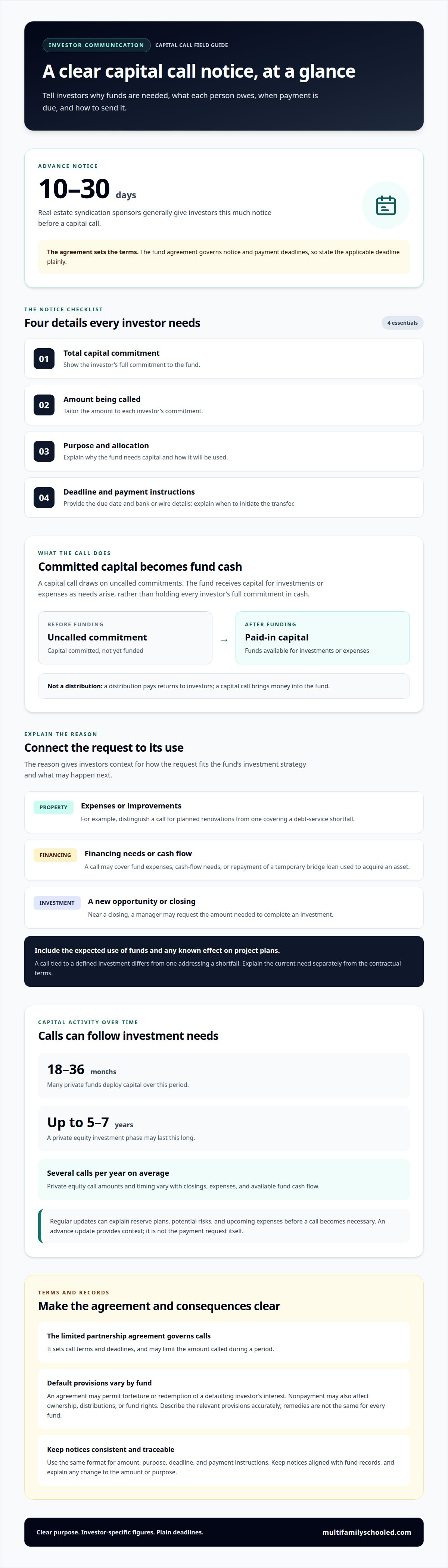
How much advance notice must a fund give investors? Real estate syndication sponsors generally give investors 10 to 30 days’ notice before a capital call. The fund agreement sets the applicable notice and payment terms, so the stated deadline matters.
Fund teams deciding how to communicate a capital call to investors should start with a clear notice. It should connect the amount requested to each investor’s commitment and explain how to pay. Include these details:
- The investor’s total capital commitment.
- The amount being called from that investor.
- The purpose of the call and how funds will be allocated.
- The payment deadline and bank or wire details.
Explain why the need has arisen. For example, distinguish a call for planned renovations from one covering a debt-service shortfall. State what happens next, including the expected use of funds and any known effect on project plans. This context helps each investor assess how the request fits the original investment strategy.
Investor communication shouldn’t begin with the formal notice. Regular updates can explain reserve plans, potential risks, and upcoming expenses before a call becomes necessary. An advance update isn’t the payment request itself. It prepares investors for what may happen and gives them context for the later notice.
Knowing how to communicate a capital call to investors also means keeping each notice and reporting period consistent. Use the same format for the amount, purpose, deadline, and payment instructions, while tailoring the figures to each investor. State the deadline plainly, explain when to initiate the transfer, and provide a contact for questions. In private equity, a concise notice can also summarize an investment opportunity and its stage. Investors can then understand both the action required and the reason for it.
How capital calls work in private equity and venture capital
In private equity and venture capital, investors commit capital upfront and fund portions when the manager needs them. The fund’s limited partnership agreement sets the terms for making calls and meeting commitments.
Funding Project Expenses and Cash Flow
A capital call turns uncalled commitments into paid-in capital that the fund can use for investments or expenses. This staged approach lets a fund request money as needs arise instead of holding every investor’s full commitment in cash.
For example, a general partner may use a temporary bridge loan to acquire an asset, then call capital to repay it. Calls can also cover fund expenses or cash-flow needs. The reason matters to investors: a call tied to a defined investment differs from one addressing a shortfall. A call may provide access to an opportunity, but it also requires fresh liquidity and adds exposure to the fund’s risks.
Timing Calls Around Investment Closings
Call timing often follows investment activity. Many private funds deploy capital over 18 to 36 months, while a private equity investment phase may last up to 5-7 years. A venture capital fund may call capital as it advances investments, rather than collecting the entire commitment at the start.
Near a closing, the manager may request the amount needed to complete an investment. Some general partners use bridge financing first, then call investors to repay the loan. This can help a fund move quickly on an opportunity, but investors still need to plan for the payment deadline. The limited partnership agreement governs call procedures and deadlines.
Private equity funds issue capital calls several times per year on average. The amount and timing vary with closings, expenses, and available fund cash flow. Calls can let investors participate in opportunities using their committed equity, but they also reduce the uncalled capital available for later investments. Clear updates about expected activity help investors understand why a call is happening and how it fits the fund’s investment plan.
Transparent explanations of fund capital needs
A clear capital call notice connects the fund’s need to its investment plan. The fund manager should explain the reason, expected use, and likely effect of the requested capital. For example, a call to meet a debt obligation signals a different concern from one supporting property improvements. This context helps limited partners assess the request against the fund’s strategy and documents.
The fund agreement defines how the general partner may call capital and what limited partners must contribute. Capital calls generally follow the limited partnership agreement, which may also limit the amount called during a period. For example, an agreement might restrict a general partner from calling more than half of committed capital in a year. A clear explanation should distinguish the contractual terms from the manager’s description of the current need.
Centralized records make communication easier to follow. An LP portal can let investors review fund documents, balances, past calls, and distributions in one place. Keep every notice and update consistent with those records. If the amount or purpose changes, explain why and preserve the updated information alongside earlier notices. A complete record helps investors track their interest over the life of the fund.
Explain default provisions in plain language. A fund agreement may permit forfeiture or redemption of a defaulting investor’s interest. The notice should describe the relevant consequence accurately, without suggesting every fund uses the same remedy. Investors need to understand how the agreement treats nonpayment before the deadline passes.
Feeder funds add a communication step because investors participate through an entity that invests in an underlying fund. The feeder’s notice should clearly relay the underlying call’s purpose, each investor’s share, the deadline, and applicable payment instructions. Coordinating information across both entities can help prevent mismatched amounts or dates.
Consistency matters throughout a decade-long investment relationship. Use the same terms across notices, portal records, and fund documents. Explain what has changed, what remains the same, and how the request affects the stated investment plan. This discipline helps investors distinguish a new capital need from routine fund activity.
Consequences of failing to fund a capital call
Missing a capital call deadline can trigger a default under the fund’s limited partnership agreement. The consequences depend on the agreement, so investors should understand its remedies before deciding not to contribute committed capital. Nonpayment can affect both an investor’s position and the fund’s ability to meet its obligations.
Possible consequences include:
- Penalty interest or other charges on unpaid additional capital.
- Dilution of the investor’s ownership interest, sometimes at a 1:1 ratio or a greater penalty.
- Reduced participation in future distributions or a more junior position than new capital.
- Forfeiture, redemption, or forced sale of the investor’s fund interest.
- Legal claims or proceedings for failing to meet obligations.
These outcomes aren’t automatic across all funds. The governing agreement determines which remedies apply, how they’re calculated, and whether a grace period is available. For example, one agreement might allow an extension, while another could authorize a forced sale on pre-agreed terms. The fund manager should explain the relevant provision and timing clearly, rather than imply that every listed consequence applies.
A default can also create a funding gap. Sponsors may seek additional capital from other limited partners or co-sponsors to cover the shortfall. That response may affect the fund’s capital structure and the relative position of existing investors. If new preferred equity or mezzanine debt is introduced, existing limited partner equity may become subordinate to that capital.
If you can’t meet a call, communicate promptly with the fund manager to understand the process, including any permitted grace period. Silence doesn’t change the agreement’s deadline or remedies. Review the notice, payment timing, and exact default provisions before the deadline passes.
Clear education about multifamily investment structures can help investors understand how agreements shape risk and ownership. Explore multifamily investing mentorship to build that foundation.
Multifamily Schooled
Multifamily Schooled helps investors build practical knowledge for apartment and commercial real estate investing. If capital calls raise broader questions about evaluating a deal, understanding risk, or planning your next investment, its educational resources can help you strengthen that foundation. The Mentorship Program, Live Workshops, Online Challenges, and Deal Finding Software support learning about multifamily investing and identifying potential deals. They don’t replace the terms in a fund agreement or explain the obligations of a particular investment.
Turn to Multifamily Schooled when you want to develop your investing skills beyond this capital call guide. Choose the learning format that fits how you prefer to build knowledge and take action. For guidance on your multifamily investing education, contact Multifamily Schooled.
Build Investor Confidence Beyond the Next Call
Knowing how to communicate a capital call to investors is one part of building a stronger investor relationship. Make clear communication an ongoing practice, not a response reserved for urgent funding needs. A consistent approach helps investors know where updates come from, who handles questions, and how material changes will be shared.
Use the time between capital calls to prepare. Assign responsibility for investor updates, record recurring questions, and decide how you’ll explain changes to plans or timing. When a new request arises, these habits help keep communication focused and responsive. They also give your team a practical way to learn from each interaction and improve future updates.
If you’re building your knowledge of multifamily real estate investing, Multifamily Schooled can support your next learning step. Contact Multifamily Schooled to explore how its educational resources fit your goals. Keep learning, strengthen your process, and move forward with purpose.
Frequently Asked Questions
How often do capital calls occur?
Private equity funds issue capital calls several times per year on average, but timing varies with fund activity. A fund may call capital as investments close, expenses arise, or cash-flow needs change. For example, an active investment period can bring calls closer together than a period with fewer planned transactions. Investors should use fund updates to understand upcoming activity rather than assume calls follow a fixed calendar.
How are investors notified?
Investors are typically notified in writing through the fund’s established communication process. Each investor should receive an individualized notice showing the amount and due date that apply to their commitment. For feeder funds, investor-facing communication should accurately convey the underlying fund’s request. A consistent channel and format help investors recognize formal payment requests and distinguish them from general fund updates.
What information should a capital call notice include?
A useful notice identifies the investor’s total commitment, the amount requested, the payment deadline, and the bank or wire details. It should also explain the call’s purpose and how the requested capital will be allocated. If the funds support a specific acquisition, for instance, connect the request to that transaction. Clear details help investors understand both the action required and the reason for it.
How do you calculate each investor’s capital call amount?
For a pro rata call, apply the call percentage to each investor’s commitment, subject to the fund documents. For example, an investor with a $1 million commitment would contribute $100,000 on a 10% pro rata call. Other allocation methods may apply if the agreement provides for them. The notice should show the calculation or allocation basis, so investors can understand how their individual amount was determined.
How should a capital call notice be delivered and documented?
Deliver the notice through the channel and process specified in the fund documents, then retain a dated copy with the investor’s records. Record the amount, deadline, and delivery details in that investor’s account. After sending notices, track incoming transfers and match each payment to the correct investor. This creates a clear record of what was requested, what arrived, and how fund cash flow changed.
What payment methods and wire instructions should a capital call notice provide?
The notice should state the payment method accepted under the fund’s procedures and include the bank and wire details needed to transfer funds. Identify the deadline and any reference information investors should use to match a transfer to their account. Avoid informal payment directions that conflict with the official notice. Consistent instructions help investors send the correct amount to the right destination.



