

How to Build Confidence in Your First Syndication by Evaluating Fees and Partners
What if confidence as a first-time syndication sponsor comes from asking sharper questions, not having every answer? Building the confidence to lead your first syndication starts with understanding your partners and the deal’s economics.
It’s natural to feel pressure when investors trust you to lead. Ground your decision by evaluating a partner’s experience, communication, and alignment with the deal, then tracing how fees, the promote, and the preferred return affect distributions. A promote is the sponsor’s share of profits after agreed conditions are met; a preferred return gives investors priority over certain distributions before the sponsor receives certain profit shares. Exact terms depend on the deal documents.
This guide will help you assess potential partners and understand key economic terms before taking the lead. Learn what to look for, which questions can reveal whether incentives align, and how to explain the structure clearly. Base your decision on transparency and fit, not pressure to move quickly.
Key Takeaways
- Assess a potential partner’s alignment, communication, and approach to investor suitability before deciding to work together.
- Learn how a syndication combines investor capital and a sponsor’s work, and where deal terms shape distributions.
- Identify the practical skills that help a first-time sponsor evaluate opportunities and guide a deal responsibly.
- Build investor credibility through clear communication, careful listening, and a transparent explanation of the opportunity.
Selecting and evaluating syndication partners
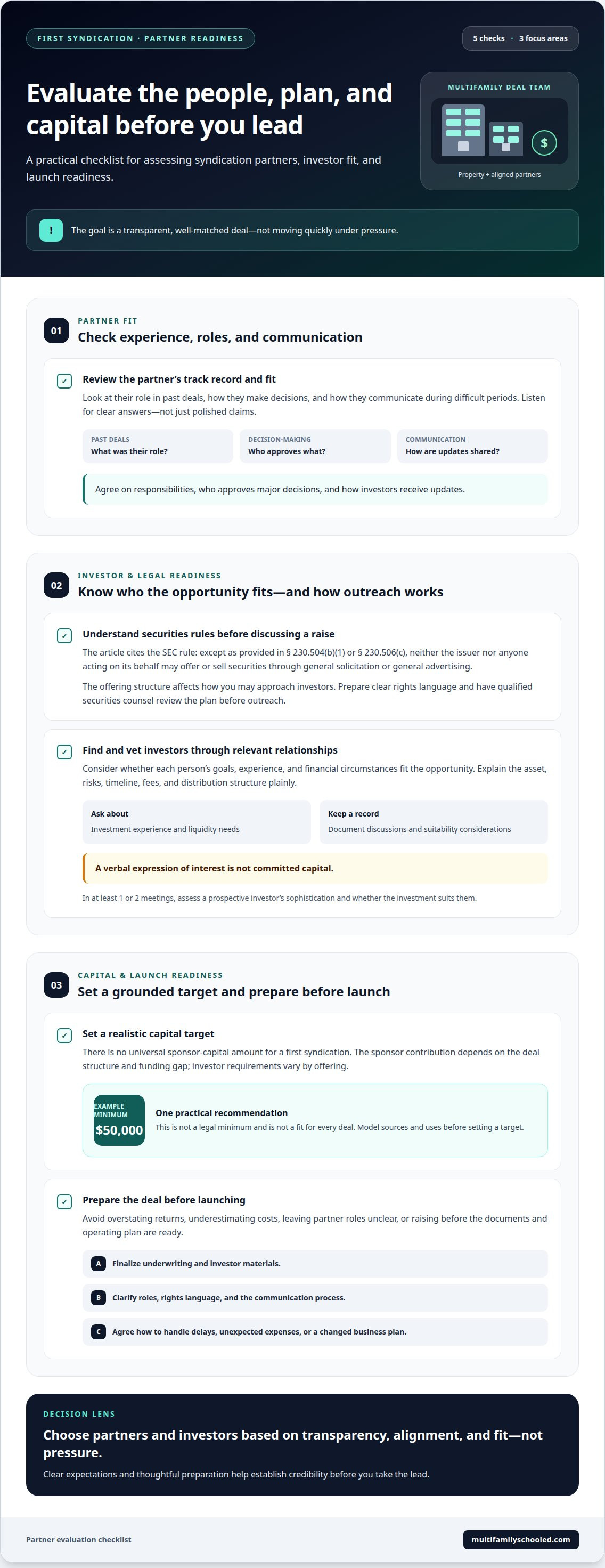
- Assess the partner’s track record and fit. Review their role in past deals, decision-making approach, and communication during difficult periods. Ask how responsibilities will be divided, who approves major decisions, and how investors receive updates. In at least 1 or 2 meetings, assess a prospective investor’s sophistication and whether the investment suits them. Listen for clear answers, not just polished claims.
- Understand the U.S. securities rules before discussing a raise. According to the U.S. Securities and Exchange Commission, except as provided in § 230.504(b)(1) or § 230.506(c), neither the issuer nor any person acting on its behalf shall offer or sell securities by any form of general solicitation or general advertising. The offering structure affects how a sponsor may approach investors, so prepare clear rights language and have qualified securities counsel review the plan before outreach.
- Set a realistic capital target. There is no universal sponsor-capital amount for a first syndication; the sponsor contribution depends on the deal structure and funding gap. Investor requirements also vary by offering. One practical recommendation sets the minimum investment at $50,000, but that is not a legal minimum or a fit for every deal. Model sources and uses before setting a target.
- Find and vet investors through relevant relationships. Build a list of people whose goals, experience, and financial circumstances fit the opportunity. Explain the asset, risks, timeline, fees, and distribution structure plainly. Ask about their investment experience and liquidity needs, then document discussions and suitability considerations. Never treat a verbal expression of interest as committed capital.
- Prepare before launching. Common first-time mistakes include overstating returns, underestimating costs, unclear partner roles, and raising before the deal documents and operating plan are ready. Finalize the underwriting, investor materials, roles, rights language, and communication process first. Confirm that partners agree on decision authority and how they will handle delays, unexpected expenses, or a change in the business plan.
What is a real estate syndication and how does it work?
- Define the investment and its purpose. A real estate syndication pools capital from multiple investors to acquire or operate property. The sponsor identifies the opportunity, organizes the deal, and coordinates its execution. Investors contribute capital under agreed documents. For an apartment building, the plan should explain the property, operating strategy, expected holding period, and possible exit.
- Map the funding before setting terms. Separate the purchase price from other project needs, such as closing expenses, planned improvements, and reserves. In a commercial shopping-center example, the property costs $10 million, and a bank provides 40% of the purchase price, or $4 million. The remaining equity requirement must be planned alongside other projected costs.
- Clarify each participant’s role. The sponsor typically coordinates acquisition and business-plan execution, while investors provide capital and receive rights described in the governing documents. Write down who makes operating decisions, how investors receive updates, and how major decisions are handled. Clear responsibilities reduce confusion when the project faces a delay or needs a change in direction.
- Explain the distribution waterfall. The operating agreement should show how available cash and sale proceeds are allocated. A preferred return describes a priority distribution to investors under the agreed terms; it is not automatically a guaranteed payment. A promote gives the sponsor a defined share of profits after specified conditions. Show the order of distributions with a simple example in the offering materials.
- Connect the plan to the exit. Set out how property operations, financing, and a potential sale fit together. A five-year sale plan, for example, should explain what assumptions support that timing and what could alter it. Investors need to understand that projected outcomes depend on performance and market conditions. Align the budget, timeline, and distribution terms before presenting the opportunity.
The host described an individual real estate investor's returns as potentially ranging from 8% to 12%. The post describes committing to a 24-hour turnaround when preparing to work with a syndication partner. These details point to the importance of setting clear expectations about returns and communication.
Building trust with a new partner means demonstrating what is possible while listening to their perspective. Keeping both priorities in view can help you communicate clearly as you prepare to work together.
What skills and experience do first-time syndication sponsors need?
- Practice property underwriting. Build a model connecting rental income, operating expenses, financing, and planned improvements. For an apartment building, test how lower occupancy or higher repair costs could affect cash flow. Explain each assumption clearly. Understanding the inputs helps you identify weak projections before presenting them to investors.
- Learn to evaluate the physical asset. Review property condition, maintenance records, leases, and the surrounding market. A roof replacement, for example, can change the renovation budget and schedule. Pair financial analysis with knowledge of the building’s systems. This helps you distinguish manageable repairs from issues that could disrupt the business plan.
- Build operational judgment. Understand how leasing, maintenance, tenant communication, and expense control affect performance. You don’t need to handle every task personally, but you should know how responsibilities connect. Map who handles each function, how issues are escalated, and how operating results are monitored.
- Strengthen financial communication. Practice explaining cash flow, budget differences, and assumptions without hiding behind jargon. If repairs exceed the budget, describe the cause, financial effect, and proposed response. For a first-time sponsor, building the confidence to lead your first syndication includes explaining difficult updates with clarity and composure.
- Develop disciplined decision-making. Compare the business plan with actual property results, and document why decisions change. If leasing falls short, examine pricing, unit condition, and local demand before revising the strategy. Building the confidence to lead your first syndication also means separating evidence from optimism when results challenge your expectations.
- Know where your experience ends. Identify decisions that need specialist input, such as inspections, legal documents, tax treatment, or loan terms. Bring qualified professionals into those discussions and understand their advice before acting. A capable sponsor coordinates expertise, asks focused questions, and remains accountable for the overall plan.
Trust-building also matters when a sponsor works with partners. The post says building trust with a new partner involves demonstrating what is possible and listening; it also recommends paying creator partners on time and respecting the agreed contract. Irving Weisselberger said the partnership with his business partner had lasted over 10 years at the time of the interview.
At the time of the episode, Dragonfly Investments had acquired over 5 million square feet of retail property and 250,000 or more square feet of industrial property. These examples point to the importance of listening, honoring agreements, and building durable partnerships alongside property and financial expertise.
How can a first-time sponsor build credibility with investors?
- Show evidence, not just ambition. Present a concise account of your relevant property, finance, or operating experience. Connect each example to a task in the proposed deal. If you haven’t led an acquisition, be direct about that. Explain which experienced professionals support the work and what responsibilities they hold.
- Demonstrate what is possible, then listen. Building trust with a new partner involves these two actions. Explain the property’s strategy and potential clearly, then invite investors to share their priorities. If someone is concerned about liquidity, address how the projected hold and exit plan relate to that concern.
- Make the opportunity easy to understand. Use a clear summary to explain the property, business plan, risks, fees, and distribution structure. Define terms such as preferred return and promote in plain English. Investors should be able to follow how proceeds are allocated without relying on optimistic projections or unexplained jargon.
- Be precise about uncertainty. Separate assumptions from known facts in every projection. For example, label expected rent growth as an assumption, not a guaranteed result. Explain what could change the budget or timeline, and show how those changes would affect the plan. Investors notice when a sponsor communicates limits as clearly as potential.
- Set a dependable communication rhythm. State how you’ll share operating updates, report material changes, and respond to investor questions. A useful update identifies what happened, what it means, and the next action. If a renovation is delayed, explain the cause and revised plan rather than waiting for investors to ask.
- Follow through on every commitment. Send materials when promised, answer questions accurately, and correct mistakes promptly. Consistent execution makes your conduct easier to assess than a polished pitch alone. To strengthen your preparation for investor conversations, build your sponsor skills with focused guidance.
Multifamily Schooled
Multifamily Schooled helps aspiring sponsors build practical knowledge for evaluating apartment deals and preparing to lead a syndication. Turn to its educational resources when you want structured guidance connecting deal analysis, sponsor responsibilities, and investor communication. The Mentorship Program, Live Workshops, and Online Challenges offer ways to develop your understanding, while Deal Finding Software supports the search for potential opportunities. These resources can help you identify the skills and decisions to strengthen before presenting a deal. They’re educational support, not a substitute for qualified legal, tax, or investment advice tailored to your offering. If you’re ready to keep developing your sponsor skills, contact Multifamily Schooled to discuss the next step that fits your learning goals.
Take the Next Step With Clarity
Your first deal doesn’t need to prove everything about your future as a sponsor. Treat it as a responsibility to lead carefully, make decisions you can explain, and build a process you can improve. Confidence grows through preparation and deliberate action, not pressure to launch before you’re ready.
As you move forward, choose a practical next step: sharpen your deal analysis, strengthen investor communication, or deepen your understanding of sponsor responsibilities. Building the confidence to lead your first syndication means turning what you learn into decisions you can stand behind. Keep your standards clear, and let sound preparation guide your pace.
If you’d like guidance as you develop your approach, contact Multifamily Schooled. Your first syndication can be the start of a stronger, more capable investing journey.
Frequently Asked Questions
How can a first-time sponsor build confidence pitching a deal to investors?
Build confidence by rehearsing a clear pitch that explains why the sponsor is suited to lead, why the partner fits, and why the timing matters. Prepare a one-page overview, then practice explaining the key assumptions without reading from it. Ask a trusted listener to challenge your reasoning and identify unclear terms. Revise the pitch, then answer investor questions directly, including what could change the plan.