

How to begin a real estate portfolio with goals, market research, and cash reserves
A portfolio doesn’t begin with a pile of properties. It begins with a plan. A real estate portfolio is the collection of property investments you own, which may include residential, commercial, and industrial assets. Building a real estate portfolio from scratch means choosing investments that fit your goals, researching the markets they depend on, and setting aside cash for ongoing costs and unexpected setbacks.
It’s easy to focus on finding a property and overlook the decisions that make it a workable investment. Start by defining what you want your portfolio to achieve, then consider how much risk you can manage and which investment approach suits your circumstances. A thoughtful first move can create a foundation you can build on over time.
This guide explains what belongs in a real estate portfolio and walks you through setting goals, assessing risk, choosing a starting strategy, researching markets, and planning cash reserves. You’ll also learn how to use common real estate rules of thumb as initial screening tools, then look beyond them to evaluate a property’s numbers. Take the steps in order to turn an ambitious goal into a clearer investment plan.
Key Takeaways
- Define what you want your investments to deliver before choosing a property or financing strategy.
- Match your first investment to your risk tolerance, available capital, and preferred level of involvement.
- Research local jobs, rental demand, vacancy, and development plans to spot markets with durable potential.
- Use rental rules of thumb to screen opportunities, then run the full numbers, including operating costs and debt.
- Plan cash reserves for mortgage payments, operating expenses, and unexpected repairs before expanding.
What is a real estate portfolio?
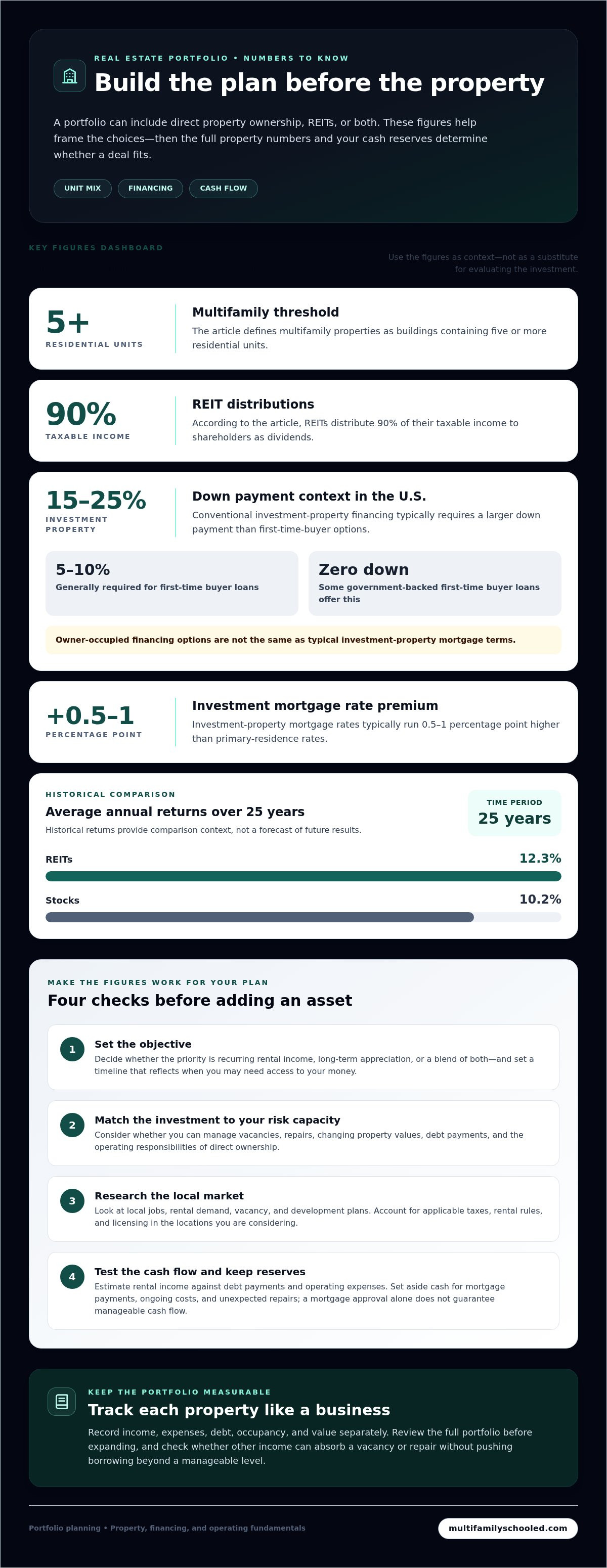
A real estate portfolio is the set of property investments you own, such as residential, commercial, or industrial properties. Multifamily properties contain five or more residential units. A portfolio can also include long-term rentals or real estate investment trusts (REITs).
For rental properties, establish clear routines for maintenance, rent collection, and recordkeeping. Screen tenants consistently by reviewing rental history, income, and credit information, and apply the same criteria to each applicant.
- Choose the assets your portfolio will hold. Decide whether you want direct ownership, REITs, or a mix of residential and commercial investments. Direct ownership gives you control over a property, but also requires decisions about financing and operations. REITs provide real estate exposure without directly owning properties. According to the Internal Revenue Service, REITs distribute 90% of their taxable income to shareholders as dividends.
- Separate owner-occupied financing from investment financing. In the United States, conventional financing for an investment property typically requires a 15-25% down payment. First-time buyer loans generally require around 5% to 10%, and some government-backed first-time buyer loans offer zero down payment. Those owner-occupied options are not the same as typical investment-property mortgage terms.
- Calculate borrowing capacity before making an offer. Loan-to-value ratio, or LTV, is the percentage of a property's value financed through a loan. A lender also weighs income, debts, credit history, and the property itself. Estimate the payment against expected rental income, operating expenses, and reserves. A property that qualifies for a mortgage may still strain your cash flow.
- Compare financing options against the investment plan. Investment-property mortgage rates typically run 0.5-1 percentage point higher than primary-residence rates. Compare the payment, loan term, down payment, and flexibility with the property's expected income and holding period. Choose financing that suits the investment, rather than selecting a property solely because a lender will approve the loan.
- Use leverage carefully as values and debt change. A mortgage can help you acquire an asset without paying its full purchase price upfront, but excessive debt raises risk when income falls or costs rise. Some investors borrow against property rather than sell it; mortgages generally have lower interest rates than other loans because the property secures the debt. Compare the new payment with cash flow before using equity to buy again.
- Track the portfolio like a business. Record each property's income, expenses, debt, occupancy, and value separately. Review those figures regularly before adding another asset. If one rental has vacancies or repairs, the full portfolio view shows whether other income can absorb the shortfall without pushing borrowing beyond a manageable level.
Setting investment goals and assessing risk tolerance
Set a clear objective before choosing an asset: prioritize rental income, long-term appreciation, or a blend of both. Then match your strategy to your timeline and capacity for risk.
For U.S. rental investing, tax treatment, landlord laws, and licensing requirements vary by state and locality. Identify the jurisdictions you’re considering, then account for applicable taxes, rental rules, and licensing in your plan.
-
Set Portfolio Objectives and Timelines
Write down what you want from your investment portfolio, such as recurring income, asset appreciation, or both. Then set a timeline that reflects when you may need access to your money. Real estate is generally a long-term investment, and appreciation may build gradually. If your goal depends on holding property through changing market conditions, don’t base your plan on a quick sale.
-
Assess Risk and Investment Tradeoffs
Choose an investment level you can sustain through vacancies, repairs, or lower rental income. Direct ownership can offer control over an asset, but it also brings operating responsibilities and less liquidity than publicly traded investments. Compare those demands with your available time, debt payments, and comfort with changing property values. A strong projected return may not suit you if the risks exceed your capacity.
- Decide how much of your real estate investment exposure should come from direct ownership and how much from REITs. REITs provide property exposure without requiring you to own buildings directly. Over 25 years, REITs delivered average annual returns of 12.3%, compared with 10.2% for stocks. Treat historical returns as context for comparison, not as a forecast for your own results.
- Start with an investment size and structure you can manage, then expand only after reviewing actual performance. Track rental income, payments, operating costs, and vacancies alongside your original objectives. If the numbers or your available time change, adjust your next investment rather than scaling by habit. This measured approach helps keep one property’s demands from dominating your broader financial plan.
- Build your knowledge as your strategy develops. Before committing to a new specialty or asset class, study how property type, financing, local demand, and operating needs affect potential returns. Compare each opportunity with your written risk limits and timeline. Keep learning, and adapt when experience reveals a mismatch between your goals and the work involved in property management.
Choosing a starting point and researching local markets
For anyone building a real estate portfolio from scratch, choose a strategy and location before committing capital. Local jobs, rental demand, vacancies, property values, and interest rates shape rental income, costs, and potential returns.
-
Research Local and National Markets
Compare national trends with the specific city or neighborhood you’re considering. U.S. median home sale prices rose from around $329,000 in 2020 to $416,900 in the first quarter of 2025. That context helps frame affordability, but national figures can’t tell you whether a local tenant pool supports your target property types. Check local rents, vacancy patterns, employment, and planned development before narrowing your search.
-
Evaluate Local Conditions and Returns
Assess how local conditions could shape income and resale value. Strong employment and new development can support housing demand, while rising vacancies may weaken rent collection. Interest rates also affect financing costs and potential returns. Compare properties using local rents, operating expenses, and likely demand rather than assuming a national trend will produce the same result in every neighborhood.
- Choose a strategy that fits your resources and operating capacity. A long-term rental depends on steady tenant demand and ongoing property management. A short-term flip relies more on the purchase price, renovation needs, and resale demand. Compare those demands with your available time and financing before focusing on a property type. Your strategy should make sense in the specific market, not just on paper.
- Study several neighborhoods, not just one attractive listing. Track asking rents, sale prices, vacancy patterns, and local employers across each area. Look for durable demand drivers, such as expanding job opportunities or future development, and note risks that could reduce tenant interest. A lower purchase price alone doesn’t prove a property can build wealth if local demand is weak.
- Set a concentration limit before selecting properties. The 5% portfolio rule suggests allocating no more than 5% of a portfolio to any single investment property. As you continue building a real estate portfolio from scratch, use this principle to screen opportunities, then consider how property type, location, and income sources affect overall exposure. A varied investment portfolio can spread reliance across residential, commercial, and other real estate holdings.
- Build a simple market comparison before making your first commitment. Record each location’s property values, rental demand, vacancy conditions, employment trends, and development potential in the same format. Then compare the evidence with your chosen strategy. This makes differences visible, helps explain why one area may support stronger income, and keeps a promising headline from replacing local analysis.
Real estate rules of thumb and cash reserves
Use screening rules to compare rental prospects, then test each property’s full costs. For example, the 50% rule estimates operating costs before mortgage payments.
-
Analyze Cap Rate, Cash Flow, ROI, and LTV
Calculate each metric before judging a property. Cap rate equals net operating income divided by market value, while cash flow shows whether income covers expenses. Return on investment measures profitability, and loan-to-value compares borrowing with property value. CBRE reported a 4.74% capitalization rate for Class A multifamily properties in H1 2025. Treat that market figure as context, not a target for every asset.
-
Budget for Cash Flow and Hidden Costs
List expected rent, mortgage payments, taxes, insurance, maintenance, and vacancy costs. The 50% rule estimates that operating costs, excluding the mortgage, consume half of rental income. Under that estimate, a property earning $3,000 in monthly rent has $1,500 in ongoing costs before debt payments. Add likely repairs and periods without a tenant before deciding whether projected cash flow supports the investment.
-
Apply Rules of Thumb and Set Cash Reserves
Use the 1% and 2% rules as quick filters, not purchase decisions. The 2% rule suggests a $150,000 home should ideally rent for $3,000 monthly. Local rents and expenses still determine whether either example produces viable cash flow.
- Set a reserve target before committing funds to another property. The 3-3-3 rule advises keeping three months of mortgage payments, three months of operating expenses, and 3% of the property’s overall value in cash reserves. This creates separate cushions for debt obligations, routine operations, and larger property costs. Keep reserve money accessible rather than counting it toward the down payment.
- Compare cap rate with the property’s actual financing and operating picture. The 7% rule typically refers to aiming for a minimum 7% annual net return or cap rate. A property’s cap rate excludes mortgage costs, so it won’t show the full effect of an interest rate or loan payment. Review cash flow and LTV alongside cap rate before comparing properties in an estate investment portfolio.
- Stress-test the budget against lower rent, a vacancy, or an unexpected repair. Single-family rental cap rates commonly range from 4-10%, depending on the market, so location and costs matter. A rule of thumb can flag weak numbers, but it cannot replace a complete calculation. Preserve cash reserves after closing, and reassess them when property values, expenses, or financing conditions change.
Real estate portfolio definition
A real estate portfolio is the complete set of property investments you own. To understand its purpose, look beyond the number of properties and track how each asset contributes to income, appreciation, and risk.
- List every real estate asset and its role. Record each property, ownership share, property type, location, financing, and current use. A residential rental might provide recurring rental income, while a commercial property may contribute a different income stream. Include real estate investment trusts if you hold them, since they provide exposure without direct property ownership. This inventory gives you a clear starting point for comparing assets.
- Group assets by how they produce value. Separate properties held for rental income from those held primarily for potential appreciation. A long-term rental depends on rent, occupancy, and expenses; a property bought for appreciation depends more heavily on market values and the holding period. Label each asset’s main purpose to reveal whether your portfolio’s results rely too heavily on one outcome.
- Map concentration and diversification. Sort holdings by location, property type, and income source. A portfolio concentrated in one neighborhood may react strongly if a local employer closes or rental demand weakens. A mix of residential, commercial, and industrial properties can spread exposure across different market conditions. Diversification doesn’t remove risk, but this map shows where one local or economic change could affect several assets at once.
- Measure each property’s contribution. Track rental income, occupancy, operating expenses, debt payments, and changes in property values. Review these measures together, not as isolated wins. A property can appreciate while producing weak cash flow, or generate rental income while needing substantial repairs. Compare results with the asset’s original purpose to decide whether it still supports your wider investment plan.
- Set a review routine for the whole portfolio. Update your inventory when you buy, sell, refinance, or change how a property is used. Then compare total income, expenses, debt, and values with your objectives. For example, if a rental no longer supports your income target, reconsider its role before adding another similar asset. Strengthen your next decisions by exploring real estate investing resources and building your portfolio knowledge.
- Use the portfolio view to guide growth. Judge a potential addition by how it changes the collection, not only by its individual numbers. A new asset may add rental income but also increase exposure to one property type or location. Compare its expected role with your existing holdings, financing obligations, and operating demands. A portfolio is a connected group of investments, so each purchase should strengthen its overall balance.
Multifamily Schooled: Mentorship Program
Multifamily Schooled’s Multifamily Mentorship Program can help you turn market research, deal analysis, and financing concepts into a clearer plan for pursuing apartment buildings. Consider mentorship when you’ve defined your goals but need structured guidance on finding and evaluating opportunities. Live workshops and online challenges offer focused ways to strengthen your investing knowledge, while MFScout.ai provides deal-finding, analysis, and capital-raising tools.
The next step is to match your learning approach to the work ahead. Build your understanding of apartment investing, refine your criteria, and use that framework to assess opportunities against your goals and risk tolerance. Multifamily Schooled’s educational resources focus on helping investors learn how to find and purchase apartment buildings.
To explore the Multifamily Mentorship Program and decide whether it fits your next step, visit multifamilyschooled.com.
Make Your Next Move With Intention
The next advantage comes from turning careful analysis into a repeatable decision process. Before pursuing an opportunity, write down the criteria it must meet, the risks you can accept, and the reasons you’d walk away. That simple discipline keeps urgency from replacing judgment when a promising property appears.
Building a real estate portfolio from scratch isn’t about collecting properties as quickly as possible. It’s about making each decision fit the direction you’ve chosen, then learning from the results before taking the next step. Keep your standards clear, stay curious, and let evidence guide your progress.
If you’re ready to develop your apartment investing knowledge and put your plan into action, explore Multifamily Schooled’s educational resources. Keep moving forward, one thoughtful investment decision at a time.
Frequently Asked Questions
How many properties should I start with when building my portfolio?
Start with an investment you can evaluate and operate responsibly, often a single property for a direct-owner beginner. The right starting point depends on your available capital, time, financing, and comfort handling vacancies or repairs. Before expanding, track how the first investment performs under different operating conditions. Add another property when you can explain how it fits your goals and manage its demands without relying on optimistic assumptions.
What should I look for when selecting a property?
Look for a property whose condition, location, and likely rental demand fit your investment plan. Compare achievable rent with operating expenses, financing payments, and repair needs. Review the building’s major systems and maintenance history, then consider how vacancies or delayed repairs would affect your budget. A compelling purchase price alone isn’t enough. Choose an asset you can evaluate financially and operate within your available resources.
How much money do you need to start investing in real estate?
There’s no single starting amount because the route matters. A $5,000 investment may be enough to begin through options such as REITs or crowdfunding. Directly purchasing a rental property requires funds for the down payment, closing costs, initial repairs, and reserves. Conventional investment-property financing typically requires a 15-25% down payment. Estimate the full cash needed for your chosen approach, not just its entry cost.
What are the best ways to finance a first rental property?
Compare conventional investment-property financing with other options based on the asset, down payment, interest rate, and expected rental income. Conventional financing typically requires a 15-25% down payment, and investment-property mortgage rates typically run 0.5-1 percentage point higher than primary-residence rates. First-time buyer programs may apply to eligible owner-occupied purchases, but they aren’t interchangeable with investment-property financing. Match the loan to how you’ll use the property.
How do I analyze rental property cash flow, cap rate, and ROI?
Calculate each measure separately, then use them together. Cash flow shows whether rental income covers expenses and debt payments. Cap rate equals net operating income divided by market value, before mortgage costs. ROI measures investment profitability against the capital invested. Include realistic vacancy, repairs, insurance, and operating expenses in your estimates. Test how changes in rent, costs, or interest rates affect the result before deciding whether the property meets your criteria.
How do I find and evaluate a first investment property?
Begin with a defined location and property type, then compare active opportunities against consistent criteria. Gather local rental, vacancy, property-condition, and expense information for each candidate. Build a conservative income-and-cost estimate, inspect the building, and review financing terms before making an offer. Keep notes on why each property passes or fails your criteria. This record helps you recognize patterns and avoid letting excitement about one listing drive the decision.
How do I choose between single-family homes, multifamily properties, and REITs?
Choose based on your desired involvement, available capital, and preferred exposure. A single-family rental concentrates operations in one home. Multifamily properties have five or more residential units, combining multiple homes within one property. REITs provide real estate exposure without direct ownership. Compare each option’s income potential, expenses, liquidity, and management demands. The best fit supports your goals without stretching your resources or risk tolerance.



