

How to Audit Multifamily Leases for Rent and Term Errors
The rent roll is only the starting point. Knowing how to audit leases during multifamily due diligence means comparing each lease and its supporting documents with reported rent, concessions, lease dates, term lengths, signatures, and billing records. Reconcile differences against payment histories and deposit records, then document each variance before relying on projected income.
A clean-looking spreadsheet doesn’t prove that the lease files support the income shown. Missing signatures, free-rent periods, undocumented concessions, or inconsistent tenant details can affect your understanding of a property’s actual income and obligations. A consistent, file-by-file review helps uncover gaps and gives you specific questions to resolve during diligence.
This guide explains what to compare, which documents to include, and how to set a practical audit scope and timeline. You’ll also learn how estoppels fit into the review and what to assess when considering a third-party lease audit provider. Use the checklist to turn scattered files into documented findings you can act on.
Key Takeaways
- Compare lease terms with rent roll and payment records to spot mismatches that could affect reported income.
- Use tenant estoppels to compare residents’ understanding of their lease obligations with the records.
- Set audit scope around the property’s files, data sources, and diligence schedule so findings arrive in time to inform decisions.
- Assess a third-party auditor’s methodology, variance reporting, and the limits of the review before engaging them.
Identifying rent, concession, and lease-term discrepancies
Start with the rent roll, then compare each resident’s executed lease with related records. This sequence connects reported property income to the contract terms and payment evidence behind it.
- Match rent and lease dates. Compare each lease’s monthly rent, start date, end date, and term length with the management rent roll; mismatches can distort scheduled income.
- Check concessions and ancillary fees. Look for free-rent periods, discounts, waived charges, and tenant billing schedules in leases and addenda, then compare them with amounts recorded for each resident.
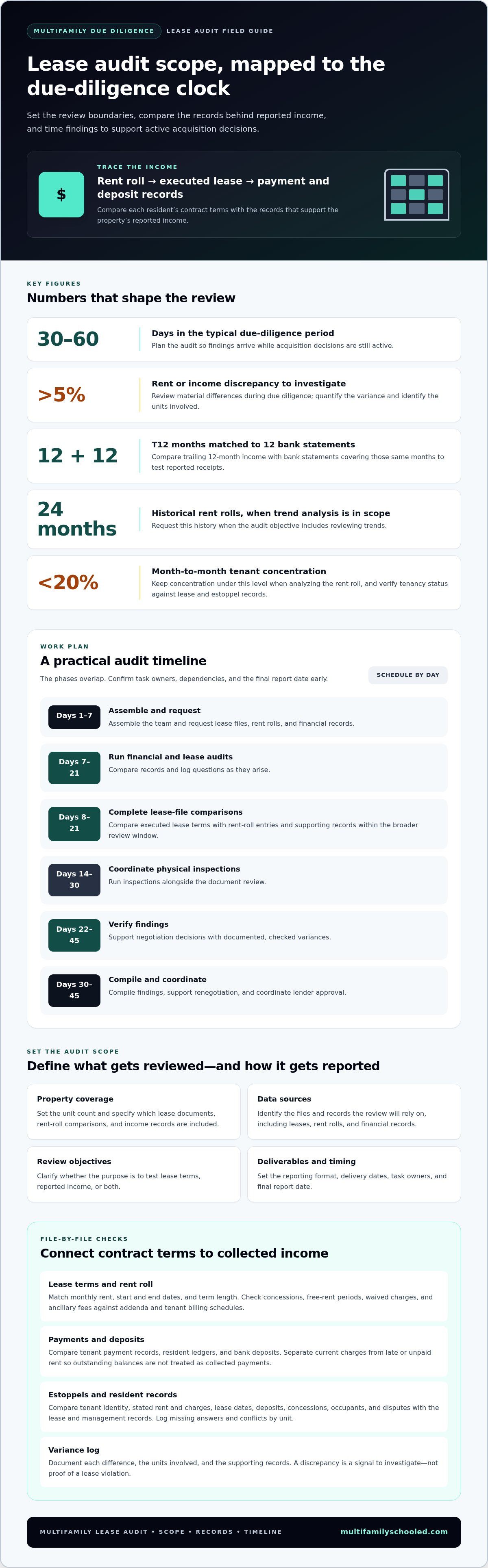
- Investigate material differences. Review rent or income discrepancies greater than 5% during due diligence, since they may affect the property’s reported performance and assessment.
- Reconcile T12 income with deposits. Compare the trailing 12-month income and expense statement with 12 bank statements matching those months; use bank records to test whether reported receipts reached the account.
- Use payment history to test rent-roll accuracy. Review tenant payment records for delinquencies, late rent, and arrears, and compare unpaid balances with resident ledgers and reported collections.
- Reduce manual entry carefully. Importing property-management-system data into audit software can speed rent-roll processing; reconcile imported fields against source files to catch mapping errors.
For delinquent rent, arrears, and payment history, compare resident ledgers with payment records and bank deposits over the review period. Separate current charges from unpaid or late rent so reported income doesn’t treat an outstanding balance as collected payment.
Rent mismatches, undocumented concessions, incorrect lease terms, and inconsistent timing can affect underwriting assumptions. Quantify each variance, identify the units involved, and show how corrected income could affect valuation, financing analysis, or purchase-term negotiations.
Tenant estoppel certificates
A tenant estoppel certificate records a resident’s confirmation of key rental facts, such as current rent, lease dates, deposits, concessions, and unresolved disputes. Compare each response with the executed lease, rent roll, and property management records. The certificate adds the tenant’s perspective to the file review, helping owners identify discrepancies before making a purchase decision.
- Match tenant identity across records. Compare the tenant ID and name on the rent roll, lease, and lease application to catch mismatched or incomplete files.
- Compare stated rent and charges. Reconcile the certificate’s rent, fees, and concessions with the lease and tenant billing schedule; a different amount may indicate an undocumented arrangement or a records error.
- Confirm term and occupancy details. Check the stated lease dates and listed occupants against the signed agreement and application, so the review reflects the documented tenancy.
- Track missing or inconsistent responses. Record each unanswered question or conflict by unit, then compare supporting records before including the issue in the valuation assessment.
To identify unauthorized occupants, subleases, or possible lease violations, compare the lease’s named residents and subletting provisions with the tenant application, estoppel response, and available occupancy records. Record conflicting details for follow-up. A discrepancy is a signal to investigate, not proof of a violation.
Review month-to-month tenancies as a group. Keep month-to-month tenant concentration under 20% when analyzing the rent roll, and note whether the certificates and lease records support each tenancy status. Concentration can affect how owners assess rental stability and future income.
Finally, compare the estoppel’s account of tenant billing schedules with management records. For example, if a certificate reports a recurring charge that doesn’t appear in the resident ledger, flag the unit and trace the charge to its supporting document. A clear variance log helps decision-makers distinguish isolated file errors from patterns that could affect property valuation or negotiations.
Audit scope, methodology, and timelines
Set the audit scope before requesting files. Define the unit count, data sources, review objectives, reporting format, and delivery dates. For a real estate acquisition, specify whether the assessment covers lease documents, rent-roll comparisons, income records, or all of these. A written checklist keeps the review focused and responsibilities clear.
Match the work plan to the property’s due diligence period, which typically lasts 30-60 days. A workable schedule can overlap document review, financial analysis, and inspections:
- Days 1-7: Assemble the team and request lease files, rent rolls, and financial records.
- Days 7-21: Run financial and lease audits, logging questions as they arise.
- Days 8-21: Complete lease-file comparisons within the broader review window.
- Days 14-30: Coordinate physical inspections alongside document review.
- Days 22-45: Verify findings and support negotiation decisions.
- Days 30-45: Compile findings, support renegotiation, and coordinate lender approval.
These phases can overlap. Confirm task owners, dependencies, and the final report date early, so findings arrive while acquisition decisions remain active. Request historical rent rolls covering 24 months when trend analysis is part of the objective.
For consistent results, apply the same comparison method to every file in scope. Record the source document, unit, variance, and supporting evidence in a unit-level log. Deliverables can include a findings summary, resident-level variance log, and document references. A lease-file audit compares records and data; it doesn’t replace legal review or a compliance audit unless the agreed scope includes them.
Local landlord-tenant laws determine which lease provisions, charges, notices, and records need closer review. Identify the property’s jurisdiction and assess lease terms against the requirements that apply there. Use legal review to interpret compliance questions.
Agree on how findings will be compiled, checked for consistency, and delivered within the engagement timeline. A defined scope, repeatable checklist, and dated reporting milestones make it easier to resolve open issues before the due diligence period ends.
What lease documents should be reviewed during multifamily property due diligence?
Build a document set for every occupied unit, then compare related records together. Reviewing an executed lease alone can miss later amendments, separate fee terms, or evidence that a file is incomplete. Use this checklist to connect each resident’s agreement with the property’s reported information.
- Collect the executed lease and confirm every required signature. Compare the named tenant, unit, rent, start date, end date, and term with the rent roll; an unsigned or mismatched agreement needs its own variance entry.
- Include every addendum and amendment. Match each document to the base lease and check its effective date, because a later change may alter rent, occupancy terms, or other obligations.
- Review concession and fee documents. Locate written terms for free rent, discounts, waived charges, and recurring fees, then compare them with the lease and tenant billing schedule.
- Check guaranties and special provisions. Record any guarantor or non-standard clause alongside the associated unit, so unusual obligations don’t disappear in a general file summary.
- Compare security deposits with the deposit register. Note the amount stated in the lease and any later adjustment, then flag differences between the contract and the property’s records.
- Keep supporting resident records with the lease file. Compare the lease application and relevant account records with the agreement to identify missing tenant details or inconsistent billing history.
Create a unit-level index listing each expected document, whether it is present, and any issue found. For example, if an amendment changes a lease end date, record the date shown in both documents and flag the rent-roll entry for reconciliation. This makes missing items and conflicting terms visible without treating them as the same problem.
A well-organized file set supports a consistent acquisition review. To strengthen your broader multifamily due diligence, build your real estate acquisition knowledge.
Multifamily Schooled: Mentorship Program
Multifamily Schooled’s Multifamily Mentorship Program helps investors build the knowledge to find and purchase apartment buildings. Consider it as you develop an acquisition process and want structured education alongside practical next steps. Lease audits are one part of evaluating a deal; investors also need to understand how property income, documents, and operating assumptions fit together.
Choose a learning format that fits your goals. Multifamily University offers broader education, while Live Workshops and Online Challenges provide focused learning experiences. Deal-finding software supports the search for potential opportunities. These educational tools don’t replace legal review of lease documents.
If you’re ready to strengthen your multifamily investing knowledge, explore the Mentorship Program.
Turn diligence findings into a stronger next move
A lease review can shape more than an acquisition decision. Treat its findings as a starting point for the questions you’ll carry into ownership: which records need better controls, what assumptions need regular attention, and where your investing knowledge should grow next. Knowing how to audit leases during multifamily due diligence is one practical way to build that judgment.
Keep developing your approach beyond a single transaction. Multifamily Schooled offers a Multifamily Mentorship Program, Live Workshops, and Online Challenges for investors building their multifamily knowledge and deal evaluation skills. Explore the learning path that fits your next step.
Explore Multifamily Schooled’s learning options and keep building the skills to move forward with clarity. Your next informed decision starts with what you learn today.
Frequently Asked Questions
What are audit procedures for lease agreements?
Lease audit procedures compare executed agreements with property records and reported income. To understand how to audit leases during multifamily due diligence, first define which units and records belong in scope, then use one consistent review method. Track each exception by unit, document, and issue type. Separate missing paperwork from conflicting terms, and refer questions about legal interpretation to qualified counsel.
How do you verify rent rolls against signed leases and tenant payment records?
Match each rent-roll entry to the signed lease and resident payment ledger using unit and tenant identifiers. Check whether the ledger shows an amount charged, an amount received, or an unpaid balance; these figures mean different things. For example, a payment posted to the wrong unit can make one account appear delinquent and another overstated. Trace unmatched entries to their supporting transaction records.
How can you audit lease terms, concessions, renewal options, and expiration dates?
Read the lease alongside its amendments and addenda, then note which document controls each changed term. Capture renewal options, required notice windows, rent adjustments, concessions, and expiration dates in a unit-level schedule. For example, a renewal option may change the expected vacancy date even if the rent roll shows the original expiration. Compare the schedule with reported assumptions before evaluating future income.
How do you verify security deposits, prepaid rent, and other tenant balances?
Reconcile each resident balance across the signed lease, account ledger, deposit register, receipts, and relevant bank records. Separate refundable deposits from prepaid rent, credits, fees, and unpaid charges rather than treating them all as collected rental income. For example, a deposit recorded under a former tenant’s name may be misattributed after a unit transfer. Document the amount, account, and source record for every unresolved difference.
What tenant estoppels and lease confirmations should buyers request?
Request a signed tenant estoppel confirming the resident’s current understanding of occupancy and lease obligations. Ask it to identify rent, lease dates, deposits, prepaid amounts, concessions, renewal rights, disputes, and any claimed side agreements. Compare the response with the executed file and account history. If a tenant reports a verbal promise that isn’t in the documents, record the difference for follow-up before relying on the stated terms.
What lease clauses can create buyer liabilities or limit rent increases and termination?
Review clauses that affect future income or the owner’s obligations, including rent-adjustment limits, renewal options, early termination rights, maintenance commitments, guarantees, and rights of first refusal. For example, a renewal provision with a fixed rent formula may constrain future pricing assumptions. Flag clauses that create obligations beyond the current term or limit the owner’s choices. Have qualified counsel assess their legal effect and applicable local requirements.



