

How to Adjust the Price After Due Diligence Findings
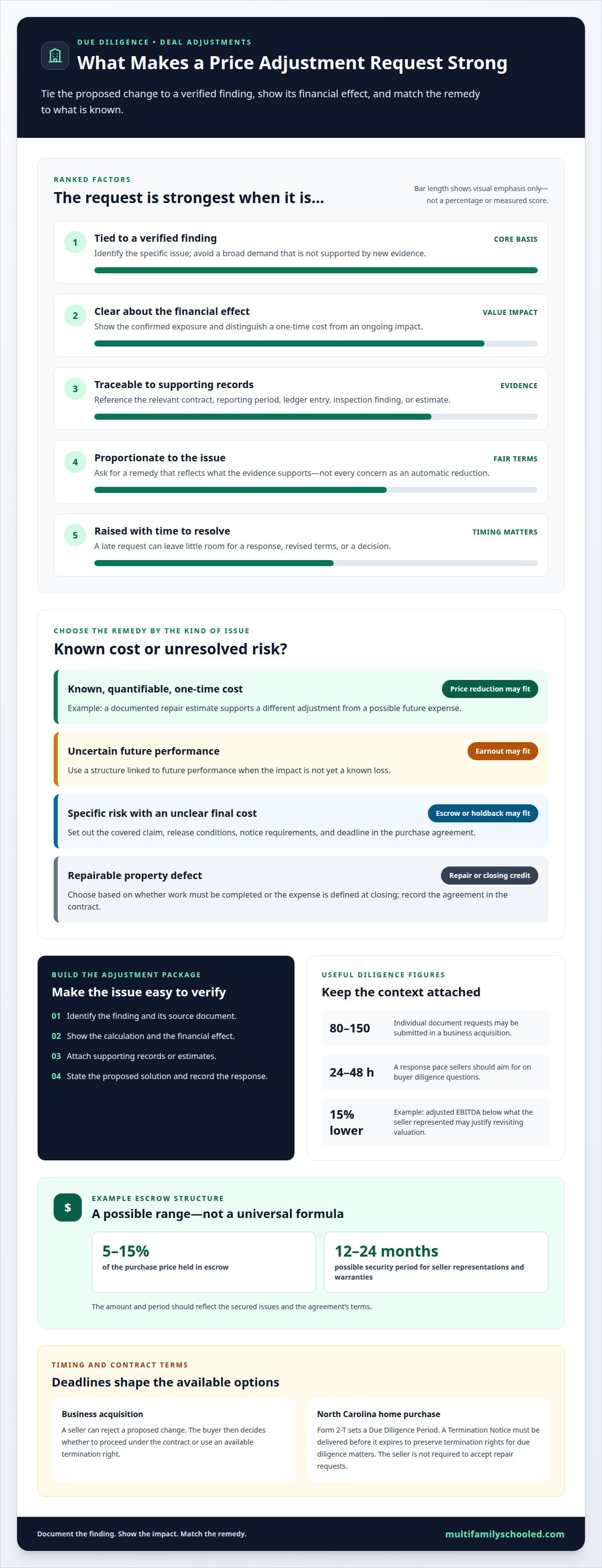
A due diligence finding may justify a lower price when it changes the deal’s underlying value. To understand how to renegotiate with a seller after due diligence findings, tie the proposed adjustment to a verified issue and explain its financial impact. A known, quantifiable, one-time cost may support a price reduction; uncertainty about future performance may be better addressed with an earnout, escrow, or holdback.
It’s reasonable to seek fair terms without letting a genuine problem derail a promising acquisition. The strongest request is specific, documented, and proportionate to the finding, rather than a broad demand raised late in negotiations. This article explains which findings can affect business value, how to calculate and present an adjustment, and how to use contractual protections when the final impact is unclear. You’ll also learn when renegotiation is practical and when a serious issue calls for pausing or reassessing the deal.
Key Takeaways
- Connect each adjustment request to a documented finding and a clear explanation of how it affects the deal’s value.
- Distinguish a substantiated price renegotiation from a broad demand that isn’t tied to new evidence.
- Use an escrow or holdback to address a specific unresolved risk when its financial impact is still uncertain.
- Assess whether liabilities, revenue risks, contract issues, or compliance concerns change the business’s ability to operate or earn.
Documenting and calculating an adjustment request
Start with the finding, the evidence, and its effect on the agreed price. In a business acquisition, buyers may submit 80-150 individual document requests during due diligence. A virtual data room can organize those requests alongside financial statements, contracts, tax filings, and seller responses. Give each issue a clear reference, such as a contract name, reporting period, or ledger entry. That lets both parties trace the adjustment to a specific record instead of debating a general concern.
Can a seller refuse to renegotiate after due diligence? Yes. A seller can reject a proposed price reduction or other change, and the buyer can decide whether to proceed under the contract or exercise any available termination right. Show the calculation in your request: identify the confirmed exposure, explain its financial effect, and distinguish a one-time cost from an ongoing impact. For example, a repair estimate supports a different adjustment from recurring revenue lost under a customer contract.
Keep a request log with the document requested, date submitted, response received, and unresolved issue. Sellers should aim to respond to buyer due diligence questions within 24-48 hours. That pace helps surface missing evidence while the parties still have time to negotiate. A clear adjustment package can include the relevant document, a calculation, supporting estimates, and a proposed solution, such as a price reduction or escrow for an uncertain amount.
Home purchases follow contract-specific timelines. In North Carolina, the Offer to Purchase and Contract form 2-T advises buyers to make repair or improvement requests early enough to conclude negotiations before the Due Diligence Period expires. Buyers may request any number of repairs, but the seller isn’t obligated to agree. If the buyer doesn’t deliver a Termination Notice before that period expires, the buyer waives the right to terminate based on due diligence matters. Attach inspection findings and repair estimates to each request, then record the seller’s response and any agreed contract change.
Factor timing into the calculation. A late request can leave little room for a response, revised terms, or a decision. In a business deal, distinguish a verified liability from a possible future expense. In a home purchase, distinguish a documented defect from a preference upgrade. Specific evidence gives both parties a practical basis for discussing an adjustment without treating every diligence concern as an automatic price reduction.
Is it normal to renegotiate price after due diligence?
Yes. A post-diligence adjustment may be reasonable when new evidence changes the purchase’s value. The strength of the request depends on the finding and how it affects the financials.
Purchase Price Adjustments
A purchase price adjustment changes the agreed amount to reflect a documented issue discovered during diligence. It allows the parties to negotiate based on evidence rather than assumptions. A targeted request should identify the finding, explain its financial effect, and state the proposed adjustment. Without a specific diligence basis, a broad demand can look like a bad-faith retrade. The seller can refuse, leaving the parties to decide whether to proceed under the existing contract or pursue available options.
Financial Findings and Price Reductions
Financial findings support a price reduction when reliable records show that the business is worth less than represented. For example, adjusted EBITDA that is 15% lower than the seller represented may justify revisiting the valuation. A working capital gap against the target in the letter of intent can instead be corrected through the closing statement mechanism in the purchase agreement. Buyers should connect each proposed reduction to the relevant financial record and avoid treating uncertain future performance as a known loss.
Choosing an Adjustment Format
Match the adjustment to the problem: consider a price reduction for a known, quantifiable, one-time cost, and an earnout when future performance is uncertain. For a repairable property defect, buyers may request seller repairs or a closing credit. Should a buyer request a price reduction, seller repairs, or a closing credit? Choose based on whether the issue creates a lasting change in value, requires work to be completed, or involves a defined closing expense. Record the agreed remedy clearly in the contract.
Contract Terms and Contingencies
State-specific forms and signed contract terms determine the parties’ negotiation and cancellation options. What state-specific laws or contract terms govern post-due-diligence negotiations? The applicable state rules and the signed agreement control; in North Carolina, form 2-T sets a Due Diligence Period and requires a Termination Notice before expiration to preserve termination rights for diligence matters. How do due diligence and inspection contingencies affect a buyer’s right to renegotiate or cancel? They define the relevant review period and available remedies, so buyers must act within the contract’s deadlines. In North Carolina, the seller isn’t required to accept repair requests.
Escrows and holdbacks to secure seller recourse
An escrow or holdback reserves part of the purchase price to cover an identified risk after closing. The purchase agreement should specify the covered claim, release conditions, and deadline. This structure can keep a transaction moving when both parties agree that a risk exists but disagree about its final cost.
A buyer may hold 5-15% of the purchase price in escrow for 12-24 months as security for seller representations and warranties. Those figures describe one possible arrangement, not a universal formula. The amount and period should reflect the issues being secured and the agreement’s terms. Spell out which claims qualify, how notice must be delivered, and what happens to any remaining funds when the period ends.
For a specific uncertain liability, a targeted holdback can reserve funds for that exposure. Alternatively, a specific indemnity can allocate losses from a known risk to the seller, particularly when the amount is difficult to quantify. The mechanisms work differently: an escrow sets aside money, while an indemnity establishes responsibility for covered losses. The agreement should clarify whether both apply to the same claim.
An earnout addresses a different issue: uncertainty about future business performance. Rather than securing a current liability, it makes part of the purchase consideration depend on future results. Before closing, the purchase agreement should define the milestone, measurement period, and accounting basis. Clear definitions give both parties a consistent way to assess performance.
Choose the mechanism that fits the finding. A disputed tax exposure, for example, may call for a specific indemnity or targeted escrow, while uncertain future revenue may suit an earnout. A holdback can secure funds for a specific identified risk; indemnification terms can address a category of risk the seller is better positioned to bear. Compare each option’s effect on the seller’s proceeds, the buyer’s recourse, and the closing terms. The final agreement should identify the risk, set release conditions, and explain how a claim affects reserved funds.
Due diligence findings affecting business value
A finding matters when it changes the target’s expected cash flow, risk, or ability to operate. Undisclosed liabilities, concentrated revenue, working capital shortfalls, unassignable customer contracts, and unreported licensing or regulatory issues can all affect the purchase price. The key question is whether the evidence changes the deal’s economics or practical value, not simply whether diligence uncovered a new detail.
Start with the transaction model. A working capital shortfall may affect the funds needed at closing, while the departure of a major customer can weaken projected revenue. An unassignable contract may eliminate income the buyer expected to retain. For each finding, assess its scale, duration, and operational impact. Then compare those facts with the assumptions behind the agreed target price.
Test financial evidence against its source. If the seller’s report shows revenue from a key customer, review the related contract and renewal terms. Vendor due diligence can help identify risk, but it doesn’t replace buyer due diligence. Targeted additional review is especially useful in high-risk areas, such as a major liability or a license essential to operations.
How does renegotiating after due diligence differ for residential real estate and business acquisitions? A residential request often focuses on a property condition, such as a roof repair, and the contract’s inspection process. A business acquisition may involve cash flow, working capital, customer contracts, or regulatory exposure. The parties assess how each finding affects ongoing value and operations.
Some findings call for a pause, not an immediate price change. Fraud or material misrepresentation can destroy trust. A liability approaching or exceeding the transaction’s total value, or the loss of a license or essential contract, may make the deal uneconomic. If new issues keep surfacing, reassess the pattern: it may point to poor records, weak controls, or deliberate concealment.
Finally, examine the purchase agreement’s pricing structure. A locked-box transaction generally leaves limited room to revisit price after completion, so address material findings before signing or through separate contractual protection. The takeaway is straightforward: measure each finding against the target’s disclosed economics, operating ability, and agreed deal structure before deciding whether to adjust, pause, or walk away.
Multifamily Schooled: Deal Finding Software
Multifamily Schooled’s MFScout.ai helps investors find and analyze apartment-building opportunities and raise capital. It supports an earlier stage of the acquisition journey, before diligence findings may require a price adjustment. The platform provides deal-finding, analysis, and capital-raising tools; it does not replace reviewing a purchase agreement or assessing a seller’s representations.
Use these tools as part of a clear acquisition process: identify potential deals, evaluate each opportunity, then document material findings during due diligence. Investors seeking structured guidance can explore the Multifamily Mentorship Program, Live Workshops, or Online Challenges. These offerings support learning, while negotiation decisions still depend on the evidence and contract terms in each transaction.
If you’re building your apartment-investing process, contact Multifamily Schooled to discuss the next step.
Build Your Next Deal with Greater Clarity
A difficult negotiation can sharpen your approach to the next acquisition. Carry that learning forward by defining what makes a deal viable before discussions begin, then use new evidence to guide decisions instead of pressure or momentum. This makes it easier to judge whether a proposed change still fits your investment goals.
Learning how to renegotiate with a seller after due diligence findings is one part of becoming a more disciplined apartment investor. Multifamily Schooled offers a Multifamily Mentorship Program, Live Workshops, and Online Challenges for investors who want structured education as they build their acquisition skills.
Take the next step in your investing education. Contact Multifamily Schooled today to explore a path that fits your goals. Keep learning, stay focused, and move toward your next opportunity with purpose.
Frequently Asked Questions
Should I walk away from a deal instead of renegotiating?
Walk away when a finding undermines the deal’s core value or makes the business impractical to operate. Fraud, a liability approaching or exceeding the transaction’s total value, or the loss of a license essential to operations can justify ending discussions. Compare the risk with the business’s future cash flow and your ability to operate it. If the issue can be isolated and addressed contractually, renegotiation may still be workable.
What should a buyer do if new issues keep surfacing throughout the due diligence process?
Pause the process and assess whether new findings point to a broader problem with records or controls. For example, repeated unexplained differences between reported revenue and supporting records may indicate more than an isolated error. Group findings by source, identify outstanding evidence, and reassess whether the seller’s disclosures can be relied on. A recurring pattern may signal weak controls, poor record-keeping, or deliberate concealment.
Can a buyer change the price after LOI?
Yes, the parties can negotiate a revised purchase price after signing a letter of intent, especially when diligence uncovers material information that changes the deal’s assumptions. An LOI may outline proposed terms, while the definitive purchase agreement sets out the transaction’s detailed obligations. Review the LOI’s language and negotiation status, then present a supported change for discussion before signing final documents.
Can a deal still close after due diligence finds issues?
Yes. A finding doesn’t automatically prevent closing. The parties may agree to revised terms, allocate a risk through contract protections, or proceed without changing the deal. For example, a manageable customer-contract issue might be addressed with a specific indemnity, while the loss of a critical operating license could threaten the entire transaction. The key question is whether the remaining risks fit the buyer’s investment case and the agreed documents.
What due diligence findings justify renegotiating a purchase price?
Findings can support a price discussion when they materially affect expected earnings, working capital, or the ability to operate. Examples include undisclosed liabilities, concentrated revenue, a working capital shortfall, a customer contract that can’t be assigned, or an unreported licensing issue. Ask whether the finding changes an assumption used to value the business. A newly discovered detail with no economic or operational effect may not support a reduction.
How do buyers quantify repair costs and adjust an offer after inspection?
Separate safety or functional defects from cosmetic preferences, then define the work needed to address each documented problem. For a roof leak, distinguish its source from any resulting interior damage and obtain estimates covering the same repair scope. Compare the estimates with the inspection findings, then request a remedy that fits the purchase terms, such as completed repairs or a closing credit. Keep the request tied to the documented condition.