
Hard Money Loans vs Bridge Loans for Multifamily Costs
When comparing hard money loans vs. bridge loans for multifamily investing, start with what the financing needs to accomplish. Hard money loans are often used to buy and renovate properties. Bridge loans can cover a temporary gap between acquisition and longer-term financing or another exit. Because the labels can overlap, compare the loan’s cost, rehab funding, repayment plan, and refinance path rather than relying on its name.
Both options can help move a multifamily deal forward, but speed alone does not make either one the better fit. The right choice depends on the property’s condition, the work required, and your repayment plan. Set the exit strategy before committing, not after renovations begin.
This guide compares the two loan types across costs, underwriting, rehab financing, refinancing, and exit strategies. It explains which factors matter when a property needs substantial work, when the plan is to stabilize and refinance, and how to assess the full financing plan against the deal’s timeline.
Key Takeaways
- Choose financing based on the property’s needs and the purpose of the loan, not the label alone.
- Compare the full borrowing cost, including fees, equity requirements, and any funds held back.
- Map your refinance or other repayment plan to the property’s renovation and stabilization milestones.
- For a rehab project, understand how funding is structured and what must happen before the next financing step.
What’s the Real Difference Between Bridge Loans and Hard Money Loans?
In multifamily real estate, both are short-term private loans, but the labels do not guarantee identical terms. Compare the property, renovation plan, repayment timeline, and goal for permanent financing before choosing.
Rates, Fees, and Loan-to-Value Ratios
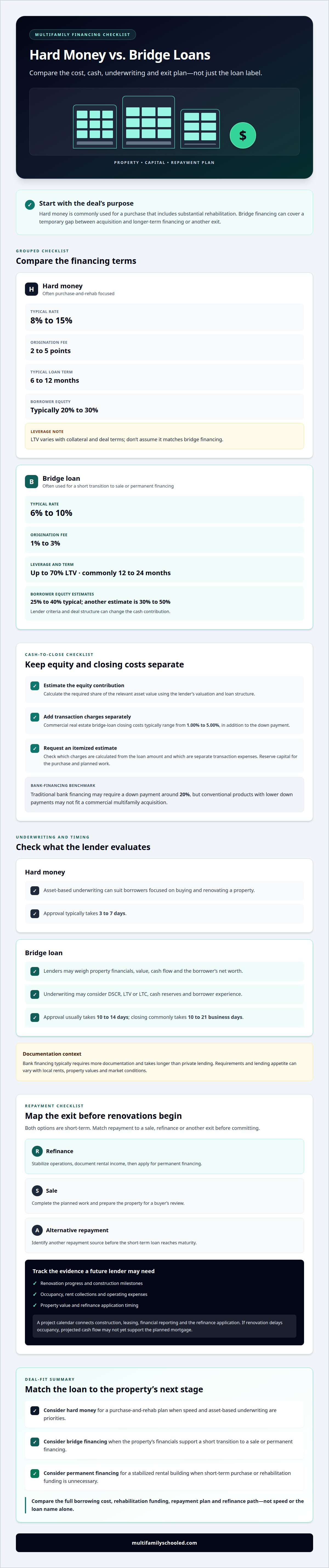
Hard money rates typically range from 8% to 15%, with origination fees of 2 to 5 points. Bridge loan rates typically range from 6% to 10%, with origination fees of 1 to 3%; commercial bridge leverage can reach 70% LTV. Hard money LTV varies with collateral and deal terms, so don’t assume it matches bridge financing.
These ranges address the cost comparison, but property type and borrower profile also affect approval. Multifamily purchases, rental properties, and commercial buildings may suit either option. Hard money is commonly used when a purchase includes substantial rehabilitation.
Property Types and Borrower Situations
Hard money lenders secure short-term loans against investor assets, which can suit borrowers focused on buying and renovating a property. Bridge lenders may weigh the multifamily property’s financials, value, cash flow, and the borrower’s net worth. For rental buildings, income and occupancy help show operating performance, while the property’s condition affects its value and renovation needs.
Bridge-loan underwriting may consider DSCR, LTV or LTC, cash reserves, and borrower experience. Documentation often focuses on the property’s financials and the borrower’s finances. Bank financing typically requires more documentation and takes longer than private lending. Requirements and lending appetite can vary with local rents, property values, and market conditions.
Qualification, Documentation, and Repayment Structures
Commercial bridge loans commonly run 12 to 24 months; hard money loans usually run 6 to 12 months. Both are short-term, so map repayment to a sale, refinance, or other exit. Bridge approval usually takes 10 to 14 days, with closing commonly taking 10 to 21 business days; hard money approval typically takes 3 to 7 days.
Permanent financing may suit a stabilized rental building when short-term purchase or rehabilitation funding is unnecessary. Use this table to compare the main differences:
| Option | Typical rates | Origination fees | Leverage and term |
|---|---|---|---|
| Hard money | 8% to 15% | 2 to 5 points | Terms usually 6 to 12 months |
| Bridge | 6% to 10% | 1% to 3% | Up to 70% LTV; commonly 12 to 24 months |
Choose hard money for a purchase-and-rehab plan when speed and asset-based underwriting are priorities. Consider bridge financing when the property’s financials support a short transition to a sale or permanent financing.
Down payments and closing costs
Budget equity and transaction costs separately. Hard money lenders typically require borrowers to have 20% to 30% equity, while bridge lenders may require 25% to 40%. Another bridge qualification estimate places required equity at 30% to 50%, showing how lender criteria and deal structure can change the cash contribution. Equity is not the same as closing costs, so include both in the acquisition plan.
For commercial real estate bridge loans, closing costs typically range from 1.00% to 5.00%. These expenses sit alongside the down payment. Ask for an itemized estimate showing which charges are calculated from the loan amount and which are separate transaction expenses.
Use a simple cash-to-close calculation: estimate required equity, add lender and third-party charges, then reserve capital for the purchase and planned work. For example, a 30% equity requirement means the borrower funds that share of the relevant asset value, plus applicable closing costs. The lender’s valuation, loan structure, property condition, and due diligence affect the final amount.
Traditional bank financing for real estate investment properties may require a down payment around 20%. That can differ from bridge equity requirements, while conventional loan products with lower down payments have eligibility limits and may not fit a commercial multifamily acquisition. Compare the total cash needed, not just the headline down payment. A multifamily investment plan can also help connect acquisition costs with the property’s renovation and operating needs.
Exit strategies and refinancing
Set the repayment route before closing. A multifamily investor using a bridge loan may plan to refinance into a permanent mortgage after renovations and lease-up. A hard money borrower may also refinance, sell the building, or repay from another source. Each route depends on the property’s condition, cash flow, and ability to qualify for replacement financing.
For a refinance, plan the project around how a future lender will assess the asset. Track renovation progress, occupancy, rent collections, operating expenses, and property value. These records help show whether the building’s income can support permanent debt. A lender may assess debt-service coverage, loan-to-value, reserves, and borrower experience, so stronger operating results can strengthen the refinance case.
- Refinance: Stabilize operations, document rental income, then apply for permanent financing.
- Sale: Complete the planned work and prepare the property for a buyer’s review.
- Alternative repayment: Identify another repayment source before the short-term loan reaches maturity.
Create a calendar with milestones for construction, leasing, financial reporting, and the refinance application. For example, if renovations delay occupancy, projected cash flow may not yet support the planned mortgage. A structured timeline links each project stage to the evidence a future lender needs. It can also reveal gaps early, while there is still time to adjust the exit plan.
Calculate the payoff amount using principal, accrued interest, and any applicable charges. Some hard money lenders charge prepayment penalties of 2% to 5% of the remaining balance. Include that possibility when comparing an early refinance with holding the loan longer. Then test whether expected rental cash flow supports the replacement mortgage and ongoing property expenses.
Choose an exit that reflects the asset’s progress, not just the acquisition date. If the building already produces stable income, permanent financing may be easier to pursue than another short-term loan. If substantial work remains, tie each funding decision to a clear completion and repayment milestone.
Hard money loans for multifamily rehabs
A hard money loan can support a multifamily purchase that needs renovation before conventional financing is suitable. Build the financing plan around the work, not just the acquisition. Separate purchase funds from rehabilitation costs, then map each project phase to the property’s condition, rental income, and intended exit. This makes funding needs clear before you commit.
Start with a written scope of work. List each repair, its estimated cost, and its effect on occupancy or rent collection. Then compare the total budget with available capital and the building’s current income. This example shows why project costs and financing charges need separate line items.
- Property: Document existing condition, vacancies, and repairs needed before leasing.
- Borrower: Present relevant experience, available equity, and a realistic project timeline.
- Exit: Connect renovation completion to rental operations, refinancing, or sale.
Credit is only one part of the review. Some hard money lenders consider deals from investors with credit scores below 600 when the deal is strong enough. The property, collateral, borrower experience, and repayment plan still matter. Compare financing options by asking how each lender evaluates the asset and planned work, rather than relying on credit alone.
Keep the schedule shorter than the loan’s available term, where possible, and allow room for delays. A late repair can postpone leasing, reduce income, and push back a refinance. Before selecting a money loan, organize the scope, cost estimates, and repayment milestones together. Explore multifamily investment planning tools to strengthen the acquisition and rehab plan.
Multifamily Schooled
Multifamily Schooled helps investors build the knowledge and deal-finding skills to make informed multifamily decisions. Its educational resources can help as you shape an acquisition plan, evaluate a property, or learn how financing choices connect to renovation and exit strategies. The Mentorship Program, Live Workshops, Online Challenges, Deal Finding Software, and Multifamily University support learning at different stages, from identifying opportunities to planning a purchase. Use these resources to sharpen your investment process and approach lender conversations with a clearer view of the deal. Ready to strengthen your multifamily investing approach? Contact Multifamily Schooled.
Make Your Next Multifamily Move With a Clear Plan
Choosing between hard money loans and bridge loans for multifamily properties is one part of building a sound investment strategy. Next, connect the financing decision to the deal itself: what must happen before the property can perform, what evidence supports your assumptions, and how the plan can adapt if the project changes.
Put those decisions in writing before pursuing a property. A clear acquisition thesis helps you assess opportunities consistently, explain your plan to lending partners, and identify gaps between the property’s needs and your intended path. Strong investing depends on disciplined execution, not a loan label alone.
If you’re ready to develop your multifamily investing skills and put a more deliberate plan into action, contact Multifamily Schooled. Take the next step with focus, keep building your knowledge, and move toward your next opportunity with purpose.
Frequently Asked Questions
What Are the Risks of Using a Bridge Loan?
The main risks are repayment pressure, refinancing delays, and weaker property performance. If renovations or leasing take longer than planned, rental income may not support the next mortgage when the bridge loan matures. For example, a building with unfinished units may produce less cash flow than projected. Stress-test the exit plan against slower occupancy and lower rent collections before relying on refinancing.
What are the alternatives to bridge loans for commercial real estate investments?
Traditional bank financing and permanent mortgages can be alternatives, particularly for properties with established operations. Bank loans generally have lower interest rates than other real estate investment financing, but underwriting requires more documentation and takes longer. For a stabilized multifamily property, compare permanent financing with a short-term loan based on operating history, income, property condition, and how soon the purchase must close.
What are the costs associated with bridge loans?
Commercial real estate bridge loan closing costs typically range from 1.00% to 5.00%, while origination fees commonly range from 1 to 3 points. Build a cash-to-close estimate that separates lender charges, due diligence, and funds unavailable at closing.
What is the difference between a hard money loan and a bridge loan for multifamily properties?
A hard money loan is commonly asset-backed financing for a purchase or renovation; a bridge loan finances a temporary transition, such as moving from acquisition to permanent debt. Typical hard money rates range from 8% to 15%, compared with 6% to 10% for bridge loans. The practical distinction is the deal’s purpose and repayment route, not just the loan label.
What are the main risks, penalties, and costs of multifamily hard money and bridge loans?
Both can become costly if the property isn’t ready for repayment or refinancing on schedule. Hard money lenders may charge prepayment penalties of 2% to 5% of the remaining balance. Bridge financing can involve origination fees and funds held back until stated conditions are met. Review the payoff terms, disbursement conditions, and projected cash flow together before setting the project budget.
When should an investor choose a hard money loan versus a bridge loan for a multifamily property?
Consider hard money when an acquisition involves substantial renovations and needs short-term, asset-based financing. Consider a bridge loan when the property needs temporary financing before a sale or permanent mortgage. For example, a building requiring major repairs may call for a rehab-focused plan, while an operating property awaiting longer-term financing may suit a bridge strategy. Match the loan to the planned exit.



