

Assess Multifamily Tenant Default Risk Beyond the Largest Tenants
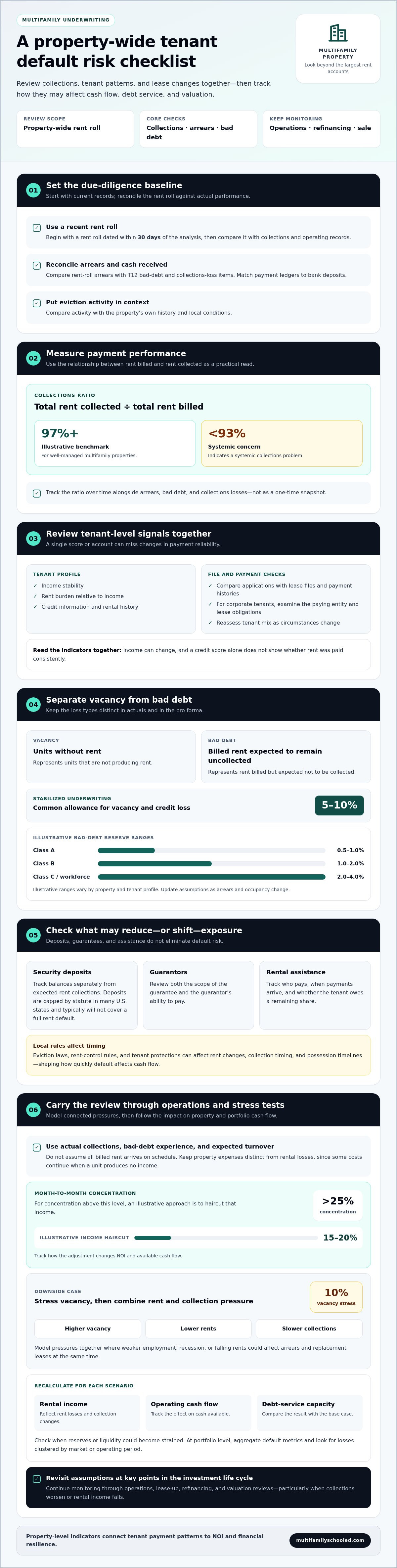
A strong multifamily underwriting review looks beyond the largest tenants. To underwrite tenant default risk in multifamily, assess rent collections, arrears, bad debt, and month-to-month lease concentration across the property, then track how those measures change over time. The collections ratio, total rent collected divided by total rent billed, offers a practical read on payment performance; 97% or above is an illustrative benchmark for well-managed multifamily properties.
It’s easy to focus on occupancy or a few large rent accounts. Yet smaller tenant-level problems can accumulate, weaken net operating income (NOI), and put pressure on the balance sheet, especially as market conditions change. This article explains how to assess default risk across a rent roll, monitor it throughout the investment life cycle, and stress-test its effects on NOI and financial resilience. You’ll learn to connect property-level indicators with portfolio risk, so your underwriting goes beyond a snapshot of today’s largest tenants.
Key Takeaways
- Track tenant payment patterns and lease changes throughout ownership, not just during acquisition underwriting.
- Investigate month-to-month tenant concentration above 15% and rent-roll gaps greater than 5% against T12 gross potential rent.
- Stress-test higher vacancy and lower rent scenarios to see how tenant losses could affect NOI and balance-sheet resilience.
- Look beyond the largest tenants: smaller accounts can reveal portfolio-wide patterns that a top-tenant review may miss.
Monitoring tenant risk throughout a building's investment life cycle
Start due diligence with a rent roll dated within 30 days of analysis, then compare it with collections and operating records. After acquisition, track the same metrics through operations, refinancing, and sale.
Collections and Default Measures
Collections and default measures compare rent billed with rent received, overdue balances, and eviction activity. The collections ratio is total rent collected divided by total rent billed; 97% or above is an illustrative benchmark, while a ratio below 93% indicates a systemic collections problem. During due diligence, compare rent-roll arrears with T12 bad-debt and collections-loss items, and reconcile payment ledgers with bank deposits. Track eviction activity against the property’s own history and local conditions.
Tenant-Level Risk Indicators
Tenant-level risk indicators include income stability, rent burden relative to income, credit information, and rental history. Assess them together: income can change, and a credit score alone doesn’t show whether rent was paid consistently. Compare application records with lease files and payment histories. For corporate tenants, examine the paying entity and its lease obligations. Reassess the tenant mix during operations, since changing circumstances can affect income reliability.
Vacancy and Bad Debt Estimates
Vacancy estimates represent units without rent; bad debt estimates represent billed rent expected to remain uncollected. Keep these losses distinct when reviewing actual collections and building the pro forma. Stabilized underwriting commonly allows 5 to 10% for vacancy and credit loss. Illustrative bad-debt reserve ranges vary by property and tenant profile: 0.5% to 1.0% for Class A, 1.0% to 2.0% for Class B, and 2.0% to 4.0% for Class C or workforce housing. Update assumptions as arrears and occupancy change.
Deposits, Guarantors, and Rental Assistance
Deposits, guarantors, and rental assistance may reduce or shift exposure, but they don’t eliminate default risk. Security deposits are capped by statute in many U.S. states and typically won’t cover a full rent default. Track deposit balances separately from expected rent collections. For guarantors, review the scope of the guarantee and the guarantor’s ability to pay. For rental assistance, track who pays, when payments arrive, and whether the tenant owes a remaining share. Local eviction laws, rent-control rules, and tenant protections affect rent changes, collection timing, and possession timelines, shaping how quickly a default can affect cash flow.
Effects on NOI volatility and balance-sheet risk
Tenant defaults reduce rental income and make net operating income (NOI) less predictable. Model both collection shortfalls and their effects on cash flow, debt coverage, and asset valuation.
Default-Related Cash Flow Assumptions
Default-related cash flow assumptions estimate how unpaid rent and vacancy reduce the income available for operating expenses and debt service. These assumptions matter because lenders assess whether the property can support its loan, while lower NOI can put pressure on valuation and balance-sheet flexibility.
Build the projection from actual collections, bad-debt experience, and expected turnover rather than assuming 100% of billed rent arrives on schedule. Keep property expenses distinct from rental losses: some costs continue even when a unit produces no income. For month-to-month concentration above 25%, an illustrative approach is to haircut that income by 15% to 20%. Track how the adjustment changes NOI and available cash flow.
Stress Testing Default Risk
Stress testing models how tenant payment problems could worsen amid weaker employment, a recession, or falling rents. This matters because default losses may rise during market softening and lease-up, with losses potentially affecting multiple properties at once.
Run a downside case with vacancy stressed to 10%, then model lower rents and slower collections alongside it. Don’t treat those pressures as separate if job loss could increase arrears while rent declines make replacement leases less profitable. For each scenario, recalculate rental income, operating cash flow, and debt-service capacity. Compare results with the base case to see when reserves or liquidity could become strained.
At the portfolio level, aggregate default metrics across assets and look for losses clustered by market or operating period. A downturn affecting several properties at once can weaken cash flow more sharply than an isolated default. Revisit assumptions during lease-up, refinancing, and valuation reviews, particularly when collections worsen or rental income falls. A consistent multifamily underwriting framework helps you compare these scenarios.
Limits of analyzing only the largest tenants
Top-tenant analysis can reveal concentrated exposure, but it won’t capture every source of rent-roll weakness. Compare major accounts with the rest of the tenant base, and check whether lease expirations cluster.
Measure each tenant’s share of rental income, then review the combined exposure of the largest accounts. Map lease expirations by date and rent amount. The key question is whether several vacancies could occur together and pressure operating cash flow.
In three analyzed funds, a greater share of sub-investment-grade income sat with the top 10 tenants than with the remaining tenants. In two of those three funds, the top 10 also generated most total income. These findings show why a top-tenant review matters, but not why it should be the whole analysis. Smaller leases can collectively represent substantial capital exposure.
Expiration timing adds another layer. In one illustrative profile, 63% of total rent expired across 2028 and 2029. That concentration could require multiple renewals or replacements in a short period, affecting income and valuation. Multifamily leases shorter than 6 months may deserve scrutiny where 12-month leases are standard. Terms of 10 years or longer are unusual, while a lease-up surge within 90 days before listing is a red flag.
Estimate the exposure across the entire rent roll, including month-to-month leases and upcoming expirations. For 15% to 25% month-to-month concentration, an illustrative approach reduces that income by 10% to 15%; above 25%, the illustrative haircut is 15% to 20%. These adjustments help test whether the property’s offering remains resilient when renewals, turnover, or collections weaken. Use them as scenario inputs, not as a substitute for assessing actual lease terms and tenant payment patterns.
Concentration can look different across portfolios: in the balanced funds studied in the MSCI Pan-European Quarterly Property Fund Index, rental income from the top 10 tenants often represented less than half of portfolio income. That contrast reinforces the need to interpret a concentration measure in context rather than treat a fixed threshold as universal.
Dependence can also be severe outside property. One brokerage customer accounted for 60% of the brokerage’s business before filing for bankruptcy. This example illustrates how a single relationship can expose an enterprise to disruption, while property analysis still needs to account for smaller tenants, lease timing and payment behavior across the full rent roll.
How is tenant default risk measured in multifamily real estate underwriting?
Assess default risk by combining collection performance, rent-roll arrears, bad-debt history, and tenant-level warning signs. No single score captures every exposure: collections may be stable today even as lease changes or tenant deterioration create future risk. Compare current rent-roll balances with trailing-twelve-month operating results, and investigate discrepancies before relying on projected income.
The collections ratio is total rent collected divided by total rent billed. Pair it with arrears aging and recorded bad debt to distinguish late payments from losses likely to remain uncollected. Company failure scorecards commonly express projected failure probability as a percentage over 12 months. Such scores use data on how often similar companies fail and why, offering context for corporate tenants, not a substitute for reviewing actual lease payments.
For a longer investment view, tenant failure or default probabilities can be projected up to 10 years into the future. Treat that horizon as a way to examine changing exposure, not as a fixed prediction. Compare the property’s operating history with tenant mix, lease duration, and the timing of potential income loss. Then test whether the current bad-debt reserve aligns with the asset’s tenant profile.
Illustrative bad-debt reserves vary by property type: Class A multifamily uses 0.5% to 1.0% of gross potential rent, Class B uses 1.0% to 2.0%, and Class C or workforce housing uses 2.0% to 4.0%. These ranges help frame assumptions, but arrears and historical collections losses should support the selected estimate. Stabilized multifamily underwriting typically allows 5 to 10% for vacancy and credit loss. Keep vacancy and bad debt distinct in the model, so physical empty units don’t hide unpaid rent or distort the loss estimate.
As a consistency check, compare rent-roll arrears with bad-debt and collection-loss items in the trailing-twelve-month operating statement. This can help show whether recorded losses align with reported delinquency.
Multifamily Schooled: Mentorship Program
Multifamily Schooled’s Mentorship Program is a next step for investors who want to build their apartment investing knowledge and apply it to real deal analysis. If you’re moving from underwriting concepts to evaluating opportunities, Multifamily University can help strengthen your understanding of multifamily investing. Live Workshops and Online Challenges offer additional ways to engage with the material, while Deal Finding Software supports the deal search process.
Use these educational resources to develop a consistent approach to reviewing rent rolls, collections, and downside scenarios. They can help when you’re assessing an acquisition or refining how you evaluate investment risk. Explore the learning options and choose a format that fits your goals.
Visit multifamilyschooled.com to learn more.
Turn Underwriting Insight Into Your Next Investment Move
Build a repeatable decision process before a potential acquisition becomes a commitment. Knowing how to underwrite tenant default risk in multifamily means carrying disciplined questions into every investment decision, rather than treating diligence as a one-time exercise. Keep assumptions visible, document why they fit the property, and revisit them when operating conditions change.
That discipline can also sharpen conversations with partners and lenders. You’ll be better prepared to explain what could affect performance, which assumptions need attention, and how you’ll respond if conditions shift. The goal isn’t to eliminate uncertainty, but to make informed choices with a clear view of the risks you’re taking.
If you’re ready to strengthen your investing approach, connect with Multifamily Schooled and explore a learning path that fits your next step. Keep building your skills, and move forward with greater clarity.
Frequently Asked Questions
What is multifamily underwriting?
Multifamily underwriting evaluates an apartment property’s potential financial performance and investment risks before purchase or financing. Knowing how to underwrite tenant default risk in multifamily means considering how uncertainty in rent collection could affect a deal’s assumptions, not just its projected returns. For example, compare the proposed purchase price with income under a scenario in which some tenants pay late, then assess whether the investment still fits your financing and risk goals.