

4 Checks to Test Passive Investment Assumptions and Risks
A polished return projection isn’t proof that a passive investment is sound. To learn how to do due diligence as a passive investor, review projected returns, test the assumptions behind them, and examine the operator’s track record and transparency. Treat every claim as something to verify, not a result to take for granted.
It’s reasonable to want a hands-off investment without being hands-off about the decision. A focused review can help you understand how cash flow and projected returns are calculated, what could change those figures, and whether the people managing the investment support their claims with clear information.
This guide breaks the process into four checks: assess cash-on-cash returns and internal rate of return, stress-test financial assumptions, evaluate operators’ track records, and review sponsor reporting and transparency. Use these checks to ask sharper questions and make a more informed decision before investing.
Key Takeaways
- Separate annual cash flow from investment-period returns, and understand how each figure is calculated before weighing a projected outcome.
- Test how changes in rents, expenses, occupancy, and exit assumptions could affect the deal’s performance.
- Compare fund operators’ claims with clear records of assets, ownership, and past results.
- Assess sponsor transparency through consistent reporting, credible references, and willingness to explain decisions and risks.
1. Reviewing cash-on-cash returns and internal rate of return
Start with the return measures, then trace each figure to its assumptions. Cash-on-cash return compares annual before-tax cash flow with the total cash invested. Internal rate of return (IRR) estimates an annualized return across the investment period and accounts for the time value of money. They answer different questions, so don’t treat them as interchangeable. An 8% to 10% return level is described as a tendency toward which investments revert to the mean, not a promise or benchmark for every deal.
Test how the business plan supports those projections. Review the market assumptions for rent, occupancy, expenses, and property demand, then compare them with the property’s current performance. Check projected cash flow against actual portfolio distributions and operating results. A return calculator might assume an exit in 5 years, with example valuation multiples of 2 times sales or 6 times EBITDA. Treat these as assumptions to scrutinize, not expected outcomes. Historical returns and probability projections may not reflect future performance.
Review the private placement memorandum, operating agreement, and subscription documents with a trusted legal adviser. Locate the fee schedule, how fees are calculated, distribution priorities, transfer limits, and exit provisions. Ask an accountant or tax adviser to explain how the documents describe income allocations and tax reporting. U.S. tax implications depend on the investment structure and your circumstances, so seek advice before committing.
Legal and company reviews matter as much as returns. Check whether the target company has required permits or licenses, complies with applicable regulations, and maintains its corporate filings. Examine litigation, regulatory issues, environmental matters, intellectual property, and contracts with employees, vendors, and suppliers. Compare claims with company records and portfolio reporting. This helps show whether the business plan rests on documented operations or unsupported projections.
Liquidity and loss of principal are key risks: private investments may limit access to capital, and you can lose your investment. A professional review is especially useful when fees, tax allocations, legal terms, or exit provisions are unclear, or when company disclosures raise questions. An attorney can assess legal documents, while an accountant can examine financial assumptions and tax treatment. Their review can help you understand the obligations and risks before deciding.
2. Testing financial assumptions and sensitivity analyses
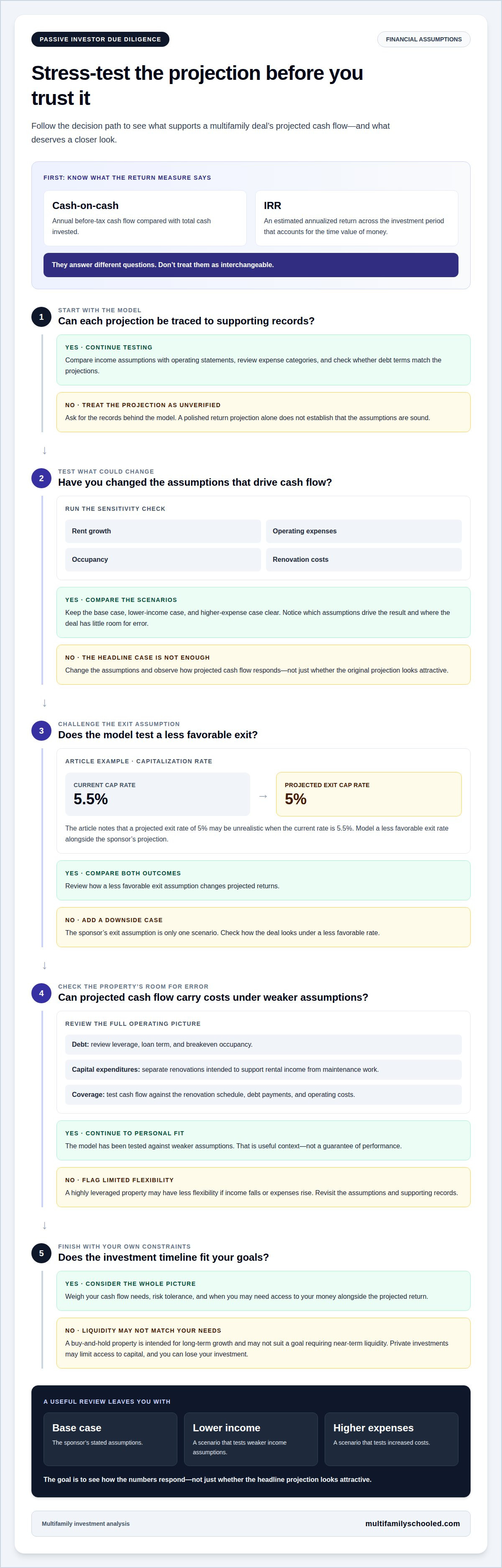
A projection is only as useful as the assumptions behind it. Build a sensitivity analysis by changing rent growth, operating expenses, occupancy, and renovation costs, then observe how each change affects projected cash flow. This reveals which assumptions drive the outcome and where the deal has little room for error.
Compare the proposed exit assumption with the market. If the current capitalization rate is 5.5%, a projected exit capitalization rate of 5% may be unrealistic. Model a less favorable exit rate alongside the sponsor’s projection. Also review leverage, the loan term, and breakeven occupancy. A highly leveraged property may have less flexibility if income falls or expenses rise.
Review the capital expenditure budget closely. Identify the share allocated to renovations intended to support rental income, such as improvements designed to support rents. Separate these from maintenance work that may not increase income. Then test whether projected cash flow can cover the renovation schedule, debt payments, and operating costs under weaker assumptions.
Assess whether the investment fits your goals before judging its projected return. Consider when you may need access to your money, your cash flow needs, and how much risk you can tolerate. A buy-and-hold property is intended for long-term growth, so it may not suit a goal requiring near-term liquidity. Review your portfolio and financial goals each year, and consider whether the property still fits your circumstances.
Financial due diligence means tracing the model back to its supporting records. Compare income assumptions with operating statements, review expense categories, and check whether debt terms match the projections. A multifamily investing toolkit can help organize these questions. Keep each scenario clear: base case, lower-income case, and higher-expense case. The goal is to see how the numbers respond, not just whether the headline projection looks attractive.
3. Checking fund operators’ track records and claims
Knowing how to do due diligence as a passive investor means testing headline claims against records. An operator may describe a portfolio by asset value, unit count, or total deals, but these measures aren’t interchangeable. One reported example involved a fund claiming 28 units while owning only 17. Request an asset-by-asset schedule and compare it with ownership records and operating reports. This helps establish what the fund owns and how its portfolio is described.
Separate realized results from estimates of future growth. A property’s value may rise without producing cash for investors, and an unrealized gain doesn’t establish an exit price. For example, a property purchased for $100,000 and now valued at $250,000 shows an increase in stated value. Review the valuation date, method, debt, and whether a sale occurred. Confidence comes from evidence, not a strong presentation.
Check debt and property condition alongside performance. Another reported example described a portfolio property worth about $2 million with $3 million in default. Compare property values with outstanding debt and payment status, then assess the operator’s explanation. Review distribution history, occupancy, operating expenses, and capital needs. A rising asset count means little if cash flow weakens or obligations exceed property value.
Trace each claim to its supporting records. Match reported assets to ownership documents, compare operating results with investor reports, and distinguish completed sales from projected exits. Look for clear explanations when actual performance differs from projections. One reported fund claimed $130 million in assets. Ask how that figure was calculated and whether it represents property value, debt, or another measure.
Learning how to do due diligence as a passive investor also means reviewing the operator’s disclosures over time. Compare dated financial statements, acquisition and disposition details, and explanations of losses as carefully as success stories. A useful track record includes setbacks and explains how decisions changed afterward. This helps you assess claims based on evidence rather than polished growth narratives.
4. Evaluating the sponsor’s track record and transparency
Compare sponsors using the same criteria: reporting quality, communication, background information, and performance across investments. Review sample updates for clear operating results, material changes, and explanations of missed targets. Consistent reporting helps you track trends over time. Also assess whether the sponsor can pass a background check and whether their stated experience matches documented responsibilities.
Ask for contact information for at least 3 business partners who can serve as references. Speak with people who have worked with the sponsor and ask about communication, decision-making, and how setbacks were handled. Compare those accounts with investor updates and the sponsor’s description of prior deals. Specific, consistent answers can support confidence; gaps between accounts deserve closer scrutiny.
To compare passive investment opportunities, place their reporting, strategy, risks, and sponsor experience side by side. Check whether each sponsor explains performance changes and provides timely information about property operations. A strong comparison looks beyond projected returns to how clearly each operator reports what happened and what decisions followed.
Watch for red flags such as inconsistent claims, unexplained changes in reported information, unanswered questions about conflicts, or pressure to decide before reviewing documents. These signs don’t prove fraud, but they warrant careful scrutiny. According to the U.S. Government Publishing Office, a conflict of interest exists when an investment company is managed or selects portfolio securities to benefit affiliated people or other interests rather than all classes of its security holders. Review disclosed relationships and consider how they may affect decisions.
Make transparency an ongoing standard, not a one-time impression. Compare updates across reporting periods, note whether material issues receive clear explanations, and keep key communications with the offering documents. Strengthen your review process with multifamily investing guidance focused on informed decisions.
Multifamily Schooled
Multifamily Schooled helps investors build the knowledge to evaluate apartment opportunities with greater clarity. After reviewing returns, assumptions, and sponsor reporting, you can use its educational resources to continue learning about multifamily investing. The Mentorship Program, Live Workshops, Online Challenges, and Deal Finding Software offer different ways to develop your understanding of deal analysis and investment decisions.
Use that education to sharpen your questions, interpret the numbers, and recognize where a projection depends on assumptions you need to understand. The right next step is continued learning before committing capital, especially if you’re new to passive real estate investing or want a more structured approach.
Contact Multifamily Schooled to discuss your next steps in learning about multifamily investing.
Turn Better Questions Into Better Decisions
Make your next step a stronger investment process, not a faster commitment. Learning how to do due diligence as a passive investor is an ongoing skill: each opportunity gives you a chance to sharpen your judgment, identify the information that matters, and decide whether the risks fit your plans. Keep learning before you commit capital.
Multifamily Schooled offers a Mentorship Program, Live Workshops, and Online Challenges for investors who want to build their understanding of multifamily investing. Use these resources to approach future opportunities with clearer questions and a more deliberate decision-making process.
Contact Multifamily Schooled to discuss investing and take a thoughtful next step toward your goals.
Frequently Asked Questions
What Does Due Diligence Really Look Like for Passive Investors?
Due diligence is a structured review before you commit money, followed by attention to investment updates. For example, compare the sponsor’s written plan with property-level information, then note which assumptions depend on future rent or expense changes. Keep a record of unresolved questions and the documents that address them. This turns a broad review into a process you can revisit as new information arrives.
What does due diligence mean for a passive investor?
It means understanding what you’re investing in, who makes decisions, and how the investment could affect your finances. Passive doesn’t mean risk-free or free of responsibility. Consider whether your capital may be tied up, how you would respond to delayed distributions, and whether the investment matches your goals. The result should be a clear view of the trade-offs, not simply a yes based on projected returns.
What documents should passive investors review before investing?
Read the offering materials and governing agreements alongside property and company records. Compare the business plan with operating statements, debt details, renovation plans, and sponsor updates. Check that key figures and descriptions align across documents, and note differences that need explanation. A dated, organized set of materials makes it easier to track changes between the initial presentation and the final investment terms.
How do I evaluate a sponsor's track record and background?
Look for evidence of the sponsor’s role in prior investments, not just a list of properties or headline valuations. Review how past projects performed, how setbacks were communicated, and whether the sponsor explains outcomes that differed from expectations. Ask business references about the sponsor’s follow-through and clarity. A sound assessment considers both results and conduct, including how the operator handles difficult news.
How can I verify an investment's assumptions, valuation, and cash flow projections?
Trace projected income and expenses to the records supporting them, then compare the property’s valuation method with its operating condition and debt. For instance, if a model assumes higher rent after renovations, examine the planned work and how the projection accounts for costs and timing. Test a weaker operating scenario too. This helps identify which assumptions have the greatest effect on projected cash flow.
What legal documents and investor rights should I review?
Review the private placement memorandum, operating agreement, and subscription documents with a trusted legal adviser. Focus on how the agreements define voting or consent rights, investor notices, access to information, distribution procedures, and transfer restrictions. Check which decisions the sponsor controls and what happens if the investment plan changes. Understanding these terms before signing clarifies your role and the limits of your rights.



