

Why Invest in Apartments Over Houses: The Scalability Secret for 2026
Stop playing small with single-family rentals that drain your energy and cap your growth. Managing five houses in five different zip codes isn't a portfolio; it's a high-stress job that's nearly impossible to scale. You're likely hitting a wall with residential loan limits or drowning in scattered maintenance costs. You need to understand exactly why invest in apartments over houses if you want to break through these barriers and secure your financial future. Professional investors are ditching the "one house at a time" grind for the massive efficiency and stability of multifamily buildings.
You want a passive income that replaces your 9-to-5 and builds a lasting legacy. I know you feel the frustration of slow progress while the median home price in 2026 sits at $424,900. This guide promises to show you how to bypass the single-family struggle and use the math of apartments to accelerate your success. You'll learn how the permanent 100% bonus depreciation under the One Big Beautiful Bill Act creates a tax-saving powerhouse for your business. We will explore the proven system for scaling your portfolio with speed, precision, and total confidence.
Key Takeaways
- Escape the single-family grind by consolidating your efforts into one high-performing asset that simplifies management, lending, and growth.
- Master commercial valuation to understand why invest in apartments over houses by driving wealth through Net Operating Income rather than relying on neighbor comparisons.
- Protect your cash flow from the "zero occupancy" trap by using the law of large numbers to maintain stability even during unit vacancies.
- Use massive economies of scale to slash expenses and hire professional management, allowing you to focus on strategy instead of maintenance.
- Follow a strategic 90-day roadmap to find off-market deals and transition into the multifamily space with total confidence and speed.
The Scalability Trap: Why 10 Houses Are Not Equal to 1 Apartment Building
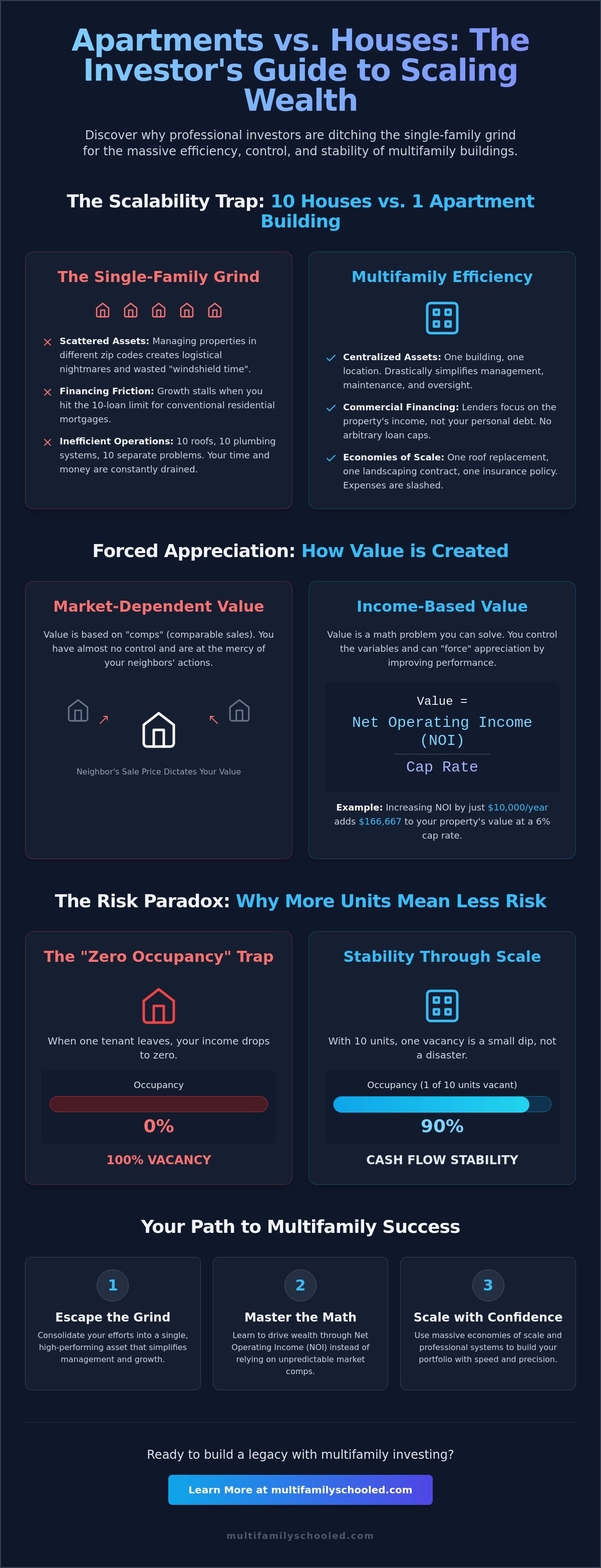
Most investors start with a single-family house because it feels familiar. You've lived in one, so you think you can manage one. But soon, you find yourself trapped in the "Single Family Grind." This is a cycle of acquiring one-off properties that demand individual attention and unique solutions for every problem. You end up with ten different problems in ten different locations. This is exactly why invest in apartments over houses. You want to build a business that works for you, not a series of chores that keep you tethered to your phone.
Scaling with houses means you're doing ten times the work for the same unit count. Every house has its own roof, its own plumbing system, and its own lawn. You're effectively managing ten separate tiny businesses. In multifamily housing, you bring all those units under one roof. This centralization accelerates the velocity of your money. You can recycle your capital and grow your net worth at a speed single-family rentals simply can't match. If you're ready to break out of the slow lane, our Mentorship Program can show you the exact path to your first building.
To see the real-world impact of this shift, watch this video:
The Logistics of Scattered vs. Centralized Assets
Stop wasting your life on "windshield time." When your rentals are scattered across the city, you spend hours driving between properties just to check on a leaky faucet or a late tenant. Centralized assets change your life. One location means you sign one property management contract and work with one maintenance crew. You gain massive efficiency through centralized utilities and services. Instead of ten separate landscaping bills, you pay one. This centralization slashes your operational overhead and puts more cash in your pocket every month. It turns a chaotic hobby into a streamlined wealth machine.
Financing Friction: The Residential Loan Limit
You'll eventually hit a wall that stops most house investors cold. Conventional residential lenders usually cap you at ten loans. Once you reach that limit, your growth stalls. You're forced to look for creative, high-interest debt just to keep moving. Commercial lending is different. Lenders focus on the asset’s performance and its ability to generate income rather than just your personal debt-to-income ratio. You can secure 50 units in a single transaction with one commercial loan. Stop begging for small residential approvals. Use professional debt to fuel your empire and close bigger deals with less personal friction.
Forced Appreciation: Turning Math into Millions
When you buy a house, you're at the mercy of the market. If your neighbor sells their home at a discount because of a divorce or a job transfer, your property value drops instantly. You have zero control. This lack of agency is the primary reason why invest in apartments over houses. In the commercial world, value is a math problem you can solve. You don't wait for the market to give you a win. You create the win yourself through forced appreciation. It's about taking command of your financial destiny today.
Residential Comps vs. Commercial NOI
Houses are valued based on "comparable sales" in the area. If three houses nearby sold for $400,000, yours is likely worth the same. It doesn't matter if you have better tenants or higher rent. Commercial properties, however, are valued based on the income they produce. The formula is simple: Value = Net Operating Income (NOI) / Cap Rate. Net Operating Income is the lifeblood of commercial real estate. When you increase the income or decrease the expenses, the property value rises. It's predictable. It's reliable. It's the fastest way to build massive equity.
The Multiplier Effect of Small Improvements
Think about the power of the multiplier. If you manage a 20-unit building and add a $50 monthly pet fee per unit, you've increased your annual income by $12,000. In a market with a 6% cap rate, that small move just added $200,000 to your property's value. You can't do that with a single house. You can also find wealth in the expenses. If you use our deal finding software to identify properties with bloated trash or utility costs, you can trim $200 a month and see a similar spike in your valuation. Small changes lead to life-changing results.
Operational efficiencies change your financial trajectory. Houses often take decades of market appreciation to see the kind of growth an apartment building can achieve in just 18 months. You are the driver. You decide the rent. You control the costs. You dictate the final price tag. This isn't just investing; it's engineering wealth. You're no longer hoping for a good year. You're making one happen through strategic management and aggressive optimization. Stop gambling on the housing market and start building a real business.
The Risk Paradox: Why More Units Actually Mean Lower Risk
You think buying a 20-unit building is riskier than buying one house. You're wrong. It's a risk paradox. In a single-family home, your income is binary. It's either 100% or 0%. If your tenant leaves, your income vanishes instantly, but the mortgage remains. This "Zero Occupancy" trap is the fastest way to drain your savings. This is why invest in apartments over houses. You need the law of large numbers on your side. Stop letting fear of "bigger deals" hold you back. Scale is your shield.
If you own a 10-unit building and one person moves out, you're still 90% occupied. You're still profitable. You don't have to panic or dip into your personal bank account to cover the bills. A detailed multifamily vs. single-family investing analysis proves that the diversified income stream of apartments provides a safety net that single houses can't match. With the national rental vacancy rate sitting at 7.3% in early 2026, you need a portfolio that can absorb a vacancy without going under. This fundamental shift in exposure is why invest in apartments over houses for long-term security.
Binary Risk vs. Fractional Risk
A single bad tenant can ruin a house investor. They stop paying, and your cash flow evaporates while you wait months for an eviction. In an apartment building, you deal with fractional risk. One non-paying tenant is just a minor bruise on your monthly Net Operating Income. You can manage economic vacancy—the difference between gross potential rent and actual cash collected—without losing sleep. It gives you the predictability you need to build a real business.
- Predictable Maintenance: Budget for repairs across a large pool of units rather than being surprised by one massive bill.
- Cash Flow Stability: Multiple checks coming in every month ensure the mortgage is always covered.
- Operational Buffer: Higher income allows you to hire professionals to handle the headaches.
The Safety of Commercial Debt
Banks understand this risk profile. They actually prefer lending on a 20-unit building over a single house because the asset's income pays the debt, not just your personal salary. Many commercial loans are non-recourse. This means the lender can't come after your personal assets if the property fails. You protect your family while you build your empire. Lenders view multifamily as the safest asset class in 2026. They use a Debt Service Coverage Ratio (DSCR) as a built-in safety check. If the math doesn't work, they won't fund it. This protects you from making a bad investment. If you want to master these numbers, join our Mentorship Program today.
Operational Efficiency: One Roof, One Loan, One Mission
Single-family rentals are often just a hobby masquerading as a business. If you're managing five houses, you're likely the one answering the call when a water heater breaks at 2:00 AM. You're the one vetting every tenant and chasing down five different checks across town. It's exhausting. This operational friction is exactly why invest in apartments over houses. You want a system that works without you. You need a mission-driven asset that consolidates your effort and maximizes your output. Stop acting like a handyman and start acting like a CEO.
Think about the simplicity of a single location. You have one loan to service. You have one insurance policy to manage. You file one tax return for the entire building. Instead of a scattered mess of paperwork, you have a streamlined P&L that shows you exactly where your money is going. This isn't just about saving time. It's about creating a professional environment where you can actually scale without losing your mind. You're building an enterprise, not a series of chores.
Buying in Bulk: The Power of Scale
Don't believe the myth that bigger buildings mean bigger maintenance headaches. The truth is quite the opposite. When you have 20 units in one place, you have massive negotiating power. You aren't calling a plumber for one leaky faucet; you're hiring a contractor to service an entire building. Buying 20 water heaters at once gets you a bulk discount that house investors can't touch. Your cost-per-unit for major repairs like roofing drops significantly. Even your insurance premiums are often lower per door because you're covering one centralized structure instead of ten separate homes.
Passive Ownership Through Professional Management
You can't afford an on-site manager for a single-family house. The math just doesn't work. But with a 50-unit apartment building, the property pays for its own professional management. This is the secret to true passive income. You remove yourself from the "Toilet, Tenant, and Trash" cycle entirely. Your job isn't to fix faucets. Your job is to find the next deal and manage the manager. This shift in focus is essential for exponential growth. If you're ready to stop being a landlord and start being an owner, join our Mentorship Program to learn the systems of the pros.
Professional management ensures your asset is optimized 24/7. They handle the midnight emergencies and the late-night tenant disputes. You get a monthly report and a wire transfer. That's it. You've successfully transitioned from a high-stress job to a high-yield investment. This level of efficiency is why invest in apartments over houses in 2026. You're building a legacy, not just collecting rent. It's time to treat your wealth like the professional enterprise it deserves to be.
Your 90-Day Roadmap: Transitioning to Multifamily in 2026
Stop looking at Zillow. It's a graveyard of retail prices and amateur competition. If you want to understand why invest in apartments over houses, you must look where others aren't. Real deals happen off-market through direct relationships and sophisticated data. You aren't just buying a building; you're acquiring a cash-flow machine that operates on a totally different level than a single-family rental. You need a system that identifies high-probability sellers before they ever reach the public market. This is how the pros build empires while others are stuck fighting over scraps.
You need a 90-day roadmap to navigate this transition with total confidence. Don't guess. Follow a proven framework that moves you from education to your first closing with speed and precision. Phase one is mastering the math of Net Operating Income. Phase two is building your deal flow using modern technology. Phase three is securing the commercial debt that protects your personal assets. This systematic approach is the only way to scale your wealth without the high-stress grind of managing scattered houses.
Systems and Tools for the Modern Investor
Technology is your greatest ally in the search for multifamily wealth. You can't manually search for deals in 2026 and expect to win. Use Real Estate Radar to identify high-probability sellers with surgical precision. This software finds the opportunities that others miss. Once you have a lead, use the Multifamily Tool Kit to analyze the numbers instantly. It removes the guesswork. It gives you the power to make bold, data-driven offers. You will see exactly why invest in apartments over houses once you visualize the massive equity potential on your screen.
The Mentorship Advantage
Don't do your first big deal alone. The complexity of a multi-unit building can feel daunting, but a mentor acts as your shortcut to success. You need a coach who has already achieved the results you want. Our Mentorship Program provides a specific, high-impact guarantee. Find a deal in 90 days or we provide one for you. This is about total accountability. It's about joining a community of high-achievers who are all moving toward the same goal of financial independence.
Stop thinking small. Your 90-day journey starts now. You have the blueprint. You have the tools. You have the support system. Take the first step toward replacing your 9-to-5 with passive income that actually lasts. Secure your legacy today. Start your 90-day journey and witness the life-transforming power of multifamily investing for yourself.
Claim Your Multifamily Empire Today
The single-family grind is a relic of the past. You now have the blueprint to bypass the "Zero Occupancy" trap and use forced appreciation to engineer your own wealth. Scaling is no longer a mystery; it's a strategic math problem that you are now equipped to solve. Understanding exactly why invest in apartments over houses is the critical shift that separates struggling landlords from elite wealth builders. You don't have to wait for the market to move. You have the power to create value right now.
Success requires the right tools and the right mentor. Justin Brennan’s multi-generational expertise provides the foundation you need to skip the learning curve. With our all-in-one ecosystem and Real Estate Radar software, you'll identify off-market deals before the competition even wakes up. We are so confident in our system that we offer a 90-day deal-finding guarantee. Stop thinking small and start building a legacy that lasts for generations. Your future self is waiting for you to take the lead.
Join the Mentorship Program: Find Your Deal in 90 Days. This is your moment to seize the opportunity and transform your financial trajectory forever. You have the vision; now take the action.
Frequently Asked Questions
Is it harder to get a loan for an apartment building than a house?
No, it is actually often easier because commercial lenders prioritize the property's performance over your personal debt-to-income ratio. While a residential loan for a house depends on your salary, an apartment loan depends on the building's ability to generate cash. This is a core reason why invest in apartments over houses. Lenders view the diversified income of multiple units as a safer bet than a single tenant.
How much money do I need to start investing in apartments?
You don't need millions of your own cash to start. Most commercial deals require a 20% to 25% down payment, but many successful investors use partners or syndication to pool capital. By leveraging other people's money, you can control a 20-unit building with the same personal investment you'd use for a single house. Focus on finding the deal first; the capital follows the opportunity.
Can I invest in apartments if I have no experience with houses?
Yes, you can start with apartments immediately. Many professional investors skip the "single-family grind" entirely because the business models are completely different. Managing houses teaches you to be a landlord, while apartments teach you to be a business owner. Starting with multifamily allows you to learn the systems of scale and commercial valuation from day one without unlearning residential habits.
What is a good cap rate for an apartment building in 2026?
A strong target for 2026 is a cap rate between 6% and 8% depending on the specific asset class and regional demand. In high-growth markets like the Sunbelt, you might see lower cap rates due to higher demand. Always look for value-add opportunities where you can increase the Net Operating Income. A lower entry cap rate is acceptable if you have a clear plan to force appreciation through management.
Do I need a special license to buy multifamily real estate?
Licensing is not a requirement for purchasing apartment buildings. Any individual or legal entity like an LLC can purchase multifamily property. However, you do need a proven system and the right tools to analyze the numbers correctly. Success in this field is about education and execution, not a piece of paper from a licensing board. Stop waiting for permission and start building your empire today.
What happens if the market crashes while I own an apartment building?
Apartment buildings are historically one of the most resilient assets during a market downturn. When homeownership becomes unaffordable, the renter pool actually expands. Even if property values dip temporarily, your cash flow remains stable because people always need a place to live. This stability is a primary reason why invest in apartments over houses during uncertain economic times. Your risk is spread across multiple tenants.
How do I find off-market apartment deals?
The best deals are found through direct outreach to owners and using specialized software like Real Estate Radar. You must bypass the public listings where everyone else is bidding. Build relationships with commercial brokers and use data to identify tired landlords or properties with high vacancy. Proactive deal-finding is the only way to secure the high cash-on-cash returns that professional investors demand in 2026.
Is it better to buy a 4-unit or a 10-unit building for my first deal?
Go for the 10-unit building. Properties with five or more units are classified as commercial real estate, which means they are valued based on income rather than residential comps. A 4-unit building is still stuck in the residential valuation world. By starting with at least 10 units, you unlock the power of forced appreciation and professional management that smaller properties simply cannot support. Think bigger from the start.



