

What Is a Preferred Return in Real Estate? The Investor’s Guide to Profits
Stop being the last person to get paid in your own deals. Most investors gamble with their capital because they lack the "Investor's Shield" that ensures they see a profit before the sponsor takes a dime. You want financial independence through multifamily assets, but complex waterfall structures often feel like a trap designed to keep you in the dark. It's time to gain total clarity on what is a preferred return in real estate so you can stop guessing and start leading your portfolio with authority.
I understand the frustration of staring at a deal split document and wondering if you're getting a fair shake. The fear of being left behind is real, but it ends today. This guide is your blueprint to mastering the "pref" and turning confusion into a strategic advantage. You'll learn to analyze typical return percentages between 6% and 10% with total confidence. We'll break down cumulative structures and distribution waterfalls to show you exactly how to protect your hard-earned capital. Get ready to unlock massive returns and build a legacy of wealth through proven multifamily systems.
Key Takeaways
- Define exactly what is a preferred return in real estate to ensure you are always the first to profit before any sponsor promote kicks in.
- Visualize the distribution waterfall to master the flow of cash and guarantee your initial seed money returns to your pocket first.
- Compare "True Pref" and "Pari-Passu" structures to choose the profit model that best protects your capital and aligns sponsor interests.
- Navigate the capital stack with ease by understanding the critical differences between a preferred return and high-risk "Hard" preferred equity.
- Follow a proven 90-day blueprint to stop over-analyzing and start engaging brokers with the confidence and authority of an expert investor.
What Is a Preferred Return? Your Shield in Multifamily Investing
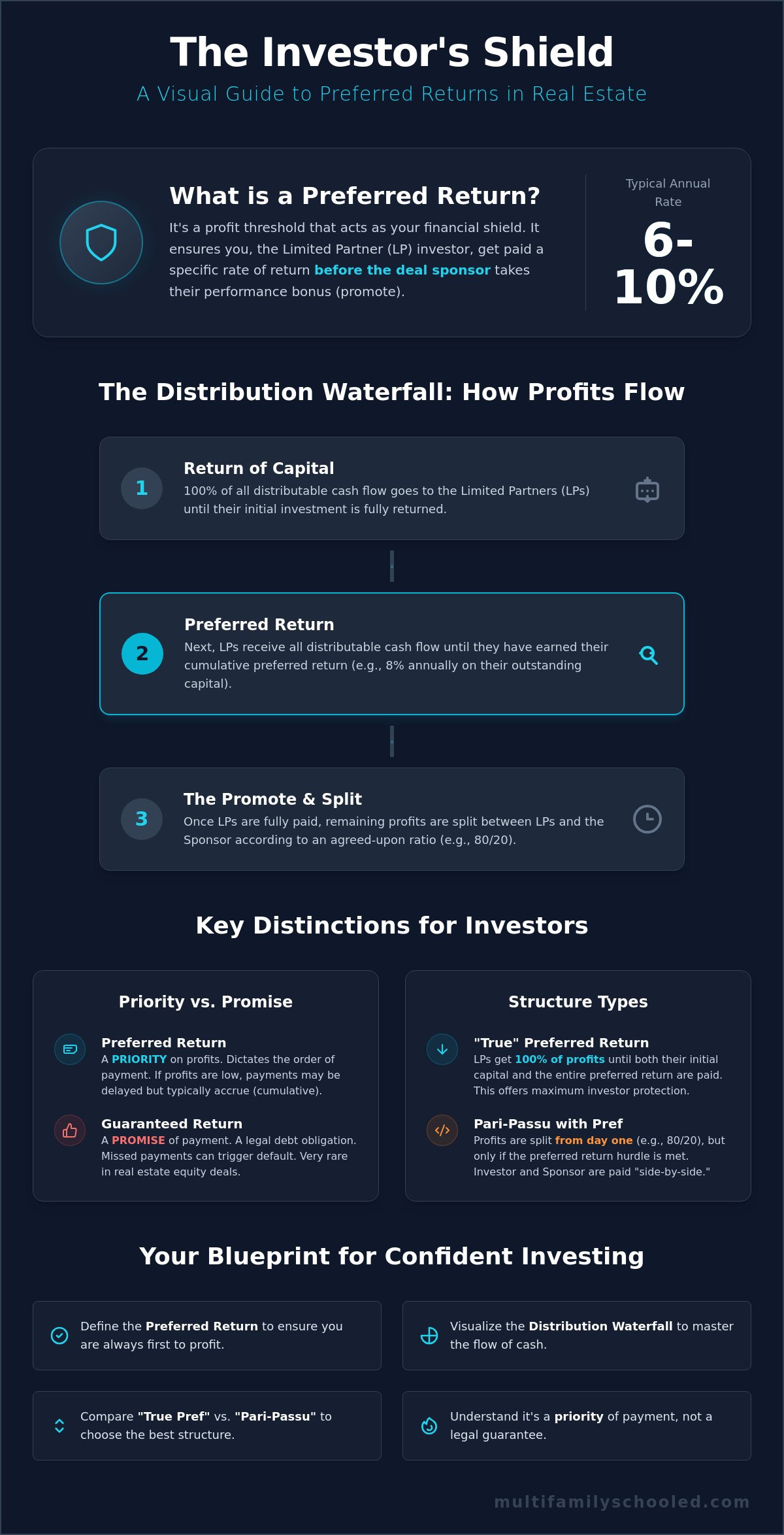
You are entering the high-stakes arena of multifamily investing. To win, you must understand what is a preferred return in real estate. Think of the "pref" as your financial bodyguard. It is a profit threshold that ensures you, the investor, get paid before the sponsor touches their performance bonus. In 2026, savvy capital is not moving without this protection. It aligns the sponsor's hustle with your safety. If the property doesn't perform, the sponsor doesn't get their promote. This "LPs First" mentality is how you build a reputation that attracts millions in capital. It proves you value your partners more than your own ego.
To better understand how this structure protects your cash, watch this breakdown:
The preferred return is the engine of the Distribution waterfall. It dictates who eats first when the rent checks clear. Typically, investors see rates between 6% and 10%. This isn't just a number on a spreadsheet; it's a commitment to transparency. By prioritizing investor returns, you transform a risky venture into a professional asset class. If you want to master these structures and start closing deals, check out our Mentorship Program to learn the ropes from experts who have been there.
The Psychology of the Pref
High-net-worth individuals demand clarity. A preferred return makes your deal "fundable" because it signals professional risk management. It slashes investor anxiety in volatile markets. By offering a pref, you tell your partners that their capital is the priority. This is your secret weapon for winning over skeptical partners on your very first deal. Show them you are willing to wait for your big payday until they are whole. That is how you win the game of trust.
Preferred Return vs. Guaranteed Return
Don't confuse a priority with a promise. A preferred return is not a legal guarantee of payment like a bank loan. If a property misses its numbers in Year 1, you might not see a check immediately. However, if the deal is cumulative, that unpaid return stacks up for later payouts. A preferred return is a distribution priority that dictates the order of payments, not a debt obligation that triggers a default if missed. It's about who gets the first dollar of profit, not a promise that the dollar will exist every single month.
The Distribution Waterfall: Mapping Your Path to Profit
Visualize your investment as a series of cascading pools. This is the distribution waterfall. It's the legal hierarchy that dictates exactly how every dollar of profit flows from the property to your bank account. You cannot master what is a preferred return in real estate without understanding where it sits in this flow. It isn't just about the percentage; it's about the order. When you control the waterfall, you control your financial destiny. Stop guessing and start analyzing your deals with the precision of a seasoned pro.
The flow starts with Stage 1: The Return of Capital. Before any profits are split, the Limited Partners (LPs) usually get their original seed money back. This is the ultimate safety net for your principal. Once the initial investment is returned, the deal moves to Stage 2: The Preferred Return. This is typically a 7% to 9% annual hurdle. Only after the investors have received this specified return does the sponsor move to Stage 3: The Catch-Up and the Promote. This is where the sponsor finally shares in the surplus profits as a reward for their management and execution. The catch-up phase allows the sponsor to receive a portion of the profits to align their total earnings with the agreed-upon split.
Tiered Returns Explained
Deal structures often become more aggressive as performance improves. These are tiered returns. As the project hits higher Internal Rate of Return (IRR) hurdles, the profit split shifts. You might start with an 80/20 split where 80% goes to investors and 20% to the sponsor. Once a specific profit milestone is reached, the split could jump to 70/30 or even 50/50. This "promote" increases the sponsor's incentive to maximize the asset's value. It's a win-win system that rewards high performance. If you want to model these complex splits like a pro, grab our Multifamily Tool Kit to run the numbers yourself.
Return of Capital vs. Return ON Capital
Distinguish these two concepts to protect your tax position. Return of capital reduces your "basis" in the property. It's essentially getting your own money back, which often carries different tax implications than a return ON capital, which is pure profit. LPs prioritize getting their original principal back to de-risk their position as quickly as possible. This becomes vital during a refinance. If a property is refinanced and 100% of the investor capital is returned, the preferred return calculation might change or even stop, depending on the operating agreement. A successful refinance is a massive milestone. It allows you to pull your capital out while still retaining ownership and cash flow. This is the fast track to scaling your portfolio and achieving true independence.
True Pref vs. Pari-Passu: Choosing Your Profit Structure
Choosing the right structure determines how much weight you carry as a sponsor. You must decide between a True Preferred Return and a Pari-Passu model. A True Pref is the gold standard for investor protection. In this scenario, investors receive 100% of their specified return before you, the sponsor, see a single cent of profit. It is a bold statement of confidence in your deal. Conversely, a Pari-Passu structure puts everyone on equal footing. Here, both you and your investors receive your respective returns simultaneously, proportional to the capital you have each invested. This changes your risk profile significantly. While True Pref is more attractive to high-net-worth individuals, Pari-Passu is often used when the sponsor is putting up a massive chunk of the equity. Understanding what is a preferred return in real estate means knowing which lever to pull to close the deal.
You also need to decide between simple interest and compounding returns. Simple interest is the easiest way to explain returns to new investors. It keeps the math clean and the expectations clear. However, over a 5 to 7 year hold, the structure of your pref will define your reputation. Do you want to be the sponsor who prioritizes their partners, or the one who cuts corners? The answer will dictate how fast you can scale your portfolio.
Cumulative Prefs: The Investor's Best Friend
Cumulative returns ensure investors are made whole before sponsors profit. If a property has a rough first year and cannot pay the full 8%, that unpaid balance doesn't just vanish. It rolls over. It stacks up. This creates a powerful alignment of interests. In long-term multifamily holds, the power of compounding ensures that you stay focused on the exit strategy. Non-cumulative returns are rare in this industry because they leave your partners exposed. If you want to build a legacy, stick to cumulative models that protect your capital providers at all costs.
Negotiating the Pref as a New Sponsor
Stop guessing about market rates. In 2026, a 6% to 10% pref is the standard for value-add multifamily deals. As a new sponsor, your job is to balance this investor demand with your own operational needs. You cannot scale if you are starving your own company. Use Real Estate Radar to hunt for off-market deals with enough meat on the bone to support a healthy pref. This software gives you the edge you need to talk to brokers with absolute authority. Don't just ask for a deal. Demand one that fits your proven system and provides the returns your partners expect.
The #1 Confusion: Preferred Return vs. Preferred Equity
Many investors trip over terminology and lose their shirt. You cannot afford that mistake. Understanding what is a preferred return in real estate is only half the battle. You must also distinguish it from Preferred Equity. These two concepts might sound similar, but they live in different worlds within the capital stack. One is a handshake agreement on profit splits. The other is a high-stakes financial instrument with the power to take over your property if things go south. Master this distinction now to protect your assets and your reputation.
The capital stack is a hierarchy of who gets paid and when. Senior debt always sits at the top. It gets paid first because it has the most security. Below that lies Preferred Equity, often called a "Hard Pref." At the bottom is Common Equity, which is where your standard Preferred Return or "Soft Pref" lives. If you are a new investor, keep your structures simple. Don't over-complicate your first deal with layers of exotic financing. Start with a clean equity split that rewards your partners and secures your future. Complexity is often a mask for a bad deal. Stick to the fundamentals and grow fast.
Security vs. Upside
Preferred equity holders are essentially lenders in disguise. They want security, not the massive upside of a sale. They receive a fixed rate of return, which can reach as high as 13% in certain opportunistic structures. However, they rarely share in the back-end profits when you exit the deal. Their position is "hard" because they often have "forced sale" or "change of control" rights. If the sponsor fails to pay, the preferred equity holder can step in and take over the management. Protect your deal from predatory terms by ensuring you have enough cash flow cushion to meet these aggressive obligations.
Which One Do You Need?
Use a preferred return to attract Limited Partners (LPs) who want to grow wealth alongside you. It signals that you are a "partners-first" sponsor and builds long-term loyalty. Use preferred equity only when you need to fill a specific gap in your financing that your primary lender won't cover. It is a powerful tool for scaling, but it comes with sharp edges. Take immediate action and review your operating agreement for "clawback" provisions. These clauses can force a sponsor to return previously paid promotes if the deal underperforms in later years. Mastery of these details is what separates the amateurs from the industry icons.
Ready to stop guessing and start closing? Access our exclusive training resources to master the capital stack and dominate your market today.
Master the Pref, Find Your Deal: The 90-Day Blueprint
Theory is dead. Action is everything. You have spent years thinking about financial independence, but thinking doesn't buy apartment buildings. By now, you understand exactly what is a preferred return in real estate and how it safeguards your partners. This knowledge is your weapon. Use it. While your competitors are still trying to figure out the difference between simple and cumulative interest, you will be submitting LOIs that brokers cannot ignore. When you speak the language of "prefs" and "waterfalls" with absolute certainty, you aren't just another tire-kicker. You are a closer. Brokers will bring you their best off-market deals because they know you have the sophistication to fund them.
The Multifamily Schooled system is designed to take you from zero to your first building in just 90 days. We don't believe in endless study. We believe in proven frameworks that produce tangible results. Mentorship is the ultimate shortcut to mastering these complex structures without the expensive trial and error. Stop over-analyzing. Start executing. Your future self is waiting for you to make a move.
Your Deal-Finding Engine
Success starts with the right data. Use Real Estate Radar to identify undervalued apartments before they ever hit the open market. This software allows you to hunt with precision and find owners ready to exit. Once you find a target, structure your offer with a compelling preferred return that makes the deal irresistible to Limited Partners. Pitch your opportunity using the "Investor Shield" framework. This positioning transforms a standard real estate deal into a protected wealth-building vehicle. You aren't just asking for money. You are offering a secure path to massive returns. When you lead with the pref, you eliminate investor anxiety and secure the capital you need to scale.
Take the Next Step Toward Freedom
You don't need to be a math genius or a corporate titan to buy an apartment building. You need a system that works. The power of the Multifamily Schooled Mentorship lies in its ability to simplify the complex and provide a direct path to ownership. We provide the tools, the network, and the blueprint. You provide the hunger. This is your moment to break free from the 9-to-5 grind and build a legacy of multi-generational wealth. Claim your future today. Start your 90-day journey and watch how fast your life can change when you follow a proven methodology. The clock is ticking. Get started now.
Take Command of Your Financial Destiny
You now possess the blueprint to analyze any multifamily deal with absolute authority. You have mastered the distribution waterfall and learned how to shield your capital from unnecessary risk. This clarity is the foundation of a successful investment career. You are no longer guessing; you are leading with a proven system.
Understanding what is a preferred return in real estate is the difference between a gambler and a professional. You have the knowledge to build trust with partners and secure your position in the capital stack. Don't let this momentum fade. The window of opportunity in multifamily investing is wide open for those who act decisively. The market rewards the prepared, and you are now ready to compete at the highest level.
It is time to turn this education into assets. Leverage Founder Justin Brennan's multi-generational real estate expertise and our proprietary deal-finding software to find undervalued properties today. Use our proven system to buy your first apartment building in just 90 days. Ready to find your first deal in 90 days? Join our Mentorship Program now! Your legacy of wealth is waiting for you to claim it. Success is a choice; make yours today.
Expert Answers to Your Top Questions
Is a preferred return the same as an interest rate?
No, a preferred return is a distribution priority for equity, not a debt obligation. Interest rates are fixed costs that you must pay to a lender regardless of the property's performance. A pref only pays out if the building generates enough profit to cover it. It is the "Soft Pref" that lives within your equity structure, offering priority without the legal threat of foreclosure if a payment is missed.
What is a typical preferred return for multifamily real estate in 2026?
Typical rates currently range from 6% to 10% annually for value-add multifamily deals. This percentage depends heavily on the specific risk profile of the asset and the current market conditions. Stabilized assets might offer lower rates, while opportunistic projects often hit the higher end of that range. Understanding what is a preferred return in real estate helps you benchmark these offers against the competition with total confidence.
Can a preferred return be higher than the actual cash flow?
Yes, the pref threshold can exceed the property's immediate cash flow. If the building only generates 4% cash flow but has an 8% pref, the unpaid 4% usually accrues. This is where cumulative structures become your best friend. It ensures that you receive your full return once the property's performance improves or when the asset is eventually sold.
What happens to the preferred return if the property is sold?
The sale triggers a final payout through the distribution waterfall. Any unpaid or accrued preferred return is paid out first from the net sale proceeds. Once the pref is satisfied, the remaining cash is used to return the original capital to the investors. Only after these steps are complete do the remaining profits get split between the partners and the sponsor.
Do all real estate syndications offer a preferred return?
No, not every syndication includes a pref. Some deals use a straight split where profits are divided from the very first dollar earned. However, high-tier sponsors use preferred returns to provide an "Investor Shield" and attract serious partners. It is a hallmark of a professional, investor-first deal structure that prioritizes capital protection over sponsor bonuses.
How do I calculate the preferred return on a monthly basis?
Divide your annual preferred return percentage by 12 and multiply it by your initial capital contribution. For an 8% pref on a $100,000 investment, your monthly target is $666.67. This calculation gives you a clear milestone for tracking your passive income. Use this simple math to monitor your asset performance and ensure your sponsor is hitting their targets.
What is a 'catch-up' provision in a preferred return structure?
A catch-up allows the sponsor to receive 100% of the next available profits after the pref is met until their total earnings match the agreed-upon split. If the deal is an 80/20 split, the sponsor "catches up" to their 20% share of the total distributed profits. This mechanism aligns everyone's interests before the deal moves into the final promote tiers.
Can a sponsor ever get paid before the preferred return is met?
Sponsors typically receive asset management fees or expense reimbursements before the pref is paid. These are operational costs required to run the building, not profit splits. However, the sponsor's "promote" or performance-based bonus is almost always locked behind the preferred return hurdle. This ensures you get your priority return before the sponsor sees their management reward.



