

What is a PPM in Real Estate Syndication? The 2026 Investor's Guide
The Private Placement Memorandum (PPM) isn't just a legal hurdle; it's the professional blueprint that separates amateur deal-seekers from elite multifamily syndicators. If you want to scale your portfolio in a market where commercial real estate investment is forecasted to reach $562 billion this year, you must understand what is a PPM in real estate syndication and how it functions as your ultimate legal shield. Most aspiring investors stall because they're terrified of SEC non-compliance or feel buried under a mountain of legal jargon. It's time to stop guessing and start executing like a pro.
It's completely normal to feel overwhelmed by the complexities of Rule 506(b) or the nuances of the 2025 One Big Beautiful Bill Act. You've worked too hard to let a paperwork error derail your path to economic empowerment. This 2026 guide will show you how to master the PPM to protect your assets and build unshakable trust with your investors. We'll break down the legal requirements of syndication, explain the current accredited investor thresholds, and give you the strategic framework needed to close your first large deal with total confidence.
Key Takeaways
- Understand exactly what is a PPM in real estate syndication to transform from an amateur seeker into a professional, high-level syndicator.
- Identify the critical "Risk Factors" that act as your ultimate legal shield, protecting your assets and your reputation from future liability.
- Navigate the high-stakes world of SEC Regulation D to ensure your capital raises are bulletproof and fully compliant with 2026 standards.
- Learn the "Pro Investor" method for reviewing profit waterfalls and fee structures to build absolute certainty before you commit.
- Shift your focus from legal overwhelm to rapid execution by integrating the PPM into a proven 90-day system for closing your first deal.
What is a PPM in Real Estate Syndication?
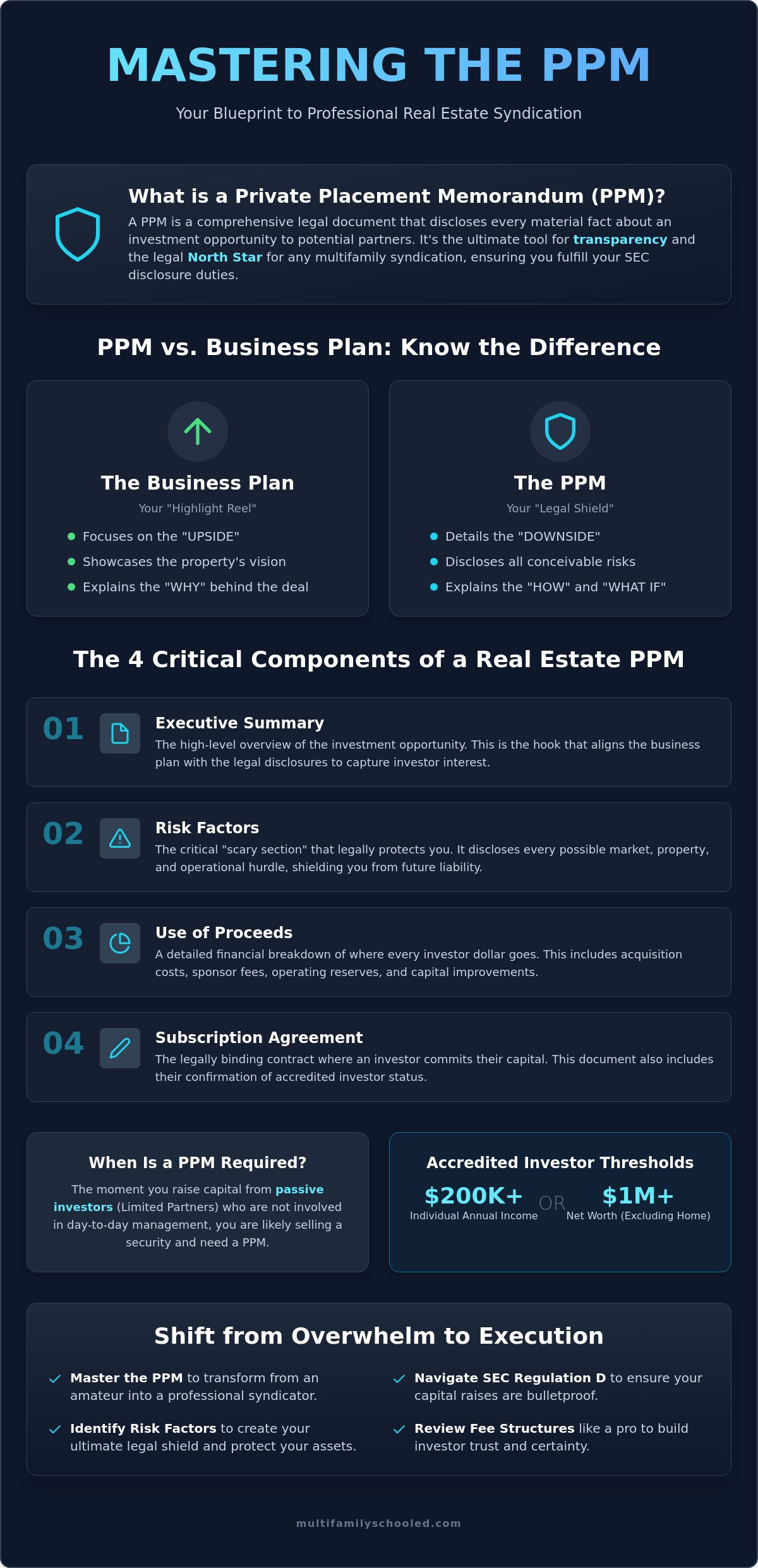
Stop playing small and start protecting your empire. If you're serious about scaling your portfolio, you must understand what is a PPM in real estate syndication. A Private Placement Memorandum (PPM) is a comprehensive legal document designed to disclose every material fact about your investment to potential partners. It's the ultimate tool for transparency. It ensures you and your investors are on the same page regarding the risks, terms, and business strategies of the deal. The PPM is the operational and legal North Star for any multifamily syndication.
To better understand this concept, watch this helpful video:
Regulation D is your playground; don't get kicked out. The SEC requires this document to ensure you aren't selling an unregistered security illegally. By providing a PPM, you fulfill your duty of disclosure. This protects you, the sponsor, from future claims of fraud or misrepresentation. If a risk is clearly outlined in the document, an investor cannot later claim they weren't warned. This isn't just about red tape. It's about building a foundation of trust that allows you to raise millions with total confidence.
PPM vs. Business Plan: Know the Difference
Don't confuse your marketing with your mandate. A business plan is your highlight reel; it's designed to show high-net-worth investors the massive "upside" and the vision for the property. It's the "why" behind the deal. The PPM is the "how" and the "what if." It details the "downside" and every conceivable risk that could impact the investment. High-level investors expect both. They want to see the vision in the plan, but they need to see the protection in the PPM before they wire their capital.
When Exactly Do You Need a PPM?
The moment you step away from joint ventures and into the world of passive capital, you need a PPM. If you are raising money from Limited Partners who aren't active in the day-to-day management, you're likely selling a security. The threshold is simple: if they aren't "active," it's a security. Navigating these rules is exactly why investors join our mentorship program to see how we structure these deals for maximum safety. Understanding what is a PPM in real estate syndication is the first step toward closing your first 50-unit deal and beyond. Stop guessing and start following a proven system.
The 4 Critical Components of a Real Estate PPM
Mastering what is a PPM in real estate syndication requires a look under the hood. This isn't a single document; it's a structural masterpiece that binds your vision to legal reality. To succeed in 2026, you need more than just a good deal. You need a bulletproof framework. This Guide For Entrepreneurs highlights how these components serve as the definitive disclosure for your partners.
The first piece is the Executive Summary. This provides the high-level overview of the investment opportunity. It's the hook that aligns your business plan with the legal disclosures. Next, you have the Risk Factors. This is the "scary" section that legally protects you from future lawsuits by disclosing every possible hurdle. The Use of Proceeds is a detailed breakdown of where every investor dollar goes. It covers acquisition costs, fees, and necessary reserves. Finally, the Subscription Agreement is the actual contract where the investor commits their capital and confirms their status. Each component must be precise to ensure total SEC compliance.
Consider the Use of Proceeds as your financial transparency report. Investors in 2026 are sophisticated. They want to see exactly how much capital is going toward the property purchase versus acquisition fees or asset management reserves. If your numbers are vague, you lose credibility instantly. The Subscription Agreement acts as the final gatekeeper. It's where the investor makes their legal representations, such as whether they meet the $200,000 individual income threshold or the $1 million net worth requirement. Without these signed documents, your raise isn't just incomplete; it's a liability.
Deep Dive into Risk Factors
Don't hide from the truth. Professional syndicators use risk factors to build trust. In 2026, you must address market risks like the projected 8.8% national multifamily vacancy rate. Property risks include environmental issues or unexpected capital expenditures. You also need to disclose sponsor risks. What happens if you are no longer able to lead? Transparency is your greatest asset here. It proves you've done the work to protect the collective interest. It turns a potential "gotcha" into a sign of professional mastery.
Understanding the Operating Agreement
The Operating Agreement sets the rules of the game for the LLC holding the property. It defines the "Waterfall," which is how distributions are handled and when investors get paid. It also outlines voting rights. What decisions do the investors actually control? Clarity here prevents disputes and ensures a smooth operation for the life of the asset. If you want to see how elite syndicators structure these agreements, explore our mentorship program to start your journey. This is where you learn to build a foundation that supports a multi-generational legacy.
Why the PPM is Your Ultimate Legal Shield
Stop treating your legal documents like a necessary evil. In the high-stakes world of multifamily investing, what is a PPM in real estate syndication? It's your primary defense against litigation and federal scrutiny. This document provides anti-fraud protection that no handshake can ever offer. By disclosing every material risk upfront, you effectively neutralize an investor's ability to sue you for those specific risks later. Transparency isn't just a moral choice; it's a strategic survival tactic that protects your freedom and your future earnings.
Professionalism attracts capital. Sophisticated, high-net-worth investors expect a standardized, attorney-backed document before they even consider your pitch deck. If you approach a family office or an accredited investor with a flimsy agreement, you've lost the deal before it started. When you truly grasp what is a PPM in real estate syndication, you realize it is the bridge between a simple idea and a scalable business. Using a proven framework ensures you're playing by the same rules as the industry titans. It signals that you respect the capital you're raising and the people who are trusting you with their hard-earned money.
Regulation D: 506(b) vs. 506(c)
Choosing the right path for your first 90-day deal is critical. Rule 506(b) allows you to raise capital from up to 35 non-accredited but sophisticated investors, provided you have a pre-existing relationship and don't use general solicitation. This is often the fastest route for your first raise within your personal network. Conversely, Rule 506(c) allows you to publicly advertise your deal on social media or at events. However, you can only accept verified accredited investors. Don't mix these up. A mistake here can lead to heavy fines or being barred from future raises entirely.
The Role of the SEC in 2026
The regulatory landscape is shifting toward extreme transparency. In 2026, the SEC has increased its focus on fee disclosure and sponsor compensation structures. Handshake deals and under the table arrangements are a recipe for disaster in this modern market. You must be explicit about acquisition fees, asset management fees, and disposition fees. To stay ahead of these requirements, check out the Multifamily Tool Kit for more compliance resources. Protect your reputation and your wealth by following the system to the letter.
How to Review a PPM Like a Pro Investor
Don't just skim the pages; audit them. Mastering what is a PPM in real estate syndication means knowing how to spot the difference between a profitable venture and a legal trap. You must approach this document with the mindset of a forensic accountant. Your goal is to ensure the legal reality matches the marketing promise. If your pitch deck promised a specific return, that exact structure must be codified here. This is where your deal either stands strong or falls apart under scrutiny.
Start by verifying the "Waterfall." This is the profit distribution schedule. Ensure the splits between the General Partners and Limited Partners are exactly what you discussed. If you promised a 70/30 split or a 7% preferred return, it needs to be written in stone. Next, scrutinize the fees. Professional syndicators are transparent about acquisition fees, asset management fees, and disposition fees. In 2026, investors are looking for fair compensation for the sponsor's work without "junk" fees that erode their returns. If the fees seem padded, the trust is broken.
Check the reserves. With the national multifamily vacancy rate projected to hit 8.8% by the end of 2026, liquidity is your best friend. Does the deal have enough "rainy day" cash to survive a market shift? A pro investor looks for a robust capital expenditures budget and operating reserves. Finally, look at the timeline. What is the projected hold period? You need a clear exit strategy that explains exactly how and when investors will get their capital back. Whether it's a three year value add or a ten year legacy hold, the PPM must define the path to the exit.
Red Flags to Watch For
- Excessive Junk Fees: Look for "marketing fees" or "administrative surcharges" that don't add value to the asset.
- Vague Use of Proceeds: If a large chunk of capital is labeled "miscellaneous" or "general costs," demand a breakdown.
- Exit Ambiguity: A lack of clear communication on how and when investors can liquidate their position is a massive warning sign.
The 'Gut Check' for New Syndicators
Does this document make you feel like a leader or a target? If you feel nervous reading your own PPM, your deal probably isn't ready for prime time. You must be able to explain every page of this document to your grandmother. Simplicity is the ultimate sophistication. Use Real Estate Radar AI to validate your deal assumptions and market data before you finalize your disclosures. When your data is solid, your PPM becomes a tool of persuasion rather than a source of anxiety. If you're ready to stop overthinking and start closing, join our mentorship program and learn to build deals that command respect.
Master the System: From PPM to Your First Deal
Stop overthinking the paperwork. You've learned what is a PPM in real estate syndication, but knowledge without action is just a hobby. In the 2026 market, the winners are those who move with speed and precision. The Private Placement Memorandum is a vital tool for protection, but the deal is the engine that drives your wealth. You need both to win. Don't let the fear of legal jargon stop you from securing the assets that will define your financial future. It's time to shift your focus from the library to the field.
Our 90-day system is designed to take you from asking what is a PPM in real estate syndication to holding a signed deal in your hands. We provide the blueprint. You provide the drive. This isn't just about reading documents; it's about building a multi-generational legacy through economic empowerment. Join the movement of investors who are taking control of their destiny right now. The opportunities in multifamily are massive for those who follow a proven framework and refuse to settle for average results.
Your success depends on your ability to execute. Amateur investors get stuck in "analysis paralysis" while professionals build systems. By integrating legal compliance with aggressive deal finding, you create a foundation that can't be shaken. The market won't wait for you to feel ready. You must seize the current opportunity and use the tools available to scale your portfolio with absolute confidence. This is your moment to transition from a student of the game to a master of the industry.
The 90-Day Roadmap to Multifamily Success
- Step 1: Learn the Language. Master core concepts like PPMs, Cap Rates, and profit waterfalls so you can speak with authority to any investor.
- Step 2: Find the Assets. Use our proprietary deal-finding software to locate off-market apartment buildings before your competitors even know they exist.
- Step 3: Partner with a Mentor. Work directly with an expert to structure your deal and ensure your legal docs are bulletproof and professional.
Your Next Step: The 5-Day Challenge
Ready to stop reading and start doing? Take the first step toward your first large deal. Learn the A-Z of apartment investing in just five days. This is where your journey truly begins. Register for the 5-Day Multifamily Challenge now! Don't wait for the "perfect" time. The market is moving, and your future is waiting. Secure your spot and start building your empire today.
Build Your Legacy with Absolute Confidence
You've moved beyond the basics. You now understand what is a PPM in real estate syndication and why it's your ultimate legal shield. You know how to audit waterfalls and spot red flags before they cost you a fortune. But knowledge is only the starting line. In the 2026 market, speed and execution separate the dreamers from the closers. Every day you hesitate is a deal that someone else adds to their portfolio.
It's time to stop analyzing and start acquiring. Secure Your Spot in Our 90-Day Mentorship Program to bridge the gap between where you are and where you want to be. We provide direct coaching from Justin Brennan and exclusive access to our proprietary Deal Finding Software. We are so confident in our system that we guarantee a deal within 90 days. Don't leave your financial future to chance. Follow the blueprint, use the tools, and take command of your destiny today.
Expert Insights: Your PPM Questions Answered
Is a PPM legally required for every real estate deal?
A PPM is not strictly required for small joint ventures where every partner has an active, daily role in property management. However, the moment you raise passive capital from Limited Partners, you are likely selling a security. To comply with SEC Regulation D and provide full disclosure, having a PPM is a non-negotiable step for professional syndicators who want to stay out of the regulatory crosshairs.
How much does it cost to have an attorney draft a PPM in 2026?
Legal fees for a custom PPM depend on the complexity of your deal and the experience of your securities counsel. While some beginners try to cut corners, investing in high-quality legal drafting is a small price to pay for total asset protection. Expect costs to vary based on whether you are using a boutique firm or a large national practice. Professional counsel ensures your document reflects the latest 2026 SEC filing requirements.
Can I write my own PPM using a template?
You can use a template to gather your data, but never issue a document without professional legal review. A template is a starting point, not a finished product. Real estate laws and SEC focus areas shift constantly. A generic form won't account for the unique risks of your specific deal or the current economic climate. Use a template to save time, but use an attorney to save your business.
What is the difference between a PPM and an Offering Memorandum?
The Offering Memorandum (OM) is your marketing engine, while the PPM is your legal shield. Your OM focuses on the property's potential, the neighborhood growth, and the projected returns. In contrast, what is a PPM in real estate syndication is a disclosure document that focuses on the risks and legal structure. You use the OM to get investors excited and the PPM to get them protected.
Does a PPM guarantee that I won't get sued by investors?
No document can stop someone from filing a lawsuit, but a PPM makes winning that lawsuit much harder for an unhappy investor. By explicitly disclosing market, property, and sponsor risks, you neutralize the argument that they weren't warned. It proves you provided all material facts before they committed their capital. It's your best defense against claims of misrepresentation if the market shifts.
How long is a typical real estate syndication PPM?
A comprehensive PPM usually ranges from 40 to over 100 pages. This length is necessary because it includes the main memorandum, the operating agreement, and the subscription agreement. It must cover everything from the "Waterfall" profit splits to the 2026 tax implications of the One Big Beautiful Bill Act. It's a deep dive into the mechanics of the investment.
When should I provide the PPM to a potential investor?
Provide the PPM once an investor has reviewed your pitch deck and expressed a firm interest in joining the deal. It's the final document they review before signing the subscription agreement. Don't lead with the PPM. Use your marketing materials to build interest and your legal docs to finalize the partnership and secure the capital.
What happens if I raise money without a PPM?
Raising passive capital without proper disclosure is a recipe for disaster. You open yourself to SEC enforcement actions, massive fines, and personal liability. If the deal fails, investors can sue you for rescission. This means you could be forced to pay back every dollar plus interest because you failed to disclose what is a PPM in real estate syndication and the risks involved.