

What Is a Good Debt Service Coverage Ratio (DSCR) for Multifamily in 2026?
Your multifamily empire lives or dies by a single three-digit number. You have found the perfect apartment complex, but the fear of a cold rejection from your lender is paralyzing. It's a common struggle; many investors feel lost trying to figure out how their Net Operating Income actually interacts with their debt service in this fast-moving market. You want to stop guessing and start closing. You deserve a clear path to asset accumulation.
Knowing exactly what is a good debt service coverage ratio multifamily lenders require in 2026 is your key to unlocking massive leverage. Whether you are eyeing a Fannie Mae loan at a 1.25x minimum or looking at bank financing with rates reaching up to 12.75%, mastering this metric ensures your deal gets funded instead of falling through. This is about more than just a calculation. It's about gaining the confidence to command the room and secure your financial independence through a proven system.
In this guide, you will master the current 2026 benchmarks for DSCR and learn the strategic moves to manipulate this ratio in your favor. We will show you exactly how to analyze your deals like a pro so you can seize the $176 billion in agency lending capacity waiting for you this year. It is time to turn your uncertainty into an unstoppable portfolio.
Key Takeaways
- Aim for the 1.20x to 1.25x "sweet spot" to satisfy most commercial lenders and secure your funding immediately.
- Discover exactly what is a good debt service coverage ratio multifamily agencies like Fannie Mae and Freddie Mac demand for maximum leverage in 2026.
- Learn how a low DSCR can "constrain" your loan, forcing a lower LTV and requiring more of your own capital upfront.
- Stop walking away from tight deals by using strategic revenue boosters like RUBS and pet fees to force your ratio higher.
- Transform into a professional underwriter by mastering the systematic frameworks and proprietary tools provided in our Mentorship Program.
Understanding DSCR: The Number That Decides Your Deal’s Fate
Your multifamily deal isn't a deal until a lender says it is. The Debt Service Coverage Ratio (DSCR) is the ultimate gatekeeper. It's the pulse of your investment. Lenders use this single metric to measure your ability to pay back the loan without breaking a sweat. It represents the only cushion between your massive profit and total bankruptcy. If you don't master this number, you don't own the asset.
Determining what is a good debt service coverage ratio multifamily investors should target starts with understanding that this number is a risk assessment tool. It tells the bank how much "extra" cash your property generates after all the bills are paid. It's your financial shield. Without it, you are exposed. To better understand this concept, watch this helpful video:
The Simple DSCR Formula
You don't need a PhD in finance to master this calculation. The formula is straightforward: Net Operating Income (NOI) divided by Total Annual Debt Service. Think of it as a simple division problem that determines your financial destiny. You must define your NOI accurately to get a real result. Net Operating Income is all revenue minus all operating expenses, excluding debt. If your math is off here, your entire deal is a house of cards.
Your Total Annual Debt Service is the other half of the equation. This includes both your principal and interest payments for the entire year. When you divide your NOI by this number, you get a ratio. This ratio tells the lender exactly how many times over your property can pay its own mortgage. High ratios mean safety. Low ratios mean danger. You want to be in the safety zone every single time.
Why 1.0 Is Never Enough
A ratio of 1.0 means you are exactly breaking even. This is the ultimate danger zone. In the high-stakes world of 2026 multifamily investing, a 1.0 ratio leaves zero room for vacancies, unexpected repairs, or economic shifts. If one tenant leaves, you are suddenly paying the mortgage out of your own pocket. That is not an investment; it's a liability. Lenders will run from a 1.0 deal because there is no safety margin to protect their capital. When asking what is a good debt service coverage ratio multifamily lenders are looking for, remember that 1.0 is the floor you never want to touch.
Lenders view the safety margin as their insurance policy. They know that markets fluctuate. A strong ratio proves you are a sophisticated operator who plans for success. There is an incredible emotional peace of mind that comes with a strong ratio. It means you can sleep at night knowing your asset is protected. A strong DSCR isn't just for the bank. It's for your own financial freedom. Don't settle for "just enough" when you can build a fortress through our Mentorship Program and secure your future.
What Is a "Good" DSCR? 2026 Benchmarks for Multifamily Success
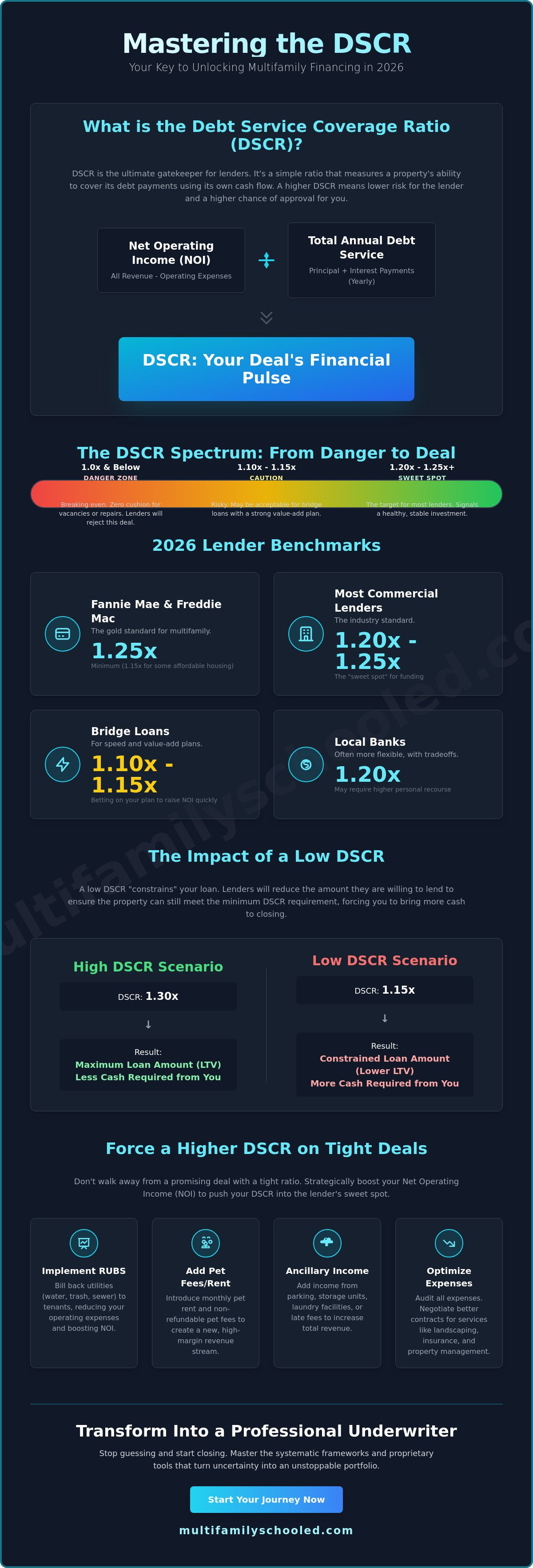
The 2026 lending environment is fast and unforgiving. You cannot afford to guess your numbers. For most commercial lenders, the "sweet spot" for a successful deal is a ratio between 1.20x and 1.25x. This is the industry standard that signals your property is healthy and your debt is manageable. If you hit this range, you are in the game. If you fall below it, you are fighting an uphill battle for funding.
Agency lenders like Fannie Mae and Freddie Mac are the gold standard for multifamily financing. In June 2026, they typically require a strict minimum DSCR of 1.25x to grant you maximum leverage. For certain mission-driven affordable housing deals, Fannie Mae may go as low as 1.15x, but don't count on that for standard market-rate assets. If you are looking for speed and flexibility over long-term stability, bridge loans might allow for 1.10x or 1.15x. These lenders are betting on your value-add plan to skyrocket the NOI quickly. Local banks often sit at 1.20x, but they will likely demand higher personal recourse in exchange for that lower cushion.
Regional and Property Class Variations
Your location and asset class change the definition of "good." Class A properties in prime markets often see lower DSCR requirements, sometimes between 1.15x and 1.20x, because lenders perceive the risk as minimal. However, if you are chasing Class C properties in secondary or tertiary markets, expect lenders to demand a higher cushion of 1.30x or more. Current 2026 interest rates are driving these benchmarks. With DSCR loans ranging from 6.1% to 8.0% and conventional bank loans reaching up to 12.75%, your margin for error has shrunk. You must underwrite with these specific 2026 rates in mind to find what is a good debt service coverage ratio multifamily lenders will actually approve today.
Global DSCR: Why Your Personal Finances Matter
Lenders don't just look at the property; they look at you. They often calculate your "Global DSCR," which is your total personal income versus your total personal debt. If you have a high-paying W2 job or other successful businesses, your personal financial strength can actually save a deal with a borderline property DSCR. This is why new investors must track their personal debt-to-income ratio with obsession. Your personal stability acts as a secondary safety net for the bank. Mastering these benchmarks is the first step toward economic empowerment. Use our Multifamily Tool Kit to stress-test your numbers against these current 2026 standards and ensure your deal is bulletproof.
The Underwriting Ecosystem: How DSCR Interacts with NOI and LTV
Lenders are not just looking at your purchase price. They are obsessively analyzing the property's ability to service the debt while maintaining a safety margin. DSCR and Loan-to-Value (LTV) are in a constant, high-stakes tug-of-war. You might qualify for a 75% or 80% LTV based on the property value, but if the cash flow is weak, the lender will "constrain" the loan. This means they will lower your LTV to ensure the DSCR stays within their required range. When asking what is a good debt service coverage ratio multifamily lenders will accept, you must realize that a "good" number on paper is worthless if it doesn't support your desired leverage.
Mastering your numbers means knowing exactly which lever to pull and when. Net Operating Income (NOI) is the primary lever you can control to directly increase your DSCR. If you can't raise the NOI, you can't raise the loan amount. Understanding this ecosystem is the difference between an amateur and a professional investor. You must become the master of your deal's destiny by controlling the data before the bank does.
The Loan Constraint Trap
Imagine you have found a deal and want 80% LTV, but the property's current cash flow only supports a 1.25x DSCR at 70% LTV. This is the loan constraint trap. In this scenario, the lender will only give you 70%, which instantly increases your "cash in deal" requirement. You suddenly need to find significantly more equity to close. This is why identifying high-yield properties from the start is vital. Use Real Estate Radar to identify high-NOI opportunities that won't get trapped by these aggressive lender constraints.
Net Operating Income (NOI) Deep Dive
NOI is the lifeblood of your investment. A $10,000 increase in annual NOI doesn't just put more money in your pocket; it exponentially increases your DSCR and your total borrowing power. However, you must be realistic. Lenders prioritize "Actual" NOI from your trailing 12-month statements over your "Pro Forma" projections. They will almost certainly "haircut" your income by 5% or more for vacancy and "pad" your expenses to create a worst-case scenario. If your deal still shows a strong DSCR after these adjustments, you have a winner. Stop guessing and start underwriting with the precision required to win in the 2026 market.
Strategic Moves: 5 Ways to Force a Higher DSCR on a Tight Deal
Don't walk away from a deal just because the bank says no. A low DSCR is a problem to solve, not a reason to quit. You are an architect of deals. If the numbers don't work, you must re-engineer them. Understanding what is a good debt service coverage ratio multifamily lenders require is only half the battle; the real pros know how to manufacture that number when the initial underwriting comes in cold. You have the power to turn a "no" into a "yes" by pulling specific strategic levers.
- Increase Revenue: Implement a Ratio Utility Billing System (RUBS) to stop bleeding cash on water and electric bills.
- Decrease Expenses: Protest your property taxes immediately or renegotiate third-party management contracts to lean out your operations.
- Buy Down the Rate: Use points to lower your annual debt service. A lower interest rate directly shrinks your denominator and explodes your ratio.
- Seller Financing: Structure a second mortgage with the seller to lower the primary debt load, making the bank feel safe and secure.
- Amortization Extensions: Push for a 30-year schedule instead of 25 to drop your monthly obligation.
The Power of RUBS and Ancillary Income
Shifting utility costs to your tenants through RUBS immediately boosts your NOI without requiring a single rent hike. You can also add value through storage units, laundry facilities, or reserved parking fees. These small additions add up fast. A mere 5% revenue bump can be the difference between a failing DSCR and a funded empire. Every dollar of income you find is magnified by the cap rate, creating massive equity and lending power out of thin air. This is how you win when others are too afraid to look closer.
Interest Rate Management
Your debt structure is a flexible tool. Interest-only (IO) periods are your secret weapon for maximizing early-year DSCR. By removing the principal component of your payment for the first 24 to 36 months, your ratio will skyrocket. This gives you the breathing room to implement your value-add plan. Negotiate with your lenders based on your track record and the strength of your business plan. With 2026 interest rates for DSCR loans sitting between 6.1% and 8.0%, every basis point you shave off matters. Stop guessing and start executing with the elite strategies found in our Mentorship Program to ensure your deals always cross the finish line.
Master the Math: How Multifamily Schooled Turns You Into a Pro
Stop playing small with your financial future. Understanding what is a good debt service coverage ratio multifamily lenders require is the baseline, but executing on that knowledge is where real wealth is built. The difference between a dream and a deed is your ability to analyze numbers with absolute precision. You cannot afford to guess when millions of dollars are on the line. It is time to stop being an observer and start being an operator who commands respect from lenders and partners alike.
We provide more than just information; we provide a battle-tested blueprint for economic empowerment. Our system is designed to take the complexity out of underwriting and replace it with a clear, strategic path to asset accumulation. You deserve a mentor who has already walked the path and can show you the shortcuts. By joining our movement, you gain immediate access to the proprietary methods that turn average deals into funded empires.
The 90-Day Deal Challenge
Our Mentorship Program simplifies deal analysis so you can move with speed and confidence. We don't just teach theory; we focus on tangible results. This is an action-oriented environment where you get eyes on your deals from mentors who have closed thousands of units. They help you identify the hidden risks and find the levers to pull to ensure your DSCR meets the 2026 benchmarks we've discussed. We stand by our results with a "No-Fail" guarantee. We help you find the deal, or we provide it. You are joining an elite community of investors who are closing 50+ unit deals right now, proving that success is attainable for anyone who follows the prescribed system.
Your Next Step to Financial Freedom
The path to long-term independence starts with a single, decisive action. Stop being an amateur who gets rejected by banks and start being a professional underwriter. Your journey to mastery begins with the right tools. Download our Multifamily Tool Kit for deal analysis today. This kit allows you to stress-test your numbers and determine what is a good debt service coverage ratio multifamily property owners need to secure high-leverage financing in the current market. Do not let hesitation steal your momentum. The 2026 market is full of opportunity for those who are prepared to seize it. Start your journey today and unlock the prosperous future you have always envisioned.
SECURE YOUR FUNDING AND SCALE YOUR EMPIRE
The days of guessing your way through a deal are over. You now know that a 1.25x ratio is your golden ticket to agency funding. You understand that your Net Operating Income is the most powerful lever you can pull to force a deal to work. Mastering what is a good debt service coverage ratio multifamily lenders require in 2026 has moved you from an amateur spectator to a strategic operator. You are ready to command this market with absolute precision.
Don't let this momentum fade away. Your path to total financial independence is open. Gain immediate access to our proprietary Deal Finding Software and receive expert, mentor-led deal reviews to ensure your underwriting is bulletproof. We guarantee you will find a deal in 90 days. It is time to stop dreaming and start closing.
Join the Mentorship Program and Find Your First Deal in 90 Days!
The life of economic empowerment you desire is within your reach. Follow our proven system, trust the math, and take the leap today. Your future starts the moment you decide to act.
Frequently Asked Questions
What is the minimum DSCR for a multifamily loan in 2026?
The standard minimum for most commercial lenders in 2026 is between 1.20x and 1.25x. Agency lenders like Fannie Mae and Freddie Mac strictly demand 1.25x for most conventional assets. Some mission-driven affordable housing deals may allow for 1.15x, but you should always aim for the 1.25x benchmark. Securing this ratio ensures you have the safety margin required to protect your investment and satisfy your lender's risk requirements.
Can I get a loan if my property DSCR is below 1.0?
You cannot secure a traditional permanent loan if your DSCR is below 1.0 because the property is not generating enough income to cover its own debt. This is a red flag that signals imminent default to any bank. If your deal sits in this danger zone, you must utilize bridge financing or seller carry-back notes to improve the property's performance. Once you stabilize the asset, you can refinance into a long-term loan.
How does an interest-only period affect my DSCR?
An interest-only period dramatically increases your actual cash flow by removing the principal portion of your debt service. This lower payment makes your ratio look much stronger on a cash basis during the initial years of your deal. However, most lenders will still qualify your deal based on the higher, fully amortizing payment. Use the interest-only phase to aggressively reinvest in the property and skyrocket your Net Operating Income immediately.
What is the difference between DCR and DSCR?
There is no functional difference between Debt Coverage Ratio (DCR) and Debt Service Coverage Ratio (DSCR). They are interchangeable terms used by industry professionals to describe the same pulse-check metric. Both calculations divide your Net Operating Income by your total annual debt obligations. Whether you use DCR or DSCR, the goal remains the same: proving your property can easily afford its mortgage while leaving a healthy profit for you.
Does a higher DSCR mean a better investment?
Not always. While a high ratio provides a massive safety cushion, it might also mean you are under-leveraged and missing out on higher returns. Understanding what is a good debt service coverage ratio multifamily investors should target requires a balance between safety and leverage. A 2.0x ratio is safe, but it often means your capital is not working as hard as it could. Aim for the sweet spot where you maximize leverage without sacrificing security.
How often do lenders check the DSCR after the loan is closed?
Most commercial lenders will require you to submit annual financial statements to verify your DSCR stays above a specific covenant. Some aggressive lenders may even check quarterly for larger, more complex deals. If your ratio falls below the agreed-upon threshold, the lender can trigger a "cash trap" where they hold your excess profits. Maintain your operations with discipline to ensure you never violate these critical loan covenants.
How do interest rate hikes impact my property DSCR?
Interest rate hikes increase your annual debt service and directly crush your DSCR. With 2026 interest rates for DSCR loans currently ranging from 6.1% to 8.0%, your margin for error is thin. You must offset these rising debt costs by aggressively increasing your revenue or slashing operating expenses. If you don't control your income, the rising cost of capital will eventually erode your equity and put your deal at risk.
What expenses are excluded when calculating NOI for DSCR?
You must exclude debt service, depreciation, and large capital expenditures from your NOI calculation. These items are not part of the day-to-day operating costs of the building. Focus only on your gross potential rent minus vacancy, taxes, insurance, and utilities. Mastering this specific math is the first step toward becoming a professional operator. It allows you to see the true earning potential of any apartment complex before you commit your capital.



