

Value Add Apartment Investing Examples: Manufacturing Equity in 2026
Stop waiting for the market to hand you a win and start manufacturing your own wealth. In a 2026 environment where commercial mortgage rates can reach 8.75%, passive investors are watching their margins vanish. You don't have to be one of them. You've likely felt the sting of stagnant cash flow or the paralyzing fear of over-improving a building without seeing a return. It's a common trap to get lost in the confusion of cap rate math while searching for deals that actually have meat on the bones. Mastering real value add apartment investing examples is the difference between a hobby and a high-performance business.
I'm here to tell you that success isn't about luck; it's about a proven system. This guide breaks down the exact strategies that industry leaders use to force appreciation regardless of market cycles. You'll master the techniques to turn underperforming units into high-yield assets that pay you for years. We're diving deep into a clear list of high-ROI upgrades and the specific math required to scale your portfolio fast. This is your blueprint to find, fix, and flip the script on your first value-add deal today.
Key Takeaways
- Master the math of forced appreciation to manufacture equity and grow your Net Operating Income in any market cycle.
- Implement high-impact renovation strategies like the "Kitchen and Bath" rule to secure maximum rent premiums immediately.
- Scale your revenue without a hammer by optimizing operational efficiencies and professionalizing property management systems.
- Study real-world value add apartment investing examples to identify underperforming buildings with massive upside potential.
- Launch your 90-day execution blueprint to assemble a power team of brokers, lenders, and contractors for rapid results.
The Value-Add Philosophy: Why You Must Manufacture Equity
Value-add is not a suggestion; it is a survival tactic. It is the deliberate process of increasing a property's Net Operating Income (NOI) through strategic improvements. While others pray for market appreciation, you take control. Forced appreciation allows you to dictate the value of your asset by improving its performance. This isn't passive waiting. It is aggressive wealth creation. Looking at value add apartment investing examples reveals that the most successful investors don't wait for the tide to rise. They build their own ship.
The market in 2026 demands this level of precision. With commercial mortgage rates for multifamily buildings currently ranging from 5.46% to 8.75%, your margins are under attack. You cannot afford to buy a property that just sits there. You need a 90-day deal finding mindset to identify assets where you can immediately cut fat and boost revenue. If you aren't manufacturing equity, you are losing it to the cost of capital. Success starts with the hunt.
To better understand this concept, watch this helpful video:
Core vs. Value-Add: Choosing Your Strategy
Buying a "turnkey" property is a Core strategy. It's safe, but it's slow. These properties offer low risk and equally low rewards. If you want to transform your financial future, you must target the value-add sweet spot. These are assets with 20% to 30% upside potential hidden beneath the surface. You are moving beyond basic real estate investment strategies and entering the world of high-performance equity growth. "Tired" assets, often ignored by institutional buyers, are your gold mine. They represent the fastest path to long-term independence.
The "Diamond in the Rough" Mindset
Stop looking at what a building is. Start looking at what it could be. You must look past peeling paint and stained carpets to see the strong bones underneath. Many "mom and pop" owners are "lazy" sellers who have ignored deferred maintenance for decades. These are the opportunities you want. While you can renovate a unit, you can't move the dirt. Focus on prime locations with sub-par management. Study successful value add apartment investing examples to train your eye. Use tools like Real Estate Radar to find these off-market gems before the competition wakes up. Your future is hidden in the properties others are too afraid to touch.
Physical Value-Add Examples: High-Impact Renovation Strategies
Physical transformation is the fastest way to force appreciation. You aren't just painting walls; you are engineering a lifestyle that tenants will pay a premium to join. Successful value add apartment investing examples always start with the "Kitchen and Bath" rule. These two rooms determine the majority of a tenant's decision. If you win here, you win the lease. In 2026, a cosmetic refresh averages $50 to $150 per square foot. This makes it a highly accessible entry point for massive gains without the cost of a full gut renovation.
Ditch the outdated "landlord beige." The market has moved toward sophisticated grey and white palettes. This shift creates a clean, modern feel that justifies immediate rent bumps. Don't forget the "jewelry" of the unit. Swapping out old hardware for matte black or brushed nickel is a low-cost move with high-impact results. Combine this with bright LED lighting to make the space pop. It is one of the many proven ways to invest in real estate that professional operators use to stay ahead. If you want the full list of renovation specs, check out our Multifamily Tool Kit to streamline your next project.
Interior Upgrades That Drive Rent Premiums
Choose your materials wisely to maximize ROI. Quartz countertops are the gold standard for durability and aesthetic appeal. While they cost more than laminate, the rent premium and longevity often pay for the upgrade in less than two years. Pair these with stainless steel appliance packages to attract high-quality tenants who treat the property with respect. For flooring, Luxury Vinyl Plank (LVP) is non-negotiable. It offers the high-end look of wood with the waterproof durability required for rental environments. These choices reduce long-term maintenance costs while driving top-of-market rents.
Amenity Addition: Creating Community Value
Look beyond the four walls of the apartment to build community value. Adding "lifestyle" features like dog parks, BBQ stations, or secure package lockers creates a stickier tenant base. You can also convert underutilized basement space or old storage rooms into a small fitness center or a co-working hub. This is especially effective in 2026 as remote work remains a staple. Don't overlook the power of "private" amenities. Fencing in small backyards for ground-floor units can command a significant monthly premium. These value add apartment investing examples turn a standard building into a destination, allowing you to manufacture equity through increased demand and lower vacancy.
Operational Value-Add: Boosting NOI Without a Hammer
Most investors think they need a sledgehammer and a dumpster to create value. They're wrong. Operational value-add is the art of increasing your Net Operating Income (NOI) through pure business engineering. It's about finding the leaks in the bucket and plugging them fast. When you study successful value add apartment investing examples, the most profitable deals often involve zero structural changes. They simply involve professionalizing a "mom and pop" operation that has been neglected for years. This is where you turn a stagnant building into a high-performance wealth machine.
You must move with speed and precision. Implementing tech-enabled leasing reduces your vacancy time and slashes your marketing costs. Use advanced tools like Real Estate Radar to identify exactly where your property sits compared to the market. If your rents are $200 below market because the previous owner didn't want to "bother" the tenants, you've found a gold mine. This data-driven approach is essential for any value-add multifamily property in 2026. Stop guessing and start using the data to manufacture your equity.
Revenue Maximization and Ancillary Income
Stop leaving money on the table. Implementing a Ratio Utility Billing System (RUBS) allows you to pass through water, sewer, and trash costs directly to the tenants. This immediately boosts your bottom line without a massive base rent hike. You should also look at ancillary income streams. Charge for premium covered parking, on-site storage units, or monthly pet rent. Even a "Smart Home" package with keyless entry and smart thermostats can command a $25 to $50 monthly premium. These small wins stack up to massive equity gains when you apply the cap rate math.
Expense Reduction: Trimming the Fat
Trimming the fat is just as important as growing the top line. Start with energy efficiency audits. Replacing old bulbs with LEDs and installing low-flow toilets can slash your utility bills by 15% or more. Don't accept the first quote you get; negotiate your vendor contracts for landscaping, trash removal, and insurance. Finally, focus on tenant retention. Turnover is the ultimate profit killer. Proactive maintenance and community engagement keep tenants in place. This saves you thousands in leasing fees and prep costs every single year. Use these value add apartment investing examples to tighten your operations and maximize your take-home pay.
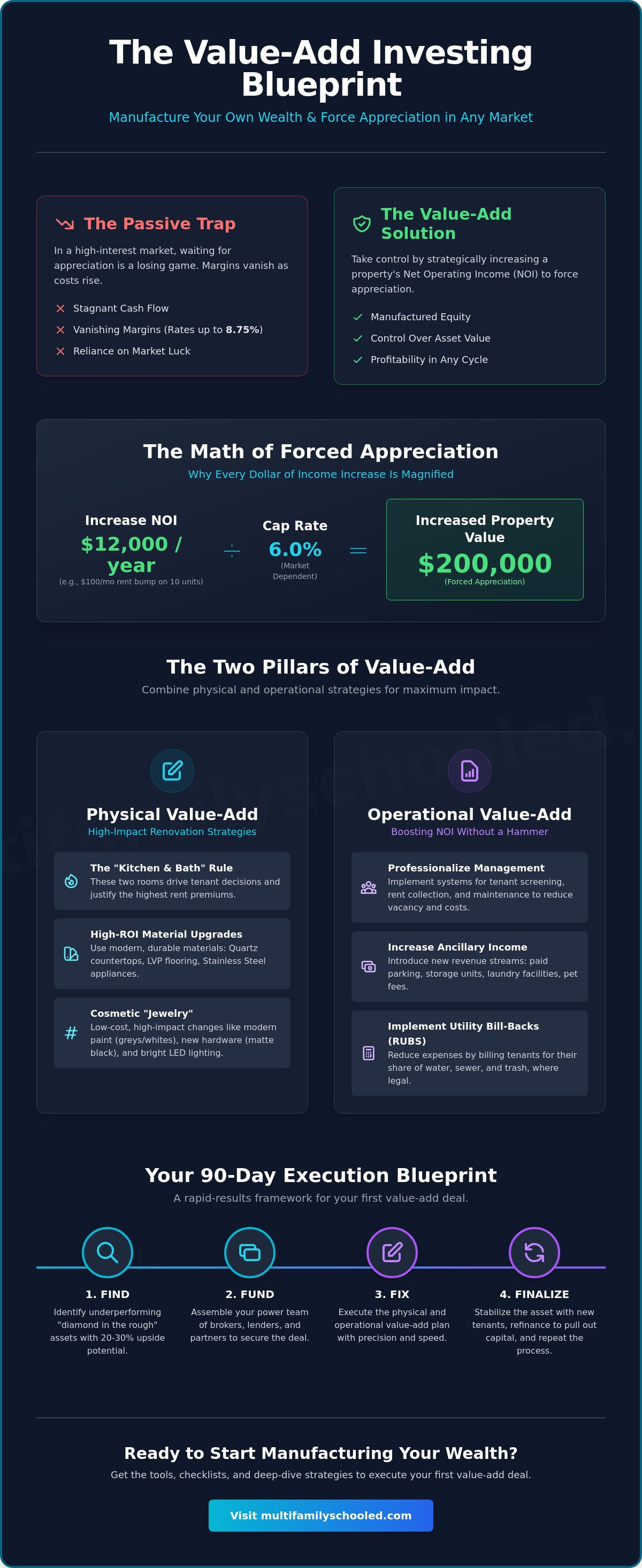
The Math of Forced Appreciation: Why Every Dollar Counts
Commercial real estate isn't a guessing game. It is a math game. Unlike residential houses where value depends on what the neighbor's house sold for, apartment value depends on the income you produce. The formula is simple: Net Operating Income (NOI) divided by the Cap Rate equals your Property Value. Cap Rate is the yield an investor expects for a specific risk level. When you understand this, you stop being a spectator and start being a manufacturer of wealth. This is the core of all successful value add apartment investing examples.
Think about the scale. Imagine you own a 100-unit building. You implement a few of the strategies we've discussed and raise the rent by just $50 a month per unit. That is an extra $5,000 in your pocket every month. That is $60,000 in new annual income. In a market with a 6% cap rate, that $50 raise just added $1,000,000 to your property's value. You didn't wait for a market boom. You forced that appreciation through smart execution.
This is the "Multiplier Effect" in action. Every single dollar you save in expenses or add in revenue is worth $15 to $20 in total asset value. If you cut a redundant $100 monthly expense, you haven't just saved $1,200 a year. You've increased your net worth by $20,000. Stop looking at small numbers. Start looking at the massive equity they represent. To master these calculations and start hunting your own deals, join our Mentorship Program today.
The Forced Appreciation Calculator
Let's look at a concrete example. Suppose you increase your monthly NOI by $1,000 through better management or unit upgrades. In a 6% cap rate market, the math is clear: $12,000 in annual NOI increase divided by 0.06 equals $200,000 in brand new equity. This income-based appraisal is why multifamily investing is superior to single-family. You control the outcome. You aren't at the mercy of "comps." You are the one setting the standard.
Refinancing: The "BRRRR" for Apartments
The ultimate goal of any value-add project is the "refi and hold." Once you've increased the NOI, you get a new appraisal based on that higher income. You can then transition from high-interest bridge debt to long-term agency financing, which currently sees rates in the 5.3% to 6.0%+ range. This allows you to pull your initial capital out tax-free. When you have all your original money back and still own the cash-flowing asset, you've achieved "infinite returns." That is how you build a legacy.
Executing Your Value-Add Strategy: The 90-Day Blueprint
The clock is ticking. 2026 is the year of the operator, not the spectator. With new apartment deliveries expected to hit their lowest levels since 2014, the window to acquire and reposition assets is wide open. Stop over-analyzing and start hunting. The market rewards those who move with speed and precision. You have seen the value add apartment investing examples that create millions in equity. Now, it is time to execute your own. Manufacturing equity is a life-transforming journey that requires a decisive first step.
You cannot do this alone. You must build your "Power Team" immediately. This includes hungry brokers who bring you off-market deals, sharp lenders who understand the 2026 rate environment, and reliable contractors who hit their deadlines. Speed is your greatest asset. Use the Multifamily Tool Kit to analyze deals in seconds rather than hours. This tool ensures you only spend time on properties with actual "meat on the bones." Mentorship is the final piece of the puzzle. It is the only way to avoid the "rookie" renovation mistakes that can swallow your profits before you even finish the first unit.
Finding the Right Value-Add Deal
Great deals are found, not given. You must master direct-to-seller marketing while simultaneously cultivating pocket listings from top-tier brokers. Target "High-C" properties located in "B" neighborhoods. These are assets with significant deferred maintenance but located in areas where tenants already demand a premium lifestyle. This gap is where your profit lives. Leverage Real Estate Radar to identify these off-market opportunities before they ever hit the public portals. This proactive approach allows you to secure value add apartment investing examples with built-in equity from day one.
The Multifamily Schooled Mentorship Advantage
We don't believe in "some day." We believe in 90 days. Our system is designed to get you a deal under contract within your first three months of focused effort. You gain immediate access to proven renovation templates, vendor lists, and the strategic support needed to navigate complex closings. We provide the blueprint; you provide the action. Ready to build your legacy and secure your financial future? Apply for our Mentorship Program today and start manufacturing the equity you deserve.
Claim Your Stake in the 2026 Market
You now have the blueprint to stop wishing for market growth and start forcing it. By mastering the value add apartment investing examples we've covered, you're no longer at the mercy of interest rates or economic shifts. You understand that every dollar saved in expenses and every rent premium earned through strategic renovations is a direct injection of equity into your portfolio. The math is on your side. The opportunity is right in front of you. It's time to stop being a spectator and start being an operator.
Don't let another month slip away while others build their legacies. You can achieve deal-ready status in just 90 days with our proven system for finding off-market multifamily assets. We provide the tools you need to win, including our proprietary Real Estate Radar software to pinpoint high-upside opportunities before the competition even wakes up. Find your first apartment deal in 90 days; join the Mentorship Program today. Your journey to long-term independence starts with a single, decisive action. We are ready to provide the path. Success is waiting for you.
Frequently Asked Questions
What is a typical budget for a value-add apartment renovation?
A typical budget depends on your scope, but a cosmetic refresh in 2026 averages $50 to $150 per square foot. For a mid-range renovation, expect to invest between $150 and $300 per square foot. These figures are essential when studying value add apartment investing examples to ensure your projections stay realistic. Always include a 10% to 15% contingency fund to handle unexpected site conditions or material price shifts during the project.
How long does a value-add execution usually take?
A full value-add execution typically spans 12 to 24 months depending on the unit count and your vacancy rate. You want to renovate units as they become vacant to maintain cash flow throughout the process. Speed is your ally. Implementing a 90-day stabilization plan for operational fixes can provide immediate results while you work through the physical interior upgrades. Stay aggressive and keep your contractors on a strict, high-performance timeline.
Can I do a value-add project on a small 4-unit property?
You can absolutely execute a value-add strategy on a 4-unit property because the principles of forced appreciation remain the same. While smaller buildings don't offer the same "Multiplier Effect" as a 100-unit complex, a $100 rent increase still significantly boosts your asset's valuation. It's a perfect training ground to master your systems before scaling up. Start small, prove the concept, and then move into larger multifamily assets to build your legacy.
What is the biggest risk in value-add apartment investing?
The biggest risk is over-improving a property beyond what the local submarket can support in rent premiums. You must know your ceiling. If the highest rent in the neighborhood is $1,500, spending extra on luxury fixtures won't get you to $1,800. Miscalculating renovation costs or failing to account for the current 5.46% to 8.75% interest rate environment can also crush your returns. Precision in your initial analysis is mandatory for success.
How do I find contractors for a large-scale multifamily renovation?
Find reliable contractors by leveraging referrals from local apartment associations or your professional brokerage network. Don't just hire a residential handyman for a commercial-scale project. You need crews familiar with the speed and durability requirements of multifamily housing. Verify their licenses, check recent project completions, and always bid the job out to at least three different firms. This ensures competitive pricing and clear, enforceable timelines for your renovation.
Is it better to do interior or exterior renovations first?
Start with exterior renovations to immediately transform the property's curb appeal and signal a change in management. Making the building look safe and premium from the street attracts higher-quality applicants before they even see a unit. Once the exterior is stabilized, move into interior value add apartment investing examples like the "Kitchen and Bath" rule. This sequence maximizes your marketing efforts and reduces your initial vacancy time while you manufacture equity.
What is a "heavy" vs "light" value-add strategy?
A light value-add focuses on cosmetic interior refreshes and operational efficiency gains like implementing a utility billing system. A heavy value-add involves structural changes, gut renovations, or solving major deferred maintenance issues. Light strategies are faster and lower risk for new investors. Heavy projects offer massive equity upside but require more capital and a veteran power team. Choose the strategy that matches your current risk tolerance and available capital resources.
How do interest rates affect the value-add exit strategy?
Higher interest rates, currently ranging from 5.46% to 8.75%, require you to be more aggressive with your forced appreciation math. You must increase the NOI significantly more than in a low-rate environment to achieve a profitable exit or refinance. These rates make the "refi and hold" strategy more challenging. You need a rock-solid operational plan to ensure your new appraisal value supports pulling out your initial capital tax-free when you transition to long-term financing.



