

Underwriting Multifamily Renovation Costs: 2026 Guide
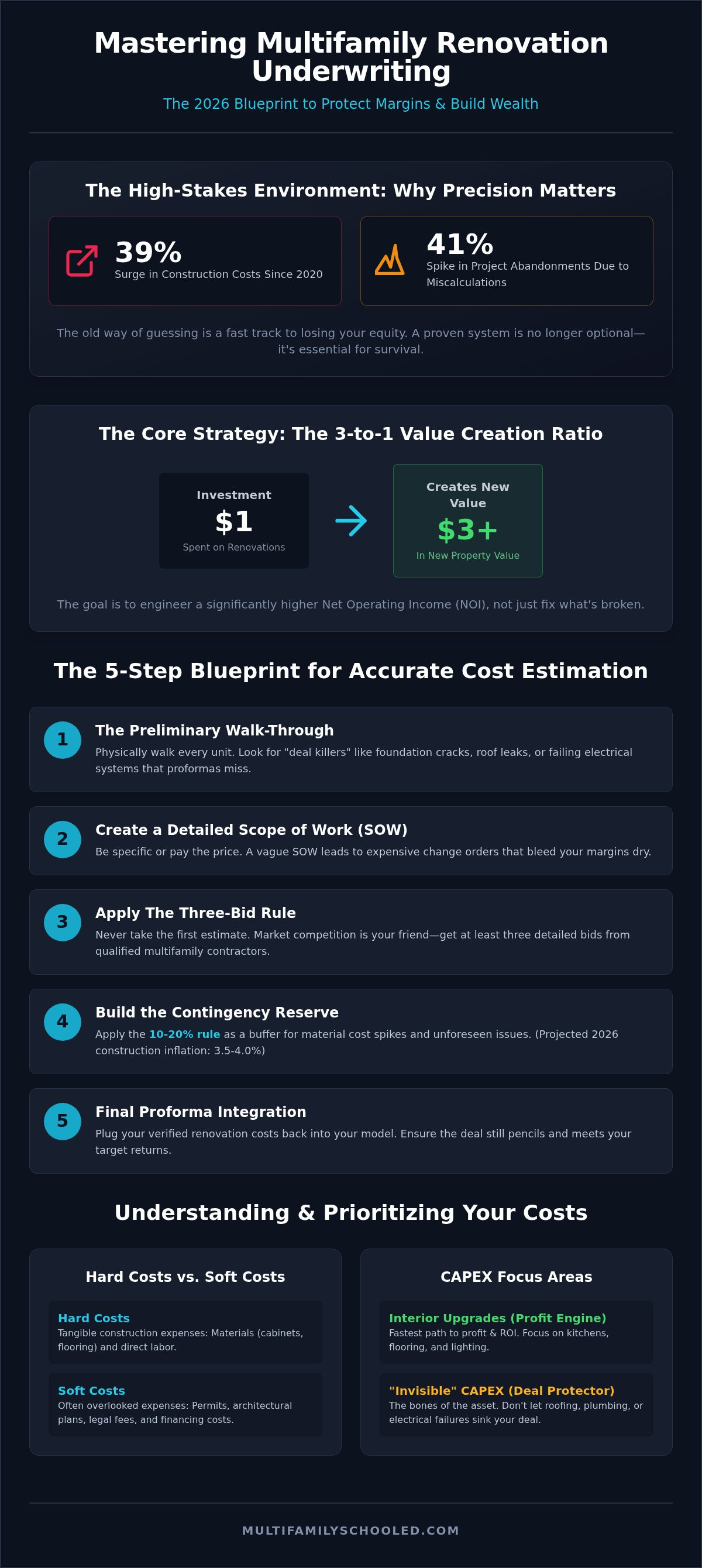
Construction costs have surged 39% since 2020; by late 2025, project abandonments spiked by a staggering 41%. These aren't just numbers. They are the graveyard of deals that lacked a bulletproof system. You know the gut-punch of a surprise structural issue or a contractor bid that doubles overnight. Inflation-driven material spikes are the new reality, and the old way of guessing is a fast track to losing your equity and your reputation.
It is time to stop the guesswork and start winning. You are here because you want to master how to underwrite multifamily renovation costs with surgical precision. This 2026 guide delivers the exact, repeatable system you need to protect your margins and build long-term wealth. We are handing you the blueprint to estimate costs accurately, even when budgets tighten and markets shift. It is about taking control of your financial destiny.
You will learn the latest 2026 cost benchmarks, how to build an ironclad contingency plan for budget overruns, and the specific steps to present your numbers to lenders with total authority. Stop fearing the hidden costs. Start dominating the deal with a proven framework. Let's get to work.
Key Takeaways
- Target a 3-to-1 value creation ratio by mastering the bridge between current property value and future equity growth.
- Use our 5-step blueprint for how to underwrite multifamily renovation costs to spot structural red flags before they cost you a fortune.
- Deploy value engineering strategies to swap high-cost materials without sacrificing the rent premiums your investors expect.
- Leverage the 2026 tech stack to combine the deep "DNA" analysis of spreadsheets with the rapid speed of AI parsing tools.
- Secure lender confidence by having industry pros double-check your budget through our elite mentorship and 90-day deal system.
Underwriting Renovations: The Foundation of Multifamily Value-Add Wealth
Underwriting is the engine of your real estate empire. It is the bridge between a property's current state and its future equity. To understand What is underwriting in a multifamily context, you must see it as a strategic map for wealth creation. Mastering how to underwrite multifamily renovation costs is no longer just a "good skill" to have. In 2026, it is the only way to survive. You aren't just looking at numbers on a screen; you're predicting the future of an asset and protecting your capital from market volatility.
The "Value-Add" strategy is your secret weapon for rapid wealth accumulation. The goal is simple: for every $1 you spend on renovations, you should create $3 or more in new property value. You aren't just fixing what's broken; you're engineering a significantly higher Net Operating Income. This requires a ruthless focus on two distinct categories:
- Hard Costs: These are the tangible construction expenses, including materials like cabinets and flooring, plus the direct labor to install them.
- Soft Costs: These are the often-overlooked expenses like permits, architectural plans, legal fees, and financing costs that can sink a deal if ignored.
Winging it is a recipe for disaster in the current economic climate. Construction costs have climbed roughly 39% since 2020, which means your margins for error have vanished. Investors who guess their numbers are the ones facing foreclosure today. You must be systematic, precise, and urgent in your estimation to protect your downside and ensure your project remains profitable from day one.
The Role of NOI in Renovation Math
Every dollar you invest must move the needle on your Net Operating Income (NOI). High-quality renovations justify rent premiums that tenants are eager to pay. If a $6,000 unit refresh allows you to raise rent by $250 a month, you've just unlocked massive value. This isn't just about monthly cash flow; it's about the total exit price. Cap Rate compression in this context refers to the increase in property value that occurs when you improve the asset quality and risk profile, allowing it to trade at a lower yield.
Interior vs. Exterior CAPEX Underwriting
Interior upgrades are your fastest path to profit. Focus on modern kitchens, durable flooring, and energy-efficient lighting to grab the highest ROI. When you are learning how to underwrite multifamily renovation costs, you'll find that interior work is generally easier to scale and predict because it follows a repeatable pattern across the building. But don't let "Invisible CAPEX" sink your ship. Roofing, plumbing, and electrical systems are the bones of the asset. If they fail, your fancy kitchens won't matter to a lender or a buyer. Exterior overhauls, while impactful for curb appeal, often hide structural red flags that can double your budget in a heartbeat. If you want your renovation budget double-checked by pros before you close, our Mentorship Program provides the expert oversight you need to move with absolute confidence.
The 5-Step Blueprint for Accurate Renovation Cost Estimation
Data clouds cannot smell mold. AI parsing tools might give you a head start, but they cannot spot termite damage or outdated aluminum wiring hidden behind a fresh coat of paint. To succeed in the 2026 market, you need a physical presence and a ruthless process. Learning how to underwrite multifamily renovation costs requires moving beyond the spreadsheet and into the units. Follow this blueprint to eliminate the guesswork and protect your capital.
- Step 1: The Preliminary Walk-Through. Stop guessing. Walk every unit if possible. Look for the "deal killers" like foundation cracks, roof leaks, or failing electrical systems that your proforma didn't account for.
- Step 2: Creating the Scope of Work (SOW). Be specific or pay the price later. A vague SOW leads to expensive change orders that bleed your margins dry.
- Step 3: The Three-Bid Rule. Never take the first estimate. Market competition is your friend; get at least three detailed bids from qualified multifamily contractors.
- Step 4: Building the Contingency Reserve. Apply the 10-20% rule. With projected construction inflation hitting 3.5% to 4.0% in 2026, you must have a buffer for material cost spikes.
- Step 5: Final Proforma Integration. Does the deal still pencil? Plug your verified renovation costs back into your model. Ensure your Debt Service Coverage Ratio stays above 1.25x even with current loan rates.
Mastering the Scope of Work (SOW)
Itemize every unit type by floor plan. Don't just say "kitchen refresh." Specify the cabinet style, the exact flooring brand, and the lighting fixtures. Standardized finishes across your portfolio make maintenance easier and allow you to buy materials in bulk. This level of detail is how you ensure renovations pay off and keep your exit cap rate in the 5.5% to 7.0% range. To start with professional templates, grab our Multifamily Tool Kit.
Vetting Your General Contractor (GC)
Ask about their multifamily history. A residential house flipper is not an apartment pro. You must verify their insurance and call their three most recent project references. Adopt a "Trust but Verify" mindset. Audit their material cost assumptions against current market rates. If you want a pro to double-check your budget before you sign, our Mentorship Program offers the direct feedback you need to move with absolute certainty.
What to Do When Your Renovation Goes Over Budget
The hammer has hit the nail, and the budget is bleeding. Project abandonments surged 41% in late 2025 because investors failed to prepare for the reality of a shifting market. If you didn't master how to underwrite multifamily renovation costs with a proper buffer, you're now playing defense. You must act with urgency to stop the leak before it swallows your equity. This isn't the time for panic; it's the time for a ruthless tactical audit.
Isolate the source of the overrun immediately. Is it a material cost spike driven by 2026 inflation? Is it labor inefficiency? Or is it the "while we're at it" disease of scope creep? You cannot fix what you haven't quantified. Once you identify the leak, you must choose between value engineering or a strategic pause to protect your Net Operating Income.
Value Engineering Your Way to Safety
Value engineering isn't about being cheap; it's about being smart with your capital. Identify materials where "good enough" still commands the rent premium you need. Focus on these three high-impact swaps:
- Flooring: Use high-quality Luxury Vinyl Plank (LVP) instead of tile to save on both material and labor.
- Cabinets: Reface existing boxes with modern doors rather than a full tear-out and replacement.
- Fixtures: Move from designer brands to standardized, mid-range stainless steel packages that look identical to tenants.
Renegotiate with your vendors by offering volume-based incentives for your next project or the remaining phases of the current one. Labor efficiency is the hidden budget killer because disorganized staging forces you to pay for idle hours while your crew waits for delayed material shipments. If your budget is spiraling, our Mentorship Program can help you audit your numbers and pivot before it's too late.
Managing Investor Expectations
Transparency is your only path to maintaining trust. Report budget variances effectively by explaining the "why" and presenting the solution simultaneously. Update your cash-on-cash return projections in real-time so your partners see the long-term vision despite the short-term hurdle. You must decide early if you will tap into your operating reserves or initiate a capital call. A well-managed operating reserve is usually the preferred shield, but it requires you to have planned for this during the initial underwriting phase. If the numbers no longer support the full renovation, use the "Pause and Pivot" strategy. Stop the interior turns, stabilize the property with current tenants, and wait for the market to catch up to your projections.
Tech vs. Tradition: Choosing Your Multifamily Underwriting Toolset
Speed is the currency of the 2026 multifamily market. If you spend three days manually entering data into a legacy spreadsheet, the deal is already gone. A competitor has already analyzed it, toured it, and submitted an LOI. Mastering how to underwrite multifamily renovation costs requires a balance between raw speed and surgical precision. You need a toolset that allows you to move fast without missing the red flags that lead to financial ruin.
Manual spreadsheets are the foundational DNA of any great investor. They force you to understand the "why" behind every formula. However, they are prone to human error and are far too slow for high-volume deal flow. On the other end of the spectrum, AI parsing platforms like Archer and PropRise offer incredible speed. They can digest a T-12 and Rent Roll in seconds. But software is a tool; it is not a mentor. It lacks the strategic "gut check" needed to identify if a renovation plan actually makes sense for a specific submarket.
Why Real Estate Radar Changes the Game
Success starts with the right pipeline. Real Estate Radar is our proprietary solution designed to feed your underwriting engine with high-probability opportunities. Instead of wasting time on "dry" deals, this software filters for properties with clear value-add potential. It reduces analysis paralysis by highlighting where the gaps between current and market rents are the widest. This system integrates seamlessly with the expert templates and calculators found in our Store, giving you a complete ecosystem to scale your acquisitions. You can move from finding a deal to having a verified renovation budget in record time.
The Danger of "Garbage In, Garbage Out"
Blind reliance on AI data clouds is a dangerous trap. If the software uses outdated material costs or incorrect market comps, your entire proforma is a lie. You must use tech to stress-test your assumptions, not replace your judgment. Verify your renovation costs against the 3.5% to 4.0% construction inflation rates projected for 2026. Use software to run multiple "what-if" scenarios: what happens to your 1.25x DSCR if labor costs jump another 10%? The hybrid approach is the only way to win. Use technology for the heavy lifting, but rely on human expertise for the final "Yes" or "No." Stop guessing and start using the tools that guarantee your success. Get started with Real Estate Radar today.
Stop Guessing: How Our Mentorship Guarantees Your Underwriting Accuracy
You have seen the data. You know the 2026 market is unforgiving. Relying solely on a model you downloaded online is a gamble with your financial future. Mastering how to underwrite multifamily renovation costs isn't just about formulas; it's about real-world accountability. You need a partner who has been in the trenches and seen every structural surprise imaginable. Stop being a student of the industry. Start being an owner who moves with absolute conviction. This is your chance to join a movement of high-achievers who refuse to let market volatility dictate their success.
The difference between a "good deal" and a "deal of a lifetime" often comes down to the quality of your counsel. While software can parse a spreadsheet, it cannot tell you if a contractor is padding their bid or if a submarket is cooling. We provide the strategic "gut check" that turns a risky project into a wealth-generating asset. You aren't just buying a course; you're gaining a professional oversight team that ensures your renovation budget is bulletproof before you ever commit capital.
The 90-Day Roadmap to Your First Building
Our Mentorship Program isn't a passive experience. It is a high-octane results factory. We provide a systematic roadmap designed to take you from searching to closing in just 90 days. A mentor is the best insurance policy you can buy against a bad renovation budget. While others are paralyzed by "what-ifs," you will have a pro double-checking your numbers. We help you find the deal, verify the math, and navigate the complexities of 2026 financing. Apply for Mentorship Today and stop leaving your legacy to chance.
Direct feedback is the key to mastering how to underwrite multifamily renovation costs. You will also gain immediate access to our national network of vetted GCs and vendors. In a market where construction costs have jumped 39% since 2020, knowing exactly who to hire is the difference between a successful value-add and a financial nightmare. We provide the human expertise and the accountability that spreadsheets simply cannot offer.
Real Success Stories
We have watched countless investors make the leap from a "single-family mindset" to true multifamily mastery. The shift is psychological. It moves you from a place of fear to a state of calculated confidence. Our students aren't just looking at units; they are building multi-generational empires. They use our proprietary frameworks to navigate 2026's 3.5% to 4.0% inflation rates with ease. They don't panic when they see a structural red flag because they have the system to price it and the network to fix it. Seize the 2026 market opportunities now. Your life-transforming journey starts the moment you stop guessing and start following a proven blueprint.
Seize Your 2026 Multifamily Empire Today
Success in this market isn't about luck; it's about a repeatable system. You've learned that accurate underwriting is the bridge to massive equity. Mastering how to underwrite multifamily renovation costs allows you to protect your margins while others succumb to inflation and hidden structural risks. You now have the blueprint to spot red flags, vet contractors, and pivot when budgets tighten. It's time to stop being a spectator and start building your legacy.
Don't let analysis paralysis hold you back. We provide the tools, the network, and the multi-generational real estate expertise you need to win. With our proprietary Real Estate Radar software and a 90-Day Deal Guarantee, we eliminate the guesswork. You aren't just buying a building; you're securing your long-term independence. Join the Mentorship Program and Find Your First Deal in 90 Days. Your journey to multifamily mastery starts right now. Success is within your reach.
Frequently Asked Questions
How much should I budget per unit for a multifamily renovation in 2026?
Budgeting depends on your specific scope; cosmetic refreshes cost significantly less than full gut renovations. With construction costs up 39% since 2020, you must use current local bids rather than outdated averages. Factor in the projected 2026 construction inflation rate of 3.5% to 4.0% to ensure your numbers stay realistic. Always verify these costs with a local contractor before finalizing your proforma to protect your investment margins.
What is the difference between hard costs and soft costs in underwriting?
Hard costs cover the tangible aspects of construction, including materials like flooring and cabinets plus the labor to install them. Soft costs include the "invisible" expenses such as permits, architectural fees, legal costs, and financing points. When learning how to underwrite multifamily renovation costs, you must account for both categories. Ignoring soft costs is a common mistake that can lead to a 10% to 15% budget shortfall before you even break ground.
Should I use a General Contractor or manage the renovation myself?
Hiring a General Contractor is usually the smartest move for investors who want to scale quickly. A GC provides a single point of accountability and established vendor relationships, which are vital for hitting a 90-day stabilization goal. Self-managing might save a small percentage on fees, but it often leads to costly delays and disorganized staging. Focus on being an owner and strategist while letting a professional team handle the daily construction headaches.
What happens if my renovation budget exceeds my construction loan?
You must immediately look to your contingency fund or operating reserves to cover the gap. If the shortfall is massive, you may need to initiate a capital call or "value engineer" the remaining units to reduce expenses. Lenders typically require a minimum Debt Service Coverage Ratio of 1.25x. If your overruns threaten this ratio, you risk defaulting on your loan terms. Act quickly to stabilize the project and protect your equity.
How do I account for inflation in a 12-month renovation project?
Account for inflation by building an escalation clause into your contractor agreements or increasing your contingency reserve. Industry data projects construction inflation between 3.5% and 4.0% for 2026. You should also consider pre-purchasing high-cost materials like appliances or flooring to lock in current prices. This proactive approach prevents mid-project price spikes from eroding your projected returns. Don't wait for costs to rise; bake those increases into your initial underwriting today.
Can I underwrite a multifamily deal without a professional inspector?
Underwriting without a professional inspector is a dangerous gamble that often leads to financial ruin. While a preliminary walk-through is great for spotting red flags, an inspector finds "invisible CAPEX" like failing sewer lines or outdated electrical panels. These hidden issues can easily add six figures to a renovation budget. Investing in a professional report is the cheapest insurance policy you'll ever buy. It gives you the leverage needed to negotiate a credit or walk away.
What is a "contingency" in a renovation budget and how much is enough?
A contingency is a dedicated financial buffer used to pay for unexpected issues that arise during construction. For a standard value-add project, a 10% to 20% contingency is the industry benchmark. If you are dealing with an older building or a heavy structural renovation, lean toward the 20% mark. Having this cash set aside ensures that a single broken pipe or mold discovery doesn't derail your entire 90-day deal timeline.
How do I calculate the ROI of a specific unit upgrade?
Calculate your Return on Investment by dividing the annual rent increase by the total cost of the upgrade. For example, if a $6,000 kitchen refresh nets an extra $200 per month, your annual gain is $2,400. This results in a 40% ROI on that specific spend. Focus your capital on upgrades that tenants value most, such as modern flooring and stainless appliances. This strategy is the core of how to underwrite multifamily renovation costs for maximum equity growth.