

Types of Commercial Real Estate Investments: The 2026 Strategy Guide
You're standing on the edge of a $1.5 trillion wealth transfer, and most investors are too paralyzed by options to even step off the curb. It's easy to feel overwhelmed when you're trying to decode different types of commercial real estate investments in a market with $117 billion in quarterly volume. You want to replace your W2 income with stable distributions, but the fear of making a million dollar mistake keeps you on the sidelines. You've heard about 5.70% multifamily rates and shifting cap rates, yet you still lack a repeatable system to find the right deal.
We understand the frustration of watching off-market opportunities slip away while you're stuck analyzing public listings. This guide changes that. You're about to master the exact framework to identify the best assets for your portfolio. We'll show you how to cut through the noise and close your first multifamily deal in just 90 days. We'll dive into the 2026 market landscape, compare asset performance across sectors like industrial and retail, and give you the proven tools to build generational wealth starting right now.
Key Takeaways
- Discover why multifamily assets are the ultimate wealth accelerator and how one deal can replace ten single-family rentals.
- Master the "Golden Formula" to accurately analyze various types of commercial real estate investments and stop guessing on property values.
- Learn to spot "deal-killer" physical and financial red flags using our professional audit checklist.
- Execute a precise 90-day blueprint to find, underwrite, and close your first apartment deal with total confidence.
- Leverage expert mentorship to bypass years of mistakes and gain instant credibility with the brokers holding the best off-market deals.
What is Commercial Real Estate and Why Multifamily Wins in 2026
Stop chasing single-family houses. Start building an empire. Commercial property refers to real estate used specifically for business purposes or residential buildings with five or more units. It's not just a building. It's a cash-flow machine. In the world of types of commercial real estate investments, you aren't just a landlord. You're a business owner. This distinction is where true wealth is created.
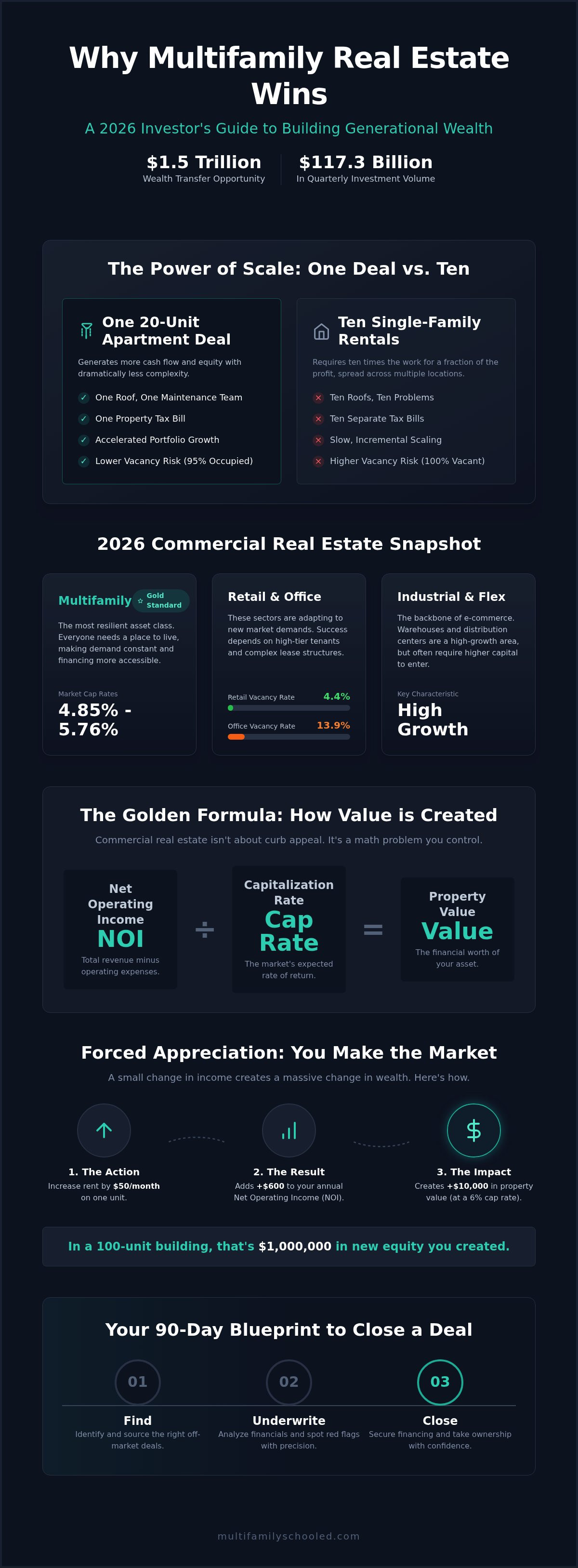
The "Wealth Gap" is real. Closing one 20-unit apartment building generates more cash flow and equity than managing 10 scattered single-family rentals. You save time. You save on management costs. Most importantly, you scale faster. Why would you do ten times the work for a fraction of the profit? The 2026 market is stabilizing, and smart money is moving now. U.S. commercial investment volume hit $117.3 billion in the first quarter of 2026 alone. Institutional capital is flooding into Multifamily because it’s the most resilient asset class available.
You control the outcome through forced appreciation. Residential property values rely on what your neighbor’s house sold for last month. Commercial value is a math problem. When you increase the Net Operating Income (NOI) by raising rents or cutting expenses, the property value skyrockets. You don't wait for the market to go up. You make it go up.
The 4 Main Types of Commercial Real Estate
Understanding the different types of commercial real estate investments is your first step toward total financial independence. Each asset class has its own rules and risks.
- Multifamily (Apartments): These are the gold standard. Everyone needs a place to live, regardless of the economy. Financing is more accessible, and the demand remains high in 2026.
- Retail and Office: These sectors are adapting. The office sector currently faces a 13.9% vacancy rate. Retail is stronger at 4.4% vacancy, but these deals often require complex leases and high-tier tenants.
- Industrial and Flex: This is the backbone of e-commerce. Warehouses and distribution centers are booming as reshoring efforts increase. It's a high-growth area but often requires more capital to enter.
Why Multifamily is the Gold Standard for Beginners
Multifamily is the bridge between residential comfort and commercial profit. It feels familiar but performs like a powerhouse. You get the economy of scale. Managing 20 doors under one roof is significantly more efficient than managing 20 separate locations. One roof. One tax bill. One landscaping crew.
Your vacancy risk is lower. If one tenant leaves a single-family house, you are 100% vacant. If one tenant leaves a 10-unit apartment building, you still have 90% occupancy. This stability protects your mortgage payments and your peace of mind. If you're ready to stop guessing and start closing, our Mentorship Program provides the exact blueprint to secure your first deal in 90 days. Move fast. The 2026 market won't wait for you.
The Financial Framework: Mastering CRE Math and Analysis
Forget about curb appeal. Commercial real estate isn't a popularity contest. It's a math problem. You're buying a stream of income, not a pretty building. Unlike Real Estate Investment Trusts (REITs) where you own shares in a massive pool, direct ownership allows you to control the variables. This is the secret to mastering different types of commercial real estate investments. You must understand the Golden Formula: Property Value equals Net Operating Income (NOI) divided by the Cap Rate. Change the math, change your life.
Net Operating Income (NOI) vs. Gross Income
Gross income is vanity. Net Operating Income (NOI) is sanity. NOI is your total revenue minus all operating expenses before you pay the mortgage. This is where you "force" value. If you raise the rent by just $50 on a single unit, you add $600 to your annual NOI. At a 6% cap rate, that simple move adds $10,000 in instant equity. Multiply that by a 100-unit complex. You just created $1 million in wealth. Watch out for expense traps. Property tax resets after a sale can crush your margins if you don't underwrite them correctly during your due diligence.
Understanding Cap Rates in the 2026 Market
The Cap Rate is the rate of return you'd expect if you bought the building in cash. In 2026, Multifamily cap rates hover between 4.85% and 5.76% depending on the asset class and location. Interest rates are currently ranging from 5.60% to 9.00% for conventional loans. This creates a tight spread. Don't panic. A compressed cap rate in a high-growth Sunbelt market like Phoenix or Nashville means investors expect massive rent growth. You aren't just buying current income. You're buying future upside.
Spotting underperforming assets is your ticket to the fast track. Look for high vacancy or "lazy" management where expenses are bloated. Use metrics like Cash-on-Cash Return to measure your immediate yield. Look at the Internal Rate of Return (IRR) to see the total performance over your hold period. The Equity Multiple tells you exactly how many times you'll double your money. Mastering these numbers is what separates successful types of commercial real estate investments from million-dollar mistakes. If you want to master these calculations quickly, download our Multifamily Tool Kit to start underwriting like a pro.
Evaluating Commercial Deals: A Professional Checklist
Finding a property is easy. Finding a deal is a skill. When you're analyzing different types of commercial real estate investments, your checklist is your shield against disaster. Start with the physical inspection. You aren't just looking for chipped paint. You're hunting for "deal killers." Structural cracks or outdated HVAC systems can turn a profitable asset into a money pit. If the roof needs $200,000 in repairs, that cost comes right out of your forced appreciation. Don't guess. Get an expert on-site.
Next, perform a ruthless financial audit. Verify the Rent Roll. Demand the T-12 statements for the last year. If the seller claims the building is 95% occupied but the bank deposits don't match the numbers, walk away. In 2026, market analysis is non-negotiable. Look at the data. Is the population migrating toward this neighborhood? Are local jobs stable? Check the local supply pipeline. You don't want to buy an existing complex just as a massive 500-unit development opens across the street and crashes your rents. Ensure the zoning and compliance align with your 2026 business plan before you sign.
The Power of Off-Market Deal Finding
The best deals never hit the public market. LoopNet and the MLS are often where deals go after the professionals have already passed on them. You need to get to the source. Use Real Estate Radar to identify motivated sellers before they ever call a broker. This software gives you the edge by providing direct access to property data and owner contact information. Simultaneously, build deep broker relationships. Show them you're a serious closer. When you have credibility, you become the first call for "pocket listings" that never see the light of day.
Due Diligence: Avoiding the Million-Dollar Mistake
Due Diligence is the 30-day window where you verify every claim the seller made. This is your time to be a skeptic. Your lender will require a Phase 1 Environmental Report. They won't fund any types of commercial real estate investments that might have underground contamination. Perform a full lease audit. Physically walk every unit. Confirm that the tenants on the rent roll actually live there and are paying the stated rent. Don't take the seller's word for it. Verification is the only way to protect your capital and ensure your 90-day blueprint stays on track. If you want to see how we handle these audits in real-time, join our next Online Challenge.
The 90-Day Blueprint: Your Action Plan to Close a Deal
Stop waiting. Financial freedom isn't a distant dream. It's a choice made through decisive action. Most people spend years "learning" without ever making an offer. We don't do that. You need a structured timeline to cut through the noise and force results. The 2026 market is moving fast. With $1.5 trillion in commercial debt maturing by the end of the year, the opportunities for disciplined investors are massive. Don't be the person who watches from the sidelines.
Phase 1 (Days 1-30): Foundation and Market Selection. You can't hit a target you can't see. Pick your market. Focus on high-growth Sunbelt cities like Phoenix, Dallas, or Miami where corporate relocations keep multifamily vacancy rates low at 4.4%. Use this month for deep education. You must understand how different types of commercial real estate investments perform in varying economic climates. Master the fundamentals now so you can move with confidence later.
Phase 2 (Days 31-60): Lead Generation and Underwriting. This is the volume phase. You must underwrite at least 10 deals to find one that actually pencils out. Start submitting Letters of Intent (LOIs). Speed is your greatest asset here. The more offers you make, the closer you are to a "yes." You are comparing yields and identifying the best types of commercial real estate investments for your specific goals.
Phase 3 (Days 61-90): Financing and Closing. Secure your debt. Whether you're looking at multifamily loan rates starting at 5.70% or CMBS options, get your term sheets ready. Raise your capital from partners or investors. Close the deal. This isn't just a transaction. It's the start of your new life as a commercial owner.
Financing Your Deal: Bridge Loans vs. Agency Debt
Understanding your leverage is critical. Agency debt through Fannie Mae or Freddie Mac is the gold standard for long-term stability on stabilized properties. If you're tackling a value-add project in 2026, bridge loans provide the flexible capital you need to renovate, increase NOI, and refinance. Don't overlook seller financing. It is a powerful tool for structuring deals with low money down when traditional bank requirements are tight.
Building Your Multifamily Dream Team
This is a team sport. You need a commercial attorney who understands local zoning and an investor-focused CPA who can maximize your tax benefits through cost segregation. Find property managers who are proactive. They are the boots on the ground that ensure your distributions stay consistent. Download the Multifamily Tool Kit to track your team and manage your growing pipeline. If you want a proven guide to walk you through every step of this 90-day process, apply for our Mentorship Program today.
Fast-Track Your Success: Why You Need a CRE Mentor
The high stakes of commercial deals demand a professional approach. A mistake on a $3M apartment building isn't just a setback. It's a financial disaster. In residential real estate, you might survive a $300k house error. In the world of types of commercial real estate investments, you need a shield. Mentorship is that shield. It provides you with "Speed to Market" and the instant credibility required to get your phone calls returned by top-tier brokers. They don't have time for amateurs. They want to talk to closers who have a team behind them.
Access to the Network Effect is your secret weapon. When you join a high-level community, you gain more than just advice. You gain co-investors and proprietary deal flow that never reaches the public. This is how you scale from zero to hundreds of doors. Stop the endless research. Analysis paralysis is the enemy of wealth. You need a battle-tested system that prioritizes execution over theory. The 2026 market is stabilizing, but the best opportunities go to those who move with authority and a proven blueprint.
The Multifamily Schooled Advantage
Our Mentorship Program is designed for rapid results. We provide a 90-day deal guarantee to ensure you stay focused on the objective. If you can’t find a deal within that window, we will provide one for you. This commitment from Justin Brennan and the team is unmatched in the industry. It removes the fear of the unknown. If you prefer an immersive environment, our 3-Day Live Workshop offers an intensive deep-dive into underwriting and market selection. You'll learn to master all types of commercial real estate investments alongside other high-performers who are ready to close.
Take the First Step Today
Your journey toward generational wealth starts with a single decision. Don't let another year pass while you're stuck in a W2 job watching others build empires. Join the 5 Day Challenge to build your foundation and start seeing deals through a new lens. The 2026 economic landscape is ripe for those who are prepared. Your first apartment building is waiting for you to take the lead. 2026 is the year of the commercial investor.
Own Your First Apartment Building in 90 Days
You've now seen the framework to move from a W2 employee to a commercial asset owner. You understand the math behind NOI and why multifamily is the ultimate wealth accelerator in 2026. Mastering the various types of commercial real estate investments is no longer a mystery; it's a systematic process you can follow. The only thing standing between you and generational wealth is the decision to stop researching and start executing. Your future self is waiting for you to take the lead.
Don't let the fear of a million dollar mistake keep you on the sidelines. You can leverage our proprietary Real Estate Radar software and the wisdom of multi-generational real estate experts to find off-market deals before anyone else. We are so committed to your success that we offer a bold guarantee. Find a deal in 90 days or we provide one for you. Start Your 90-Day Journey: Join the Mentorship Program and claim your seat at the table. Your legacy begins with this single, decisive step. Take action today.
Frequently Asked Questions
How much money do I need to start investing in commercial real estate?
You don't always need millions in the bank to get started. While traditional lenders often require a 20% to 25% down payment, savvy investors use partnerships or seller financing to lower their personal capital requirements. Many of our students start by raising capital from private partners. This strategy allows you to control large types of commercial real estate investments without draining your own savings. Focus on finding a great deal first; the money usually follows the math.
Is commercial real estate riskier than residential real estate?
Commercial real estate is often more stable because it's a business based on performance, not neighborhood emotion. In a single-family rental, one vacancy means you are 100% empty and paying the mortgage out of pocket. In a 20-unit apartment building, a single vacancy only represents a 5% dip in revenue. This built-in diversification provides a safety net that residential properties can't match. When you master the numbers, you eliminate the guesswork and reduce your risk.
What is a "good" cap rate for an apartment building in 2026?
A "good" cap rate in 2026 typically falls between 5% and 8% depending on the property class and location. Current data shows Suburban Class A multifamily assets averaging around 4.85%, while Suburban Class C properties offer higher yields near 5.76%. Don't just chase the highest number. A lower cap rate in a high-growth market like Phoenix or Miami often signals massive future appreciation. You want a balance of immediate cash flow and long-term equity growth.
Can I invest in commercial real estate while working a full-time job?
Yes, you can absolutely build a commercial empire while keeping your W2 income. The secret is building a "Dream Team" to handle the daily heavy lifting. Once you secure a property, your role shifts from active landlord to strategic asset manager. By hiring professional property management and using automated systems, you focus on high-level decisions while your team executes the plan. This is how you build generational wealth without sacrificing your current career.
Do I need a special license to buy commercial property?
No, you do not need a real estate license to purchase commercial property for your own portfolio. You are acting as the principal in the transaction. However, you do need a specialized education in commercial contracts, underwriting, and due diligence. Mastery of the different types of commercial real estate investments is far more valuable than a state license. Your success depends on your ability to analyze the math and execute a proven business plan.
What is the difference between a "Class A" and "Class C" property?
Class A properties are the gold standard; they are typically newer buildings in prime locations with luxury amenities and high-income tenants. Class C properties are older assets, often 20 to 30 years old, that may need physical repairs or better management. Class A offers lower risk but lower returns. Class C is where the "value-add" magic happens. You buy a Class C building, renovate the units, increase the income, and force the property's value to skyrocket.
How do I find commercial real estate deals that aren’t on the internet?
Stop wasting time on public listing sites where deals go to die. The best opportunities are found off-market by contacting owners directly. Use proprietary software like Real Estate Radar to identify motivated sellers before they ever call a broker. You should also build deep relationships with local commercial brokers. When they know you are a serious closer with a track record, you’ll be the first person they call with "pocket listings" that never hit the web.
What happens if a commercial tenant leaves in a multifamily building?
In a multifamily building, a single vacancy is just a minor operational blip. Your other tenants continue to pay rent, which covers your mortgage and operating expenses. This is the power of the economy of scale. A vacancy is actually an opportunity to refresh a unit and increase the rent to 2026 market rates. Unlike a single-family home, your cash flow doesn't stop just because one person moves out. You simply fill the unit and keep growing.



