

The Ultimate Multifamily Due Diligence Checklist: Stop Guessing and Start Closing in 2026
The difference between a 20% IRR and a total portfolio wipeout isn't luck; it's the 30 days you spend hunting for the truth before you sign the closing papers. You've seen the 5.79% average cap rates and the reaccelerating rent growth across the country. The opportunity to build massive wealth in 2026 is here. But if you're guessing on your numbers, you're gambling with your future. You need a battle-tested multifamily due diligence checklist that turns every inspection into a strategic negotiation tool. Stop worrying about buying a lemon with hidden structural issues or falling for an inflated rent roll. It's time to take control of the process and secure your financial legacy.
I know the pressure of staring at a mountain of lender documents while wondering if the seller is hiding a massive maintenance bill. It's overwhelming to keep up with new regulations like the 21st Century ROAD to Housing Act or California's AB 628 habitability standards. This guide provides the exact system we use at Multifamily University to vet assets and secure high-yield deals. You'll learn how to uncover hidden risks, verify every dollar of income, and gain the leverage to demand a price drop when the facts don't align with the pro-forma. Let's build your repeatable system for success and start closing deals that actually hit your targets.
Key Takeaways
- Bridge the "Truth Gap" between broker marketing and reality by treating due diligence as an aggressive hunt for facts rather than a passive task.
- Master the financial audit to uncover "expense masking" and verify every dollar of the rent roll before you commit your capital.
- Deploy a comprehensive multifamily due diligence checklist that mandates a 100% unit walk to eliminate the risk of hidden maintenance nightmares.
- Build a Reconciliation Matrix to turn your inspection findings into powerful negotiation leverage for immediate price drops and pro-forma adjustments.
- Learn how to integrate these frameworks into a proven 90-day closing system to secure your first high-yield asset with total confidence.
The 2026 Multifamily Due Diligence Framework: Why a Checklist is Your Only Shield
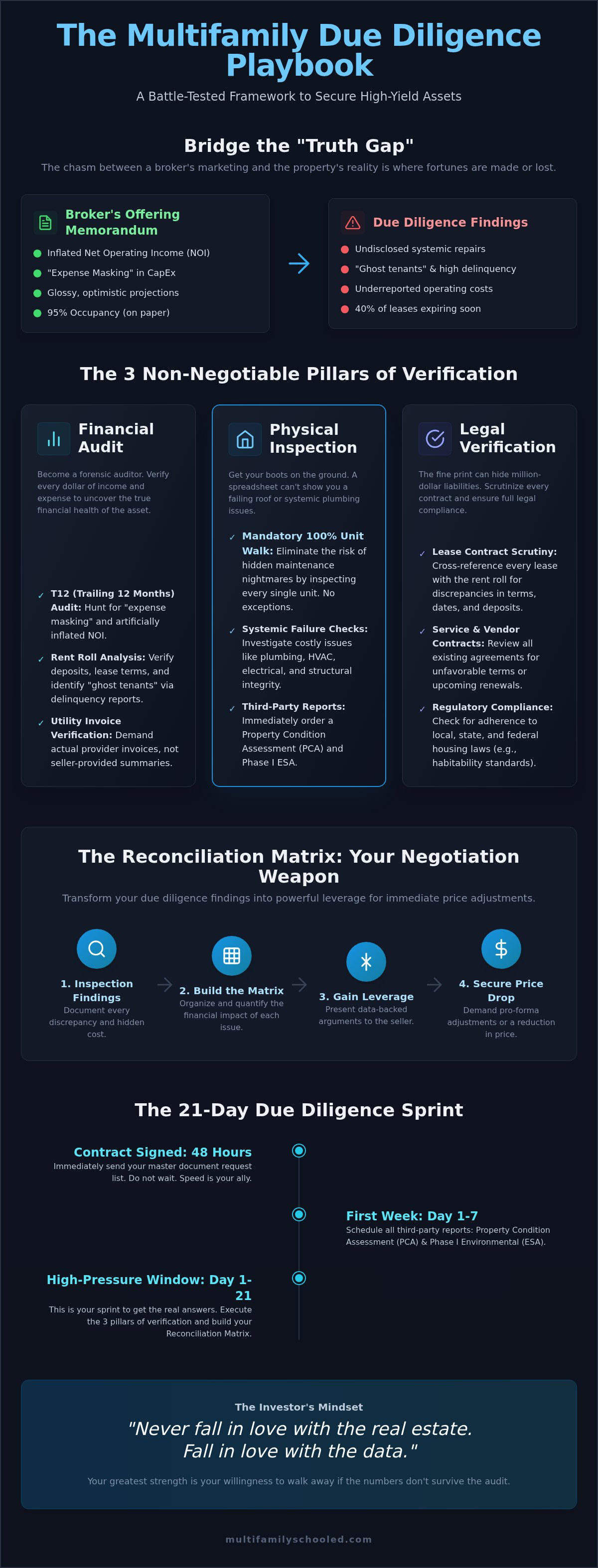
In the fast-paced 2026 market, due diligence is your aggressive 30 to 60 day hunt for the facts. It's the only window you have to verify every claim the seller made during the honeymoon phase of the deal. With multifamily cap rates hitting 5.79% and national rent growth reaccelerating, the stakes are massive. You aren't just doing "homework" for a lender. You're protecting your equity from the "Truth Gap." This gap represents the chasm between a broker’s glossy Offering Memorandum and the gritty reality of the property’s actual performance. It's where deals go to die or where fortunes are made through savvy negotiation.
A professional multifamily due diligence checklist focuses on three non-negotiable pillars: Financial, Physical, and Legal verification. You must audit the trailing 12 month expenses, walk every single unit, and scrutinize every lease contract. In a year defined by shifting interest rates and new federal housing laws like the 21st Century ROAD to Housing Act, missing a single detail isn't just a mistake. It's a financial catastrophe. Verification is the only way to ensure the pro-forma numbers you fell in love with actually exist in the real world.
The High Cost of Skipping a Step
Imagine closing on a 50 unit building only to discover a systemic plumbing failure two weeks later. A single undisclosed issue like this can easily cost $100,000 or more; it instantly erases your projected cash flow. Even a small lease discrepancy, such as an unverified utility bill back-billing, can tank your Cap Rate and lower the property's valuation by hundreds of thousands. You must adopt the "Walk Away" mindset. Your greatest strength in any negotiation is your willingness to kill the deal if the numbers don't survive the audit. Never fall in love with the real estate. Fall in love with the data.
Setting Your Due Diligence Timeline
Speed is your ally. You have 48 hours from the moment the contract is signed to send your master document request list. Don't wait. Schedule third party reports like the Property Condition Assessment (PCA) and Phase I Environmental Site Assessment (ESA) immediately. While the standard deal cycle might be 90 days, you need a 21 day due diligence sprint to get the real answers. This is where a Mentorship Program provides its greatest value. A mentor acts as your safety net to ensure no red flag goes unnoticed during this high pressure window.
Phase 1: The Financial & Legal Paper Trail (Trust but Verify)
The honeymoon period ends the moment you sign the Letter of Intent. Now, you must transition from optimistic buyer to forensic auditor. Phase 1 of your multifamily due diligence checklist is the financial and legal paper trail, where you move beyond the broker's pitch to find the hard truth. You aren't just looking for documents. You're looking for the discrepancies that will save you millions. Sellers love to hide the ugly truth in the fine print, and your job is to drag it into the light.
The T12 (Trailing 12 Months) audit is your primary weapon against "expense masking." Sellers often bury recurring repairs in the capital expenditure (CapEx) accounts to artificially inflate the Net Operating Income (NOI). If a property shows zero plumbing repairs over a year, but the owner replaced five water heaters, they're hiding a systemic maintenance issue. Demand the actual utility invoices from the providers rather than trusting a summary spreadsheet. If you're using our Deal Finding Software, you can benchmark these expenses against regional data to see if the seller is underreporting costs.
Rent roll analysis is a core component of any professional multifamily due diligence checklist. You must verify security deposits and lease expiration dates for every resident. A building that is 95% occupied is a liability if 40% of those leases expire within 30 days of closing. Identify "ghost tenants" by cross-referencing the rent roll with the delinquency report. If a resident hasn't paid in three months, they aren't a tenant; they're a vacancy you haven't admitted yet.
Spotting "Creative Accounting" in the T12
Scrutinize every line item. Look for "Capitalized Expenses" that are actually daily repairs. Verify the NOI against independent bank statements to ensure the cash shown on the paper actually hit the owner's account. This level of scrutiny is what separates professional investors from amateurs who buy a lemon. If the bank statements show $10,000 in monthly deposits but the rent roll claims $12,000, you've found a $2,000 red flag that justifies a price drop.
The Legal & Title Deep Dive
Your legal audit must be just as rigorous. Review the Title Report for hidden liens or easements that could restrict your ability to renovate or expand. Check the Certificate of Occupancy (C of O) for every single unit to ensure you aren't buying illegal dwellings. Contacting the local municipality is the only way to uncover planned utility rate hikes that could slash your cash flow by 10% or more overnight. Don't just trust the seller's word; verify it with the people who issue the bills.
Phase 2: The Physical Inspection—Walking Every Unit to Uncover Hidden Costs
The financial audit tells you what happened in the past. The physical inspection tells you what's going to happen to your bank account in the future. You've verified the rent roll; now you must verify the asset itself. This is the most labor-intensive part of your multifamily due diligence checklist. It requires you to get on-site and move with purpose. You aren't just looking at the property; you're hunting for the deferred maintenance that the seller "forgot" to mention during the tour.
Adhere to the 100% Rule. Never settle for a "representative sample" of units. If a seller tells you that 10 units are "just like the ones you saw," assume they're hiding a disaster. You must see every square inch of the property. Missing just one unit with a massive mold infestation or a structural floor failure can instantly wipe out your first year of cash flow. A professional investor doesn't leave their ROI to chance. They verify every door.
Your exterior audit must focus on the "Big Three" capital expenses: the roof, the foundation, and the parking lot. These are the heavy hitters that can cost six figures to repair. Look for pooling water on flat roofs or cracks in the foundation that signal shifting soil. Scrutinize the mechanical systems next. Check the serial numbers on HVAC units and boilers to determine their age. If the systems are at the end of their 15 to 20 year life cycle, you need to bake those replacement costs into your offer immediately.
The Interior Unit Walk Protocol
Inside the units, your protocol must be systematic. Open every cabinet. Check under every sink for leaks, water damage, or the silent deal killer: mold. Test every appliance, flip every light switch, and check the flooring for soft spots. Use a standardized grading system for each unit. Grade them as "Classic," "Partial Reno," or "Fully Renovated." This data allows you to verify if the "Value-Add" potential the broker promised is actually achievable or if the units are already at the top of the market.
Ordering Third-Party Professional Reports
You can't see through walls, so hire experts who can. A Property Condition Assessment (PCA) is non-negotiable. It provides an engineering perspective on structural integrity. In 2026, lenders are more cautious than ever about environmental risks. You must order a Phase I Environmental Site Assessment (ESA) to identify hazardous materials or historical contamination that could create massive legal liabilities. If the building is over 30 years old, order specialist inspections like a sewer scope or a termite bond. These reports aren't just expenses. They're the insurance policies that protect your wealth.
Mastering this physical hunt is part of the curriculum at Multifamily University. Don't go into the field alone when you can have a mentor guiding your every move.
The Reconciliation Matrix: Turning Data into a Winning Negotiation
The data collection phase is over. Now, the real work begins. You must feed every discovery from your multifamily due diligence checklist into a Reconciliation Matrix. This isn't just a spreadsheet; it's your battle plan for the closing table. It's the moment where the seller's promises meet the cold, hard reality of your findings. If the numbers don't align, the price must move. You aren't being difficult; you're being a professional fiduciary for your capital.
Cross-reference the rent roll against your physical findings immediately. If the seller claims Unit 202 is a "Premium" renovation earning top-of-market rent, but your walk revealed 1990s laminate and leaking faucets, you've found a discrepancy. Use Real Estate Radar to validate local market comps and see if those "pro-forma" rents are even possible in the current 2026 landscape. If the market average is $1,600 but the seller is projecting $1,900 without the upgrades to back it up, your valuation just changed. You must calculate the "Real" NOI by subtracting every dollar of discovered deferred maintenance and realistic expense adjustments.
The Go/No-Go Decision Point
Every investor has a threshold. You must decide if the discovered deferred maintenance fits your investment thesis or if it's a deal-breaker. Stress-test the deal against 2026 volatility. With the Federal Reserve projecting a 3.4% funds rate, you need to know if the asset survives a sudden rise in vacancies or a dip in rent growth. Use the Multifamily Tool Kit to run these final numbers with precision. If the deal doesn't yield a 15% plus return after all adjustments, you must be prepared to walk away. Never chase a bad deal just because you've spent three weeks auditing it.
The Art of the "Re-Trade"
A re-trade is your opportunity to align the purchase price with the property's actual condition. Use your Property Condition Assessment (PCA) report as objective leverage. Don't just ask for a lower price; present the engineer's findings and the associated repair bids. This allows you to ask for a credit or a price reduction without appearing like you're "nickel-and-diming" the seller. Present these findings to the broker as a solution to a problem, not an attack on their listing. A re-trade should only be used for legitimate, undiscovered issues that were not apparent when you made your initial offer. Ready to master the art of the close? Join our Mentorship Program and let an expert guide your next negotiation.
Execute Your First Deal in 90 Days with Multifamily Schooled
You've mastered the components of a multifamily due diligence checklist. You know how to audit the T12 and walk the units. But information without execution is just noise. To win in 2026, you need more than a list of tasks; you need a proven framework that turns a lead into a high-yield asset in record time. Multifamily Schooled isn't just about teaching. It's about doing. We provide the proprietary software and the strategic mentorship required to navigate the complexities of the current market with total certainty. This is your path to economic empowerment and long-term asset accumulation.
A checklist is a map, but our system is the engine that drives you to the closing table. Many investors get stuck in "analysis paralysis," fearing they'll miss a red flag that costs them millions. We eliminate that fear by providing a repeatable system to vet any apartment building. You'll gain the confidence to negotiate price drops based on your findings and ensure every deal you close actually hits its projected pro-forma numbers. It is time to stop being a spectator and start being an owner.
The 90-Day Deal Guarantee
Speed is the ultimate competitive advantage. Our Mentorship Program is built around a singular goal: getting you into a deal within 90 days. We don't just give you the tools; we provide the deal flow. Founder Justin Brennan serves as your due diligence safety net, reviewing your findings and ensuring you don't miss a single red flag. He brings multi-generational industry heritage to your deal table. This level of expert oversight is why our students close with total confidence. Stop analyzing and start acting. The market doesn't wait for the hesitant. It rewards the decisive. You have the multifamily due diligence checklist. Now you need the coach to help you execute it flawlessly.
Join the Multifamily Schooled Ecosystem
Success is a team sport. When you join our ecosystem, you gain access to a community of "Warrior" investors who are actively closing deals. Attend our 3-Day Live Workshop for a deep-dive training session that covers everything from advanced underwriting to sophisticated negotiation tactics. This is where theory meets the real world. You'll learn how to use our Deal Finding Software to spot the opportunities that brokers haven't even listed yet. Our system is designed to remove the guesswork. We simplify complex professional concepts into actionable methodologies that produce tangible results.
Your journey toward financial independence starts with a single decision. Don't let the fear of a hidden maintenance issue keep you on the sidelines while others build their legacies. You now have the blueprint. Apply for Mentorship and Close Your First Deal today. Join a fast-moving movement of successful investors. Secure your future and start closing deals that actually work. The 90-day clock starts now.
Claim Your Seat at the Closing Table
You've got the roadmap. You know that a 100% unit walk and a forensic financial audit are the only things standing between you and a high-yield asset. This multifamily due diligence checklist isn't just a document; it's your shield against the "Truth Gap" and your weapon at the negotiation table. But knowledge without action is just a hobby. In the volatile 2026 market, you need a system that moves as fast as the deals do. Your financial legacy depends on the decisions you make today.
Don't let another 90 days pass without an asset in your portfolio. Leverage Founder Justin Brennan’s multi-generational industry heritage to protect your capital and secure long-term independence. Our proprietary deal-finding software uncovers the gems while our Mentorship Program provides a bold 90-day deal performance guarantee. You don't have to guess anymore. You don't have to worry about buying a lemon with hidden issues. Follow the blueprint, trust the data, and take the leap into asset ownership today.
Apply for the Mentorship Program and Close Your Deal in 90 Days. Your journey to economic empowerment and massive wealth starts right now. Success is within your reach if you follow the system.
Frequently Asked Questions
What is the most important document in multifamily due diligence?
The Trailing 12-Month (T12) Profit and Loss statement is the most critical document you'll audit. It reveals the property's actual cash flow rather than the optimistic projections found in a broker's brochure. You must compare this T12 against independent bank statements to verify every dollar of income. Use your multifamily due diligence checklist to cross-reference expenses and ensure the seller isn't masking repairs as capital improvements to inflate the property's valuation.
How long does the due diligence period typically last for an apartment building?
A standard due diligence period usually lasts between 30 and 60 days. However, the 2026 market moves fast. You often need to execute a 21-day sprint to verify the asset before your earnest money becomes non-refundable. Act with urgency from the moment your offer is accepted. Schedule your third-party inspections immediately. If you're in our Mentorship Program, we'll help you compress this timeline while maintaining a forensic level of scrutiny.
Do I really need to walk every single unit in a 100-unit complex?
Yes, you must adhere to the 100% Rule. Never settle for a "representative sample" of units. Sellers often hide their worst units, including those with fire damage, severe mold, or structural failures, from the tour. Walking every door is the only way to protect your capital. It's the only way to ensure your CapEx budget is 100% accurate. Professional investors don't leave their ROI to chance; they verify every square inch.
What are the biggest "red flags" that should make me walk away from a deal?
Irreconcilable financial discrepancies, systemic environmental contamination, and major structural foundation issues are immediate deal-killers. If a seller refuses to provide bank statements or if you find "ghost tenants" on the rent roll, stop the deal. Your multifamily due diligence checklist is designed to catch these lethal flaws before you close. Never fall in love with the real estate. Be ready to kill the deal if the data doesn't survive your audit.
How much should I expect to spend on third-party reports during due diligence?
Costs vary based on the asset's size and age, but you must budget for the Property Condition Assessment (PCA) and Phase I Environmental Site Assessment (ESA). These reports are mandatory for most Agency or FHA loans in 2026. While these fees represent an upfront investment, they're your insurance policy against millions in future losses. They also provide the objective data you need to negotiate a price drop during the re-trade phase.
Can I perform due diligence myself, or do I need a professional team?
You need a professional team for technical reviews like structural engineering and environmental assessments. However, you must remain the lead auditor. Don't outsource your final decision-making to a third party. A mentor acts as your strategic safety net, ensuring your team doesn't miss critical red flags. Multifamily Schooled teaches you how to manage these professionals effectively. You're the owner; you need to know the truth behind every report they produce.
What happens if I find an issue after the due diligence period expires?
Once the due diligence period expires, your earnest money usually becomes "hard" or non-refundable. Finding a major issue after this point means you're either stuck with the repair costs or you lose your deposit to walk away. This is why a high-speed, high-intensity audit is mandatory. You have one window to find the truth. Use it aggressively. Our 90-day deal cycle is designed to ensure you find every issue before the clock runs out.
How does seller financing change the due diligence process?
Seller financing often simplifies the document volume required by traditional lenders, but it doesn't change your need for a rigorous audit. You're entering a long-term partnership with the seller. You must be even more diligent about verifying the NOI and physical condition to ensure the debt service is sustainable. Verify the asset's performance just as strictly as you would for a bank. Ensure the property can actually support the terms you're signing.