

The Ultimate Multifamily Due Diligence Checklist: Stop Guessing and Start Closing in 2026
Most investors treat due diligence as a boring administrative chore, but for the pros, it's a high-stakes hunt for the truth that can save you millions. You've found a deal that looks perfect on paper, but you need a multifamily due diligence checklist to ensure you aren't buying a lemon with a crumbling foundation or a faked rent roll. It's normal to feel overwhelmed by the mountain of lender documents and the fear of missing one tiny red flag that sinks your returns. You deserve to walk into every closing with total certainty and the power to negotiate from a position of strength.
This guide provides the exact framework used by elite investors to strip away the seller's polish and reveal the real asset underneath. We'll show you how to verify every cent of income, identify hidden maintenance nightmares, and use your findings to justify a price drop. You're about to master a repeatable system to vet any apartment building. Gain the confidence to hit your projected numbers in 2026. Stop guessing and start closing with the authority of a seasoned pro.
Key Takeaways
- Bridge the "Truth Gap" between broker marketing and reality by treating the 30-day due diligence window as an aggressive hunt for facts.
- Expose "expense masking" and hidden liabilities by performing a deep-dive audit of the Trailing 12 Months (T12) and every individual lease.
- Eliminate the risk of massive repair bills by using a comprehensive multifamily due diligence checklist that mandates a physical walk of every single unit.
- Transform your inspection findings into a powerful negotiation tool to secure price drops or credits for capital expenditures before you sign.
- Deploy a repeatable, mentor-led system to vet any apartment building and move from a nervous lead to a confident owner within 90 days.
The 2026 Multifamily Due Diligence Framework: Why a Checklist is Your Only Shield
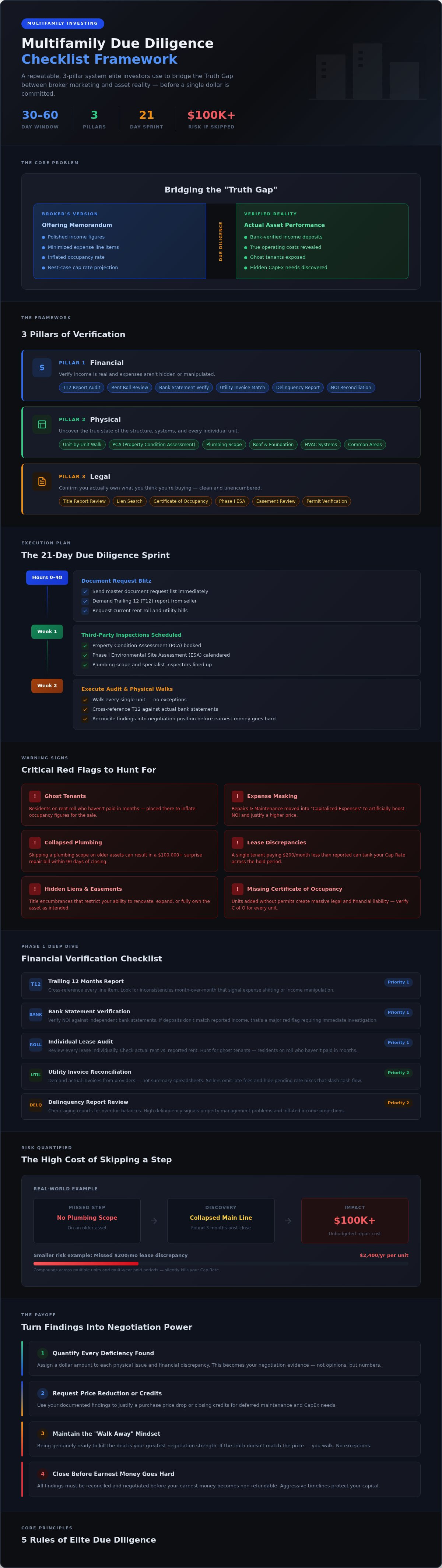
Due diligence isn't a passive administrative phase. It's a high-intensity, 30 to 60-day window where you verify every single claim the seller made. In 2026, market volatility has made financial verification more critical than ever. You can't rely on "market averages" or broker projections to protect your capital. You must bridge the Truth Gap. This gap is the distance between the broker's polished Offering Memorandum and the messy reality of the asset's actual performance. Your multifamily due diligence checklist is the only tool that prevents you from falling into that void.
A successful hunt relies on three pillars of verification. First, the Financial pillar ensures the income is real and the expenses aren't hidden. Second, the Physical pillar uncovers the true state of the bricks and dirt. Third, the Legal pillar confirms you actually own what you think you're buying. If you ignore any of these, you aren't investing; you're gambling with your future.
The High Cost of Skipping a Step
One missed detail can destroy your returns for years. Consider an investor who skips a deep plumbing scope on an older asset. Three months after closing, they find a collapsed main line. That's a $100,000 expense that wasn't in the budget. Even smaller errors, like missing a single lease discrepancy where a tenant is actually paying $200 less than reported, can tank your Cap Rate. You must maintain a "Walk Away" mindset. Being ready to kill the deal is your greatest strength at the negotiating table. If the truth doesn't match the price, you walk.
Setting Your Due Diligence Timeline
Speed is essential. In a 90-day deal cycle, you need a 21-day due diligence sprint. You can't afford to wait for the seller to get organized. You drive the process. Using a proven multifamily due diligence checklist allows you to maintain an aggressive pace. Use this timeline to stay on track:
- The First 48 Hours: Send your master document request list. Demand the T12, rent roll, and utility bills immediately.
- The First Week: Schedule third-party inspections. Get your Property Condition Assessment (PCA) and Phase I Environmental Site Assessment (ESA) on the calendar to avoid lender delays.
- The Second Week: Execute your physical unit walks and financial audit.
This aggressive pace ensures you find the red flags before your earnest money becomes non-refundable. It's the same systematic approach we provide in our Mentorship Program to help you close with total confidence and zero guesswork.
Phase 1: The Financial & Legal Paper Trail (Trust but Verify)
Your multifamily due diligence checklist starts with the paper trail. Don't take the seller's word for it. Trust is earned through verification. You need the Trailing 12 Months (T12) report and the current Rent Roll immediately. These documents are the heartbeat of the deal. If the heartbeat is irregular, you need to know why before you commit your capital. You're looking for consistency between the numbers on the page and the cash in the bank.
Utility bill reconciliation is another non-negotiable step. Demand the actual invoices from the providers. Do not settle for a summary spreadsheet. Sellers often omit late fees or ignore pending rate hikes that could slash your cash flow. Cross-reference these invoices against the T12 to ensure every expense is accounted for. This level of scrutiny reveals the true operating cost of the asset.
Spotting "Creative Accounting" in the T12
Sellers often play games with the T12 to inflate the sales price. One common tactic is "expense masking." They move standard "Repairs & Maintenance" costs into "Capitalized Expenses" to artificially boost the Net Operating Income (NOI). You must verify the NOI against independent bank statements. If the deposits don't match the reported income, you've found a major red flag. Look at the delinquency report too. "Ghost tenants" are residents who appear on the rent roll but haven't paid rent in months. They're just there to make the occupancy look healthy for the sale.
The Legal & Title Deep Dive
Legal due diligence is about protecting your ownership and future profits. Review the Title Report for hidden liens or unexpected easements that could restrict your ability to renovate or expand. Verify the Certificate of Occupancy (C of O) for every single unit. If a unit was added illegally without proper permits, you could face massive fines or be forced to decommission it. It's also vital to check local municipal records for planned utility hikes or property tax reassessments. A sudden jump in operating costs can destroy your pro-forma overnight. Mastering these audits is the difference between a high-yield asset and a financial nightmare. Our Mentorship Program provides the exact tools to help you dissect these documents with the precision of a seasoned pro.
Phase 2: The Physical Inspection—Walking Every Unit to Uncover Hidden Costs
This is where the "Truth Gap" becomes visible. You've audited the numbers; now you must audit the bricks and mortar. The physical inspection is the most labor-intensive part of your multifamily due diligence checklist. It's a high-stakes hunt for deferred maintenance that the seller "forgot" to mention. You aren't just looking at walls. You're looking for liabilities that could drain your bank account after closing. Don't delegate this entire process to a third party. You need to see the asset with your own eyes to truly understand your investment.
Follow the 100% Rule. Never settle for a "representative sample" of units. Brokers love to show the three cleanest units and hide the thirty that need full gut renovations. Walk every door. No exceptions. One hidden hoarder unit or an undisclosed fire-damaged apartment can instantly blow your renovation budget. While you're on-site, focus on the "Big Three" capital expenses: the roof, the foundation, and the parking lot. These are your heaviest hitters. If the roof is at the end of its life or the foundation is shifting, you have the ammunition you need to demand a price reduction.
The Interior Unit Walk Protocol
Move fast but stay thorough. Check under every single sink for active leaks or signs of mold. Mold is a silent deal killer that can lead to massive litigation and remediation costs. Test the appliances, flip every light switch, and check the flooring condition. Grade each unit as you go. Is it "Classic," "Partial Reno," or "Full Reno"? This grading system allows you to verify the seller's "Value-Add" claims. If they say every unit is ready for a $200 rent bump but you find they're already renovated, your upside just vanished. This systematic approach is a core pillar of what we teach in Multifamily University.
Ordering Third-Party Professional Reports
You need experts to back up your findings. In 2026, lenders are more cautious than ever. They will demand a Phase I Environmental Site Assessment (ESA) to ensure there's no historical contamination or hazardous material on site. You also need a Property Condition Assessment (PCA). Hire a structural engineer to identify flaws you might miss, like aging boilers or outdated electrical panels. Don't be afraid to call in specialists. A sewer scope or a termite inspection is a small price to pay for peace of mind. These reports aren't just for the bank. They are your shield against unforeseen disasters.
The Reconciliation Matrix: Turning Data into a Winning Negotiation
You've walked every unit. You've audited the bank statements. Now, it's time to merge that data into a single source of truth. This is the Reconciliation Matrix. It's the most powerful stage of your multifamily due diligence checklist because it turns raw observations into financial leverage. If the rent roll claims Unit 4B is a "Premium Reno" but your physical walk revealed 20 year old carpet and leaking faucets, you've found a discrepancy. These aren't just errors. They are opportunities to protect your capital and force the seller to face reality.
Every discovery requires a "CapEx Budget" adjustment. If the physical inspection uncovered $75,000 in structural repairs or end of life HVAC systems, your original pro-forma is dead. You must recalculate the "Real" NOI. This means accounting for the actual expenses discovered during your deep dive. Use Real Estate Radar to validate local market comps and ensure your projected rent bumps are realistic for 2026. Data is your only defense against overpaying for a problem property.
The Go/No-Go Decision Point
Success in multifamily is often about the deals you don't do. You must establish a clear threshold for deferred maintenance. If the cost to stabilize the asset exceeds your investment thesis, you have reached a Go/No-Go decision point. Stress-test the deal for the current 2026 economy. What happens to your cash flow if interest rates spike or vacancy rates climb by 5%? Don't rely on gut feelings. Use the Multifamily Tool Kit to run your final numbers under high pressure scenarios. If the deal breaks under stress, walk away with your capital intact.
The Art of the "Re-Trade"
A "re-trade" is a formal request for a price reduction or credit based on your findings. This is where your Property Condition Assessment (PCA) becomes a weapon. Present the engineer's report to the broker as objective proof of undisclosed issues. Be firm but professional. You aren't being difficult; you're adjusting the price to reflect the asset's true condition. A re-trade should only be used for legitimate, undiscovered issues to maintain your integrity with brokers. When you present facts instead of opinions, you negotiate from a position of absolute authority. Ready to master these high stakes conversations? Join our Mentorship Program and learn to negotiate like a pro.
Execute Your First Deal in 90 Days with Multifamily Schooled
A static PDF or a basic multifamily due diligence checklist can only take you so far. It tells you what to look for, but it doesn't tell you how to react when you find a $50,000 roof leak or a faked rent roll. To win in 2026, you need more than a list; you need a battle-tested system. Multifamily Schooled provides that entire ecosystem. We move you from the theory of the classroom to the reality of the closing table. Our proprietary Deal Finding Software identifies high-yield opportunities that brokers haven't even listed yet. This gives you a massive head start before the due diligence clock even starts ticking. You aren't just checking boxes; you're executing a professional acquisition strategy.
The transition from a passive observer to an asset owner is a life-transforming journey. Most people get stuck in "analysis paralysis" because they fear making a million dollar mistake. We eliminate that fear by providing a repeatable, strategic framework. Our approach simplifies complex professional concepts into actionable steps. You'll have the tools to verify every seller claim with surgical precision. This isn't about supplemental earnings; it's about long-term stability and economic empowerment. You have the opportunity to build a legacy. We provide the blueprint to make it happen.
The 90-Day Deal Guarantee
We don't just teach; we deliver results. Our Mentorship Program comes with a bold commitment to your success. We help you find a deal or provide one within 90 days. During that critical due diligence window, founder Justin Brennan acts as your personal safety net. You won't have to guess if a plumbing issue is a deal-breaker or a powerful negotiation tool. You'll have multi-generational industry expertise in your corner at every step. Stop analyzing from the sidelines. Start acting with the confidence of a seasoned owner. The market moves fast. You need to move faster to seize these opportunities.
Join the Multifamily Schooled Ecosystem
Deep-dive training happens at our Live Workshops. These events are designed to sharpen your skills and expand your network. You'll join a community of "Warrior" investors who are actively closing deals and sharing real-world insights. This isn't just about one transaction. It's about joining a movement of successful professionals. The combination of our systematic multifamily due diligence checklist, proprietary software, and mentor-led guidance ensures you never miss a red flag. You've seen the blueprint. Now, it's time to build the foundation for your economic independence. Apply for Mentorship and Close Your First Deal today and start your journey toward mastery.
Take Command of Your Investment Future Today
You now possess the framework to bridge the gap between broker promises and asset reality. Mastering the multifamily due diligence checklist is about more than just avoiding a bad deal. It's about gaining the leverage you need to negotiate a price that guarantees your pro-forma numbers. You've learned how to audit the T12, walk every unit, and turn discovered liabilities into credits at the closing table. This systematic approach is the only way to secure high-yield assets in the 2026 market.
Don't let fear or lack of experience stop you from achieving economic empowerment. You can leverage founder Justin Brennan’s multi-generational industry heritage and our proprietary deal-finding software to accelerate your journey. We are so confident in our system that we provide a 90-day deal performance guarantee. It's time to stop analyzing and start acting. Your path to long-term stability and asset ownership is clear. Apply for the Mentorship Program and Close Your Deal in 90 Days. Your future is waiting for you to take command. You have the tools; now go out and win.
Frequently Asked Questions
What is the most important document in multifamily due diligence?
The Rent Roll is the most critical document because it represents the actual income stream you are buying. It's the pulse of the property. You must verify it against bank deposits and the T12 to ensure the numbers are real. Without an accurate Rent Roll, your entire valuation is based on fiction. Secure this document in the first 48 hours to start your audit with total confidence.
How long does the due diligence period typically last for an apartment building?
A standard due diligence period usually lasts between 30 and 60 days. However, the most successful investors aim for a 21 day sprint to identify major red flags before their earnest money becomes non-refundable. Speed is your greatest asset in a competitive market. Use a multifamily due diligence checklist to keep your team moving fast and ensure no critical deadline is missed during this high stakes window.
Do I really need to walk every single unit in a 100-unit complex?
Yes, you must walk every single door. Following the 100% Rule is the only way to uncover hidden fire damage, hoarder units, or undisclosed renovations. Brokers often try to hide "problem units" by showing you a small, curated sample. Don't fall for this trap. Walking every unit ensures your CapEx budget is based on reality, not a seller's polished presentation. Take control of the inspection process immediately.
What are the biggest "red flags" that should make me walk away from a deal?
Major red flags include significant structural foundation cracks, historical environmental contamination, and discrepancies between bank statements and reported income. If the seller refuses to provide original utility invoices or lease contracts, walk away. These issues often indicate deeper, more expensive problems that will tank your returns. Always maintain a "Walk Away" mindset to protect your capital from a lemon. Trust your data over the seller's promises.
How much should I expect to spend on third-party reports during due diligence?
Costs vary based on the size and age of the asset. You should budget for a Property Condition Assessment (PCA) and a Phase I Environmental Site Assessment (ESA) at a minimum. Some deals also require specialized sewer scopes or termite inspections. These reports are a necessary investment to satisfy lender requirements and protect yourself from unforeseen disasters. View these costs as insurance for your multi-million dollar acquisition.
Can I perform due diligence myself, or do I need a professional team?
You need a professional team of engineers, environmental consultants, and attorneys to handle technical audits. However, you must act as the strategic leader of this team. Don't delegate the final decision making. Using a multifamily due diligence checklist allows you to manage these experts effectively and ensure they are focused on the right risks. A mentor can also serve as a vital safety net during this complex phase.
What happens if I find an issue after the due diligence period expires?
Once the due diligence period expires, your earnest money typically becomes non-refundable. If you find a major issue after this point, you face a difficult choice: close the deal and absorb the cost or walk away and lose your deposit. This is why an aggressive, systematic audit is non-negotiable. You must uncover every red flag while you still have the leverage to renegotiate the price or kill the deal entirely.
How does seller financing change the due diligence process?
Seller financing often means fewer third-party reports are required by a traditional bank. This makes your personal due diligence even more critical. You won't have a lender's underwriting team as a second set of eyes on the deal. You must be your own advocate. Perform a deep-dive audit of the financials and physical asset to ensure you aren't overpaying for a property that a bank wouldn't touch.



