

The Ultimate Multifamily Due Diligence Checklist: Stop Guessing and Start Closing in 2026
What if your "perfect" apartment deal is actually a $2 million liability waiting to explode? You have seen the pro-forma, but you know sellers often hide the truth behind polished numbers and fresh paint. It's natural to feel overwhelmed by the mountain of lender documents or the fear of missing a critical structural flaw. To win in 2026, you need more than a gut feeling. You need a battle-tested multifamily due diligence checklist that turns you from a nervous buyer into a calculated closer who knows exactly what is under the hood.
We understand the stakes are high. You want to secure high-yield assets that actually hit their projected numbers, not inherit someone else's maintenance nightmare. This article provides the exact system our mentors use at Multifamily University to vet deals and uncover hidden risks before they cost you a fortune. You'll learn how to verify rent rolls with surgical precision and handle new 2026 requirements, like the FinCEN reporting rules, without breaking a sweat.
Stop guessing and start dominating the market. We are showing you how to find the ammunition needed to negotiate price drops and secure your financial future. This is your repeatable system to vet any building and close deals that actually perform. Let's dive in.
Key Takeaways
- Stop relying on broker promises and master the multifamily due diligence checklist to uncover the "Truth Gap" before you sign.
- Learn to audit the Trailing 12 Months (T12) with surgical precision to spot hidden expense masking that kills cash flow.
- Implement the "100% Rule" by walking every single unit to identify major structural risks and capital expense liabilities.
- Transform your inspection findings into a powerful negotiation tool to force price drops and protect your projected pro-forma.
- Transition from guesswork to a systematic 90-day closing process backed by professional mentorship and proven frameworks.
The 2026 Multifamily Due Diligence Framework: Why a Checklist is Your Only Shield
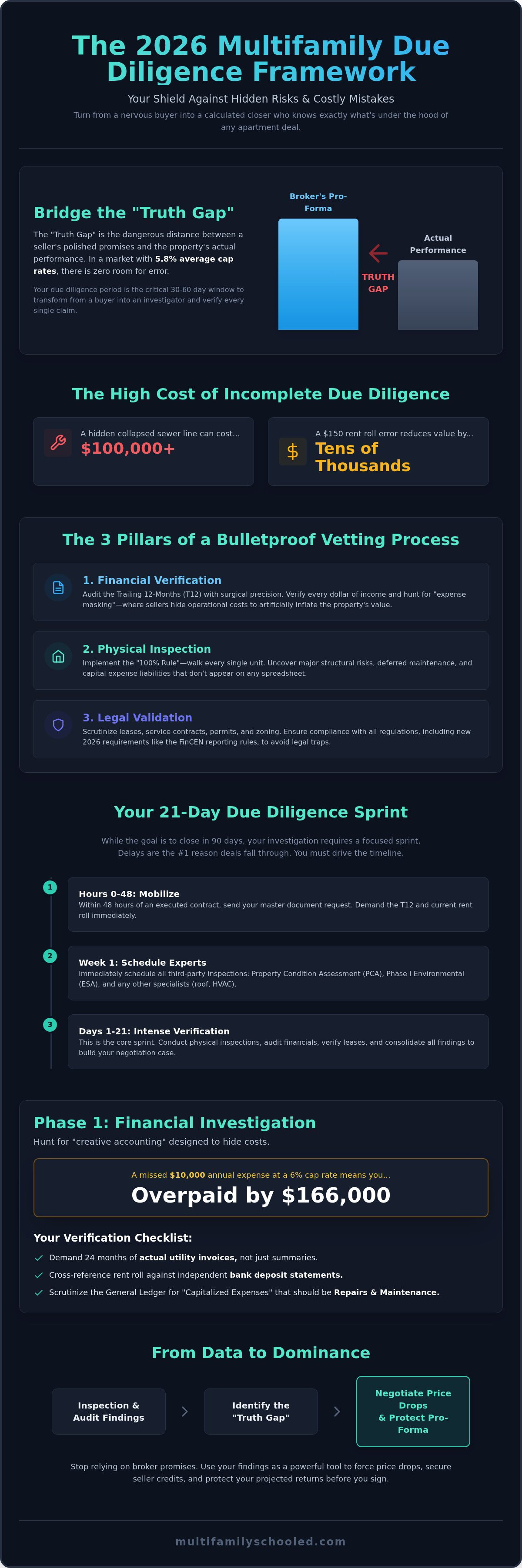
You found a deal. The numbers look incredible on paper. But right now, you are flying blind. Professional investors know that the Offering Memorandum (OM) is a marketing tool, not a source of truth. Your due diligence period is the critical 30 to 60 day window where you stop being a buyer and start being an investigator. This is your chance to verify every single claim the seller made. If you don't hunt for the truth now, you'll pay for it later.
The "Truth Gap" is the distance between what the broker promised and what the property actually produces. In 2026, market volatility makes this gap wider than ever. With average cap rates for apartment transactions sitting at 5.8% according to Arbor Realty Trust, there is zero room for error. A single missed expense can tank your returns. You must use a comprehensive multifamily due diligence checklist to bridge that gap. Your framework must stand on three pillars: financial verification, physical inspection, and legal validation. Master these, and you control the deal.
The High Cost of Skipping a Step
Mistakes in this phase are expensive. Imagine closing on a property only to discover a collapsed main sewer line two weeks later. A hidden plumbing issue like that can easily cost $100,000 or more, instantly vaporizing your renovation budget. Even small lease discrepancies matter. If a tenant is actually paying $150 less than the rent roll states, that single error reduces the property value by tens of thousands of dollars at a 6% cap rate. You must develop a "Walk Away" mindset. Your greatest strength is your willingness to kill the deal if the findings don't match the pro-forma. Protection is more important than participation.
Setting Your Due Diligence Timeline
Speed is your competitive advantage. While the standard mentorship goal is to close within 90 days, your multifamily due diligence checklist requires a focused 21-day sprint. You cannot afford to wait. Send your master document request list within the first 48 hours of an executed contract. Demand the Trailing 12-month (T12) statements and the current rent roll immediately. Schedule your third-party inspections, including the Property Condition Assessment (PCA) and Phase I Environmental Site Assessment (ESA), in the first week. Delays in scheduling these reports are the number one reason deals fall through or require stressful extensions. You are the leader of this process. Drive the timeline or the timeline will drive you.
Phase 1: The Financial & Legal Paper Trail (Trust but Verify)
Numbers don't lie, but they can be manipulated to tell a very specific story. Your job is to tear that story apart. The financial phase of your multifamily due diligence checklist is where you prove the income is real and the expenses are accurate. You aren't just looking for mistakes. You're hunting for "expense masking," a common tactic where sellers hide operational costs to artificially inflate the property's value. If you miss a $10,000 annual expense, you've effectively overpaid by $166,000 at a 6% cap rate. Don't let that happen to you.
Verification goes beyond the digital spreadsheets provided by the broker. You must demand the actual utility invoices from the last 24 months. Compare these directly to the Trailing 12 Months (T12) statement to ensure no months were "accidentally" omitted. Expert investors often highlight that multifamily due diligence requires a deep dive into the general ledger to see exactly where every dollar went. If you want to streamline this process and catch discrepancies faster, using a professional Deal Finding Software can help you organize and analyze these data points with precision.
Spotting "Creative Accounting" in the T12
Sellers are motivated to show the highest possible Net Operating Income (NOI). Watch out for "Capitalized Expenses" that should have been categorized as "Repairs & Maintenance." By moving a standard roof repair into a capital expense category, the seller keeps it off the NOI calculation, making the building look more profitable than it is. Cross-reference the rent roll against independent bank statements to verify that the cash hitting the account matches the reported income. Look closely at the delinquency report. You might find "ghost tenants" who are signed to leases but haven't paid a dime in three months. These residents are liabilities, not assets.
The Legal & Title Deep Dive
Paperwork is your legal shield. Review the Title Report for hidden liens, easements, or private covenants that could restrict your future plans. Check the Certificate of Occupancy (C of O) for every single unit to ensure the building is legally compliant. In 2026, you must also be aware of the new FinCEN reporting rules taking effect on March 1, which require stricter transparency for non-financed transactions. Finally, contact the local municipality to check for planned utility rate hikes or pending building code violations. Knowing about a 15% water rate increase before you close gives you the power to adjust your pro-forma and negotiate a better price today.
Phase 2: The Physical Inspection—Walking Every Unit to Uncover Hidden Costs
Your paper audit is finished. Now, it's time to get your boots on the ground. The physical inspection is the most visceral part of your multifamily due diligence checklist. You aren't just looking at buildings; you're hunting for liabilities that want to eat your cash flow. If you miss a foundation crack or a failing chiller system now, you won't just lose money. You'll lose the confidence of your investors. This is where deals are won or lost. You must move with purpose and precision.
Never settle for a "representative sample." Brokers will often tell you that seeing 20% of the units is enough to get the gist of the property. They're wrong. You must walk 100% of the units. The one door you don't open is exactly where the $15,000 mold remediation project or the unauthorized wall removal is hiding. By seeing every square inch, you eliminate guesswork. This is the only way to verify if the "value-add" potential promised in the marketing materials actually exists or if the building is a structural lemon.
The Interior Unit Walk Protocol
Don't just glance at the paint. You need to be methodical. Open every cabinet and check under every sink for active leaks or signs of historical mold. These are silent deal killers that lead to massive health liabilities. Test the appliances, flip every light switch, and check the flooring for soft spots. Use a standardized grading system for every unit. Mark them as "Classic," "Partial Reno," or "Full Reno." This data allows you to cross-reference the rent roll and see if the seller is actually achieving the "market rents" they claim for unrenovated units.
Ordering Third-Party Professional Reports
Total mastery requires expert eyes. You must hire a professional engineer to conduct a Property Condition Assessment (PCA). They will evaluate the "Big Three" capital expenses: the roof, the foundation, and the parking lot. In 2026, with construction costs still high, a surprise roof replacement can cost $250,000 or more. Your lender will also demand a Phase I Environmental Site Assessment (ESA). While the "21st Century ROAD to Housing Act" has streamlined some environmental reviews for commercial conversions, you still need to ensure no historical contamination exists on your site. If the PCA suggests issues, don't hesitate to order a sewer scope. Spending $500 on a specialist now can prevent a $50,000 disaster after you close. This isn't just an inspection. It's an aggressive hunt for the truth.
The Reconciliation Matrix: Turning Data into a Winning Negotiation
You've finished the hunt. Now, you must make sense of the kill. Data is useless unless you reconcile it. The Reconciliation Matrix is where your financial audit meets your physical findings. This is the heart of your multifamily due diligence checklist. If the rent roll claims unit 204 is "fully renovated" but your physical walk revealed 1990s laminate countertops, you have a discrepancy. This isn't just a mistake. It's a negotiation opportunity. You must cross-reference every unit's reported rent against its actual condition to find the "Real" NOI.
Don't stop at the interior. Use Real Estate Radar to validate local market comps and ensure the seller's "pro-forma" rents are actually achievable in 2026. With national rent growth hovering at a modest 1.0%, you can't afford to over-project. If the seller promised $2,000 rents but the data shows a ceiling of $1,850, your valuation must change. Adjust your CapEx budget immediately based on the PCA engineer’s findings. If they identify $200,000 in immediate roof and parking lot repairs, your pro-forma needs an update before you move another inch toward closing.
The Go/No-Go Decision Point
You need to know your limit. How much deferred maintenance is too much? If the costs to hit your target yield exceed your available capital, it's time to walk. Stress-test the deal against current market conditions. With national vacancy rates hitting 8.9% in the second quarter of 2026, you must know what happens to your cash flow if your building matches that trend. Use the Multifamily Tool Kit to run these final numbers and ensure the deal still makes sense. If you want to master this analysis with a pro in your corner, explore our Mentorship Program to close with total confidence.
The Art of the "Re-Trade"
Negotiation is about leverage. Use the PCA report to show the seller exactly why the original price no longer works. Present your findings to the broker with cold, hard facts. You aren't being difficult. You're being accurate. A re-trade should only be used for legitimate, undiscovered issues that weren't apparent when you signed the Letter of Intent. When you show the seller a $50,000 sewer scope repair bill, they have a choice: give you a credit or take the property back to a market that now knows about the defect. Most will choose to close. This is how you protect your investors and secure a high-yield asset.
Execute Your First Deal in 90 Days with Multifamily Schooled
You have the blueprint. You understand the "Truth Gap." You know how to walk a unit and audit a T12. But information without execution is just a hobby. In the fast-moving 2026 market, a multifamily due diligence checklist is your shield, but the Multifamily Schooled system is your engine. A static PDF cannot answer a panicked phone call at 9:00 PM when a broker tries to pressure you into waiving a contingency. You need a system that translates data into ownership. You need a mentor who has seen every trick in the book.
Our proprietary Deal Finding Software does the heavy lifting for you. It identifies the high-yield assets that never make it to the public portals. While other investors are fighting over scraps on LoopNet, our students are using professional tools to find off-market gems with motivated sellers. We don't just teach you how to vet an apartment building. We provide the ecosystem to find, fund, and finish the deal. This is how you move from being a student of the game to a master of the asset class. Your journey to economic empowerment starts when you stop reading and start bidding.
The 90-Day Deal Guarantee
We don't believe in endless theory. We believe in results. Our Mentorship Program is built around a bold promise: we help you find a deal or provide one within 90 days. You aren't doing this alone. Founder Justin Brennan brings a multi-generational industry heritage to your side, acting as your ultimate due diligence safety net. He reviews your findings. He double-checks your reconciliation matrix. He ensures you never "buy a lemon." Stop analyzing. Start acting. The 90-day clock starts the moment you commit to the process.
Join the Multifamily Schooled Ecosystem
Success is a team sport. When you join our community, you gain access to a network of "Warrior" investors who are closing deals across the country. If you want a deep-dive, high-intensity environment, our 3-Day Live Workshop is the place to be. You'll master the multifamily due diligence checklist in a room full of people who share your ambition for long-term independence. We provide the tools, the software, and the strategic framework. You provide the hustle. Your first high-yield asset is closer than you think. Take the final step toward the life you've imagined. Apply for Mentorship and Close Your First Deal.
Stop Analyzing and Start Building Your Legacy
You have the blueprint to bridge the "Truth Gap." You know how to audit the financial paper trail and hunt for physical liabilities in every unit. Now, it's time to take that multifamily due diligence checklist and turn it into real-world results. Success in the 2026 market belongs to those who move with precision and speed. Don't let the fear of a hidden red flag keep you on the sidelines while others secure high-yield assets.
We provide the ultimate safety net for your investment journey. By leveraging Justin Brennan’s multi-generational industry heritage and our proprietary deal-finding software, you gain an unfair advantage. We are so confident in our systematic approach that we offer a 90-day deal performance guarantee. You don't have to guess. You just have to follow the system.
Your journey to long-term independence starts with a single decisive action. Take control of your financial destiny today. Apply for the Mentorship Program and Close Your Deal in 90 Days. The opportunity is here. We are ready to help you seize it.
Frequently Asked Questions
What is the most important document in multifamily due diligence?
The Trailing 12-Month (T12) statement is the absolute foundation of your investigation. It provides the raw, month by month financial performance of the property over the last year. You use this data to spot expense masking and verify that the seller's reported Net Operating Income actually matches reality. Without an accurate T12, you are just guessing at the property's value.
How long does the due diligence period typically last for an apartment building?
Most contracts allow for a 30 to 60 day window. To win in the 2026 market, you should aim for a 21 day due diligence sprint to identify major red flags early. This aggressive timeline keeps the seller engaged and ensures you have enough time to negotiate a re-trade if the physical inspection reveals hidden costs.
Do I really need to walk every single unit in a 100-unit complex?
Yes, you must walk 100% of the units without exception. The one door you don't open is exactly where the $20,000 mold remediation project or the unauthorized structural change is hiding. Professional investors never rely on a representative sample because it leaves your capital exposed to unnecessary risk. Every unit is a potential liability.
What are the biggest "red flags" that should make me walk away from a deal?
Systemic foundation failure, historical environmental contamination, and a seller's refusal to provide bank statements are immediate deal killers. If the physical inspection reveals "Big Three" capital expenses that exceed your budget by more than 20%, it's time to walk. Trust your multifamily due diligence checklist and don't let emotions keep you in a bad deal.
How much should I expect to spend on third-party reports during due diligence?
For a typical 50 to 150 unit property in 2026, you should budget between $10,000 and $30,000 for third-party reports. These costs generally range from 0.2% to 4% of the total transaction value. This investment covers your Property Condition Assessment, Phase I Environmental Site Assessment, and specialized inspections like sewer scopes or termite bonds.
Can I perform due diligence myself, or do I need a professional team?
You need a professional team to handle the technical aspects of the multifamily due diligence checklist. While you lead the strategy, you must hire specialized engineers for the structural audit and environmental experts for the Phase I ESA. A mentor acts as your final safety net, helping you interpret these reports to ensure the deal hits your pro-forma numbers.
What happens if I find an issue after the due diligence period expires?
Your earnest money deposit typically becomes non-refundable once the period ends. If you discover a major defect after this deadline, you lose your leverage to renegotiate the price or walk away without losing your deposit. This is why a rigorous and rapid inspection process is vital. You must uncover every truth before your money goes "hard."
How does seller financing change the due diligence process?
Seller financing might reduce the mountain of paperwork required by traditional lenders, but it doesn't change your need for a deep dive. You still must verify every financial claim and physical system. You don't have a bank's underwriting team as a second set of eyes, so your personal due diligence must be even more intense to protect your investment.



