

The Ultimate Multifamily Due Diligence Checklist: Secure Your Profit in 2026
What if the "perfect" 100 unit deal you just found is actually a ticking time bomb disguised by a polished rent roll? With transaction activity surging 27 percent in early 2026, the stakes have never been higher for your capital. You know that a single missed foundation issue or an undisclosed balcony inspection report can turn a projected profit into a 30,000 dollar due diligence nightmare. It is easy to feel paralyzed by the fear of hidden maintenance costs or the complexity of verifying a seller's T12 in today's shifting market. This uncertainty is the only thing standing between you and the financial independence you deserve.
You need a system that works faster than the competition. I am giving you the exact multifamily due diligence checklist designed to uncover every hidden risk and secure your profit in 21 days or less. This is the professional framework that lenders respect and elite investors use to close with total confidence. We will dive into the four critical pillars of deal verification, from navigating new 2026 regulations like FinCEN reporting to mastering the physical walkthrough. It is time to stop guessing and start executing with the precision of a seasoned pro. Your legacy starts with the next deal you vet.
Key Takeaways
- Transform due diligence from a passive task into a 21 day offensive strike to protect your capital and confirm your wealth.
- Master the 4 Pillars of the multifamily due diligence checklist to verify seller financials and inspect critical Big 5 physical systems.
- Identify catastrophic red flags like foundation failures and environmental risks early so you can renegotiate or walk away with total confidence.
- Execute a high speed, systematic timeline to coordinate third party inspections and document reviews without sacrificing accuracy.
- Eliminate the fear of the unknown by leveraging professional mentorship and software to build a repeatable, lender-respected framework.
The Make-or-Break Phase: Why Your Multifamily Due Diligence Checklist is Your Best Defense
You've locked in the deal. The Letter of Intent is signed. Now, the real work begins. This is your "Moment of Truth." You either confirm the path to your legacy or dodge a bullet that could wipe out your savings. Your multifamily due diligence checklist is not just a to-do list; it is a tactical shield. It exists to verify every single claim the seller made during the honeymoon phase of the pitch. You are moving from the dream of ownership to the hard reality of asset management.
Professional investors approach this with an "Offensive DD" mindset. You aren't just looking for leaks. You are hunting for mismanagement you can fix to create instant equity. If a seller claims a national average occupancy of 94.4 percent but hasn't raised rents to match the projected 2026 growth of 2 to 3 percent, that is a goldmine. You must perform due diligence to ensure the numbers on the page match the reality on the ground. In today's competitive environment, you usually have a tight 21 to 30 day window to execute this strike. Speed is your ally, but accuracy is your master.
To better understand how to vet your partners and the deals they bring, watch this strategic breakdown:
The Psychology of the Inspection Period
Stop falling in love with the property. The building does not care about your dreams. You must stay emotionally detached until the final reconciliation is complete. The "Trust but Verify" rule is your law. A seller-provided spreadsheet is just a fairy tale until you see the actual bank statements and lease files. Due diligence is the process of aligning physical reality with financial projections. If the two don't match, you walk away without a second thought.
Setting the Stage for a 90-Day Close
Success requires a team. You need your inspectors, contractors, and lenders ready to move before you even sign the LOI. A thorough checklist feeds directly into your Mentorship Program goals by proving you are a serious operator who respects the process. Lenders respect investors who come prepared with a systematic framework and clear data. When you have the right people on standby, a 90 day close becomes a predictable victory rather than a stressful gamble. This preparation is what separates the amateurs from the masters. It gives you the power to close when others are still stuck in analysis paralysis.
The 4 Pillars of a Bulletproof Multifamily Due Diligence Process
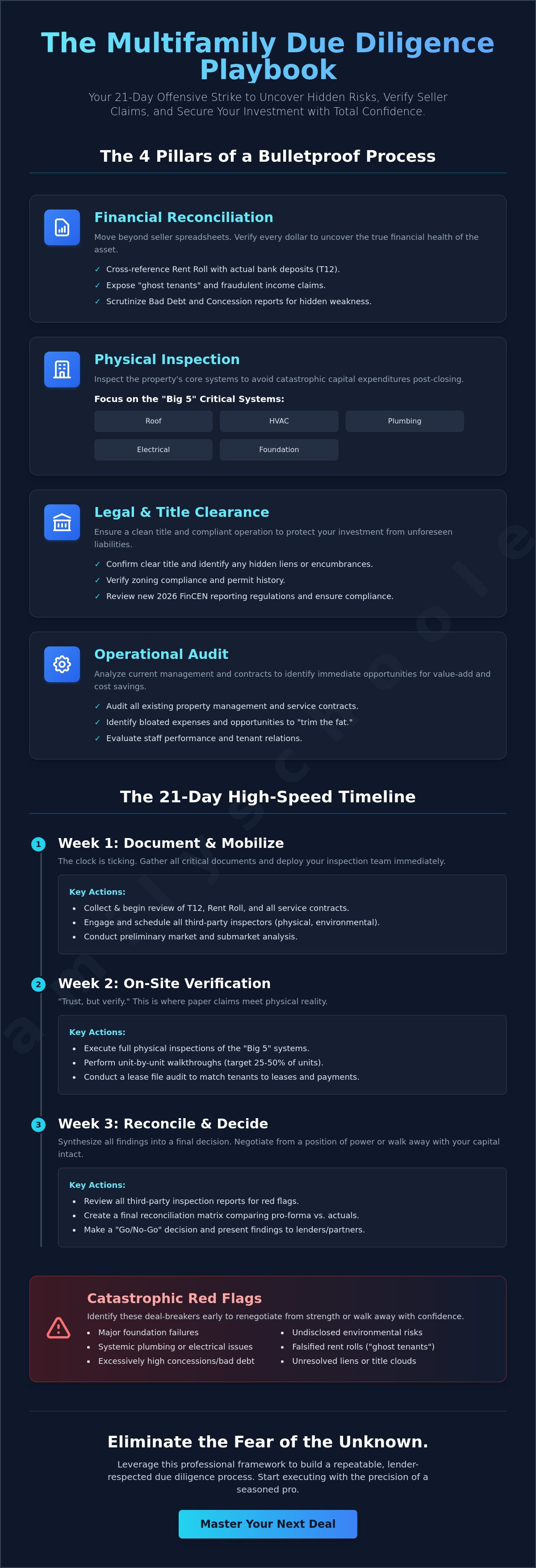
You need a fortress, not a fence. A high-level multifamily due diligence checklist is built on four non-negotiable pillars: Financial, Physical, Legal, and Operational. If any of these pillars crumble, your profit disappears. Financial due diligence involves a deep dive into the "Trailing 12" (T12) and Rent Rolls. Physical due diligence requires inspecting the "Big 5" systems: the roof, HVAC, plumbing, electric, and foundation. You must also clear the Legal and Title hurdle to ensure no hidden liens or zoning violations exist. Finally, Operational due diligence audits current property management and service contracts to find fat you can trim. This is where you separate the winners from the victims.
Financial Reconciliation: Following the Paper Trail
Stop trusting the spreadsheets the seller gave you. You must cross-reference the Rent Roll with actual bank deposits from the last 12 months. This is the only way to expose "ghost tenants" who appear on paper but don't actually pay rent. Analyze the "Bad Debt" and "Concessions" sections of the T12 with extreme scrutiny. High concessions are silent killers of apartment ROI; they suggest a property that can't attract quality tenants without heavy discounts. Request the last two years of tax returns. If the income reported to the IRS doesn't match the income on the marketing flyer, you have a major problem. You are hunting for the truth, not the sales pitch.
The Physical Walkthrough: Don't Just Sample Units
Amateurs sample 10 percent of the units. Professionals walk 100 percent of them. You cannot find the hidden hoarder unit or the slow-leak bathroom by checking a small sample. Every door you open is an opportunity to uncover a liability or a negotiation point. During the walk, you must create a detailed "Deferred Maintenance" budget. This list becomes your primary weapon for price credits or a lower purchase price during the reconciliation phase. In 2026, pay special attention to new regulations like California's SB 410, which requires disclosing the most recent balcony inspection reports. These details matter.
Using the Multifamily Tool Kit allows you to track unit conditions and appliance health in real-time as you walk. This ensures you don't miss a single broken stove or HVAC unit that requires a 30 day repair under laws like AB 628. This level of precision builds the professional framework that lenders and partners respect. You aren't just buying a building; you are acquiring a business. Treat the physical inspection like the high-stakes audit it is. If you want to master this systematic approach and close with total confidence, consider joining our Mentorship Program to learn the ropes from experts who have seen it all.
Red Flags and the Reconciliation Matrix: When to Renegotiate or Walk Away
Don't let a "good" deal blind you to a catastrophic reality. Your multifamily due diligence checklist is the filter that catches the debris before it destroys your portfolio. Major red flags are not suggestions; they are stop signs. If your Phase I Environmental Site Assessment reveals soil contamination or your property condition assessment uncovers systemic foundation failure, you are looking at a potential seven-figure liability. You must establish your "Walk Away" point before you even wire the earnest money. If the cost to cure these major red flags exceeds your contingency budget, the deal is dead. Period.
The Reconciliation Matrix is where you win the game. This is a side-by-side comparison of your initial underwriting against the hard data you found during the inspection. Did the seller claim a stable 5.7 percent cap rate while hiding a massive plumbing failure? You don't ask for a price drop because you "feel" it's too expensive. You demand a reduction because the data proves the asset is worth less. Present your findings as a professional audit. If the seller refuses to acknowledge the reality of the numbers, you have your answer. Move on to the next deal with your capital intact.
The 'Hidden Expense' Audit
Look for the spikes in the billing history. A sudden jump in water or electric bills usually signals old, inefficient appliances or massive underground leaks. Review every service contract for trash, landscaping, and pest control. Most long-term owners get lazy with these recurring costs. By simply renegotiating these contracts or switching providers, you can slash operating expenses immediately. Reducing your monthly expenses by just $1,000 adds over $150,000 in property value at current market cap rates. This is how you manufacture equity through offensive diligence. It's not just about saving money; it's about creating wealth.
The Renegotiation Blueprint
Use your inspection report as a precision tool. Instead of asking the seller to fix things, ask for a "Seller Credit" at closing. This keeps you in control of the quality of the repairs and ensures the work is done to your standards. If a seller refuses to budge on critical habitability items, remember that 2026 laws like AB 628 mandate working appliances. You have the legal and financial leverage. If you want to master the art of the "Gut Check" and know exactly when to push or pull, our Mentorship Program provides the expert guidance you need to navigate these high-stakes negotiations with total confidence.
The 21-Day Multifamily Due Diligence Timeline: Speed Without Sacrifice
In the high-speed market of 2026, hesitation is a deal killer. You have 21 days to prove the profit or kill the contract. This isn't a suggestion; it's the industry standard for elite operators. Your multifamily due diligence checklist must follow a rigid, offensive timeline to ensure you don't miss a single detail. Speed is your competitive advantage, but it only works if you have a repeatable system to follow.
- Days 1-3: The Document Dump. Demand the T12, Rent Rolls, and every active lease immediately. If the seller stalls, they're hiding something. You need this data to start your financial audit while the clock is fresh.
- Days 4-10: The Third-Party Blitz. Order your Property Condition Assessment (PCA), Appraisal, and Phase I Environmental Site Assessment (ESA) by day four. These reports often take two weeks to complete. Waiting even 48 hours can jeopardize your entire closing schedule.
- Days 11-15: The Physical Strike. This is when you walk every unit and meet your contractors on-site. You're looking for the deferred maintenance that will become your leverage in renegotiation.
- Days 16-21: The Final Reconciliation. Take the hard data from your contractors and third-party reports to update your underwriting. This is the moment you make the Go or No-Go decision with total clarity.
Accelerating the Process with Technology
Efficiency is the difference between a closed deal and a lost deposit. Use Real Estate Radar AI to verify market comps in minutes. You can't afford to spend hours manually scouring old databases when the market is moving this fast. Sync your entire team through cloud-based storage. When your inspector uploads a photo of a cracked foundation, your contractor should see it instantly. This real-time synchronization keeps your timeline on track and your team focused on the win.
Managing Third-Party Vendors
The biggest mistake rookies make is waiting too long to order the Phase I ESA. In 2026, environmental standards are stricter than ever, and a delay here can kill your financing. You must also vet your inspectors for commercial experience. A residential inspector will miss the nuances of a commercial flat roof or a central boiler system. Demand a specialist who understands the 'Big 5' systems and knows how to spot systemic failures. Your vendors are your eyes and ears; make sure they're elite.
Ready to master this 21-day offensive strike? Join our Mentorship Program to get the exact templates and expert guidance you need to close your first deal with total confidence.
Master the Deal: Leverage Mentorship and Software for Flawless Diligence
A checklist is a map, but a mentor is the guide who has already climbed the mountain. You can have the most detailed multifamily due diligence checklist in the world and still miss the subtle warning signs that only experience can spot. Real estate is a contact sport. It requires a "gut check" that data alone cannot provide. Whether it is reading between the lines of a seller's explanation for a utility spike or knowing exactly how hard to push for a credit, expert oversight is your ultimate safety net. You are building a legacy, and that journey should never be taken alone.
The "90-Day Guarantee" within our Mentorship Program is designed to solve this problem. We don't just give you a PDF and wish you luck. We guide you through your first due diligence process to ensure every red flag is identified and every profit opportunity is seized. By integrating the entire Multifamily Schooled ecosystem into your workflow, you move from an aspiring investor to a sophisticated operator. You gain the confidence to walk away from bad deals and the speed to close the winners before your competition even finishes their coffee.
The Power of the Community
Isolation is the enemy of growth. When you join the "Warrior" network, you gain immediate access to a collective intelligence that spans every major market. Need a trusted foundation specialist in North Carolina or an environmental engineer who understands 2026 FinCEN reporting? The community has already vetted them for you. Getting a "Second Set of Eyes" on your reconciliation matrix from a seasoned coach can be the difference between a profitable acquisition and a financial disaster. We provide the strategic framework so you can focus on execution.
Your Next Step toward Financial Freedom
Stop guessing and start following a system that works. If you are ready to master the fundamentals of deal vetting, start with the 5 Day Multifamily Challenge. This intensive experience will sharpen your skills and prepare you for the realities of the 2026 market. For those ready to hit the ground running with professional-grade tools, visit the Multifamily Schooled Store to download our advanced due diligence templates and eBooks. The market is moving fast. The opportunities are there for those who are prepared. Take the next step today and secure your seat at the table of high-level apartment investing.
Claim Your Economic Independence Today
The 2026 market moves at a relentless pace. You now possess the strategic framework to separate yourself from the amateurs and close deals with total confidence. By adopting an offensive mindset and following a strict 21 day timeline, you transform the multifamily due diligence checklist from a simple task into a powerful weapon for wealth creation. You've learned to verify every dollar, walk every unit, and renegotiate with the authority of a seasoned pro. This is the moment where your preparation meets opportunity.
It is time to stop watching from the sidelines and start building your empire. Leverage Justin Brennan's multi-generational real estate heritage and our proprietary Deal Finding Software to accelerate your journey. We provide a 90 day "Find a Deal" guarantee because our system is built on proven results, not theories. Ready to find your first deal in 90 days? Join the Mentorship Program now! Success isn't a matter of luck; it's a matter of following the right blueprint. You have the tools, the team, and the drive. Take action now and start living the life you were meant for. Your legacy begins with the very next door you open.
Expert Answers for Smart Investors
How much does multifamily due diligence typically cost?
Due diligence costs for a 50 to 150 unit multifamily property typically range from 10,000 to 30,000 dollars in the 2026 market. This budget covers your property condition assessment, Phase I environmental site assessment, appraisal, and title search. These expenses are a strategic investment to protect your capital and ensure you aren't buying a hidden liability. Never cut corners on these essential reports.
What is a T12 and why is it critical for due diligence?
A T12 is the Trailing 12 months of financial history for the property. It's critical because it reveals the actual income and expenses rather than just a projected snapshot. You must use your multifamily due diligence checklist to cross-reference these numbers with bank statements. This process exposes ghost tenants and hidden expenses that could drain your profit after the close.
Can I do the due diligence myself or do I need a professional team?
You must lead a professional team to execute a high level multifamily due diligence checklist properly. While you manage the strategy, you need specialized inspectors and contractors to verify the "Big 5" systems. Trying to do it all yourself is a recipe for disaster. Surround yourself with experts to ensure every foundation crack and plumbing failure is identified before you sign.
What happens if the seller refuses to provide certain documents?
Document refusal from a seller is a major red flag that usually signals fraud or severe mismanagement. You should immediately issue a formal request with a hard deadline to keep your 21 day timeline on track. If they continue to stall, be prepared to walk away from the deal. Never risk your capital on an asset with an obscured financial paper trail.
How do I handle tenant privacy during unit inspections?
You handle tenant privacy by providing a formal notice at least 24 to 48 hours before entering any units. Follow local regulations and ensure your team is professional and fast during the walkthrough. This maintains property stability and keeps you in compliance with habitability standards like California's AB 628. Respectful communication prevents tenant turnover during the transition of ownership.
What is a Phase I Environmental Site Assessment and do I always need one?
Environmental safety requires a Phase I Environmental Site Assessment (ESA) to identify potential soil or groundwater contamination. Most commercial lenders require this report before they will approve your mortgage in 2026. It's a non-negotiable step to shield yourself from massive cleanup costs. If the Phase I reveals issues, you must move to a Phase II or walk away.
How do I verify the occupancy if the units look full but the rent roll is messy?
You verify occupancy by auditing active utility accounts and requesting signed estoppel certificates from every tenant. If the paperwork is disorganized, look for recent bank deposits that match the lease agreements. This ensures you aren't buying a building full of non-paying occupants. Physical verification during the unit walk is your final line of defense against occupancy fraud.
What is the difference between a PCA and a standard home inspection?
Commercial investors use a Property Condition Assessment (PCA) because it follows much stricter standards than a standard home inspection. A PCA provides a 10 to 20 year outlook on major capital expenditures like roofs and central boiler systems. It gives you the hard data needed to create a realistic renovation budget. This commercial-grade audit is what lenders and partners expect to see.



