

The Multifamily Appraisal Process: A Masterclass for Investors in 2026
The multifamily appraisal process is not a passive event; it is a high-stakes data-driven argument that you must win to scale your empire. Most investors treat the appraisal like a black box, waiting by the phone and praying the bank's value hits the purchase price. But hope is not a strategy for long-term wealth. You've likely felt the frustration of an "appraisal gap" threatening a deal because an appraiser didn't understand how your property's income drives its value. It's time to stop leaving your financing to chance.
With the industry transition to UAD 3.6 standards starting November 2, 2026, the valuation game has become more granular and demanding. You need a proven system to navigate these changes and secure the highest possible leverage. This masterclass unlocks the commercial valuation process, giving you the power to influence the outcome and defend your property's worth to any lender. We'll provide a step-by-step 2026 timeline, a professional prep checklist, and the exact strategies you need to command the valuation you deserve.
Key Takeaways
- Learn why Net Operating Income (NOI) is the primary engine driving your property's multi-million dollar valuation.
- Implement specific steps in the multifamily appraisal process to bridge the "appraisal gap" and lock in maximum leverage.
- Discover how a professional "Deal Book" ensures you don't leave your final value to chance.
- Spot and neutralize common valuation pitfalls like conservative bias and inaccurate market rent data.
- Leverage a proven system for organizing financial data to command instant respect from lenders and appraisers.
What is the Multifamily Appraisal Process? Beyond the Residential 'Comp'
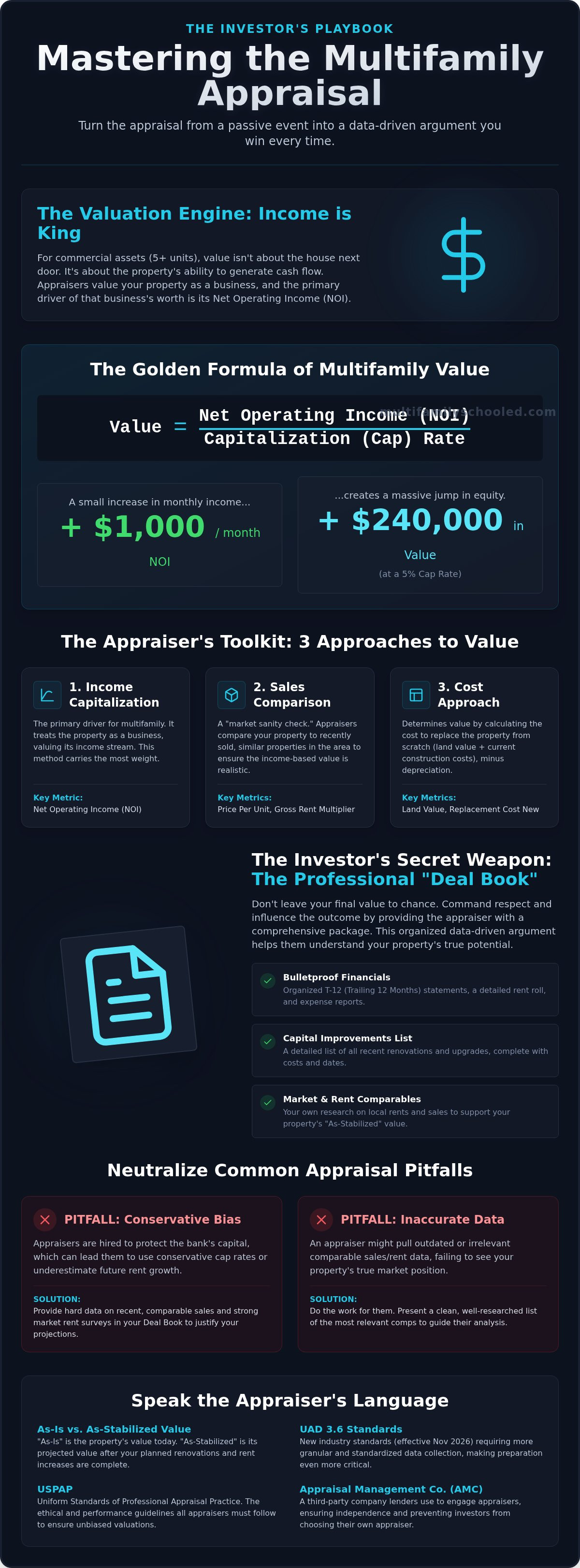
The multifamily appraisal process is the definitive valuation required by lenders to establish your Loan-to-Value (LTV) ratio and secure your financing. It's the gatekeeper to your wealth. Unlike single-family homes, commercial assets with five or more units live and die by their income. While residential appraisers obsess over the house next door, commercial professionals prioritize Net Operating Income (NOI). They view your property as a business, not just a building. If the business doesn't cash flow, the building doesn't value.
The typical 2026 timeline is rapid and demanding. It begins with the lender engaging an appraiser, moves through a rigorous site visit, and finishes with a detailed analysis phase. A Narrative Appraisal Report is a comprehensive 50 to 100 page document that provides the data-driven justification for your property's final market value. Understanding this Real estate appraisal framework is the first step toward mastering your deal's outcome and ensuring you aren't leaving money on the table.
The Role of the Appraiser in Your Capital Stack
Think of the appraiser as the eyes and ears for the lender's risk department. They aren't there to help you; they're there to protect the bank's capital. You must understand the distinction between "As-Is" value, which reflects the property's current state, and "As-Stabilized" value, which accounts for your future renovations and rent increases. In the 2026 interest rate environment, capitalization (Cap) rates are shifting. Higher rates often push Cap rates up, meaning your NOI must work harder to maintain a high valuation. Use the Multifamily Tool Kit to ensure your financial data is bulletproof before the appraiser ever sets foot on the property.
Engagement and USPAP Standards
Lenders don't just pick a name out of a hat. They select appraisers through an Appraisal Management Company (AMC) to ensure total independence and transparency. This means you cannot choose your own appraiser for a bank-funded deal. Every professional must follow USPAP (Uniform Standards of Professional Appraisal Practice) guidelines to maintain the deal's legitimacy. These standards ensure the valuation is unbiased and follows a recognized methodology. If you want to command respect throughout the multifamily appraisal process, you need the credibility that comes from a structured Mentorship Program. Don't walk into a high-stakes valuation blind; follow a proven system that gets results.
The Three Approaches to Value: How Appraisers Calculate Worth
Success in the multifamily appraisal process depends on your ability to speak the appraiser's language. They don't just look at one number and call it a day. Instead, they use three distinct methodologies to triangulate a property's true worth. These lenses allow them to view the asset from different economic angles, ensuring the final valuation is rooted in market reality. Once these figures are calculated, the appraiser performs a "reconciliation" to determine which approach carries the most weight for your specific deal.
Mastering the Income Capitalization Approach
This is the primary driver for multifamily assets. Investors buy income, and appraisers value it. The Golden Formula is simple but powerful: Value = Net Operating Income (NOI) divided by the Capitalization (Cap) Rate. In this game, small victories lead to massive wealth. A minor increase in monthly rent or a slight reduction in utility costs can trigger a staggering jump in property value. For example, increasing your monthly NOI by just $1,000 creates $240,000 in new equity at a 5% cap rate. You can calculate these critical metrics like a pro using the Multifamily Tool Kit. Master this math, and you master the deal.
When the Sales Comparison Approach Matters
While income is king, appraisers use the Sales Comparison Approach to check market sanity. They look at Gross Rent Multipliers (GRM) and price-per-unit metrics from recently sold properties. They adjust for unit mix, amenities, and "vintage," which refers to the building's age. In 2026, appraisers are laser-focused on Physical, Functional, and External Obsolescence. The industry shift toward UAD 3.6 standards means data collection is more granular than ever. You must find truly comparable off-market data to stay competitive. Use Real Estate Radar to track local transactions and defend your valuation with hard evidence.
The final method is the Cost Approach. This calculates the value of the land plus the current cost to rebuild the structure from scratch. While less relevant for older "value-add" properties, it's a vital benchmark for new construction deliveries. By reconciling these three numbers, the appraiser provides a bulletproof justification for your loan. If you want to ensure your property hits the mark every time, consider joining our Mentorship Program to learn the insider strategies that influence these outcomes. Stop guessing and start winning the valuation game today.
The Investor's Secret Weapon: Preparing the 'Appraisal Package'
Stop treating the multifamily appraisal process like a spectator sport. If you wait for the report to arrive before taking action, you've already lost. Take control by providing a professional "Deal Book" that guides the appraiser's hand. This is your chance to frame the narrative before they form their own conclusions. An appraiser is a data-hungry professional; give them the right data, and you'll get the right result.
- Step 1: Organize a clean Trailing 12-Month (T-12) income statement and a current Rent Roll. Accuracy is your best friend here.
- Step 2: Create a detailed Capital Improvement (CapEx) list. Show every dollar spent on roofing, HVAC, or flooring upgrades.
- Step 3: Provide your own "Comp" list. Use this to justify your Pro-Forma rent projections with hard market evidence.
- Step 4: Be present for the site visit. Highlighting property strengths in person prevents important details from being overlooked.
The Essential Documents for a High Valuation
A "Unit Upgrade Tracker" is vital for value-add investors. It proves exactly how much value you've injected into each door. Hand over utility bills and tax records upfront to prevent the appraiser from using "conservative" market averages that might hurt your NOI. Presenting organized, professional data reduces appraiser friction and lowers the perceived risk of the entire deal. Use the Multifamily Tool Kit to ensure your documents meet institutional standards.
Conducting the Site Visit Professionally
First impressions are everything. Optimize your property's curb appeal 48 hours before the site visit. Clean the common areas and ensure the signage is pristine. When the appraiser arrives, lead them to your "best" units first. Showcasing your top-tier finishes and premium appliances sets a high mental baseline for the rest of the tour. Don't hide from the "deferred maintenance" conversation. Address it head-on by explaining your renovation timeline and budget. This proactive approach builds trust and protects your valuation. To master these high-stakes interactions, join our Mentorship Program and gain the confidence to lead any deal to a successful close.
Common Appraisal Pitfalls & How to Overcome a Low Valuation
Don't panic if the initial report comes back lower than your purchase price. A "low-ball" number isn't the end of your deal; it's the start of your counter-offensive. In the 2026 market, many appraisers still suffer from "Conservative Bias." They play it too safe to protect their professional standing, but their caution shouldn't cost you your equity. Another frequent issue is the use of inaccurate market rents. If your appraiser relies on "comps" from 2024 or 2025, they're missing the stabilization and rent growth trends defining the current multifamily appraisal process. You must be the one to correct the record.
High vacancy rates can also tank a valuation if you don't provide context. If you're in the middle of a heavy renovation, that vacancy is a strategic move to increase future value, not a sign of market failure. You have to explain this transition clearly. If the final report is still flawed, you must initiate the "Rebuttal Process." This is a formal, data-heavy challenge to the appraiser’s findings. It's your opportunity to prove that your property's potential far outweighs a safe, surface-level estimate.
Challenging the Appraisal Report
Focus your energy on identifying factual errors first. Did the appraiser miss a unit? Is the square footage documented incorrectly? These are objective mistakes that are easy to win. Differences of opinion regarding capitalization rates are harder to fight, but you can win with better data. Provide fresh, hyper-local market evidence that the appraiser may have overlooked during their initial search. Your lender’s "Review Appraiser" acts as the final judge in this dispute. If you present a logical, evidence-based argument, they have the authority to adjust the final number and save your financing.
Using Education to Mitigate Risk
Professionalism is your greatest defense against a low valuation. Being part of a Mentorship Program signals to lenders and appraisers that you have expert oversight and a proven system. It shows you aren't just guessing; you're following a blueprint for success. This institutional-grade credibility reduces the appraiser's perceived risk of the deal. Use your network to identify "investor-friendly" appraisers who understand value-add strategies and 2026 market dynamics. When your financial analysis looks like it came from a top-tier firm, you command the respect necessary to secure higher leverage. Master the appraisal rebuttal and secure your financing by joining our mentorship today.
Scale Your Portfolio with the Multifamily Schooled System
Mastering the multifamily appraisal process is the critical bridge between a simple purchase and a scalable, high-performing business. You aren't just buying apartment buildings; you're constructing a legacy of long-term financial freedom. In our system, the appraisal is the final exam of your deal analysis. If you've followed the blueprint, it's where your vision is officially validated by the bank's capital. The 90-day system we teach treats the appraisal as a strategic milestone, not a random obstacle. By engineering the value from day one, you ensure your math always aligns with institutional expectations.
Lenders and appraisers respect one thing above all else: professional-grade data. When you present a deal backed by the Multifamily Schooled frameworks, you bring instant credibility to the closing table. They see an investor who understands the deep nuances of NOI, shifting cap rates, and 2026 market trends. This isn't about guessing what a property might be worth. It's about using the same proprietary methodologies the pros use to prove it. You're taking control of the narrative and forcing the market to recognize the value you've created.
Find and Fund Your First Deal in 90 Days
Speed is the ultimate currency in the 2026 market. You don't have months to sit on the sidelines while more aggressive investors are closing deals and accumulating assets. The Mentorship Program is designed to get you from zero to your first closed deal in just 90 days. We don't just teach you how to find a property; we provide the tools to secure it. We walk you through the complex world of commercial financing and the multifamily appraisal process to ensure your loan closes on time and with the highest possible leverage. Your success is a choice. It starts with taking decisive action now. Join the Mentorship Program and close your first deal!
The Investor's Toolkit for 2026
You need a professional edge to win in today's competitive environment. Stop relying on outdated spreadsheets and "gut feelings" that lead to expensive mistakes. Organize your deals and financial statements with the Multifamily Tool Kit to ensure your analysis is bank-ready every single time. To find the best off-market targets before your competition even knows they exist, leverage the predictive power of Real Estate Radar. These aren't just optional add-ons; they are the essential components of a successful investing ecosystem designed for speed and precision. Explore all resources in our store to professionalize your investing career and start building your empire today.
Command Your Future and Secure Your Legacy
You have unlocked the fundamental secrets to the multifamily appraisal process. You now understand that Net Operating Income is your primary lever for massive wealth and that a professional "Deal Book" is your non-negotiable secret weapon. Don't let a lender's conservative bias or outdated market data dictate your financial destiny. You have the frameworks to engineer property value and defend it with institutional-grade precision. The black box is open; it's time to step inside and take control of your capital stack.
Success in this industry belongs to those who move with speed and absolute certainty. You don't have to navigate these high-stakes valuations alone or guess your way through a deal. Get the expert oversight you need from industry veteran Justin Brennan. Our system provides direct access to proprietary analysis software and a bold performance guarantee. We help you find a deal in 90 days or we provide one for you. Secure your first apartment deal with our 90-day Mentorship Program!
Your journey to long-term independence and asset accumulation starts with a single, decisive step. Take it today and watch your portfolio scale beyond your wildest ambitions.
Frequently Asked Questions
How much does a multifamily appraisal cost in 2026?
Expect to pay between $600 and $1,500 for smaller multifamily properties as of mid-2026. FHA and USDA appraisals typically range from $400 to $900 due to specific regulatory requirements. Commercial assets with five or more units often command higher fees because their complexity requires a narrative report. Budget for these costs early in your acquisition phase. Don't let closing costs surprise you; plan your capital stack with total precision to maintain your momentum.
How long does the multifamily appraisal process take from start to finish?
The multifamily appraisal process generally takes between two and four weeks to complete. This timeline includes the initial engagement, the physical site visit, and the data analysis phase. With the transition to UAD 3.6 standards on November 2, 2026, some reports may take longer as appraisers adapt to more granular data requirements. Move fast by having your financial documents organized. Speed and accuracy are your primary weapons when securing lender approval.
Can I use a residential appraiser for a 5-unit apartment building?
No, you cannot use a residential appraiser for any property with five or more units. These assets are classified as commercial real estate and require a Certified General Appraiser. Commercial valuations focus on income generation and Net Operating Income rather than simple residential comparisons. If you want to scale your portfolio, you must work with professionals who understand commercial logic. Surround yourself with experts who can justify your property's value as a high-performing business.
What is the difference between a 'Restricted' and a 'Full' appraisal report?
A Full Appraisal Report is a comprehensive narrative document intended for lenders and third-party investors to justify a loan. A Restricted Appraisal Report is a brief summary intended only for the client's internal use and cannot be used for bank financing. Lenders require the depth of a full report to verify the loan-to-value ratio. Professionalism in your documentation is non-negotiable. Always aim for the highest standard to signal your credibility to the capital markets.
Does a high vacancy rate always lead to a lower appraisal value?
Not necessarily. While high vacancy can be a red flag, it often represents a massive value-add opportunity for savvy investors. If you are intentionally keeping units empty to perform renovations, that vacancy is a strategic step toward higher rents. You must explain this business plan to the appraiser with clear data. Prove that your "As-Stabilized" value justifies the temporary dip in income. Take control of the narrative and engineer your property's success.
How do I find a commercial appraiser who understands value-add strategies?
Start by asking your lender for their approved list of Appraisal Management Companies. Look for firms that specialize specifically in multifamily assets rather than general retail or industrial space. Networking within a Mentorship Program is the most effective way to find investor-friendly appraisers who grasp renovation strategies. They understand how your upgrades drive NOI and long-term worth. Don't leave your valuation to someone who doesn't recognize the potential in your specific market.
What happens if the appraisal comes in lower than the purchase price?
This creates an "appraisal gap" that can threaten your financing. You can fight back by initiating a formal rebuttal and providing the appraiser with more accurate market data. You might also negotiate a price reduction with the seller or increase your equity contribution. Use the Multifamily Tool Kit to present bulletproof financial evidence that supports your original valuation. Never let a single low report stop you from building your empire and securing your future.
Is a multifamily appraisal the same as a property inspection?
No, these are two distinct processes with different goals. An appraisal determines the market value of the asset for the lender's risk department. A property inspection evaluates the physical condition, safety, and mechanical systems for the buyer. You need both to protect your capital and ensure a successful acquisition. The appraisal confirms the business's worth, while the inspection confirms the building's health. Master both to build a portfolio on a rock-solid foundation.



