

Tax Implications of Selling an Apartment Building: 2026 Guide
Could two owners sell similar apartment buildings for the same price and face very different tax bills? Absolutely. The tax implications of selling an apartment building depend on more than the sale price. Adjusted basis, depreciation, ownership structure, and how you handle the proceeds can all affect the outcome.
If you’re unsure how much you might owe or when the tax could come due, it can be harder to plan your next move. This guide explains the main tax categories that may apply and the records and deal details that can affect an estimate. Use it to prepare informed questions for a qualified tax professional before you sign.
We’ll cover how adjusted basis and depreciation affect taxable gain, how holding period and ownership structure can influence the tax picture, and how options such as a 1031 exchange or installment sale may affect timing. You’ll also see which sale documents, improvement records, and depreciation history to gather. Build a clearer picture before closing, then use it to inform your next multifamily decision.
Key Takeaways
- Separate estimated sale price, debt payoff, expenses, and potential taxable gain to build a more useful pre-sale estimate.
- The tax implications of selling an apartment building can hinge on adjusted basis and depreciation history, so organize improvement and tax records early.
- Compare a taxable sale, a potential Section 1031 exchange, and an installment sale to understand how eligibility and timing may differ.
- Review ownership and transaction details before signing, since they can affect which tax rules apply and how proceeds are reported.
- Keep sale, expense, and exchange documents organized to support tax reporting and inform your next investment decision.
What tax implications can follow from selling an apartment building?
Selling an apartment building can create taxable gain, but the tax bill depends on the owner’s circumstances, records, and transaction structure. Federal tax is only part of the picture. State income-tax rules vary, and some jurisdictions may also impose local or transfer taxes. Start with a full estimate rather than relying on the expected check at closing.
A sale may involve more than one federal tax category. Holding period matters: gain on property held for more than one year may qualify for long-term capital-gain treatment, while a shorter holding period can lead to different treatment. Depreciation claimed or allowable may also affect how part of the gain is taxed. For certain real property, that portion may be treated as unrecaptured Section 1250 gain, subject to a maximum federal rate of 25%. A seller’s income may also make the 3.8% net investment income tax relevant. State taxes can add another layer.
These categories don’t mean every seller owes each tax, and a planning strategy doesn’t necessarily erase tax. A Section 1031 exchange, for example, may defer recognition of qualifying gain if its requirements are met. Deferral generally isn’t the same as elimination. The tax implications of selling an apartment building depend on the full transaction and applicable rules.
Why sale proceeds are not the same as taxable gain
Keep three figures separate: gross sale price, net cash proceeds, and taxable gain. The amount realized generally starts with the sale consideration and may account for eligible selling costs and other transaction details. Taxable gain is generally determined by comparing the amount realized with the property’s adjusted basis, though the final calculation depends on the facts and tax rules.
Your closing statement shows cash flow, not necessarily taxable gain. A mortgage payoff reduces the cash left for you, but paying off the loan doesn’t automatically reduce gain. Debt assumed or discharged as part of a transaction can affect the tax calculation, so review the deal terms rather than relying only on the net wire amount.
Cash received is what remains after closing adjustments; taxable gain is generally the amount realized minus adjusted basis.
Depreciation can change the character of part of the gain, a concept commonly called depreciation recapture. Keep depreciation schedules and improvement records available for the calculation.
Use this as a planning framework
This overview is educational guidance, not individualized tax, legal, or investment advice. Before signing, have a qualified tax professional review the ownership, transaction documents, basis records, depreciation history, and relevant federal, state, and local rules. That review can help clarify likely tax treatment and distinguish potential deferral from a permanent reduction in tax.
How adjusted basis and depreciation shape apartment-building sale taxes
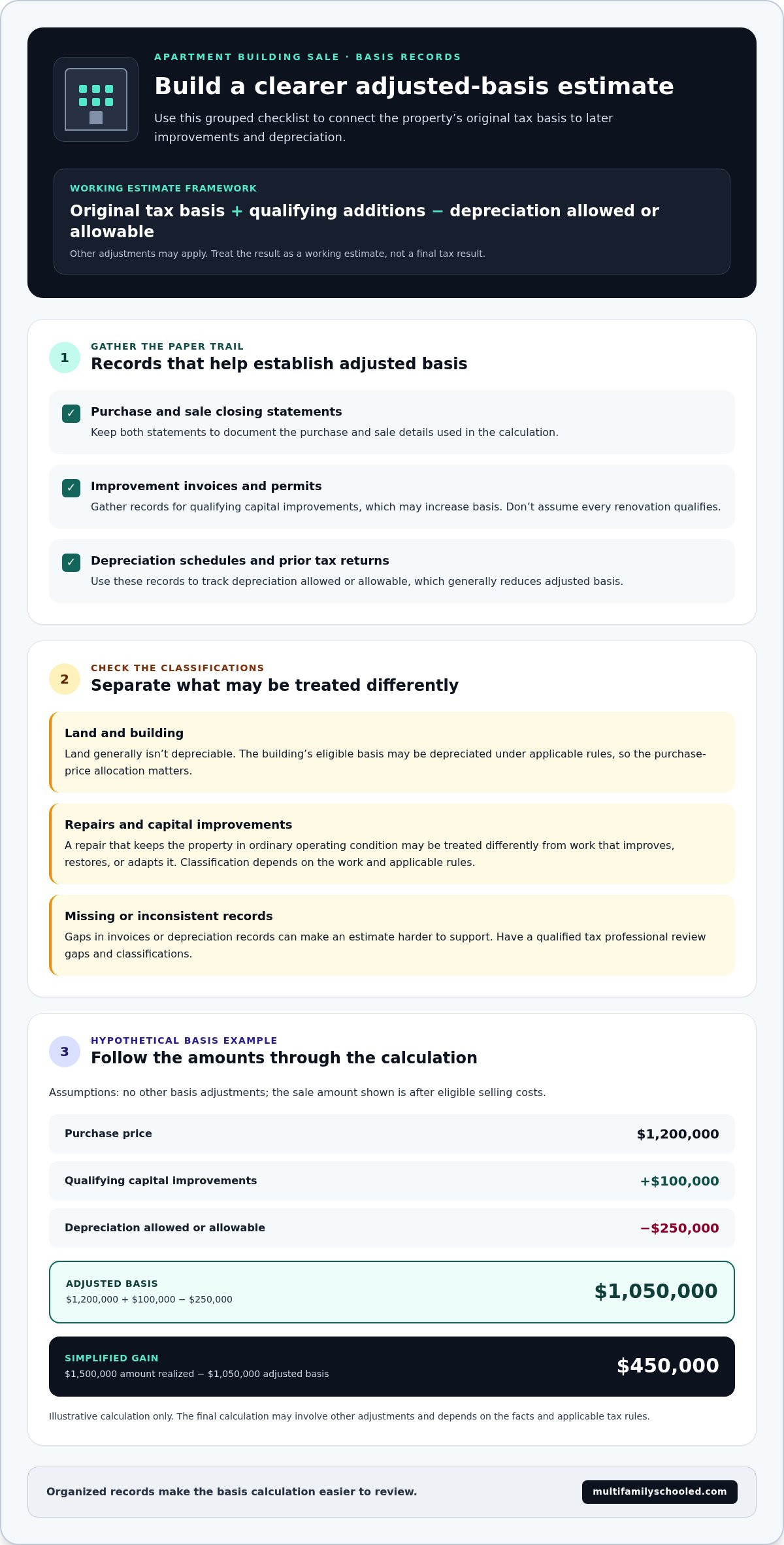
Adjusted basis is a key starting point for estimating gain. In general, it begins with the property’s tax basis, increases for qualifying capital improvements, and decreases by depreciation allowed or allowable. The calculation may involve other adjustments, so treat it as a working estimate rather than a final tax result.
Fact-dense definition: Adjusted basis is the property’s original tax basis, adjusted for qualifying additions and reductions such as depreciation. It is generally compared with the amount realized to calculate gain or loss. The IRS Publication 544 explains how gains and losses from property sales are determined and classified.
Land and buildings need separate consideration. Land generally isn’t depreciable, while the building’s eligible basis may be depreciated under applicable rules. A property’s purchase-price allocation and later changes can therefore affect the basis calculation. Depreciation may also shape the tax treatment of gain: unrecaptured Section 1250 gain generally refers to gain associated with depreciation on certain real property and may be taxed at a maximum federal rate of 25%. Section 1231 rules may apply to qualifying business property held longer than one year, but the outcome depends on the transaction, netting with other Section 1231 gains and losses, and potential lookback rules.
What records help establish adjusted basis?
Gather purchase and sale closing statements, invoices and permits for improvements, depreciation schedules, and prior tax returns. These records help connect the property’s original basis to later additions and depreciation deductions.
Repairs and capital improvements may receive different tax treatment. A repair that keeps property in its ordinary operating condition may be treated differently from work that improves, restores, or adapts it. Classification depends on the work and applicable rules, so don’t assume every renovation adds to basis. Missing invoices or inconsistent depreciation records can make an estimate harder to support. Have a qualified tax professional review gaps and classifications.
Hypothetical basis example
Assumptions: An owner buys a property for $1.2 million, allocates $200,000 to nondepreciable land and $1 million to the building, later makes $100,000 of qualifying capital improvements, and has $250,000 of depreciation allowed or allowable. Assume no other basis adjustments. Adjusted basis would be $1.05 million: $1.2 million + $100,000 - $250,000. If the amount realized after eligible selling costs were $1.5 million, the simplified gain would be $450,000. This illustration does not calculate tax or determine how gain is classified.
Good recordkeeping can also support better-informed future investment decisions. Multifamily Schooled’s multifamily investing mentorship provides investor education, while individualized tax analysis belongs with a qualified tax professional.
Taxable sale, Section 1031 exchange, or installment sale: what differs?
The sale structure can affect when eligible gain is reported, but it doesn’t automatically erase tax. A standard taxable sale, a potential Section 1031 exchange, and an installment sale follow different rules. Eligibility depends on the property, owner, and transaction. Compare the options early, before documents or proceeds make a preferred approach difficult to carry out.
| Approach | Purpose | Broad eligibility | Timing and key limits |
|---|---|---|---|
| Taxable sale | Sell and generally recognize taxable gain under applicable rules. | Available as the ordinary sale route; tax treatment depends on the facts. | Gain is generally reported for the sale year. Debt payoff affects cash proceeds, not automatically taxable gain. |
| Section 1031 exchange | Defer recognition of qualifying gain by exchanging eligible real property. | Generally applies to qualifying real property held for investment or business use, not personal-use property. | Identify replacement property within 45 days and acquire it within 180 days, or the return due date, if earlier. An extension may affect the latter deadline. Strict rules apply. |
| Installment sale | Report eligible gain over time as payments are received. | Generally requires at least one payment after the tax year of sale; it can’t report a loss. | Payment terms, interest rules, buyer payment risk, and gain components affect the result. Some depreciation-related amounts may be taxable in the sale year. |
When might a Section 1031 exchange be considered?
An exchange may suit an owner selling qualifying investment or business real property who plans to acquire replacement property. Under the Section 1031 exchange rules, timing and transaction steps matter. A qualified intermediary generally facilitates the exchange, and the seller must not take control of the sale proceeds. The same taxpayer rule and property-use details can affect eligibility. Personal-use property generally doesn’t qualify.
Mark the deadlines before closing: replacement property must be identified in writing within 45 calendar days and acquired within 180 calendar days or the tax-return due date for the sale year, whichever comes first. A tax extension can extend the latter deadline to the full 180 days. Missing a requirement can undermine the intended treatment.
How does installment-sale treatment differ?
An installment sale spreads eligible gain across tax years as payments arrive. It can align reporting with cash receipts, but it also means relying on the buyer to pay over time. Interest requirements, including applicable federal rates, and depreciation-related treatment need separate review. Model the payment schedule, buyer risk, and potential tax due in the sale year with qualified tax and legal advisers.
Deferral isn’t necessarily tax elimination. A 1031 exchange generally postpones recognition of qualifying gain rather than making it disappear; an installment method changes timing only for eligible amounts. The tax implications of selling an apartment building depend on the final deal terms and current rules. For investor education as you plan future decisions, explore multifamily investing mentorship.
What should you calculate and document before listing an apartment building?
Start planning before you sign a listing agreement or commit to sale terms. A preliminary tax estimate can help you compare offers and understand how much cash may remain after closing, but don’t mistake that figure for taxable gain. Use this sequence to organize the facts for a qualified tax professional familiar with real estate dispositions and the relevant jurisdiction.
- Confirm ownership and holding details. Gather entity documents and note every owner’s interest, how the property is held, and when it was acquired. Ownership structure, co-owners, and holding period can affect reporting and tax treatment.
- Assemble basis and depreciation records. Collect purchase and closing statements, capital-improvement invoices, depreciation schedules, and prior tax returns. Flag missing or inconsistent records instead of assuming the file is complete.
- Outline proposed sale terms. Record the estimated gross sale price, proposed closing date, payment terms, and other relevant deal provisions. Include current loan statements and an estimate of debt payoff.
- Estimate transaction expenses separately. List expected costs associated with the sale and ask the tax professional which may be relevant to the tax calculation. Don’t combine them with the loan payoff or treat every closing deduction as a tax deduction.
- Build separate cash and tax estimates. Estimate net cash proceeds by starting with the expected sale price and subtracting debt payoff and transaction expenses. Separately estimate potential taxable gain using the amount realized and adjusted basis, with applicable depreciation and other adjustments reviewed.
- Check jurisdiction and strategy considerations. Identify the state and local rules that may apply, along with any potential exchange or installment-sale plan. The property’s location, ownership, and transaction details can affect which rules are relevant.
Keep source documents with your estimates. Purchase records establish the starting point; improvement documentation and depreciation history help explain later basis adjustments. Proposed sale terms and ownership documents give the tax professional a clearer view of the transaction. If records are incomplete, identify the gaps early so the estimate can account for uncertainty.
Model the transaction before committing
Ask a qualified tax professional to review the documents and model relevant scenarios under current 2026 federal rules and applicable state and local requirements. Compare expected cash available after closing with potential taxable gain, and discuss how timing, ownership, and deal structure may affect reporting. These are different measures, so one shouldn’t stand in for the other.
A tax estimate made before deal commitments can reveal whether the expected cash and potential tax outcome fit your next move. Use the analysis to prepare questions and make informed decisions, not as a substitute for individualized tax, legal, or investment advice. For a more structured approach to future multifamily decisions, explore multifamily investing mentorship.
After the sale: plan your next investment with a clearer tax picture
Closing the sale doesn’t finalize your tax outcome. The final calculation depends on the completed transaction documents, the property’s tax records, and the filing rules that apply to your situation. Keep the settlement statement, records of sale proceeds and expenses, ownership documents, depreciation history, and any exchange paperwork together. An organized file makes it easier to reconcile closing figures with tax reporting.
Coordinate tax reporting and future investment decisions
Review the final settlement statement and transaction records with a qualified tax professional familiar with real estate dispositions and the relevant jurisdiction. Discuss the forms, reporting treatment, and filing deadlines that apply to your transaction. For example, an installment sale may require Form 6252, while exchange reporting depends on the transaction’s facts and applicable requirements. Confirm current filing rules rather than relying on a generic checklist.
Use the completed numbers to inform your next decision. Compare the cash actually available with any tax liabilities and obligations that remain, then consider how the sale fits your broader portfolio goals. A reinvestment choice should reflect your investment plan and risk considerations, not an assumption that a particular structure guarantees tax savings or returns. For continued investor education, explore multifamily investing resources.
Build a more informed multifamily investing process
A sale can create a useful checkpoint. Review what the transaction taught you about ownership structure, recordkeeping, timing, and exit planning, then carry those lessons into future acquisition decisions. Investor education can help you develop a clearer process for evaluating opportunities, while individualized tax questions still belong with a qualified tax professional.
The tax implications of selling an apartment building are specific to the completed deal and your circumstances. Keep your records organized, confirm your reporting approach, and use the final tax picture as one input in your next investment plan. If mentorship would support that learning process, explore multifamily investing mentorship. Explore Multifamily Schooled to continue building your multifamily investing knowledge.
Make your next move with a clearer plan
The tax implications of selling an apartment building depend on how adjusted basis, depreciation, ownership, and deal structure come together. A headline sale price won’t tell you your taxable gain or the cash you’ll keep. Keep those figures separate, gather the records that support your estimate, and review the proposed transaction with a qualified tax professional before committing.
A taxable sale, a potential Section 1031 exchange, and an installment sale can affect the timing and reporting of eligible gain in different ways. Deferral isn’t the same as tax elimination, and no strategy fits every owner. Strong preparation helps you identify questions to resolve and use the completed sale as one input in your next investment decision.
Keep building your knowledge for what comes next. Multifamily Schooled offers investor education, workshops, and mentorship focused on apartment and commercial real estate investing. Explore multifamily investing education and take a more informed approach to your next opportunity. Your next move starts with a clear process.
Frequently Asked Questions
What taxes do you pay when selling an apartment building?
The tax implications of selling an apartment building can include federal tax on recognized gain and distinct treatment for depreciation-related gain. State and local taxes may also apply, depending on the property and seller. The result isn’t determined by sale price alone: ownership structure, adjusted basis, holding period, eligible transaction expenses, and current law all matter. This is a general overview, not individualized tax advice. Have a qualified tax professional review your circumstances.
How is capital gain calculated when you sell an apartment building?
Capital gain is generally calculated by comparing the amount realized from the sale with the property’s adjusted basis. The amount realized and basis may require adjustments, including review of eligible transaction expenses, improvements, and depreciation. Net cash proceeds are different: paying off a mortgage can reduce the cash you receive, but it doesn’t automatically determine taxable gain. Check the records and assumptions with a qualified tax professional before relying on an estimate.
Do you pay tax on depreciation when you sell a rental apartment building?
Depreciation claimed or allowable may reduce adjusted basis and affect how gain is taxed when you sell. For certain real property, gain related to depreciation may be treated as unrecaptured Section 1250 gain, subject to specific federal rules. The amount and treatment depend on the property, depreciation history, and taxpayer’s circumstances. Don’t assume one rate applies to every sale. Ask a qualified adviser to review current federal and state treatment.
Can you avoid capital gains tax by using a 1031 exchange?
A qualifying Section 1031 exchange may defer recognition of eligible gain, but it doesn’t automatically eliminate tax. The exchange generally must involve qualifying real property held for investment or business use, and a qualified intermediary typically handles the proceeds. Strict rules apply, including a 45-day identification period and a 180-day acquisition period, subject to the tax-return due-date rule. Eligibility and current requirements need professional review before the sale closes.
What happens if you sell an apartment building with a mortgage?
At closing, sale proceeds commonly go toward paying off the mortgage or other secured debt, reducing the cash left for the seller. The payoff doesn’t automatically determine taxable gain. Gain generally requires a separate calculation using the amount realized and adjusted basis, with transaction details reviewed. Compare the lender’s payoff statement with the final sale documents, then include both in your tax estimate with a qualified tax professional.
Can you spread apartment-building sale taxes over several years?
Some sellers may use installment reporting when they receive payments over time and the transaction qualifies. It doesn’t apply to every sale or every component of gain. Depreciation-related amounts, for example, may have separate treatment and could be reportable in the sale year. Before agreeing to payment terms, model the timing of expected receipts, the buyer’s ability to pay, interest requirements, and potential tax consequences with qualified advisers.
When should I talk to a tax professional before selling an apartment building?
Talk with a qualified tax professional early, ideally before signing binding sale or exchange documents. Early review gives you time to assess adjusted basis, depreciation records, ownership structure, proposed terms, and possible transaction approaches. Timing matters for strategies with strict requirements, including a potential Section 1031 exchange. A professional familiar with real estate dispositions can evaluate your jurisdiction and current 2026 rules using your documents and circumstances.



