

Software for Finding Real Estate Deals: The 2026 Investor’s Guide
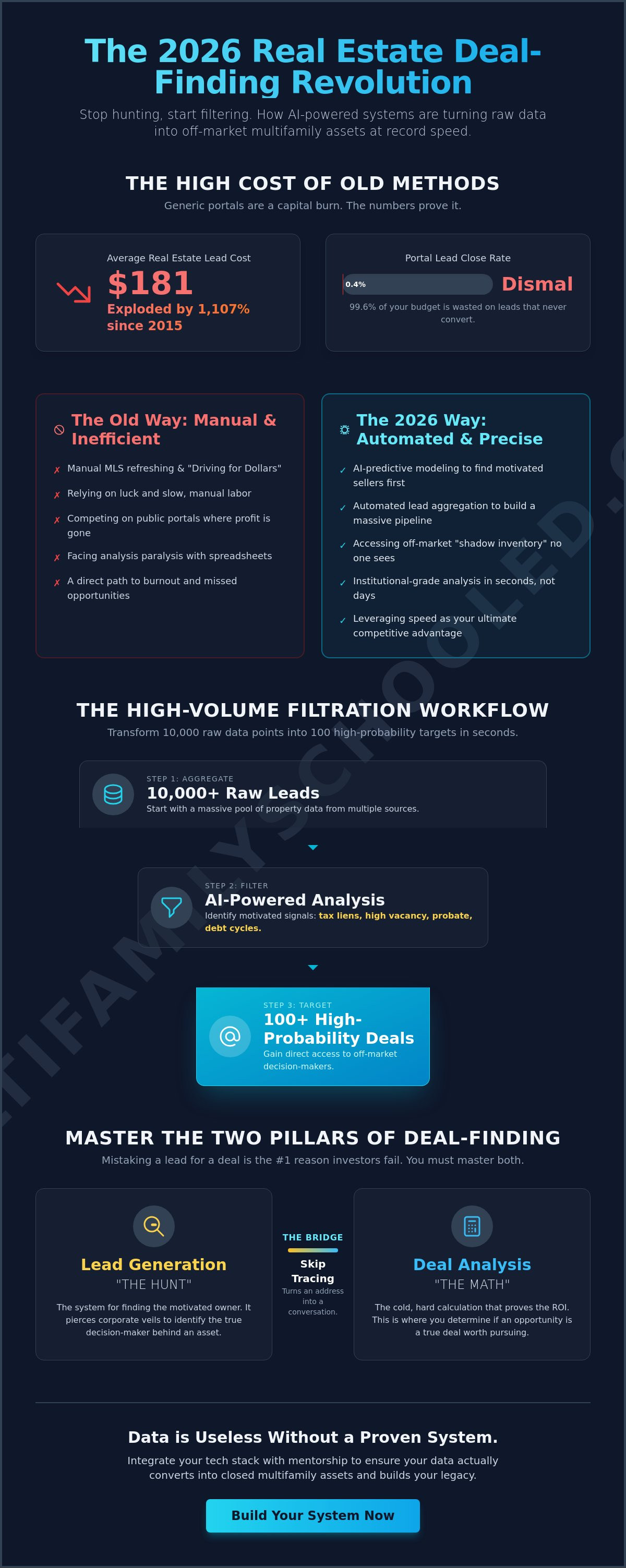
The average cost of a real estate lead has exploded by 1,107 percent since 2015, now costing you a staggering $181 just to get a name and a phone number. If you are still relying on generic portals with a dismal 0.4 percent close rate, you are burning capital while your competitors dominate the landscape. You need the right software for finding real estate deals to break out of this cycle and start winning. Stop letting analysis paralysis and disconnected subscriptions hold your portfolio back from its true potential. Success in 2026 requires a system, not a spreadsheet.
You already know that data is now a commodity. Speed is your only real advantage in this high-stakes market. This guide will show you how to master a tech stack that identifies off-market multifamily opportunities in record time. You will learn to automate your lead generation and run institutional-grade analysis in seconds. We are going to strip away the noise and focus on the specific tools that deliver closed deals, not just more data points. It is time to build your path to economic independence and secure the assets that define your future. Let's get started.
Key Takeaways
- Shift from manual property hunting to AI-predictive modeling to seize a massive competitive edge in the 2026 market.
- Discover why the right software for finding real estate deals must separate lead generation from deep ROI analysis to protect your momentum.
- Execute a 3-step high-volume filtration workflow that turns 10,000 raw leads into 100 high-probability targets in seconds.
- Gain direct access to off-market decision-makers by leveraging advanced skip tracing and institutional-grade data integrity.
- Integrate your tech stack with a proven mentorship system to ensure your data actually converts into closed multifamily assets.
Stop Hunting, Start Filtering: The 2026 Deal Finding Revolution
Stop wasting your life on manual searches. If you are still refreshing the MLS or "driving for dollars," you are already losing. In 2026, the market belongs to the fast and the automated. Modern software for finding real estate deals is an aggressive lead-aggregation engine. It does the heavy lifting while you focus on closing. The "Old Way" relied on luck and manual labor. The "2026 Way" uses AI-predictive modeling to pinpoint exactly who is ready to sell before they even call a broker. You need to stop being a hunter and start being a filter.
Success requires a massive shift in mindset. You need a system that sifts through thousands of data points to find the few that actually matter. This technological evolution mirrors the history of investment management software, which moved from basic record-keeping to the high-speed predictive tools we use today. You must adapt or get left behind by those who leverage these systems to secure assets in record time.
To better understand how AI is changing the search process and uncovering hidden opportunities, watch this helpful video:
The Death of the Manual Search
Zillow and Redfin are graveyards for professional deals. By the time an apartment building hits a public portal, the competition has already bid the profit away. Manual searching is a recipe for burnout and failure. High-competition markets demand speed. AI now identifies motivated sellers by tracking life events, debt cycles, and ownership duration. This technology flattens the playing field. Solo investors can now compete with institutional giants by using tools like Real Estate Radar to find hidden gems before they are ever listed publicly.
What Makes a "Deal" in 2026?
In our digital-first economy, the best opportunities are found in "shadow inventory." These are off-market properties that never see a "For Sale" sign. Broad lead lists are dead. You need hyper-targeted owner intent signals to find true value. Multi-generational wealth is built on the deals no one else sees. To find these "gold" opportunities, your software for finding real estate deals must prioritize specific signals:
- Proprietary Data: Accessing records that aren't scraped by every other bottom-feeding investor.
- Motivated Signals: Identifying owners facing tax liens, high vacancy rates, or probate.
- Direct Access: Getting the owner's personal contact information in one click to bypass gatekeepers.
Don't settle for the scraps left on the on-market table. Use the tech to find the hidden inventory. Use your system to close them. Seize the opportunity to build your legacy today.
Lead Generation vs. Deal Analysis: Knowing the Difference
Most investors fail because they mistake a lead for a deal. They spend thousands on software for finding real estate deals but don't know how to bridge the gap between a phone number and a signed contract. Lead generation is the hunt for the owner. Deal analysis is the cold, hard math that proves the ROI. If you use a lead-gen tool to run your numbers, you're guessing. If you use an analysis tool to find owners, you're wasting time. You must master both to scale your portfolio to 100 units and beyond.
A fragmented tech stack is a momentum killer. You need a workflow where your data flows seamlessly from discovery to calculation. Skip tracing serves as the vital bridge in this process. It turns a static address into a live conversation. Recent MIT research on real estate technology highlights how data science is now the primary driver of alpha in competitive markets. You aren't just looking for properties; you're looking for the math that makes sense. Stop waiting for the perfect deal to fall into your lap and start engineering it.
Lead Gen Tools: Finding the Motivated Seller
Finding the decision-maker behind an LLC is the ultimate 2026 power move. You need software that pierces through corporate shells to find the actual owner instantly. Focus your energy on "zombie properties" and high-equity multifamily buildings where the owner is ready to exit. Real-time data updates are mandatory. Stale leads are a liability. If your data is 30 days old, another investor has already made the call. Get there first by using a system that refreshes daily and targets specific ownership intent signals.
Analysis Tools: Making the Math Work
Institutional-grade cap rate and NOI calculators are non-negotiable for serious investors. You can't rely on back-of-the-napkin math when millions are on the line. Modern tools allow you to project 10-year cash flow in under 30 seconds by automating your data imports. You need to see the future of the asset before you place the bid. This is where Real Estate Radar becomes your secret weapon. It bridges the gap between raw data and decisive action, allowing you to filter for profit with surgical precision.
Ready to stop guessing and start winning? You can explore our Multifamily Tool Kit to see exactly how these pillars work together to build wealth. Don't let a lack of clarity stop your progress. Build your stack, master the math, and secure your financial future now.
The 4 Pillars of High-Performance Investment Software
Dominating the multifamily market in 2026 requires more than a single tool. You need a rock-solid foundation. High-performance software for finding real estate deals must be built on four non-negotiable pillars. If your current stack is missing even one, you are leaking profit and wasting time on dead leads. Mastery of these pillars is what separates the elite investor from the frustrated amateur.
Pillar 1 is Deep Data Integrity. In a market where 30-year fixed mortgage rates average between 6.36 percent and 6.62 percent, you cannot afford to base your offers on outdated information. Accuracy is your lifeblood. Pillar 2 is Seamless Skip Tracing, which gives you direct access to the decision-maker behind the LLC. Pillar 3 focuses on Dynamic Analysis. Your ROI calculations must adjust in real-time as market conditions shift. This level of sophistication is echoed in KPMG's Real Estate Innovations Overview, which details how PropTech is reshaping global investment strategies. Finally, Pillar 4 is the Integrated CRM. You must manage every relationship from the first "hello" to the final closing signature in one central command center.
Predictive Analytics and AI Lead Scoring
Stop chasing every property on the map. Modern software now scores leads based on their specific likelihood of a sale. AI algorithms analyze debt cycles and ownership duration to tell you exactly where to focus your energy. You can even use these tools to predict how interest rate fluctuations will impact specific multifamily portfolios. Heat Maps are another essential feature. They allow you to identify emerging markets before the rest of the herd arrives, ensuring you buy at the bottom of the value curve.
Mobile Integration: Deals on the Move
Your business doesn't stop when you leave your desk. Your software for finding real estate deals must have a powerful, live mobile component. Imagine standing in front of a 20-unit complex and seeing the owner's name, debt profile, and estimated equity instantly on your screen. Use GPS-tagged notes to record on-site observations that sync back to your team in real-time. The most successful investors in 2026 are those who can send a personalized direct mailer or a targeted text message from their phone while still standing on the sidewalk of the asset. Speed wins. Every time.
If you are ready to stop guessing and start executing with precision, it is time to upgrade your system. Explore the Real Estate Radar platform to see how these pillars come together to create a deal-finding powerhouse. Build your legacy on data, not luck.
Your 3-Step Workflow to Find Off-Market Gold
Luck is not a strategy. If you want to build a real portfolio, you must replace "hope" with a repeatable system. Most investors fail because they are inconsistent. They search for properties when they feel like it and wonder why their pipeline is empty. You need a high-velocity workflow that produces results every single day. By leveraging the right software for finding real estate deals, you can transform a chaotic search into a precision strike. This 3-step process is designed to find, filter, and finish deals in record time.
Consistency in this workflow beats "luck" every single time. You aren't looking for a needle in a haystack; you're using a magnet to pull the needle out. When you follow a proven path, you remove the emotional exhaustion of the hunt. You stop being a spectator and start being a closer. It is time to execute with the same level of discipline as the institutional giants you are competing against.
Step 1: Setting Your Parameters
You must define your "Buy Box" before you touch a single piece of software. If you look for everything, you will find nothing. Use your software for finding real estate deals to identify "Value-Add" opportunities in specific, high-growth zip codes. Focus your filters on multifamily assets with 5 to 50 units. This specific range is the "sweet spot" where you can fly under the radar of corporate REITs while still securing significant cash flow. In 2026, you should prioritize "Tax Default" and "Pre-Foreclosure" filters to find owners who are under immediate pressure to exit. These signals are the fastest path to a motivated conversation.
Step 2 & 3: From List to Contract
Once you have your parameters, you must execute the high-volume filter. Narrow a list of 10,000 potential leads down to the top 100 high-probability targets. Automation is your best friend here. You can now execute the skip tracing process for an entire list in one click, pulling personal cell phone numbers and emails instantly. Don't wait to reach out. Set up automated follow-up sequences so you stay in front of the owner until they are ready to talk. While the software handles the outreach, you can use the Multifamily Tool Kit to finalize your ROI analysis and prepare your offer.
Stop overthinking and start doing. Success is a choice you make by implementing the right systems today. If you are ready to master this workflow and close your next deal, join our Mentorship Program and get the blueprint for long-term wealth.
The Multifamily Schooled System: Software Powered by Mentorship
You have the data. You have the access. Now you need the edge. Software for finding real estate deals is an incredible engine, but an engine without a driver is just a heavy piece of metal. Most investors fail not because they lack tools, but because they lack a proven system to execute on what they find. You need a strategy that turns raw numbers into closed multifamily assets. Success in 2026 isn't about who has the most subscriptions; it is about who has the most discipline and the best coaching.
We believe in closing the loop. By combining the precision of RealEstateRadar.ai with world-class coaching, you remove the guesswork from your journey. You stop being a student of the market and start being a master of your portfolio. Your path to economic empowerment requires a roadmap that has been tested in the real world. Do not settle for just being a software user. Become a deal maker.
Why Software Alone Isn’t Enough
Real estate data is often a victim of the "Garbage In, Garbage Out" trap. If you don't know how to spot a "phantom" cap rate or a misrepresented NOI, your software might lead you straight into a bad investment. A mentor helps you interpret the complex signals that software spits out. Having an expert second pair of eyes on your first software-generated deal can save you from a million-dollar mistake. We teach you how to look past the screen and see the true value of the physical asset. We provide the context that algorithms simply cannot replicate.
Take the 90-Day Challenge
It is time to put your technology to work. Our Mentorship Program is designed to integrate our proprietary software for finding real estate deals directly into your daily habits. We offer a bold "Deal or We Find One" promise. If you follow our system for 90 days and use our tools correctly, we guarantee you will find a building or we will step in to help you secure one. We put our money where our software is. This is not just about passive learning; it is about aggressive action. If you are ready to dominate the market and secure your legacy, Visit our Store to get the tools you need to win. Your future is waiting for you to take the first step. Let's build it together.
Build Your Legacy Starting Today
The era of manual property hunting is dead. You now have the blueprint to master the 2026 market. Success requires more than just high-tech tools; it demands a relentless commitment to a proven system. You've learned how to separate lead generation from deep ROI analysis. You know why the four pillars of data integrity and mobile integration are non-negotiable. Now, it's time to stop reading and start executing.
Choosing the right software for finding real estate deals is your first step toward economic empowerment. But remember, the software is the engine and you are the driver. You don't have to navigate this journey alone. Under the guidance of multi-generational expert Justin Brennan, you can bypass the learning curve and secure your first asset with confidence. This is your moment to transition from a spectator to a high-performance investor.
Start Finding Your First Deal in 90 Days with Our Mentorship. We provide the proprietary RealEstateRadar.ai integration you need to win. We even offer a 90-day guarantee: find a deal or we'll provide one for you. Seize this opportunity to build your legacy and gain long-term independence. Your future self is waiting for you to take action. Let's get to work.
Frequently Asked Questions
What is the best software for finding off-market real estate deals in 2026?
The most effective software for finding real estate deals focuses on multifamily intent rather than just broad data lists. RealEstateRadar.ai is the gold standard because it combines deep data integrity with a focus on off-market opportunities. You need a platform that identifies motivated sellers before they hit the open market. Stop settling for scraped data and start using a system designed for high-performance investors.
Can I find multifamily deals using free software like Zillow?
Free platforms like Zillow are where deals go to die. These sites focus on on-market properties that are already picked over by the masses. If you want off-market gold, you must look where others aren't looking. Professionals use specialized tools to uncover shadow inventory and connect with owners directly. Don't waste your time on public leftovers when you could be building real wealth with proprietary data.
How much does real estate deal finding software typically cost?
Monthly costs vary based on the depth of the data and the level of automation provided. Specialized data tools like PropStream start around $99 per month. More comprehensive platforms like kvCORE can range from $500 to $2,000 per month depending on your team size and specific tier. Focus on your cost per closed deal rather than just the monthly subscription fee. The right tool pays for itself with a single successful acquisition.
Is AI actually helpful for finding real estate deals or is it just hype?
AI is a massive competitive advantage for investors who value speed and precision. It isn't just hype; it is a predictive tool that scores leads based on their likelihood of selling. Modern systems use AI to analyze ownership duration and debt cycles to pinpoint high-probability targets. This technology allows you to filter 10,000 leads in seconds. It turns a mountain of data into a streamlined list of actionable opportunities.
What is skip tracing and why is it included in most investment software?
Skip tracing is the process of finding the personal contact information for a property owner. This is essential because many multifamily assets are held in LLCs or trusts that hide the decision-maker. High-quality software for finding real estate deals includes this feature to give you direct access to owners instantly. It turns a physical address into a phone number or email address. You can't close a deal if you can't start a conversation.
Do I need a real estate license to use these professional software tools?
No, you do not need a real estate license to use these professional investment tools. These platforms are designed for independent investors who want to build their own portfolios. While agents use them to find listings, you will use them to find acquisitions. You have the right to research property data and contact owners directly as a private buyer. Take control of your financial future without the need for traditional gatekeepers.
How long does it take to learn how to use deal finding software effectively?
You can learn the basic technical features of most platforms in just a few days. However, mastering the strategy behind the software takes consistent practice and a proven system. Most investors find their rhythm within 30 to 60 days of daily use. Speed of implementation is key. If you follow a structured mentorship program, you can go from a complete novice to a confident closer in record time.
What is the difference between a CRM and deal finding software?
Deal finding software is used to discover and analyze potential leads. A CRM, or Customer Relationship Management tool, is used to manage the conversations and follow-ups after you find those leads. Think of the deal finding software as your radar and the CRM as your filing cabinet. You need both to scale a professional operation effectively. One finds the opportunity; the other ensures you never lose it through poor communication.



