

Real Estate Syndication Structure Explained: The Blueprint to Owning Apartments in 2026
Stop waiting for your bank account to hit seven figures before you buy your first 100-unit apartment building. Most people believe they need millions in personal cash to play in the big leagues, but that is a myth holding back 95% of aspiring investors today. You can control massive assets right now by leveraging other people's capital through a proven system. This real estate syndication structure explained guide provides the exact blueprint you need to move beyond small, slow-growth deals and start building real wealth.
You probably feel stuck with small properties because cash is tight, or maybe you're confused by the legal maze of LLCs versus LPs. It's time to stop letting fear of the SEC or complex paperwork keep you on the sidelines. We're going to give you the mastery to pool capital and close large-scale multifamily deals with confidence. You'll learn exactly how the deal is sliced, how you get paid as the sponsor, and the roadmap to setting up your first syndication. Let's unlock your financial freedom and start your journey to owning apartments in the next 90 days.
Key Takeaways
- Stop thinking small and learn how to acquire $10M+ apartment buildings by pooling capital with strategic partners.
- Get the real estate syndication structure explained to master the high-stakes relationship between General Partners and Limited Partners.
- Unlock the "Waterfall" mechanics and "Preferred Returns" to ensure cash flows directly to you and your investors.
- Protect your wealth and stay SEC-compliant by understanding the critical legal entities and Regulation D structures required for every deal.
- Deploy the "Fast 5 Method" today and follow the proven blueprint to own your first apartment complex in just 90 days.
What is Real Estate Syndication? The 2026 Power Move
Stop playing small with single-family rentals that barely move the needle on your net worth. In 2026, the elite wealth-building strategy isn't about owning a few houses; it's about institutional-grade assets. What is Real Estate Syndication? It's a powerful partnership where deal sponsors and capital providers join forces to acquire properties that would be impossible to buy alone. You don't need $5 million in the bank to control a $15 million apartment complex. You just need a proven system to pool resources and execute. This real estate syndication structure explained shows you how to stop trading time for dollars and start building massive equity.
The 2026 market shift is clear. Interest rate volatility and housing shortages have made multifamily properties the ultimate safe haven for capital. The core promise is simple: you find the deal, the investors provide the capital, and everyone wins as the asset grows. It's the fastest way to scale from zero to hundreds of units without using your own life savings for every down payment.
To better understand this concept, watch this helpful video:
The Active vs. Passive Divide
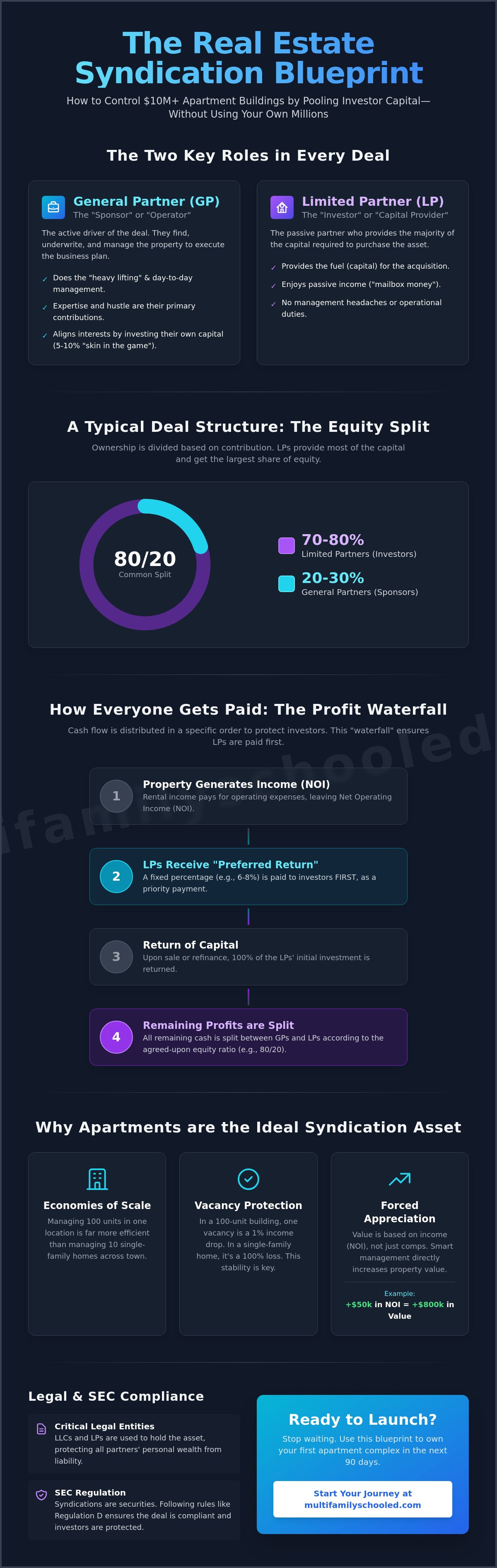
Every syndication has two distinct roles. The Sponsor, or General Partner, is the driver who uses street smarts to find, underwrite, and manage the property. They're the ones doing the heavy lifting to ensure the business plan succeeds. On the other side, the Investor, or Limited Partner, provides the funds and enjoys mailbox money without the headaches of property management. Real estate syndication is a force multiplier for your portfolio. It allows you to leverage other people's money to generate returns that far exceed what you could achieve on your own.
Why Apartments are the Ideal Syndication Asset
Apartments offer economies of scale that single-family homes can't touch. Managing 100 units in one location is significantly more efficient than managing 10 houses spread across a city. In a 100-unit building, one vacancy only represents a 1% drop in income. In a single-family home, one vacancy is a 100% loss. This stability is why sophisticated investors flock to this asset class.
You also gain the power of forced appreciation. Unlike residential homes that rely on comparable sales, apartment values are driven by Net Operating Income (NOI). If you increase the annual NOI by $50,000 through better management or renovations, you could increase the property's value by over $800,000 at a 6% cap rate. Before you jump into your first deal, use the Multifamily Tool Kit to ensure your numbers are rock solid. Understanding the real estate syndication structure explained here is your first step toward total financial mastery.
The Core Structure: Understanding the GP and LP Relationship
Stop guessing and start building wealth. The real estate syndication structure explained simply is a power-match between experts and investors. It's the exact blueprint used to control millions in assets without needing millions in your personal bank account. This structure divides the team into two distinct groups: the General Partners (GP) and the Limited Partners (LP). Each role is vital. One provides the expertise and hustle; the other provides the capital fuel.
In most successful apartment deals, you'll see an ownership split of 70/30 or 80/20. The LPs typically own 70% to 80% of the equity because they provide the majority of the funding. The GPs retain 20% to 30% as a "carried interest" for their work in putting the deal together. Most high-level GPs also put their own money into the deal. This "skin in the game" usually accounts for 5% to 10% of the total capital required. It ensures the GP's interests align perfectly with yours. Because these deals involve passive investors relying on the efforts of others, the SEC view on real estate syndicates classifies them as securities. This regulatory oversight provides a framework of transparency and protection for everyone involved.
The General Partner's Responsibilities
GPs are the boots on the ground. They are the operators who make the "90 days to ownership" promise a reality. Their job starts long before a contract is signed. They use advanced tools like Real Estate Radar to find "Green Light" deals that others miss. They don't just look at listings. They analyze market data to find properties with 15% or higher value-add potential.
The GP handles the heavy lifting. They secure the debt and often sign personal guarantees on the loan. They execute the business plan by managing renovations, pushing rent bumps, and streamlining operations. If a pipe bursts at 2 AM, the GP handles the property manager. You don't. They turn a tired building into a high-performing cash machine.
The Limited Partner's Protections
LPs are the silent partners who enjoy the rewards of multifamily ownership without the headaches. Your primary role is capital contribution. Once the wire is sent, your job is to watch the distributions roll in. The "limited" in your title refers to limited liability. You aren't responsible for the mortgage or the daily lawsuits. You only risk the capital you've invested.
This is pure passive income. You get quarterly distributions and a share of the profits upon sale. You gain all the tax benefits of direct ownership, like depreciation, without ever swinging a hammer. It's the ultimate "hands-off" wealth builder. If you're ready to see how these numbers can transform your portfolio, grab our Multifamily Tool Kit to start analyzing your first deal today.
How You Get Paid: Fees, Splits, and Waterfalls
Stop guessing how the money moves. To build real wealth, you must master the math of the deal. This is where the real estate syndication structure explained becomes your roadmap to financial empowerment. The money flows through a specific hierarchy that protects investors while rewarding the hustle of the General Partner (GP). It's a system designed for win-win outcomes. You're not just buying a building; you're investing in a proven profit machine.
Common Fee Structures for Sponsors
GPs don't work for free. They find the deals, secure the debt, and manage the chaos of daily operations. You're paying for their mastery and their ability to unlock value where others see junk. Here is the standard breakdown of how sponsors keep the engine running:
- Acquisition Fees: Expect to see 1% to 3% of the purchase price. On a $10,000,000 asset, the GP earns $100,000 to $300,000 at closing for sourcing and securing the opportunity.
- Asset Management Fees: This is typically 1% to 2% of gross monthly revenue. It covers the daily grind of overseeing the property manager and ensuring the investment hits its ROI targets.
- Disposition Fees: When the property sells for a profit, the GP often takes 1% of the sale price for handling the complex exit process.
Is it fair for the GP to take these fees? Absolutely. The GP takes on the legal liability and the 80 hour work weeks. You get the passive income without the "toilet, tenants, and trash" headaches. If you want to analyze these fees like a pro, grab the Multifamily Tool Kit to see the numbers in action.
Understanding the Distribution Waterfall
The waterfall is the blueprint for profit. It dictates the order of operations for every dollar the property generates. Don't let the jargon intimidate you. It's just a sequence of hurdles that ensures everyone is incentivized to perform.
Step 1: The Preferred Return (Pref). Most deals offer a 7% to 8% Pref. This means Limited Partners (LPs) get 100% of the available cash flow until they hit that percentage. The GP gets nothing until you get your slice. This aligns everyone's interests from day one. It proves the sponsor is confident in the deal's cash flow.
Step 2: The Catch-up. In some structures, the GP gets a "catch-up" payment after the LPs hit their Pref. This allows the GP to reach their agreed-upon percentage of the total profits before moving to the final split. It's a bridge between the initial return and the performance bonus.
Step 3: The Promote. This is the reward for excellence. Once the Pref and initial capital are returned, the remaining profits are split. A common "promote" is 70/30. The LPs take 70% and the GP takes 30%. This is where the massive wealth is created during the sale. This real estate syndication structure explained shows you exactly why the GP is motivated to crush the business plan. They only get rich when they make you money first.
Legal Entities and SEC Compliance: Staying Protected
Real estate syndication structure explained properly means understanding that your legal framework is the foundation of your entire empire. You aren't just buying brick and mortar; you're managing a regulated investment vehicle. Protection starts on day one. If your legal entity is weak, your wealth is at risk. Building a massive portfolio requires a structure that can withstand pressure from creditors and the tax man alike.
Choosing Your Entity: LLC vs. LP
The Limited Liability Company (LLC) is the gold standard for modern syndicators. It offers the liability shield of a corporation with the tax flexibility of a partnership. Most sponsors create a specific LLC for each property. This "silo" approach ensures that if one building has a legal issue, it doesn't sink your entire portfolio. Your Operating Agreement is the most important document you'll sign. It defines exactly how the General Partner (GP) and Limited Partner (LP) interact, including voting rights and distribution schedules.
Every investor receives a Schedule K-1 at the end of the year. This allows them to claim their share of depreciation. In many cases, this pass-through benefit allows investors to report a paper loss even while they receive monthly cash flow. It's a powerful tool for building generational wealth without the heavy tax burden of traditional income.
Navigating SEC Rules (506b vs 506c)
The Securities and Exchange Commission (SEC) regulates how you raise capital. Under Regulation D, you'll likely choose between two specific paths to fuel your growth:
- Rule 506(b): This is the "Quiet Deal." You cannot advertise or solicit the general public. You must have a substantive, pre-existing relationship with your investors. This rule allows you to include up to 35 "sophisticated" investors who aren't necessarily accredited.
- Rule 506(c): This is the "Public Deal." You can blast it on social media, run ads, and talk about it on podcasts. However, every single investor must be verified as "accredited" by a third party.
Compliance isn't a barrier; it's your shield. If you follow these rules to the letter, you protect your reputation and your freedom. Cutting corners on SEC filings is the fastest way to end a real estate career before it starts.
Your Private Placement Memorandum (PPM) is the 100-page document that tells investors every possible way they could lose money. It sounds scary, but it's your ultimate insurance policy. A specialized securities attorney typically charges between $10,000 and $20,000 for a standard syndication filing. It's the best money you'll ever spend. They ensure your Subscription Agreement and real estate syndication structure explained in your documents align with federal laws. Don't DIY your legal work. Hire a pro and sleep better at night.
Ready to see how these legal pieces fit into a winning deal? Download the Multifamily Tool Kit now to master the system.
Launch Your Syndication Career in 90 Days
Stop waiting for the "perfect" moment. The market moves fast, and overthinking is the fastest way to stay broke. You need a proven system that cuts through the noise. That is where our 'Fast 5 Method' comes in. This isn't about reading textbooks for years. It's about analyzing five deals every single day to sharpen your instincts. When you understand the real estate syndication structure explained in this guide, you stop seeing buildings and start seeing cash flow machines.
Most beginners fail because they make multi-million dollar mistakes on their first deal. Mentorship is your shortcut. You get to leverage 30 years of street-smart experience from 3rd generation investors. We don't just teach theory; we provide the blueprint. Our Multifamily Schooled guarantee is simple: We help you find a deal in 90 days or we give you one from our own pipeline. No one else in the industry offers that level of skin in the game. Take the first step by joining our 5-Day Challenge or apply for direct mentorship today.
The 90-Day Roadmap to Your First Building
Month 1 is about mastery and networking. You'll build your investor 'hit list' of 50 to 100 potential partners while absorbing the fundamentals. Month 2 shifts to high-gear execution. You'll use our proprietary 1-Minute Green Light Deal Analyzer to find and underwrite properties that actually make sense. By Month 3, you're raising capital and closing. This is where the real estate syndication structure explained throughout this article becomes your reality. You'll move from student to owner in 12 weeks. Speed is your greatest asset in this business.
Ready to Transform Your Life?
Stop settling for single-family scraps. One house won't change your life, but a 20-unit building will. You can own the whole building and build massive wealth for your family. Don't let another year pass you by while others claim the prime assets in your market. The system is ready. The software is waiting. The deals are out there. You just need the courage to pull the trigger on a proven process.
Apply for the Mentorship Program Today.
Own Apartments. Build Wealth. Start Now.
Claim Your Multi-Family Empire Before 2026
You've just mastered the blueprint for generational wealth. This real estate syndication structure explained guide gives you the tools to navigate GP and LP relationships with total confidence. You now understand the mechanics of distribution waterfalls and the legal necessity of SEC compliance. Knowledge is only the first step; execution is what creates millionaires. The 2026 market will reward those who move with speed and precision right now.
Justin Brennan's 3rd generation street smarts are your secret weapon in this competitive landscape. You don't have to guess if a property is a winner when you use our 1-Minute Green Light Deal Analyzer. We're committed to your success with a 90-day deal guarantee. If you don't find a deal in 90 days, we'll help find one for you. This is the exact system used to transform lives and secure financial freedom across the country. Don't let another year slip away while others build their portfolios.
Take the 5 Day Multifamily Challenge and Unlock Your First Deal
The path to your first apartment building is clear. Let's get to work and make your vision a reality today.
Frequently Asked Questions
What is the most common real estate syndication structure?
The most common real estate syndication structure is a Limited Liability Company (LLC) where profits are split 70% to investors and 30% to the general partners. This structure protects your personal assets while allowing you to scale your portfolio fast. You'll typically see a two-tier system consisting of the General Partner (GP) who manages the deal and the Limited Partners (LP) who provide the capital.
How much money does a GP need to put into a syndication?
General Partners typically invest between 1% and 5% of the total equity required for the acquisition. For a $10 million apartment complex requiring $3 million in cash, the GP often contributes $30,000 to $150,000 to show skin in the game. This alignment of interests ensures the sponsor is personally committed to the project's success and financial freedom for everyone involved.
What is a Private Placement Memorandum (PPM) in real estate?
A Private Placement Memorandum (PPM) is a legal document that outlines the specific risks, terms, and the real estate syndication structure explained in detail for potential investors. It's your blueprint for compliance under SEC Regulation D. This 40 to 60 page document protects both parties by disclosing every possible variable, from market volatility to property management strategies, ensuring absolute transparency before you wire funds.
Can non-accredited investors participate in a syndication?
Yes, you can include up to 35 non-accredited but sophisticated investors in a deal under the SEC’s Rule 506(b) exemption. This is a powerful way to help friends and family build wealth even if they don't meet the $1 million net worth threshold yet. You must have a substantive, pre-existing relationship with these individuals before offering them a spot in your apartment syndication.
How do syndicators make money if they don't have their own capital?
Syndicators generate revenue through acquisition fees ranging from 1% to 3% of the purchase price and ongoing asset management fees of 1% to 2% of gross monthly income. They also earn a carried interest or equity split, often 20% to 30% of the profits. This system allows you to build a massive portfolio and achieve financial freedom using your expertise rather than just your bank account.
What is a preferred return in a real estate deal?
A preferred return is a threshold of 6% to 8% that investors must receive before the General Partner takes any profit splits. It's an investors first policy that builds trust and attracts capital fast. If the property generates a 10% return, the first 8% goes straight to the LPs, and the remaining 2% is split according to the real estate syndication structure explained in your operating agreement.
How long do most real estate syndications last?
Most real estate syndications have a projected hold period of 3 to 7 years before the property is sold or refinanced. This timeline allows the GP to execute a value-add strategy, increasing the Net Operating Income by 20% or more to maximize the exit price. You'll see the biggest wealth explosion at the end of this cycle when the big check from the sale is distributed.
Is real estate syndication legal for everyone?
Real estate syndication is legal for any investor who follows the Securities and Exchange Commission guidelines under Regulation D, Section 506(b) or 506(c). You don't need a special license to be a syndicator, but you must follow the rules to avoid heavy fines. Start your journey today by mastering these legal frameworks and unlocking the door to large-scale apartment ownership.



