

Real Estate Syndication Fees: Master the Math Behind Big Apartment Deals
What if the fees you're terrified will kill your deal are actually the only thing keeping it alive? It's a common fear. Many investors stall because they're confused by real estate syndication fees or worried about hidden costs buried in the fine print. You want to build a legacy of assets, but you don't want to get fleeced in the process. It's time to stop letting the math intimidate you. Stop guessing. Start winning.
You've likely felt that frustration when opening a complex PPM. It feels like you need a law degree just to see who's getting paid what. We agree that transparency is the foundation of every successful apartment deal. That's why I'm going to teach you exactly how these structures work so you can evaluate opportunities with total confidence and protect your hard-earned profits. It's about economic empowerment and taking control of your financial future.
We'll strip away the confusion by detailing standard 1% to 3% acquisition fees and decoding the asset management math. You'll get a clear blueprint for reading any offering and the tactical confidence to join or lead your own syndication. Let's get to work.
Key Takeaways
- Stop viewing fees as a burden and start seeing them as the strategic engine that drives professional property management.
- Master the "Big Three" real estate syndication fees to ensure your capital is protected from day one through the final exit.
- Decode the waterfall and preferred return models to understand precisely how profits are split between partners.
- Identify "double-dipping" and other fee-structure red flags that could drain your returns before the deal even starts.
- Use these proven frameworks to evaluate any multifamily deal with the speed and precision of a seasoned pro.
What Are Real Estate Syndication Fees and Why Do They Exist?
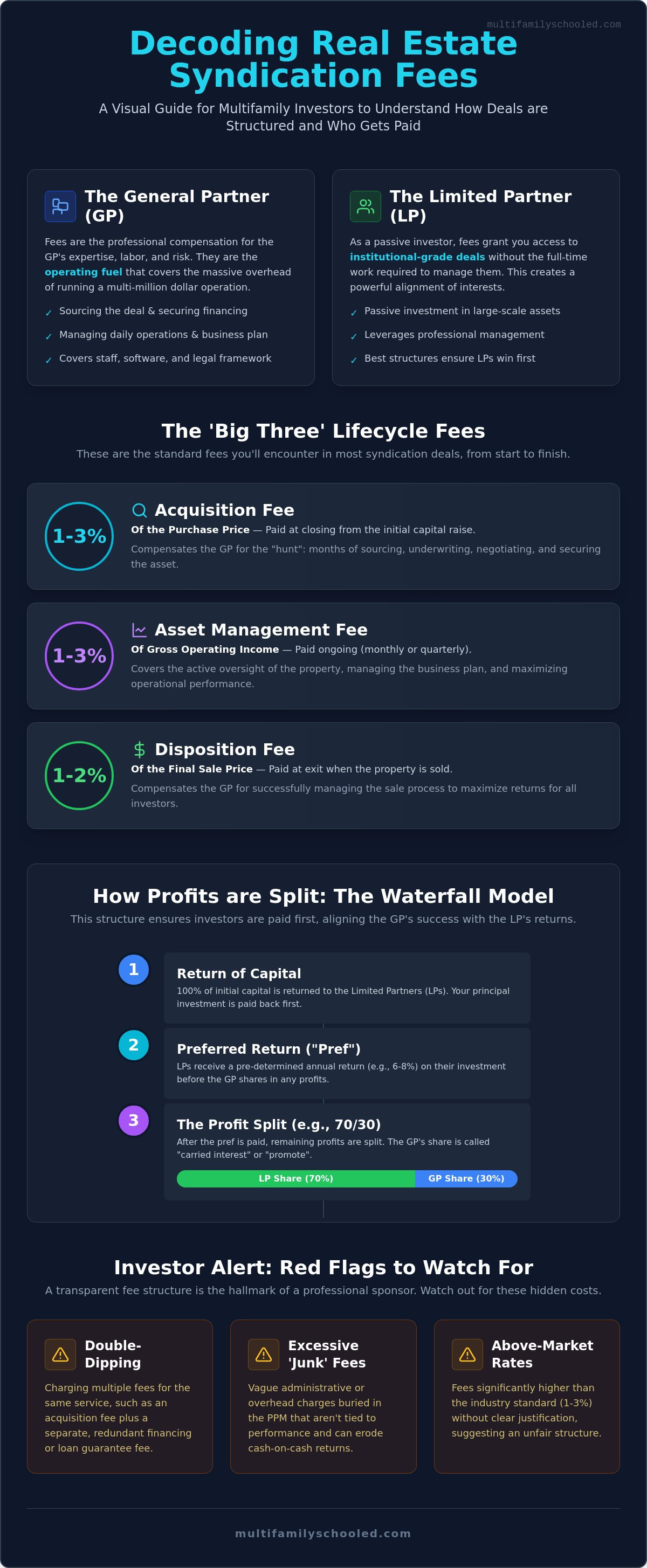
Real estate syndication fees are the professional compensation paid to the General Partner (GP) for their expertise, labor, and the significant risk they take on. Think of these fees as the operating fuel for a high-performance machine. They aren't just arbitrary costs; they're the strategic mechanism that ensures a deal is managed with institutional-grade precision. Without this compensation, a sponsor couldn't afford the staff, proprietary software, or legal framework required to execute a multi-million dollar business plan.
These fees serve a dual purpose that every investor must understand. First, they cover the massive overhead involved in Real estate syndication, including everything from due diligence to office space. Second, they incentivize the GP to outperform expectations. It's critical to distinguish these fees from the equity split. While the equity split represents your ownership percentage and long-term upside, the fees are the "salary" for the active work performed. A transparent fee structure is the hallmark of a professional sponsor who values long-term wealth over short-term tricks.
The Role of the Sponsor (GP) vs. Passive Investor (LP)
The GP is the engine of the entire operation. They're responsible for sourcing the deal, securing complex financing, and overseeing the daily management of the asset. Limited Partners (LPs) pay real estate syndication fees to access institutional-grade deals without the 40-hour work week required to run them. This relationship creates a powerful alignment of interests. When a sponsor is fairly compensated for their effort, they have the resources to protect the asset. However, the best structures ensure the GP's biggest payday only happens when the LPs win first. If you're ready to master these numbers, our Mentorship Program provides the blueprint for evaluating these partnerships.
Why You Can't Ignore the 'Small Print' in a PPM
The Private Placement Memorandum (PPM) is where the truth lives, but it's often buried in legal jargon. You must hunt for fees hidden in the fine print. Watch out for "junk fees" like excessive administrative charges or redundant financing fees that can silently erode your cash-on-cash returns. These small leaks can sink a big ship over a five-year hold. Don't let a lack of technical knowledge steal your profits. Mastering the math inside a PPM is your first mandatory step toward true financial freedom. If you want to benchmark these costs accurately, the Multifamily Tool Kit offers the exact calculators used by the pros to spot red flags instantly.
The 'Big Three' Fees: Acquisition, Asset Management, and Disposition
Mastering real estate syndication fees requires a deep dive into the lifecycle of a multifamily deal. You can't evaluate a project without knowing how the "Big Three" impact your bottom line. These aren't just line items on a spreadsheet. They're the heartbeat of the sponsor's business model. Understanding these benchmarks allows you to spot a fair deal from a mile away. Typical ranges for 2026 include:
- Acquisition Fee: 1% to 3% of the purchase price.
- Asset Management Fee: 1% to 3% of the gross operating income.
- Disposition Fee: 1% to 2% of the final sale price.
These figures represent the industry standard for professional operations. Anything significantly higher should trigger immediate questions. Anything lower might suggest a sponsor lacks the resources to see the project through. If you want to see how these fees look in a real-world scenario, use our Multifamily Tool Kit to run the numbers yourself.
Acquisition Fees: Paying for the 'Hunt'
Finding a high-performing apartment complex in today's market is a full-time grind. You aren't just paying for a signature at the closing table. You're paying for the "hunt." This fee compensates the GP for the months of cold calling, underwriting, and negotiation required to secure the asset. In a comprehensive guide to syndication fees, legal experts clarify that this fee is typically paid at closing from the initial capital raise. High-level sponsors often use proprietary Deal Finding Software to uncover off-market opportunities that never hit the public market. This ensures the acquisition fee is backed by immediate equity and superior deal flow.
Asset Management Fees: The Cost of Excellence
Managing an asset is entirely different from managing a property. Property management is tenant-facing; they handle the toilets and the leases. Asset management is the high-level execution of the entire business plan. This fee, usually 1% to 2% of gross monthly income, ensures the GP stays laser-focused on the long-term investment strategy. It covers the cost of monitoring financial performance, overseeing capital improvements, and communicating with investors. It keeps the sponsor's interests aligned with the property's health. When the property's income grows, the sponsor's fee grows. That's the definition of a win-win structure. Don't settle for mediocre oversight. Demand excellence.
The disposition fee is the final reward for crossing the finish line. It's the sponsor's incentive to maximize the exit price. When they sell the property for a massive profit, this 1% to 2% fee recognizes the value they created over the hold period. It's the ultimate performance bonus for a job well done.
Fee Structure Comparison: GP vs. LP Waterfall Models
The waterfall is the ultimate scorecard for any apartment deal. It dictates the exact sequence of how cash flows from the property into your bank account. If you don't understand this hierarchy, you don't understand your risk. While we've already detailed the "Big Three" real estate syndication fees, the waterfall is where the real wealth is carved out. It's the mechanical heart of the partnership. You must decide if you're entering a fee-heavy deal or an equity-heavy one. Fee-heavy deals prioritize the sponsor's immediate income through high upfront costs. Equity-heavy deals prioritize the long-term exit and capital gains. Choose the structure that matches your goals. Your financial legacy depends on this single choice.
A professional waterfall ensures that every dollar is accounted for before it's distributed. It acts as a filter, protecting the most vulnerable capital first. When evaluating syndication fee structures, you're looking for a balance that keeps the sponsor motivated without starving the investors. A deal with no fees might sound great, but it often leads to a sponsor who loses interest when the work gets tough. You want a partner who is fairly compensated but remains hungry for the big win at the end.
Understanding the Preferred Return Hurdle
The Preferred Return, or "Pref," is your primary safety net. It's the hurdle the GP must clear before they see a single cent of the profit split. Typically ranging from 6% to 10% in today's market, the Pref ensures you get "first dibs" on available cash flow. This structure forces the GP to perform. It aligns their success directly with your capital safety. If the property doesn't hit the Pref, the sponsor doesn't get their performance bonus. This is the highest form of accountability in private equity. Use our Multifamily Tool Kit to model how different Pref levels impact your total return over a five-year hold. Don't guess. Run the math.
GP Catch-Up and Carried Interest
Once the Pref is met, the "Carried Interest" or profit split kicks in. A common split is 70/30, where Limited Partners take 70% and the GP takes 30%. But you must watch for the "Catch-up" provision. This is a specific phase where the GP receives a larger portion of the remaining profits until they've "caught up" to their agreed percentage of the total distributed cash. It ensures the sponsor is rewarded for hitting the initial targets. The best deals are designed to reward the sponsor for massive over-performance. You want a leader who only gets wealthy when you get wealthy first. This isn't just about real estate syndication fees; it's about building a system that guarantees results. Master this logic, and you'll never fear a PPM again.
How to Evaluate and Negotiate Syndication Fees Like a Pro
Evaluating real estate syndication fees isn't just about looking for the lowest number. It's about ensuring the sponsor isn't "double dipping" at your expense. A common trick is charging a separate finance fee on top of an acquisition fee. In reality, securing debt is part of the acquisition process. If a sponsor is getting paid 2% to find the deal, they shouldn't charge another 1% just to talk to a lender. This practice artificially inflates the capital stack and can dangerously push your loan-to-value (LTV) ratio higher. Every dollar paid in "junk fees" is a dollar not working for you in the asset itself. It's a leak in your wealth-building bucket.
You must benchmark these costs against the complexity of the apartment building. A stabilized 200-unit Class A property in a primary market requires less "heavy lifting" than a distressed 50-unit value-add project. If the fees don't reflect the actual workload, the sponsor might be overcharging. Professional investors know when to walk away. If the fee structure is opaque or the sponsor refuses to provide a line-item breakdown of projected costs, that's your signal to leave the table. Protect your capital with the same intensity you used to earn it. Only invest in deals where the math is crystal clear and the sponsor is fully accountable.
Red Flags: When Fees Become Excessive
Keep a sharp eye out for "Guarantor Fees" or "Marketing Fees" that aren't clearly defined. While sponsors deserve compensation for signing on a loan, these costs should be reasonable. If the total fee load at closing exceeds 5% of the purchase price, you must perform a deep dive. Demand a line-item breakdown of every dollar. If they can't justify the expense, they're likely padding their own pockets at the expense of your cash-on-cash returns. Mastery of these details is what separates the winners from the victims in this industry. Don't be a victim.
Negotiating for Better Terms
Transparency is always more important than the absolute lowest fee. You want a sponsor who is well-capitalized and motivated to perform. However, large "Anchor Investors" often have the leverage to negotiate lower fees or better waterfall splits. If you're bringing significant capital to the deal, don't be afraid to ask for a "founder's share" or a reduced acquisition fee. This is a business of relationships and results. Start building your expertise today so you can speak the language of the pros. Join our 5 Day Challenge to learn the deal analysis fundamentals that will make you a formidable negotiator in any boardroom.
Master the Math: Achieve Your First Deal in 90 Days
You've decoded the "Big Three." You've mastered the waterfall. Now, it's time to execute. Mastery of real estate syndication fees isn't just about protecting your capital; it's about speed. In this industry, speed is everything. If you can't underwrite a deal and explain the fee structure to a partner in minutes, you'll lose the property to someone who can. Confidence comes from the math. When you know the numbers, you move with purpose. You can analyze a deal, verify the sponsor's claims, and make a decision while your competition is still stuck in the fine print. Securing your first deal in 90 days isn't just a goal; it's a standard you can reach by following a proven system.
By mastering the math behind these big apartment deals, you bypass the learning curve that traps most beginners for years. You'll understand how to use debt, equity, and fees to create a winning proposal that lenders and investors can't ignore. This is how you accumulate assets and build long-term stability in a volatile economy. You aren't just learning a skill; you're building a legacy of economic empowerment. It's time to stop letting the complexity of real estate syndication fees hold you back from the prosperity you deserve.
The Multifamily Schooled Advantage
Our system removes the hesitation that kills deals. We don't just teach theory; we provide the exact frameworks used to close assets in the real world. Our mentorship eliminates the guesswork in complex fee calculations, ensuring you never overpay or under-incentivize a partner. Our community acts as a second set of eyes, vetting deal structures and underwriting models together. This isn't just education. It's a high-octane ecosystem designed for winners. Success is attainable for anyone who follows the prescribed system. Seize the current market while others are still staring at spreadsheets.
Your Next Step to Financial Freedom
Stop dreaming about supplemental income and start building your asset base. The 90-day clock is ticking. You can spend years trying to figure this out alone, or you can follow a proven blueprint. The Mentorship Program is the definitive path to your first or next apartment deal. We've simplified the most complex professional concepts into a systematic journey toward independence. Your future self is waiting for you to take action. This is the moment to transform your financial reality and secure your future. Explore our store for all the tools you need to win and start your journey today.
Take Control of Your Financial Legacy Today
You now possess the blueprint to decode real estate syndication fees and evaluate any multifamily deal with the precision of an institutional pro. We've stripped away the mystery behind acquisition costs, asset management math, and the profit-sharing waterfall. You know what to look for and exactly when to walk away from a bad structure. Don't let this knowledge sit idle. The current market moves fast; opportunities wait for no one. It's time to transition from a spectator to a high-performing owner of massive apartment assets.
Stop guessing and start winning with a proven system. You can get direct access to Justin Brennan's multi-generational expertise and our proprietary Real Estate Radar AI software to find off-market gems before anyone else. We provide the tools, the community, and the strategy to help you find and close your first deal in just 90 days. Your path to economic empowerment and long-term independence is right in front of you. Seize it now.
Secure Your Future: Join the Mentorship Program and Find Your Deal in 90 Days
Success is within your reach if you follow the system. Let's get to work.
Frequently Asked Questions
Are real estate syndication fees tax deductible for investors?
Syndication fees are generally not immediate tax deductions for passive investors. Instead, these costs are typically capitalized and added to the property's cost basis. This means they reduce your taxable capital gains when the asset is eventually sold. Always consult with a specialized real estate CPA to understand how these structures impact your personal tax liability under current 2026 regulations.
What is a typical asset management fee for a multifamily property?
A typical asset management fee ranges from 1% to 3% of the property’s gross operating income. This fee is paid monthly to the General Partner to cover the high-level oversight of the investment. It ensures the sponsor stays focused on executing the business plan and maximizing investor returns. It's the price of professional excellence and institutional-grade management.
Can I negotiate the fees in a real estate syndication deal?
You can absolutely negotiate real estate syndication fees if you are an anchor investor bringing significant capital to the deal. Sponsors are often willing to offer lower acquisition fees or better waterfall splits to those who provide a large percentage of the required equity. Don't be a passive observer. Use your capital as leverage to secure the best possible terms for your portfolio.
What is the difference between an acquisition fee and a finder's fee?
An acquisition fee is a professional payment to the GP for the entire process of sourcing, underwriting, and closing a deal. A finder's fee is a much narrower payment specifically for the introduction of a property. Be extremely cautious with finder's fees. Paying them to unlicensed individuals can lead to severe SEC regulatory complications that could jeopardize the entire syndication.
Is a 2% disposition fee considered standard in the industry?
A 2% disposition fee is standard and widely accepted in the multifamily industry as of 2026. This fee acts as a final performance incentive for the sponsor to maximize the sale price at the exit. It rewards the GP for successfully navigating the hold period and delivering the promised returns to the Limited Partners. It's the ultimate "job well done" bonus.
What happens to the fees if the syndication deal loses money?
Ongoing fees like asset management are typically senior to investor distributions and are paid as long as the property has cash flow. However, the sponsor’s biggest payday comes from the profit split in the waterfall. If the deal loses money or fails to hit the preferred return, those performance-based splits vanish. The GP only wins big when you win first.
How do fees impact the internal rate of return (IRR) for an LP?
Fees directly reduce the net internal rate of return (IRR) for a Limited Partner. Every dollar allocated to real estate syndication fees is a dollar that isn't distributed to you. While fees are necessary to run a professional operation, excessive costs can turn a high-performing asset into a mediocre investment. Always analyze the net IRR after all fees are stripped away.
Why do some sponsors charge a 'guarantor fee' on a deal?
Sponsors charge a guarantor fee to compensate for the massive personal risk they take when signing for the property’s debt. Even with non-recourse financing, the GP is often liable for "bad boy" carve-outs. They are putting their personal balance sheet on the line to secure the loan. This fee recognizes that risk and the value of providing investors access to institutional financing.



