
Real Estate Mentorship vs Course: Which Path Leads to Success in 2026?
Most people studying the real estate mentorship vs course debate are asking the wrong question. They're not asking "which one teaches me more?" They're really asking: "Which one will actually get me into a deal?" That's a very different question, and the answer changes everything.
You already know the feeling. You've watched hours of YouTube videos, downloaded free guides, and maybe even bought a course or two. Yet you're still sitting on the sidelines, second-guessing every number, unsure if the deal in front of you is a goldmine or a trap. The information isn't the problem. The gap between knowledge and a closed deal is.
Here's the truth: a certificate without a property isn't education, it's expensive homework. Real momentum comes from having the right system, real accountability, and someone in your corner who's done it before and can show you exactly how to replicate it.
In this article, you'll discover the critical differences between courses and mentorship programs, what each path actually delivers, and how to choose the one that gets you to a closed apartment building deal within 90 to 180 days, not someday.
Key Takeaways
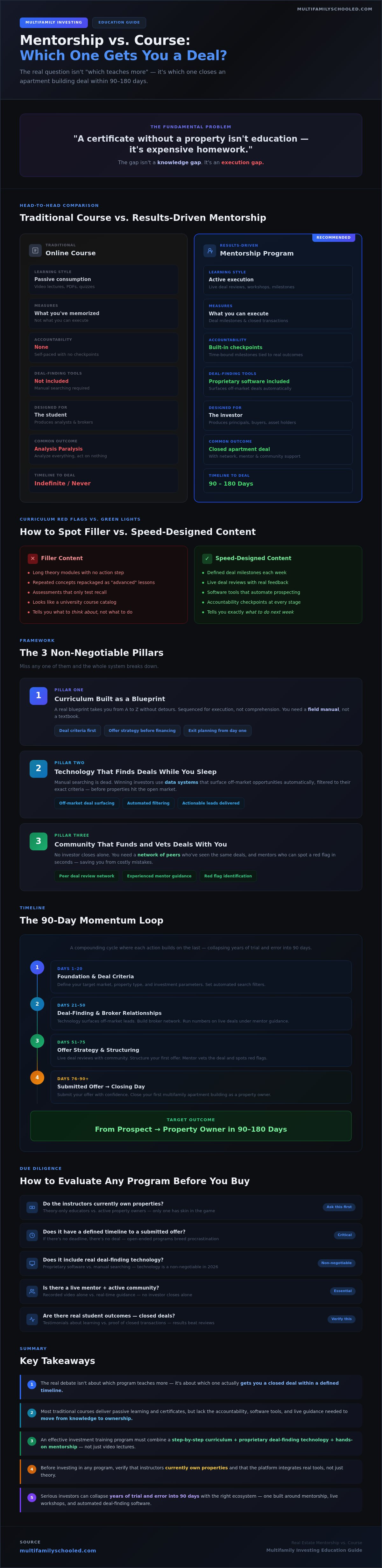
- The real estate mentorship vs course debate isn't about which teaches more-it's about which one actually gets you into a closed deal within a defined timeline.
- Most traditional courses deliver passive learning and certificates, but lack the accountability, software tools, and live guidance needed to move from knowledge to ownership.
- An effective investment training program must combine a step-by-step curriculum, proprietary deal-finding technology, and hands-on mentorship-not just video lectures.
- Before investing in any program, look for instructors who currently own properties and platforms that integrate real tools, not just theory.
- Serious investors can collapse years of trial and error into 90 days with the right ecosystem-one built around mentorship, live workshops, and automated deal-finding software.
What Is a Real Estate Investment Course and Why Most Fall Short?
A real estate investment course is a structured program designed to teach you how to identify, evaluate, and acquire income-producing assets. That's the promise. The reality? Most courses deliver a curriculum built around passive consumption: video lectures, downloadable PDFs, and multiple-choice quizzes that measure what you've memorized, not what you can execute.
That distinction matters enormously. Because in 2026, the commercial real estate market doesn't reward people who can define cap rates. It rewards people who can find an undervalued 12-unit building, run the numbers under pressure, and close before someone else does. A certificate doesn't do that for you. A system does.
This is where the real estate mentorship vs course debate starts to get interesting. The gap most investors face isn't a knowledge gap. It's an execution gap. They know what to do. They just don't know how to do it in a live market, with real sellers, real brokers, and real money on the line.
The Difference Between Academic and Practical Training
Academic real estate programs are designed to produce analysts and licensed brokers. They teach you to support someone else's deals, not to own your own. Practical training, by contrast, prepares you to be the principal: the decision-maker, the buyer, the asset holder. Knowing how to calculate net operating income is table stakes. Finding the deal, building the relationship with the broker, and structuring the offer? That's a completely different skill set, and most courses never touch it.
Why 'Analysis Paralysis' Is the #1 Course Failure
Here's what happens when you hand someone a hundred hours of content with no accountability structure: they analyze everything and act on nothing. More data without a decision framework doesn't build confidence. It builds hesitation.
A great course forces action through specific, time-bound milestones tied to real outcomes, not just module completions. Look closely at any curriculum you're considering. Ask one question: does this program tell you what to do next week, or does it just tell you what to think about?
- Filler content looks like: long theory modules, repeated concepts repackaged as "advanced" lessons, and assessments that test recall
- Speed-designed content looks like: defined deal milestones, live deal reviews, software tools that automate prospecting, and accountability checkpoints
The market moves fast. Your education needs to move faster. If a program can't get you to a submitted offer within a defined window, it's not built for the investor. It's built for the student.
The 3 Non-Negotiable Pillars of an Effective Investment Training Program
Strip away the marketing language from any training program and you're left with one question: does it have what it actually takes to get you to closing day? After evaluating the real estate mentorship vs course landscape, three pillars separate programs that produce owners from programs that produce students. Miss any one of them and the whole system breaks down.
Those three pillars are curriculum, technology, and community. Not as buzzwords. As functional components that work together to create what serious investors call a 90-day momentum loop: a compounding cycle where each action builds on the last, accelerating your path from prospect to property owner.
Pillar 1: Curriculum built as a blueprint, not a syllabus. A real blueprint takes you from A to Z without detours. That means deal criteria before market analysis, offer strategy before financing, and exit planning before you ever sign a purchase agreement. It's sequenced for execution, not comprehension. If a program's curriculum looks like a university course catalog, walk away. You need a field manual, not a textbook.
Pillar 2: Technology that finds deals while you sleep. Manual searching is dead. The investors winning in today's market aren't spending weekends scrolling listings. They're using data systems that surface off-market opportunities automatically, filter by their specific criteria, and deliver actionable leads before those properties ever hit the open market.
Pillar 3: Community that funds and vets deals with you. No investor closes alone. You need a network of peers who've seen the same deals, mentors who can spot a red flag in a rent roll at a glance, and potential partners who can co-invest when the numbers are right. That's not a bonus feature. It's infrastructure.
The Role of Deal-Finding Software
The biggest gap in traditional investment training isn't the curriculum. It's the complete absence of technology. Platforms like Real Estate Radar change the equation entirely by automating the prospecting process, giving investors access to off-market multifamily opportunities driven by real data signals rather than gut instinct. Data-driven decision making isn't a competitive advantage anymore. It's the baseline. Any program that doesn't integrate proprietary deal-finding tools into its core offering is teaching you to compete with one hand tied behind your back.
Mentorship: Why You Need a Pro in Your Corner
Courses give you information. Mentors give you judgment. There's a profound difference between knowing how to write a Letter of Intent and having an experienced investor review yours line by line before it goes out. One mentor catch on a deal structure can save you tens of thousands of dollars and months of wasted time.
Spotting a real mentor is simple: ask them how many units they currently own. Not owned. Own. Gurus sell courses. Mentors share portfolios. If the person teaching you hasn't closed a deal in the last 24 months, their advice is historical, not operational.
When all three pillars are in place, momentum compounds fast. The curriculum tells you what to do, the software finds you what to act on, and the community helps you move with confidence. That's the ecosystem that collapses years of trial and error into a defined, achievable window. If you're ready to see what a complete system looks like in practice, explore the Multifamily Schooled Mentorship Program and see how all three pillars are built into a single, structured path to ownership.
Academic Certificates vs. Results-Driven Mentorship: Which One Gets You a Deal?
Let's settle this once and for all. A two-year university certificate program in commercial real estate will cost you time, tuition, and opportunity. By the time you graduate, the market has moved, interest rates have shifted, and the investors who skipped the classroom are already collecting rent checks. That's not an argument against education. It's an argument against the wrong kind of education at the wrong speed.
The real estate mentorship vs course debate gets sharpest here: accreditation is built for employment. Asset ownership is built for wealth. Those are two completely different destinations, and the path to one won't take you to the other. Banks don't ask to see your diploma when you submit a loan package on a 20-unit building. They ask for your personal financial statement, your deal history, and your cash flow projections. A certificate doesn't appear anywhere in that conversation.
Commercial real estate is a contact sport. Deals are won through relationships with brokers, conversations with sellers, and the credibility that comes from having closed something before. You can't build that credibility in a lecture hall. You build it in the field, with a mentor who's already made the calls, read the rent rolls, and walked the properties you're now evaluating.
Here's the myth worth dismantling: you don't need a degree to buy a 20-unit building. You need a system, a network, and the confidence to make an offer. Those three things come from doing, not studying.
The 90-Day Milestone: A Benchmark for Success
A serious program doesn't measure success in module completions. It measures success in milestones. Within your first 30 days, you should be submitting a Letter of Intent on a real property. Not practicing. Not analyzing hypotheticals. Submitting. That single action does more for your confidence and credibility than any coursework ever could. Rapid wins create momentum, and momentum is what separates investors who close from investors who perpetually prepare.
The Multifamily Schooled Mentorship Program is built around exactly this structure. The timeline isn't aspirational. It's operational. Every week has a defined deliverable, and the mentorship layer ensures you're moving toward a closed deal, not just completing another lesson.
Is a Certificate Actually Worth Anything?
For a resume? Sure. For a lender underwriting your first apartment building acquisition? Not a single basis point of difference. Lenders evaluate deal experience, not academic credentials. They want to know you understand the asset, the market, and the numbers. The only credential that builds that proof is a closed deal.
- What lenders actually care about: net worth, liquidity, deal experience, and the strength of the property's cash flow
- What certificates signal: academic familiarity with concepts, not operational competence in live markets
- What deal experience signals: risk management, market knowledge, and the ability to execute under pressure
Stop chasing credentials. Start chasing deals. Every hour spent pursuing accreditation is an hour not spent building the only portfolio that matters to a commercial lender: a track record of ownership.
How to Evaluate a Multifamily Investing Course Before You Buy
Choosing the wrong program doesn't just cost you money. It costs you months. In the real estate mentorship vs course debate, the most dangerous outcome isn't picking one over the other. It's paying for something that looks legitimate but delivers nothing actionable. Here's exactly what to look for before you hand over a dollar.
Proof of Life: Does the instructor actually own buildings right now? This is the first filter, and it eliminates most programs immediately. Ask directly: how many units does the instructor currently own? Not historically. Not "in their portfolio at peak." Right now, in 2026. If the answer is vague, that's your answer. Someone teaching you to buy apartment buildings should be actively buying apartment buildings. Anything less is theory dressed up as expertise.
Software Integration: Are they handing you real tools? A course without deal-finding technology is like a cooking class with no kitchen. You'll learn the vocabulary and still go home hungry. Look for programs that integrate proprietary prospecting tools into the curriculum itself, not as an upsell, but as a core component. The Multifamily Tool Kit is a strong benchmark here: it represents the kind of essential, practical resource that separates programs built for action from programs built for passive consumption.
Support Level: Pre-recorded video or live access? A library of videos is not a support system. It's a database. Real support means live workshops, direct access to mentors who can review your specific deal, and a community that responds when you're staring at a rent roll at 11pm trying to decide if the numbers work. If the program's "support" is a FAQ page and a Facebook group, keep looking.
Exit Strategy: Does it cover the actual closing process? Most courses stop at the offer. That's exactly where new investors need the most help. A complete program walks you through due diligence, lender conversations, title coordination, and closing day logistics. If the curriculum ends at "submit your LOI," the program was built to sell you the next course, not to get you to ownership.
Questions to Ask the Course Provider
Don't rely on the sales page. Ask these directly before enrolling:
- "What is the average time for a student to find their first deal?" A program with real results can answer this specifically. Vague responses like "it depends on the student" signal that no one is tracking outcomes.
- "Do you provide the software needed to analyze and find these properties?" If the answer is no, you'll be doing manual research while other investors are using automated data systems to find off-market deals before they hit any listing platform.
- "Is there live mentorship included, or is it all pre-recorded?" The distinction matters enormously. Live access to experienced investors changes your decision speed and your confidence level in ways that video content simply cannot replicate.
Red Flags to Avoid in 2026
Some warning signs are easy to miss until you're already enrolled. Watch for these before you commit:
- No-money-down gimmicks. Programs built around creative financing tricks and zero-capital strategies are optimized for marketing, not for building a durable portfolio. Real multifamily investing requires real capital strategy, not loopholes.
- No live component. If every lesson is pre-recorded and there's no scheduled live interaction, you're buying content, not a program. Content doesn't hold you accountable. People do.
- Unverifiable testimonials. Check for specifics: property type, unit count, market, timeline. Generic praise like "changed my life" with no deal details attached is a red flag. Authentic student results are specific and verifiable.
The right program doesn't just teach you the real estate mentorship vs course framework intellectually. It forces you to apply it in real time, with real assets, and real accountability. Start with the tools that serious investors actually use and explore the Multifamily Tool Kit to see what a complete resource stack looks like before you buy anything else.
Fast-Track Your Success with Multifamily Schooled's 90-Day System
Every program in the real estate mentorship vs course space makes promises. Multifamily Schooled makes one that no competitor does: get you into a deal within 90 days, or they find one for you. That's not a marketing headline. That's a structural commitment built into every layer of the ecosystem.
The Multifamily Schooled system isn't a course with a bonus coaching call bolted on. It's a complete A-to-Z infrastructure designed for one outcome: apartment building ownership. Education, technology, mentorship, and live training all operate together inside a single, sequenced program. Nothing is siloed. Nothing is optional. Every component exists to move you closer to closing day.
The 3-Day Live Workshop is where the learning curve gets compressed into a single weekend. Three days of intensive, hands-on training with active investors who are currently buying deals. You'll walk in with questions and walk out with a defined deal criteria, a working knowledge of the offer process, and a network of peers who are on the same 90-day clock. Compare that to a multi-quarter certificate program that prepares you to support someone else's transactions, and the difference isn't marginal. It's generational.
For investors who want to test the water first, the 5-Day Challenge is the lowest-friction entry point in the industry. Five days. Real training. Real deal analysis. No long-term commitment required before you've had a chance to experience the methodology firsthand. It's built for the investor who's done the research, knows the landscape, and just needs one week to confirm they're in the right room.
2026 is not a year to wait. Interest rate cycles shift. Off-market inventory tightens. The investors who move now are locking in positions that will look prescient in five years. The ones who keep studying will still be studying.
The 90-Day Deal Guarantee
This is the detail that separates Multifamily Schooled from every other program in the market: if you complete the system and don't find a deal within 90 days, the team provides one. That single guarantee removes the primary risk of real estate training, which isn't losing money on a bad deal. It's spending time and tuition on a program that never delivers a result. No other program stands behind execution. They stand behind education. That's a different promise entirely, and it's a weaker one.
Start Your Journey Today
The Schooled advantage comes down to three things: software that finds deals automatically through Real Estate Radar, mentorship from investors who are actively buying, and a speed-based system designed to collapse years of trial and error into a defined window. That's the stack. That's what closes deals.
Your first apartment building isn't a five-year plan. It's 90 days away. Start here and put the system to work.
Your First Deal Is Closer Than You Think
The real estate mentorship vs course debate comes down to one question: do you want to learn about investing, or do you want to own a building? Courses give you content. The right mentorship program gives you a closed deal.
Three things define the path forward. You need a curriculum built for execution, not comprehension. You need technology that surfaces real opportunities automatically. And you need a mentor who's actively buying, not just teaching from memory.
That's exactly what Multifamily Schooled delivers. Justin Brennan's multi-generational expertise, proprietary Real Estate Radar software, and a bold promise that separates this program from everything else in the market: find a deal in 90 days, or the team provides one. No other program stands behind results like that.
The market won't wait. Off-market opportunities close fast, and the investors moving now are the ones who'll be collecting rent checks while others are still watching video modules.
Don't study your way to the sidelines. Start your 90-day deal journey now and put a system that actually works in your corner.
Frequently Asked Questions
Is a real estate investment course worth it in 2026?
It depends entirely on what the course delivers. A program that combines structured curriculum, live mentorship, and deal-finding technology is absolutely worth the investment. A passive video library with no accountability structure? Probably not. The market in 2026 rewards speed and execution. If a course can't get you to a submitted offer within a defined window, it's not solving your real problem.
The real estate mentorship vs course distinction matters here. The best programs blur that line intentionally, building mentorship accountability directly into the learning structure so you're moving toward ownership, not just comprehension.
How much does a typical multifamily investing course cost?
Costs vary significantly across the industry, ranging from low-priced entry-level content to high-ticket comprehensive programs. We don't quote specific pricing for Multifamily Schooled here since program investment details change and are best confirmed directly with the team. What matters more than the number is the return: a program that closes your first deal pays for itself many times over. A cheap course that never produces a deal costs everything.
Can I take a real estate investment course online?
Yes. Most serious programs today are delivered online, including live virtual workshops, recorded modules, and community platforms accessible from anywhere. Multifamily Schooled offers online training components, including the 5-Day Challenge, which is designed as a low-friction entry point you can complete without traveling or rearranging your schedule. The key is finding a program that includes live interaction, not just pre-recorded content you watch alone.
What is the best real estate investment course for beginners?
The best starting point is a program that doesn't overwhelm you with theory before giving you something actionable to do. For beginners, the Multifamily Schooled 5-Day Challenge is specifically built as a first step: five days of real training, real deal analysis, and a clear methodology, without requiring a long-term commitment before you've had a chance to experience the approach firsthand.
Look for a program that sequences deal criteria before financing, and offer strategy before analysis. Beginners don't fail because they lack information. They fail because no one tells them what to do next week.
Do I need a real estate license to take these classes?
No. A real estate license is required to represent buyers or sellers in transactions and earn a commission as an agent or broker. Buying investment property as a principal, which is what multifamily investing programs teach, doesn't require any license at all. You're learning to be the buyer, not the intermediary. That's a critical distinction, and it means you can start evaluating and acquiring apartment buildings without any licensing prerequisites.
How long does it take to finish a real estate investing program?
That's the wrong question. The right question is: how long does it take to close a deal? Multifamily Schooled is built around a 90-day timeline from enrollment to a submitted offer, not a graduation date. The 3-Day Live Workshop compresses foundational training into a single weekend. The mentorship layer then keeps you accountable to deal milestones, not module completions. Finishing the curriculum is irrelevant if you don't own a building at the end.
Will a course help me find funding for my deals?
A good program will teach you how lenders evaluate multifamily deals, what documentation you'll need, and how to structure an offer that holds up under underwriting scrutiny. Multifamily Schooled doesn't provide investment capital directly, but the curriculum covers lender conversations, deal structuring, and the financial presentation skills that give you credibility with commercial lenders. Understanding what a lender wants to see is a skill. The right program teaches it explicitly.
What is the difference between a course and a mentorship?
A course delivers information. A mentorship delivers judgment. You can watch a hundred hours of content on writing a Letter of Intent and still freeze when a real deal lands in front of you. A mentor reviews your specific LOI, flags the clause that could cost you, and tells you whether to move or walk. That real-time feedback loop is what separates investors who close from investors who perpetually prepare.
In the real estate mentorship vs course debate, the strongest programs don't force you to choose. Multifamily Schooled integrates both: structured curriculum that sequences every step, and active mentors who are currently buying deals and can guide you through yours in real time.