

Proven Real Estate Capital Raising Strategies for 2026: The Ultimate Guide
Stop begging for money and start providing the "Green Light" opportunity that high-net-worth investors are starving for in 2026. Most aspiring investors feel like a nuisance when pitching, paralyzed by the fear of sounding unprofessional or tripping over complex SEC rules. You probably feel that without a massive personal bank account or a twenty-year track record, nobody will take you seriously. It's a common trap, but it's exactly what's keeping you from the financial freedom you deserve.
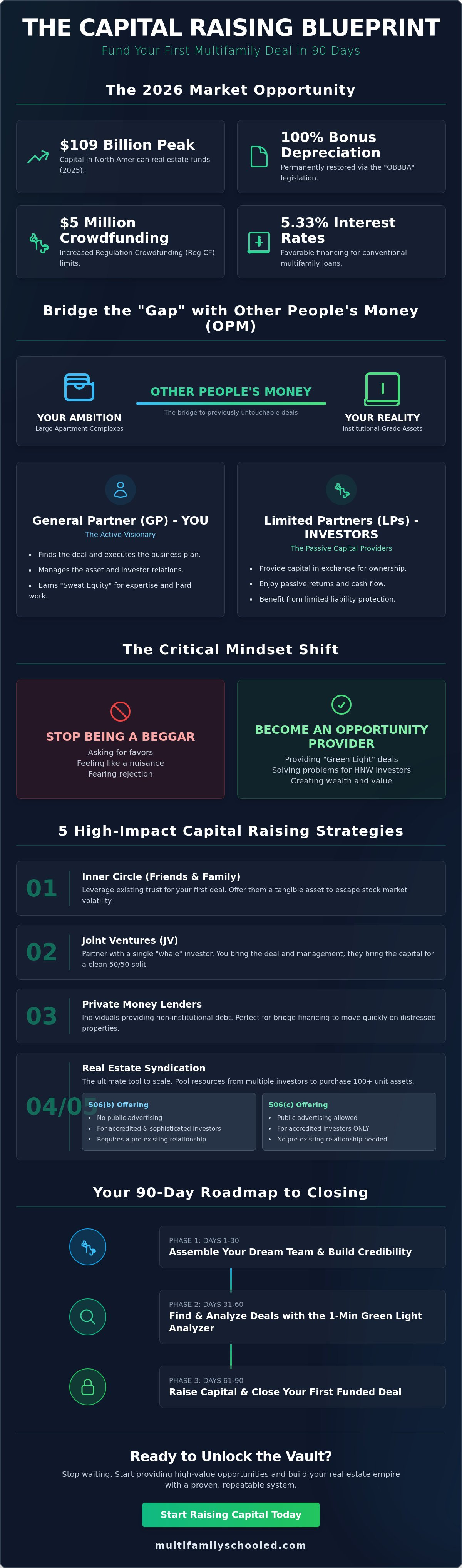
Mastering real estate capital raising strategies isn't about luck; it's about a repeatable system. With North American real estate funds hitting a $109 billion peak in 2025 and the "One Big Beautiful Bill Act" (OBBBA) permanently restoring 100% bonus depreciation, the capital is out there waiting for you. This guide will teach you the exact framework used to raise millions for multifamily deals and close your first property within 90 days. We'll break down the $5 million Regulation Crowdfunding limits, how to leverage 5.33% multifamily interest rates, and the specific steps to build professional confidence in every pitch. Get ready to unlock the vault and transform your life today.
Key Takeaways
- Learn how to scale your portfolio instantly by mastering the "Gap" problem and leveraging Other People’s Money (OPM).
- Implement five high-impact real estate capital raising strategies that transform you from a solicitor into a high-value opportunity provider.
- Build instant professional credibility using the 1-Minute Green Light Analyzer to prove deal viability to high-net-worth individuals.
- Stay legally compliant by understanding the critical differences between SEC Regulation 506b and 506c for your private offerings.
- Follow a systematic 90-day roadmap to assemble your dream team and close your first funded multifamily deal in record time.
The Foundations of Real Estate Capital Raising
Capital raising is the lifeblood of your real estate empire. It is the tactical process of securing private or institutional funds to close massive transactions without draining your personal savings. To dominate this market, you must master real estate capital raising strategies that allow you to scale beyond the limits of your own wallet. Most investors hit a wall because of the "Gap" problem. This occurs when your ambition to own large apartment complexes exceeds your available cash. By using Other People's Money (OPM), you bridge that gap and unlock deals that were previously untouchable. Mastering real estate investing fundamentals is the first step to proving you are a professional who can handle millions in capital.
To better understand the mechanics of building your capital stack and securing your first deal, watch this step-by-step breakdown:
You need to know exactly where you sit in the capital stack. Debt investors typically want a fixed return and first priority, acting much like a bank. Equity investors are your true partners; they take a piece of the ownership in exchange for their capital. Real estate syndication is the ultimate tool for multifamily wealth because it allows you to pool these resources and purchase institutional-grade assets that provide generational cash flow.
The GP/LP Ownership Structure
In a typical deal, you act as the General Partner (GP). You are the visionary finding the deal, managing the asset, and executing the business plan. Your investors are Limited Partners (LP). They provide the capital for passive returns and enjoy limited liability. This is where the "Sweat Equity" concept becomes your greatest asset. You earn a significant ownership stake through your hard work and expertise, even if you don't put a single dollar of your own cash into the deal.
Mindset Shift: From Beggar to Opportunity Provider
Stop thinking like you are asking for a favor. In 2026, high-net-worth individuals are desperate for "Green Light" deals to protect their wealth from market volatility. With multifamily properties acting as a premier hedge against inflation, you are the one providing the value. Don't let the "No Track Record" myth stop you from starting. By using a proven mentorship system and professional data from deal finding software, you show investors how your deal solves their problem of devaluing cash. You aren't a beggar; you are a wealth creator.
5 High-Impact Strategies for Raising Private Capital
You've built the foundation. Now it's time to deploy the most effective real estate capital raising strategies to fund your deals. Alternative lenders captured 37% of the market in 2025. This shift proves that private capital is rapidly taking over from traditional banks. You just need the right system to access it. Whether you are looking for your first 4-unit property or a 100-unit complex, these five strategies will get you there.
Start with your Inner Circle. Friends and family are your first line of defense for your debut apartment deal. They already trust you. By offering them a piece of a tangible asset, you help them escape the volatility of the stock market. Next, consider Joint Ventures (JV). This is where you partner with a single "whale" investor. You bring the deal and the management; they bring the cash. It's a clean 50/50 split that gets you into the game fast without the complexity of a massive group.
Don't ignore Private Money Lenders. These are individuals or small groups providing non-institutional debt. They're perfect for bridge financing when you need to move quickly on a distressed property before refinancing with a conventional 5.33% multifamily loan. If you want to see how the pros analyze these opportunities, check out this multifamily tool kit to sharpen your pitch and look like a pro from day one.
The Power of Real Estate Syndication
Syndication is how you scale from a small building to 100+ units. In 2026, you must choose between a 506(b) or 506(c) offering. A 506(b) allows you to raise unlimited capital from accredited investors and up to 35 non-accredited investors. You must have a pre-existing substantive relationship here. A 506(c) lets you advertise openly, but you can only take verified accredited investors. As the Sponsor, your role is to build absolute trust by being the face of the deal. This model turns you into a professional fund manager and allows you to build massive wealth through acquisition fees and carried interest.
Leveraging Self-Directed IRAs
This is the most overlooked source of capital in the market. Trillions of dollars sit in "lazy" retirement accounts earning pathetic returns. Educate your investors on how to move their funds from Wall Street to Main Street using a Self-Directed IRA. They can invest in your deals tax-free or tax-deferred. It's a simple process. They move cash from a traditional custodian to one that allows real estate. When you show an investor how to unlock their retirement fund to build real wealth, you become their hero. You aren't asking for money; you're helping them secure a better future.
The 'Green Light' Framework: Building Instant Credibility
Investors don't usually say "no" because of the property. They say "no" because they don't trust the person presenting it. To master real estate capital raising strategies, you must bridge the credibility gap before you even open your mouth. Most beginners show up with messy spreadsheets and vague promises. You are going to show up with a "Green Light" framework that screams professionalism. This system uses hard data to prove a deal's viability, turning a skeptical "maybe" into a confident "yes." Using Deal Finding Software automates the credibility gap by generating institutional-grade reports that make you look like a seasoned pro from day one.
You need to understand the difference between a "Teaser" and a Private Placement Memorandum (PPM). A teaser is your hook; it's a two-page high-impact document designed to grab interest. The PPM is the 100-page legal monster that handles the compliance. Don't lead with the PPM. Lead with the vision and the data. If you can't explain why a deal works in 60 seconds, you haven't found a "Green Light" deal yet. Use the 1-Minute Green Light Analyzer to filter out the noise and focus only on the winners.
Data-Driven Deal Presentation
In 2026, investors are more analytical than ever. With commercial real estate investment volume hitting $112 billion in Q3 2025, you are competing with major funds for attention. You must highlight three key metrics: Cap Rate, Cash-on-Cash return, and the Internal Rate of Return (IRR). Don't just show the present state of the building. Visualize the "Value-Add" play. Show them exactly how you will increase rents and decrease expenses to drive the property's value higher. Professional software allows you to generate these "Bank-Ready" reports instantly, giving you an edge over the amateur who is still using basic calculators.
The Investor Pitch Deck Essentials
Your pitch deck is your visual resume. It needs three critical slides to close the deal. First, the "Why This Market" slide must highlight 2026 growth trends, like the 112% year-over-year increase in the CBRE Lending Momentum Index. Second, the "Why This Deal" slide needs to show the specific Green Light indicators that prove this property is a winner. Finally, the "Why Us" slide is where you leverage your mentorship and system. Even if you are new, you are backed by a proven framework and a network of experts. This provides the security investors need to wire their funds with confidence.
Legal Compliance and Investor Management
Success in real estate syndication is built on a foundation of ironclad compliance. You aren't just buying property; you're managing other people's hard-earned wealth. On February 17, 2026, the SEC issued revised Compliance and Disclosure Interpretations that every serious investor must understand. These rules aren't here to stop you. They are here to protect you. Failing to follow real estate capital raising strategies that prioritize legal safety will destroy your reputation and your bank account before you even close your first deal. Build a fortress around your fund from day one.
Managing investors requires more than just a handshake. You need professional systems to handle distributions and K-1 tax forms without the headache. In 2026, manual tracking is a recipe for disaster. Use automated investor portals to provide transparency and build long-term trust. This level of professionalism separates the amateurs from the elite syndicators who raise millions on command. Keep meticulous records of every communication to ensure you are always ready for an audit. If you don't have a system for this, you're just gambling with your future.
Understanding SEC Exemptions
The choice between Regulation D 506(b) and 506(c) defines your entire marketing strategy. With a 506(b) offering, you cannot publicly advertise. You must have a pre-existing substantive relationship with every investor. This means you've had meaningful conversations and established a bond before the deal even exists. A 506(c) offering allows you to blast your deal across social media, but you can only accept verified accredited investors. Knowing the difference between an accredited investor and a sophisticated one is vital for staying legal. Don't guess on this. Hiring a specialized SEC attorney is a non-negotiable expense that pays for itself in peace of mind.
Building Your Investor Database
Stop waiting for a deal to start looking for money. Use the "Soft Circle" technique to get non-binding commitments before you even have a property under contract. This tells you exactly how much "dry powder" your network has ready to deploy. Track every lead in a CRM to manage preferences and follow-ups. If you want to see the exact systems we use to organize our backers, grab our Multifamily Tool Kit for professional investor tracking templates. This organization allows you to move with speed when a "Green Light" deal hits your desk. Ready to master the legal side and start pitching with confidence? Join our Mentorship Program today and get the blueprint for compliant capital raising.
The 90-Day Roadmap to Closing Your First Funded Deal
Speed is your greatest competitive advantage in 2026. While amateur investors spend years "studying" the market, our students use a proven 90-day sprint to go from zero to owning their first apartment complex. Mastering real estate capital raising strategies isn't a lifelong pursuit; it's a systematic execution of the right steps in the right order. With multifamily loan rates starting at 5.33% and the CBRE Lending Momentum Index up 112% year-over-year, the window of opportunity is wide open. You just need to move.
Days 1 to 30 are about building your "Dream Team" and your investor database. You'll secure your SEC attorney, identify your target market, and start the "Soft Circle" process we discussed earlier. By day 30, you should have a list of potential backers ready to deploy capital. From days 31 to 60, your focus shifts to finding and analyzing "Green Light" deals. Use professional software to filter through the noise and identify properties where you can force appreciation. Finally, days 61 to 90 are for pitching and closing. This is where you present your data-driven deck, secure firm commitments, and sign the paperwork on your first $1M+ deal.
Accelerating with Mentorship
Statistics show that 90% of solo investors quit before they ever close their first deal. They get paralyzed by the fear of making a mistake or sounding like a beggar during a pitch. You don't have to guess. By applying for our Mentorship Program, you leverage a 3rd generation investor's track record to build instant trust with your backers. We provide the "Safety Net" you need to ensure you never fail a pitch. In fact, we're so confident in our system that we help find you a deal in 90 days or we'll give one to you. Stop trying to figure it out alone and start using a system that's already worked for thousands of students.
Mastering the 5-Day Challenge
If 90 days feels like a marathon, start with a sprint. You can build the entire foundation of your commercial real estate empire in just one week. Take the first step today with our 5-Day Multifamily Challenge. This intensive program transitions you from passive learning to active earning by giving you the "street smarts" required to talk to brokers and investors with total authority. You'll learn how to analyze a deal in 60 seconds and identify the red flags that most people miss. Don't let another year pass you by while others build generational wealth. Unlock your financial freedom today and join the movement of successful multifamily investors.
Take Command of Your Financial Destiny
The roadmap to apartment ownership is now in your hands. You've learned how to bridge the "Gap" problem using OPM and how to navigate the 2026 legal landscape with total confidence. By implementing these real estate capital raising strategies, you stop being a seeker of funds and start being a provider of elite opportunities. Remember, alternative lenders captured 37% of the market in 2025. The capital is moving, and you must position yourself in its path to secure your future.
Don't let another 90 days slip away while you sit on the sidelines. You have access to our proprietary "Green Light" Deal Analyzer software and the "street smarts" of a 3rd Generation Multifamily Investor. We're so committed to your success that we help find you a deal in 90 days or we give one to you. This is the ultimate safety net for your journey toward passive income and wealth mastery. The system is proven, the data is clear, and the time to act is right now.
Unlock Your 90-Day Multifamily Mastery; See If You Qualify Today!
You have the tools and the blueprint. Now, take the leap and start building the life you've always dreamed of. We're ready to guide you every step of the way.
Frequently Asked Questions
How do I raise capital for real estate with no experience?
You raise capital by leveraging a mentor's track record and using a data-backed system. Beginners often think they need millions in the bank, but 90% of your credibility comes from the deal and the team you've assembled. By following a structured roadmap, you show investors that the property's performance is the priority, not your personal history. This shift in positioning transforms you from a beginner into a professional opportunity provider.
What is the most common way to raise capital for real estate syndication?
Utilizing SEC Regulation D exemptions, specifically 506(b) and 506(c), is the most frequent method. These real estate capital raising strategies helped North American funds secure $109 billion in 2025. They provide a legal framework to pool capital from multiple individuals to acquire institutional-grade multifamily assets that would be impossible to buy alone. This structure is the gold standard for scaling a real estate portfolio quickly.
Is it legal to ask for money for a real estate deal?
It's perfectly legal if you strictly follow SEC guidelines and federal laws. You must use an exemption like Regulation Crowdfunding, which was updated on February 17, 2026, to allow for $5 million raises annually. To stay safe, you must provide full disclosure through professional offering documents and avoid paying illegal finder's fees to unlicensed individuals. Always work with an SEC attorney to ensure every pitch is compliant.
What percentage of a deal does a capital raiser get?
A capital raiser usually receives 25% to 50% of the General Partner (GP) equity pool. In a standard syndication where the GP team owns 30% of the deal, the person securing the funds earns a significant portion of that stake. This compensation is based on the value you bring in bridging the "Gap" between the deal and the cash. It's a powerful way to build wealth without using your own money.
How do I find high-net-worth investors for multifamily deals?
You find high-net-worth investors by targeting busy professionals like surgeons or tech executives who need passive income. These individuals are currently shifting toward needs-based living sectors like multifamily to protect wealth. Network in high-end circles and lead with data from a deal analyzer to prove you have a Green Light opportunity. They have the capital but lack the time to find and manage deals themselves.
Do I need a license to raise capital for real estate?
You don't need a license if you are a principal member of the General Partnership with active management duties. You cannot simply act as a broker and take a commission for the raise without a license. By being involved in finding, closing, and managing the asset, you earn your ownership stake through sweat equity and management fees. This is the standard path for most successful apartment syndicators.
What is a Private Placement Memorandum (PPM)?
A Private Placement Memorandum (PPM) is a comprehensive legal disclosure document that outlines the risks and terms of an investment. It is your primary shield against future litigation and ensures you meet all SEC transparency requirements. While your pitch deck sells the vision, the PPM handles the technicalities and protects everyone involved in the deal. It's a non-negotiable part of any professional syndication package.
Can I use my own 401k to fund a multifamily deal?
You can fund deals with a 401k by rolling it over into a Self-Directed IRA or a Solo 401k. This process unlocks retirement capital to buy real estate without triggering early withdrawal penalties or immediate taxes. It's one of the most effective ways to move funds from volatile stocks into stable, cash-flowing apartment buildings. This strategy allows you to take control of your retirement and build real wealth today.



