

Private Equity Real Estate for Beginners: The 2026 Blueprint to Multifamily Wealth
You don't need a massive bank account to own a 100-unit apartment complex. You just need a better system. Most investors feel trapped in the slow lane of single-family rentals or small duplexes. It's frustrating to watch the big players dominate while you're stuck waiting for your personal savings to grow. You know there's a faster way to build wealth, but the legal jargon and capital requirements feel like a locked door. This guide on real estate syndication for beginners is your key to unlocking that door immediately.
Stop playing small and start thinking like a private equity mogul. You are going to learn exactly how to leverage professional strategies to acquire large-scale assets and hit your financial freedom goals in record time. It's about working smarter, not harder. We will break down the GP/LP model, explain how to maximize the 2026 tax benefits like 100% bonus depreciation, and provide a clear roadmap to finding your first deal. You'll gain the confidence to raise capital and the strategic framework to scale your portfolio with speed and precision. The 2026 blueprint starts right here.
Key Takeaways
- Pivot from small, slow-growth deals to massive commercial assets using professional private equity methodologies.
- Learn to dominate the GP/LP model so you can scale your portfolio without using all your own personal capital.
- Navigate the legal landscape of real estate syndication for beginners by mastering SEC rules 506(b) and 506(c).
- Sidestep the "pro-forma trap" and professional management pitfalls that often stall beginners before they even start.
- Secure a clear roadmap to your first deal within 90 days using a systematic, results-driven framework.
What is Private Equity Real Estate for Beginners?
Stop thinking like a landlord and start thinking like a fund manager. Private Equity Real Estate (PERE) isn't just for Wall Street giants anymore. It's a professional methodology for pooling capital from multiple investors to acquire, improve, and sell high-value property. In 2026, the game has changed. Individual investors are now launching "Micro-PE" firms to dominate local multifamily markets. This strategy allows you to stop chasing small, slow-growth single-family houses and start owning institutional-grade apartment complexes that generate massive cash flow.
Your goal is to outperform volatile stocks through active management and forced appreciation. By 2026, tax stability has reached a peak thanks to the "One Big Beautiful Bill Act" (OBBBA). This legislation, passed in July 2025, provides the certainty you need to scale. With 100% bonus depreciation restored for properties acquired after January 19, 2025, the incentives for real estate syndication for beginners are at an all-time high. You aren't just buying a building. You're building a wealth-generating machine.
Watch this breakdown to see how these concepts work in the real world:
The Three Pillars of Private Equity Success
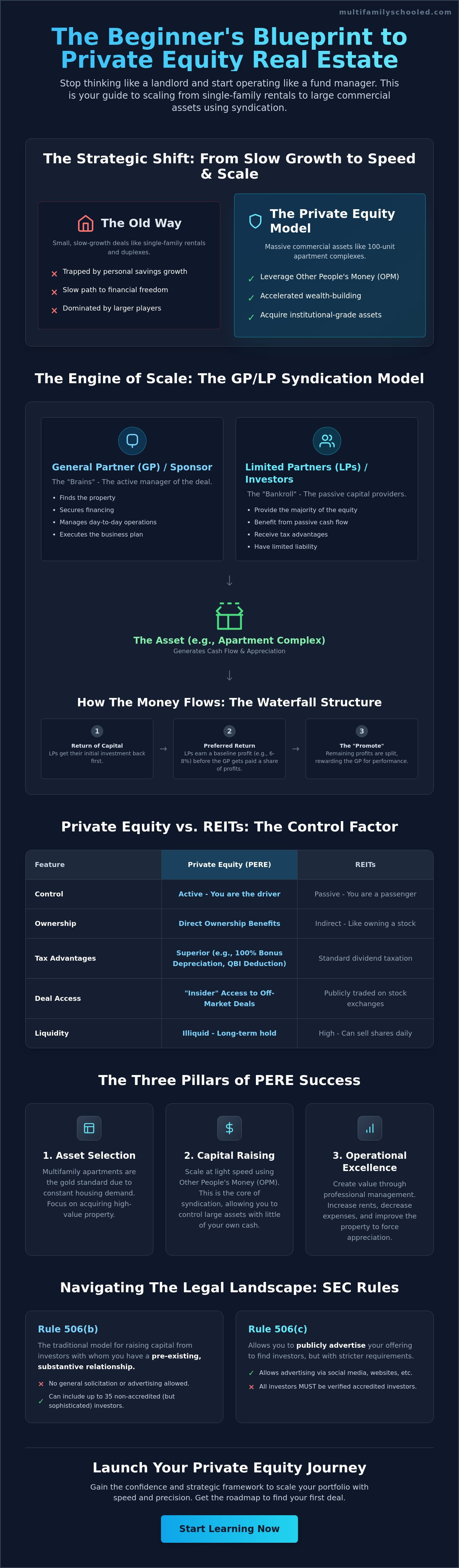
Success in this high-stakes arena rests on three specific pillars. First, Asset Selection. Multifamily apartments remain the gold standard for beginners because the demand for housing is constant. Second, Capital Raising. You scale at light speed by using OPM, or Other People's Money. This is the heart of real estate syndication for beginners. It allows you to control a $10 million asset with very little of your own cash. Third, Operational Excellence. You must create value through professional management. This means increasing rents, decreasing expenses, and improving the lives of your tenants to drive the property's value higher.
Private Equity vs. REITs: The Control Factor
Many people confuse private equity with REITs. REITs are passive and liquid. They are essentially stocks. PERE is active and high-growth. When you invest in a private equity structure, you get direct ownership benefits. This includes superior tax advantages like the permanent 20% QBI deduction for pass-through entities. You also gain an "insider" advantage. You can access off-market deals before the general public ever sees them. This allows you to negotiate better terms and secure equity on day one. You are the driver, not just a passenger. If you want to accelerate your journey, consider joining our Mentorship Program to get the exact roadmap used by top-tier firms.
The Private Equity Business Model: How the Money Flows
You need to understand how the machine works before you can drive it. In private equity, the structure is designed to reward both the brains and the bankroll. This isn't a complex mystery. It's a logical system of roles and rewards. The General Partner (GP), also known as the Sponsor, is the architect of the deal. They find the property, secure the financing, and manage the day-to-day operations. The Limited Partners (LPs) are the passive investors who provide the capital. This symbiotic relationship is the foundation of real estate syndication for beginners. It allows you to control massive assets without needing millions in your own bank account.
The money flows through a specific priority list called the waterfall structure. First, the LPs usually receive their initial capital back along with a "preferred return," which is a baseline percentage of profit. Once that threshold is met, the GP earns the "promote." This is a performance-based share of the profits that rewards the GP for hitting targets. Unlike public REITs described by the U.S. Securities and Exchange Commission, this model aligns everyone's interests. If the deal wins, everyone wins. GPs also earn acquisition and asset management fees to cover the costs of running the firm while the property appreciates.
Becoming the General Partner (GP)
The GP role is the ultimate wealth hack for beginners with hustle. You don't need to be the wealthiest person in the room; you need to be the most prepared. Your responsibilities include deal sourcing, rigorous due diligence, and maintaining investor relations. If you're worried about a lack of experience, don't be. You can build immediate credibility by partnering with seasoned mentors who have a proven track record. This allows you to leverage their reputation to win deals and raise capital. If you want to accelerate this process, our Mentorship Program provides the exact framework to step into the GP role with confidence.
Understanding the Capital Stack
The capital stack is the layers of money used to buy the building. At the bottom is Senior Debt. Banks love multifamily assets because they are historically stable. As of late June 2026, interest rates for multifamily properties range from 4.96% to 12.75%, with Freddie Mac rates starting as low as 5.52%. This debt usually covers 60-80% of the purchase price. The next layer is Equity. This is the 20-30% of the price you raise from your investors. For massive deals, you might use Mezzanine Equity. This is a hybrid of debt and equity that helps bridge the gap for larger acquisitions. Mastering this stack is essential for real estate syndication for beginners who want to scale into 100-plus unit complexes quickly.
Syndication: The Beginner Gateway to Private Equity
Real estate syndication is the legal vehicle that turns your private equity ambitions into a reality. It's the bridge between where you are and where you want to be. Why settle for a single duplex when you can acquire a 100-unit complex with the same amount of effort? The secret lies in the structure. By pooling capital from multiple investors, you gain the firepower to dominate large-scale multifamily assets. This is the ultimate gateway. It shifts your role from a small-time landlord to a professional sponsor. Real estate syndication for beginners is about mastering this leverage to achieve financial freedom in record time.
Navigating SEC regulations doesn't have to be scary. In fact, it's your competitive advantage. Most people get confused by Rule 506(b) and 506(c), but the distinction is simple. Rule 506(b) allows you to raise unlimited capital and include up to 35 non-accredited, sophisticated investors. The catch? You cannot advertise. This is perfect for your first "Friends and Family" fund. Rule 506(c) allows for general solicitation and advertising, but every investor must be verified as accredited. As of 2026, an accredited investor must have an income over $200,000 (or $300,000 jointly) or a net worth exceeding $1 million, excluding their primary residence. Holding an active Series 7, Series 65, or Series 82 license also qualifies an individual as accredited.
Accredited vs. Non-Accredited Investors
Defining who can legally invest in your deal is critical. If you're using Rule 506(b), you can tap into your personal network. These are people who already know, like, and trust you. However, don't skip the legalities. A Private Placement Memorandum (PPM) is essential. While these documents can cost between $10,000 and $25,000, they protect you and your investors. Never structure a deal without professional legal counsel. It's the cost of doing business at a high level. Building a solid foundation now prevents catastrophic legal errors later.
The 90-Day Deal Sprint
Commit to the 90-day deal sprint. This is a focused period of high-intensity activity designed to secure your first acquisition. Stop waiting for deals to come to you. You need a deal-finding mindset to survive in the 2026 market. Use professional tools like Real Estate Radar to identify off-market apartment buildings before your competitors even know they exist. Off-market deals are the lifeblood of successful syndicators. Once you find a target, create a high-impact "Deal Teaser." This one-page summary must be professional, data-driven, and urgent. Make it so compelling that investors want in immediately. You aren't just asking for money; you're providing an exclusive path to wealth.
Common Pitfalls and How Beginners Avoid Them
Success in this industry isn't just about finding a deal. It's about surviving it. Many people jump into real estate syndication for beginners with stars in their eyes, only to be blinded by avoidable errors. You must be strategic. You must be disciplined. The difference between a mogul and a statistic is the ability to identify landmines before they detonate. Don't let your first acquisition be your last because of simple negligence.
Mistake #1 is the "Pro-Forma Trap." This happens when you over-promise returns based on overly optimistic rental growth or impossible expense ratios. If your numbers only work if everything goes perfectly, your deal is a ticking time bomb. Use the Multifamily Tool Kit to stress-test your assumptions and verify your numbers against real-world data. Underestimating the complexity of professional property management is Mistake #2. This is not a "set it and forget it" business. Finally, Mistake #3 is failing to have a clear exit strategy. Your investors need to know exactly how and when they get their capital back, whether through a refinance or a strategic sale.
The Due Diligence Checklist
You win or lose during the due diligence period. Start with a Financial Audit. You must verify the Trailing 12 Months (T-12) of actual income and expenses. Bank statements don't lie. Move to the Physical Inspection. Hidden costs in aging roofs, faulty plumbing, or outdated electrical systems can erase your profit margins instantly. Finally, conduct a Market Analysis. Ensure the neighborhood is actually growing. Look for job growth and infrastructure investment. You want to be in the path of progress, not in a dying submarket.
Building Your Power Team
You cannot do this alone. You need a specialized real estate attorney and a CPA early in the process. Launching a syndication involves significant formation costs, often ranging from $15,000 to over $50,000. This is an investment in your legal safety and tax efficiency. Find a property manager who treats your asset with the same urgency as you do. Their performance directly impacts your bottom line. Most importantly, find a mentor. A mentor acts as your ultimate safety net. They provide the "second set of eyes" that prevents first-deal disasters. Real estate syndication for beginners is a team sport. If you're ready to build your squad and dominate the market, grab our Multifamily Tool Kit and start analyzing deals like a pro today.
Launch Your Private Equity Journey with Multifamily Schooled
Stop waiting for the perfect moment. The 2026 market belongs to those who act, not those who over-analyze. You don't need a three-year MBA or a massive corporate background to dominate this field. Those traditional paths are slow, expensive, and outdated. Real estate syndication for beginners is about execution. You need a proven, action-oriented framework that delivers results in weeks, not years. At Multifamily Schooled, we don't just teach you the business. We provide the tools to build it. Our ecosystem includes everything from proprietary deal-finding software to live workshops designed for immediate impact.
We stand behind our system with a bold 90-Day Promise. Find a deal within 90 days, or we provide one for you. This removes the primary hurdle that stops most beginners in their tracks. We've simplified the professional private equity process into a repeatable methodology. You've already learned about the GP/LP model and the 2026 tax advantages. Now, it's time to apply that knowledge. Your journey toward multi-generational wealth starts with a single apartment building. This is your chance to pivot from small-scale thinking to institutional-grade ownership.
The 5-Day Multifamily Challenge
This is the lowest-friction way to see if the private equity lifestyle is for you. In less than one week, you'll learn the A-Z of apartment investing. We strip away the fluff and focus on the core strategies that move the needle. You'll gain a high-level understanding of how to analyze markets and identify profitable assets. Don't stay stuck in the "learning phase" forever. Take decisive action and get started today at the Multifamily Schooled Store. It's time to see what you're truly capable of achieving.
The Elite Mentorship Program
If you're ready to scale at light speed, you need direct access to experts. Our Mentorship Program provides one-on-one guidance from Justin Brennan and a team of seasoned pros. We help you craft customized strategies for raising capital and closing major deals. You'll leverage our multi-generational industry heritage to build your own legacy. This program is for the serious investor who refuses to settle for average returns. We provide the blueprint, the software, and the support. You provide the hustle. Apply for our Mentorship Program now to fast-track your goals. Stop dreaming about financial freedom and start building it. The 2026 blueprint is in your hands. Use it.
Secure Your Financial Future Today
The blueprint for 2026 is clear. You've seen how the private equity business model works and how you can step into the role of a General Partner. You now understand that real estate syndication for beginners isn't just about pooling money; it's about building a legacy through strategic multifamily acquisitions. By mastering the capital stack and avoiding common pro-forma traps, you are already ahead of 90% of individual investors. The path to multi-generational wealth is no longer a secret reserved for Wall Street elites.
Don't let this knowledge sit idle. It's time to leverage our multi-generational industry heritage and proprietary Deal Finding Software to secure your first asset. We are so confident in our action-oriented framework that we offer a bold guarantee: find a deal in 90 days or we provide one for you. This is your moment to transition from a dreamer to a deal-maker. Start Your Journey: Join the 5-Day Multifamily Challenge Now! Success is waiting for those who move with speed and precision. You have the map. Now, take the first step toward your new life.
Frequently Asked Questions
Do I need a lot of money to start in private equity real estate?
You don't need millions to launch your first deal. As a General Partner, you leverage Other People's Money (OPM) to acquire large-scale assets. Your primary financial requirement is covering the initial formation and due diligence costs. These typically range from $15,000 to over $50,000 for professional legal and inspection fees. By pooling capital, you control a $10 million building with very little of your own personal cash. This is the ultimate wealth-building shortcut.
What is the difference between a GP and an LP in real estate?
The General Partner (GP) is the driver who finds, secures, and manages the deal. The Limited Partner (LP) is the passive investor who provides the capital for a share of the returns. GPs earn through performance and management fees while LPs enjoy hands-off income and tax benefits. This structure is the backbone of real estate syndication for beginners. It allows you to scale your portfolio by focusing on your specific strengths.
Is private equity real estate safer than the stock market?
Real estate provides tangible security that the stock market lacks. Unlike paper assets, multifamily property offers forced appreciation and massive tax advantages like 100% bonus depreciation. It is historically less volatile because the demand for housing is a fundamental human need. While every investment has risk, active management in private equity allows you to influence the outcome directly. You aren't just betting on a ticker symbol; you are driving a business.
How much do private equity real estate sponsors make?
Sponsors earn through a combination of fees and profit sharing. You can typically expect an acquisition fee of 1% to 3% of the purchase price at closing. You also earn an ongoing asset management fee to cover the costs of running the property. The real wealth comes from the "promote," which is your share of the profits after investors receive their preferred return. It rewards your expertise and successful execution of the plan.
What is a waterfall in a real estate investment?
A waterfall is the priority list for distributing deal profits to partners. It ensures that Limited Partners receive their initial capital and a baseline "preferred return" before the sponsor earns their performance bonus. This structure protects your investors and aligns everyone's interests. Once the baseline hurdle is met, the remaining cash flow is split based on the agreed-upon promote. It is a transparent system designed to reward high-performance management and successful exits.
Can I use my 401k or IRA to invest in private equity real estate?
Yes, you can use a Self-Directed IRA or a Solo 401k to participate in these deals. This allows you to move capital from traditional stocks into high-growth multifamily assets without immediate tax penalties. It is a powerful strategy to accelerate your retirement savings. Many investors use these vehicles to participate in real estate syndication for beginners. You must work with a specialized custodian to ensure your account is structured correctly for private placements.
How do I find investors for my first multifamily deal?
Start with your existing network of high-net-worth individuals. For a 506(b) offering, you can raise capital from friends, family, and colleagues who have a pre-existing relationship with you. If you choose a 506(c) offering, you can use social media and advertising to reach verified accredited investors. Focus on building trust and providing a professional, data-driven "Deal Teaser." Your ability to present a clear opportunity is your greatest capital-raising tool.
What are the risks of private equity real estate for beginners?
The biggest risks include the "Pro-Forma Trap" and hidden physical defects. You might over-estimate rental growth or miss a massive plumbing issue during the inspection phase. These mistakes can erase your profit margins instantly. You can mitigate these risks through rigorous due diligence and partnering with a mentor. A mentor provides the expert "second set of eyes" needed to spot disasters before you sign the contract. Don't let a simple error stop your journey.



