

Pitching Real Estate to Investors: 2026 Master Blueprint
What if the difference between a "no" and a seven-figure check isn't the property itself, but the three minutes after you open your laptop? Most new investors walk into meetings terrified that a single complex question will expose them as a beginner. You have the drive, but the fear of being "found out" or stumbling over financial metrics keeps your capital sidelined. It is time to stop guessing and start leading.
You already know that multifamily real estate is the key to long-term independence, yet the path to securing funding feels like a locked door. This guide is your key. You are about to master the exact framework for how to pitch a real estate deal to investors so you can command absolute confidence and secure capital fast. Even with 30-year fixed mortgage rates hovering near 6.92 percent, the right presentation makes a solid deal irresistible to those with the capital.
We are stripping away the fluff to give you a repeatable, professional system. This blueprint covers the specific metrics that matter in 2026, the slide-by-slide deck structure that wins, and the mindset shifts required to dominate investor meetings. Get ready to stop being a spectator and start being a sponsor. Your journey to economic empowerment begins with the first slide.
Key Takeaways
- Stop acting like a salesperson and start operating as a professional deal sponsor who prioritizes capital preservation over high-risk returns.
- Deploy a proven 12-slide master blueprint for how to pitch a real estate deal to investors that commands authority and eliminates beginner uncertainty.
- Decode the critical 2026 financial metrics and localized market trends that sophisticated investors require to move from initial interest to a signed check.
- Neutralize high-stakes objections instantly by using the "Protect My Money" framework to address the primary fears of accredited investors.
- Bridge the "experience gap" by leveraging a systematic mentorship approach that provides the data-backed confidence needed to lead any meeting.
Why Most Real Estate Pitches Fail (And How to Fix It)
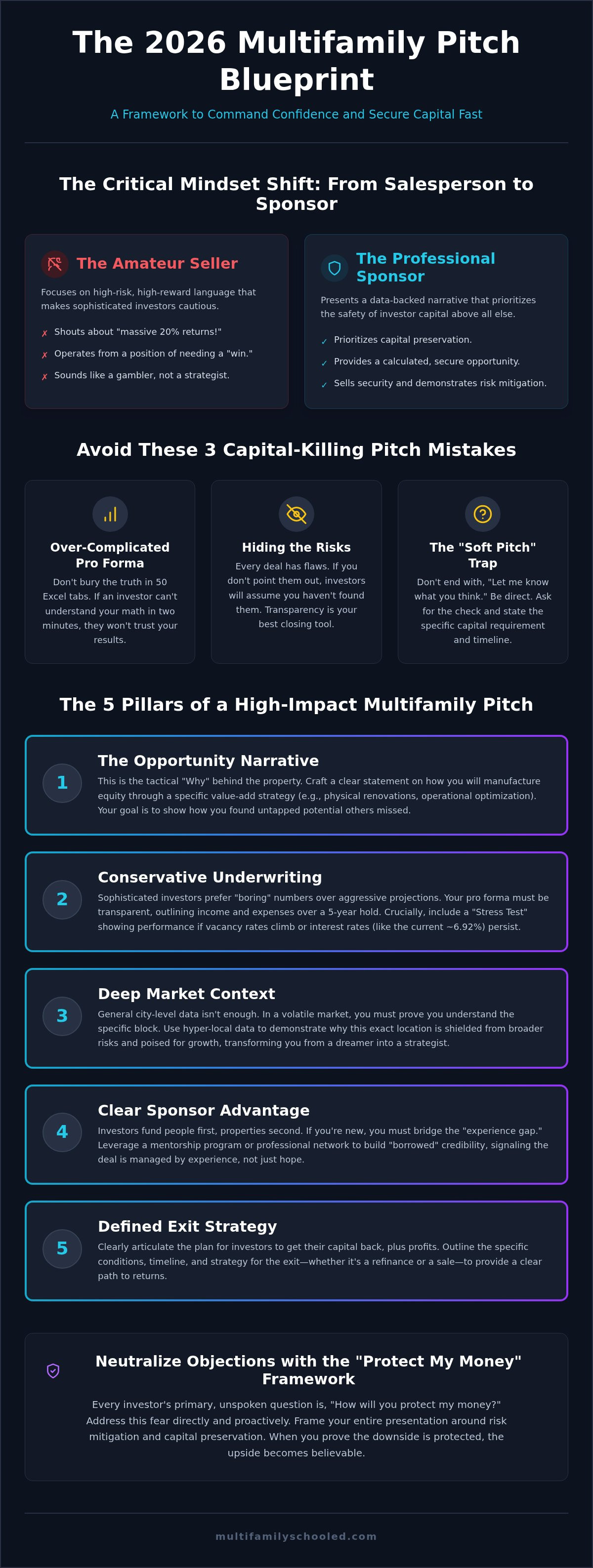
Most investors smell desperation from a mile away. When you open a meeting by shouting about "massive 20% returns," you aren't sounding like a pro; you're sounding like a gambler. This is the "Amateur Gap." Amateurs sell the upside. Professionals sell the security. In the 2026 market, where 30-year fixed mortgage rates sit near 6.92%, capital is cautious. Investors aren't looking for a lottery ticket. They want to know their principal is safe.
Stop being a salesperson. Start being a deal sponsor. A salesperson needs a win; a sponsor provides an opportunity. This shift in mindset changes everything about how to pitch a real estate deal to investors. Your pitch must be a data-backed narrative that prioritizes capital preservation above all else. If you can't show how you protect the downside, the upside doesn't matter. Investors in 2026 are dealing with localized market volatility, so your pitch must prove you understand the specific block, not just the general city.
The Trust vs. Numbers Debate
A 20% Internal Rate of Return (IRR) is just a line on a spreadsheet. Without a credible sponsor, that number is a fantasy. Sophisticated investors fund people first and properties second. If you are a beginner, you must bridge this gap by building "borrowed" credibility through a Mentorship Program or professional networks. Aligning yourself with experts who have closed hundreds of doors signals that the deal is managed by experience, not just hope. Sponsor credibility is the foundation of any successful capital raise. You must also demonstrate a firm grasp of private placement regulations to ensure your capital raise is compliant, professional, and secure from the first conversation.
Common Pitch Mistakes to Avoid
Avoid these three capital-killing errors that sink most deals before the second slide:
- Over-complicating the pro forma: Don't bury the truth in 50 tabs of Excel. Keep your financial model transparent and easy to digest. If an investor can't understand your math in two minutes, they won't trust your results.
- Hiding the risks: Every deal has hair on it. If you don't point out the risks, the investor will assume you haven't found them yet. Total transparency is your best closing tool.
- The "Soft Pitch" Trap: Don't end a meeting with "let me know what you think." Ask for the check. Be direct about the capital requirement and the specific timeline for funding.
The 2026 environment demands precision. With median monthly housing payments hitting $2,626, your underwriting must be tighter than ever. Success isn't about having the loudest pitch; it is about having the most prepared one.
The 5 Pillars of a High-Impact Multifamily Pitch
Mastering how to pitch a real estate deal to investors means building a fortress of facts around your property. You aren't just asking for money; you're inviting partners into a calculated wealth-building machine. In 2026, the threshold for excellence has shifted. Investors are sharper, and their options are plenty. To stand out, your pitch must rest on five unbreakable pillars: a compelling narrative, bulletproof underwriting, deep market context, a clear sponsor advantage, and a defined exit strategy.
Pillar 1: The Opportunity Narrative
Every great deal starts with a story. This isn't fiction; it is the tactical "Why" behind the property. You must articulate how you will manufacture equity through a specific value-add strategy. Whether it is a physical renovation or operational optimization, your narrative explains the untapped potential. Use Real Estate Radar to identify specific market inefficiencies that others missed. When you can point to data-backed evidence of why this specific property is undervalued, you transform from a dreamer into a strategist. Craft a "Why This Property" statement that is so clear a ten-year-old could understand the profit motive.
Pillar 2: Conservative Underwriting
Numbers don't lie, but they can be overly optimistic. Sophisticated investors are actually more comfortable with "boring" numbers than aggressive projections. Your pro forma should outline income and expenses over a five-year hold with total transparency. Always include a "Stress Test." Show your investors exactly what happens if vacancy rates climb or if interest rates remain near 6.92 percent longer than expected. Providing this level of detail aligns with SEC guidance on real estate investments regarding risk disclosure. When you prove the deal still works in a worst-case scenario, you win the room.
Pillar 3: The Sponsor & Mentorship Team
If you lack a personal track record of closing 500 units, you must leverage a support system. Your pitch should highlight your "Board of Advisors" to offset any perceived inexperience. By participating in the Multifamily Schooled Mentorship, you bring the weight of a proven system to the table. Mention your 90-Day System as proof of operational efficiency. This shows investors that you aren't winging it; you are following a rigorous, repeatable blueprint for success. This borrowed credibility is often the deciding factor in how to pitch a real estate deal to investors successfully.
The final two pillars, Market Context and Exit Strategy, provide the "When." You must explain why this submarket is a buy right now and exactly how you will return the capital. Whether through a refinance or a sale, your investors need to see the finish line before they start the race. If you want to refine your board of advisors today, consider joining our next live mentorship cohort to lock in your professional edge.
Building Your 12-Slide Pitch Deck for 2026
Your pitch deck is the visual proof of your professionalism. It is not just a presentation; it is a credibility builder. If your deck looks like a garage sale flyer, investors will treat your deal like junk. Sophisticated capital requires a sleek, data-heavy, and organized narrative. This is the ultimate blueprint for how to pitch a real estate deal to investors using a 12-slide master system.
- Slides 1-3: The Hook. Open with a high-impact Executive Summary. Define the "Problem" (market inefficiency or property distress) and present your "Solution" (the acquisition and value-add plan).
- Slides 4-6: The Meat. Provide the Property Overview with high-quality photos. Use 2026 Market Analysis to show why this submarket is outperforming national trends. Present the stress-tested Financials that prioritize capital preservation.
- Slides 7-9: The Team. Detail your Sponsor Profile. Highlight your participation in the Mentorship Program and your property management partners. This is where you leverage "borrowed credibility."
- Slides 10-12: The Close. Define the Exit Strategy clearly. Make "The Ask" direct and specific regarding capital requirements. Close with your Contact Info and a clear next step.
Visual Standards and Design
Clean and corporate beats flashy every time. Sophisticated investors want clarity, not clip art. Use professional templates to keep your design sleek and consistent. Follow the "One Idea Per Slide" rule for maximum impact. If you try to cram three charts and four paragraphs onto one page, you will lose the room. Keep it simple. Keep it bold. Your deck should guide the eye toward the most important number on every page.
Data Visualization That Sells
Never just paste a raw spreadsheet into your deck. Turn complex pro forma data into high-impact charts that tell a story. Show your submarket growth compared to national averages to prove your localized expertise. Use software screenshots from Real Estate Radar to prove your deal-sourcing methodology. This provides the data-backed confidence investors crave. Seeing the "Radar" in action proves you have a technological edge that other sponsors lack. It shows you aren't guessing; you are operating with a precision system.
Ready to build your first professional-grade deck? The Multifamily Tool Kit provides the templates you need to look like a pro from day one.
The Psychology of the Close: Handling Investor Objections
The slides are finished. The data is verified. Now comes the moment that separates the amateurs from the closers. Learning how to pitch a real estate deal to investors is 20 percent about the deck and 80 percent about the delivery. You must transition from a presenter to a leader. Sophisticated investors aren't just looking for a property; they are looking for a sponsor who remains unshakable when the questions get difficult. If you flinch when an objection is raised, you lose the capital.
Your primary weapon is the "Protect My Money" framework. With U.S. inflation easing to 3.4 percent as of July 2026, investors are searching for stability, not just growth. Address their number one fear before they even voice it. Show them how the deal survives localized market adjustments. When you prioritize capital preservation, you align your interests with theirs. This builds an immediate psychological bond that no spreadsheet can replicate.
When an investor asks about your experience, don't apologize for being new. Use your mentorship as a shield. Explain that you are operating within a rigorous system led by experts who have closed hundreds of millions in deals. This isn't just your deal; it is a deal backed by the Mentorship Program infrastructure. This shift moves the focus from your personal resume to the institutional-grade process you are following.
Mastering the Q&A Session
Expect the "hard" questions. You will be grilled on cap rates, debt terms, and replacement reserves. If you don't know an answer, don't guess. Use the "I'll find out" technique. Tell them, "That is a critical metric; let me pull the specific data point from our underwriting team and get it to you by 5 PM." This builds more trust than a shaky guess ever could. You can also leverage the Multifamily Tool Kit during the meeting to pull up technical checklists and professional responses instantly. Being prepared with the right tools shows you are a serious operator.
The Psychology of Urgency
Investors hate being the first ones in, but they love being part of a moving train. Start by building a "Soft Circle" list of interested partners to create momentum. When you can tell a potential investor that 40 percent of the capital is already accounted for, the psychology shifts from "Is this safe?" to "Will I miss out?" Use "First-In" incentives or set a hard deadline for the capital call to drive action. Do not chase. If an investor is hesitant, use the "Takeaway" method. Remind them that the deal is moving forward with or without them. Scarcity is the ultimate closer.
Ready to build your list and master the close? Join the 5 Day Multifamily Challenge and start filling your investor database today.
Execute the System: From Pitch to Closed Deal
The pitch is over. The "yes" is in the air. Now, you must move. A verbal commitment is worthless without a signed Subscription Agreement. In the 2026 market, speed is your only true competitive advantage. If you wait too long to send the paperwork, the capital will find another home. Master the transition from the boardroom to the bank by following a rigorous execution system.
Learning how to pitch a real estate deal to investors is the first step toward economic empowerment. But closing is where the life-transforming journey truly begins. You have the blueprint. You have the data. Now, you must have the courage to lead your investors through the finish line. Success isn't a fluke; it's a repeatable process of finding, pitching, and closing.
Streamlining the Closing Process
Transitioning from the pitch to the close requires a systematic approach to legal documentation. You need your Private Placement Memorandum (PPM), Operating Agreement, and Subscription Booklet ready for immediate distribution. These aren't just papers; they are the legal backbone of your deal. Once the funds are in, your job as a sponsor truly begins. Managing investor relations through transparent, monthly reporting is the secret to securing repeat capital for your next acquisition. Use Real Estate Radar to keep your pipeline full while you close the current deal. Automation ensures you never lose momentum and prevents you from being caught off guard by the next opportunity.
Your Path to Your First Apartment Building
You don't need your own money to buy a 50-unit apartment building. You need a great deal and a professional system. Many new investors believe they must spend years saving a down payment, but the reality is different. By mastering the art of the raise, you can control massive assets using other people's capital. The Mentorship Program acts as your operational shield, providing the expertise that investors demand before they write a check. This program is the secret weapon for new investors to gain instant credibility in any room.
- Build your database with the 5 Day Multifamily Challenge to find ready partners fast.
- Set a 90-day goal for your first close to maintain high-energy momentum.
- Access the Multifamily Schooled Store for the latest tools and community support.
Stop over-analyzing the interest rates or the national headlines. Localized opportunities exist for those who take them. Start pitching. The world belongs to the sponsors who execute. Your first deal is waiting for you to lead the way; don't let hesitation sideline your future.
Own the Room and Secure Your Future
You now possess the master blueprint to dominate investor meetings and secure the capital you need. Success in 2026 requires more than just finding a property; it requires the authority to lead. By shifting from a salesperson mindset to a professional deal sponsor, you provide investors with the capital preservation they demand. You've learned exactly how to pitch a real estate deal to investors using a data-backed 12-slide deck and the psychological frameworks of the close. Don't let this knowledge sit idle while others secure the prime multifamily assets you want.
The path to long-term independence is paved with decisive action. Stop analyzing from the sidelines and start operating with a proven system. You can leverage Justin Brennan's multi-generational expertise and our proprietary deal-finding software to eliminate guesswork. We provide the strategic tools and a 90-day performance guarantee to ensure your success. Secure your first deal in 90 days. Join the Multifamily Schooled Mentorship and start building your legacy today. Your transformation into a high-energy closer begins now. The market is moving fast; it is time for you to move with it.
Frequently Asked Questions
What is the most important slide in a real estate pitch deck?
The Executive Summary is the most critical slide because it captures immediate interest. It must clearly state the capital required, the projected return, and the specific value-add strategy. If you don't hook them in the first sixty seconds, the rest of the deck won't matter. This slide acts as a high-level map of the entire opportunity. It proves you understand the deal’s core profit motive and can articulate it with professional precision.
How do I pitch a deal if I have no prior experience?
You pitch without personal experience by leveraging a Mentorship Program and a "borrowed" track record. Show investors that you aren't a lone wolf; you are operating within a proven system led by industry veterans. Highlighting your board of advisors and professional management team eliminates the "beginner risk" in their minds. This is a core part of how to pitch a real estate deal to investors successfully when you are just starting your journey.
What financial metrics do multifamily investors care about most?
Multifamily investors focus on the Internal Rate of Return (IRR), Cash-on-Cash return, and the Equity Multiple. They also look closely at the entry and exit Cap Rates to ensure your exit strategy is conservative. In the 2026 market, debt coverage ratios are equally vital due to current interest rates. Providing a stress-tested financial model that shows how these metrics hold up under localized market pressure builds the data-backed confidence necessary to secure funding.
How long should a real estate investor pitch take?
A professional real estate pitch should last between 15 and 20 minutes. This provides enough time to cover the 12-slide master blueprint without losing the audience's attention. You want to leave at least 30 minutes for a deep-dive Q&A session where you can handle technical objections. Brevity signals respect for the investor's time and confidence in your own data. Keep your delivery punchy and move quickly through the property overview to reach the financials.
Should I share the full pro forma before the first meeting?
You should send a high-level executive summary or teaser before the meeting instead of the full pro forma. Sending a massive spreadsheet early can lead to "analysis paralysis" or allow the investor to dismiss the deal without hearing your narrative. Use the teaser to spark curiosity and secure the meeting. Once you are in the room, you can present the full financial model and answer specific questions regarding your underwriting assumptions and localized market research.
How do I find investors for my first multifamily deal?
Start by tapping into your existing network and attending local real estate meetups. You can also build a massive "Soft Circle" list by participating in a 5 Day Multifamily Challenge to learn digital lead generation. Social media platforms like LinkedIn are powerful for connecting with accredited investors who are searching for stable, long-term assets. Consistency is key; you must constantly share your deal-finding process to build the trust required for someone to write a check.
What is the difference between a pitch deck and an offering memorandum?
A pitch deck is a visual storytelling tool designed to capture interest and secure a commitment. An Offering Memorandum (OM) is a comprehensive, technical document that includes the legal disclosures and detailed property data. The deck gets them to say "yes," while the OM provides the legal framework to finalize the investment. Both are essential, but the deck is what you use in the room to inspire confidence and drive the initial capital raise.
Can I use software to help create my real estate pitch?
You absolutely can and should use software to streamline the process. Tools like Real Estate Radar provide the localized market data and inefficiencies you need to prove your deal narrative. For the deck itself, professional design software helps you maintain a clean, corporate look that beats amateur PowerPoint templates. Combining proprietary deal-finding software with professional templates ensures your pitch looks like it was created by an institutional-grade firm with years of experience.



