

Overwhelmed by Real Estate Info? Here’s What to Do
What if your next step in real estate investing isn’t more research, but a clearer filter? If you’re searching “feeling overwhelmed with real estate information what to do,” you’re not alone. Conflicting advice, unfamiliar metrics, and the fear of an expensive mistake can make it easy to open more tabs without getting closer to a decision.
You don’t need to master every strategy or market trend before making progress. You need a learning path tied to one goal, a way to separate useful information from noise, and one manageable next action. This article will help you identify what matters at your current stage, organize your learning, and decide whether structured education or mentorship could help.
Start with the outcome you want, not every topic you could study. Focus your research, compare advice against your goal, and take the next step without rushing into a commitment. Small, deliberate progress beats endless browsing.
Key Takeaways
- If you’re wondering “feeling overwhelmed with real estate information what to do,” name the decision you need to make, then set aside information that doesn’t help with it.
- Use a four-part filter to assess advice: your goal, the source, its assumptions, and the next action it supports.
- Separate useful research and low-risk practice from premature commitments. You can make progress without mastering every topic first.
- Follow a flexible seven-day learning plan to build focused knowledge, test your understanding, and choose what to explore next.
- Choose between self-study, workshops, and mentorship based on how much structure, context, or accountability you need.
Feeling Overwhelmed by Real Estate Information? Start by Naming the Decision
Real estate advice can be hard to sort through when you haven’t identified what you need to decide. One video covers financing, another dives into market analysis, and a third recommends a different strategy. Information overload sets in when you’re gathering more input than your current goal requires. If you’re searching “feeling overwhelmed with real estate information what to do,” start by naming the decision before collecting more advice.
Your immediate goal might be to decide whether multifamily investing is worth learning about, or to understand what questions to ask before evaluating an opportunity. Keep the decision small and clear. This guide is about organizing your learning, not recommending a specific property or promising an investment outcome.
For a related perspective on feeling stuck in a cycle of research, watch this video:
Why real estate research can feel contradictory
Advice often depends on location, property type, financing approach, experience, and personal risk tolerance. Two sources may reach different conclusions because they’re answering different questions. For example, one investor discussing a small multifamily property may prioritize keeping more cash available, while another may focus on reducing borrowing. Their assumptions differ, so neither recommendation automatically applies to your situation.
That flood of possibilities can lead to analysis paralysis, where weighing more options makes it harder to choose a next step. Instead of asking which source is universally right, identify the assumptions behind its advice and whether they match your goal.
What to do before opening another article or video
Pause the search and write one sentence naming the decision you’re trying to make. For example: “I want to understand what multifamily investing involves before choosing what to study next.” Then separate what you need to learn now from topics that can wait. If you’re still clarifying your goal, detailed financing strategies may not be the next priority.
Save useful material in one place and label it with the question it answers. Close extra tabs and return to your notes when the topic becomes relevant. Your takeaway: identify the next decision before collecting more real estate advice. A focused question won’t eliminate uncertainty, but it gives your learning a direction.
How to Filter Real Estate Information Without Missing What Matters
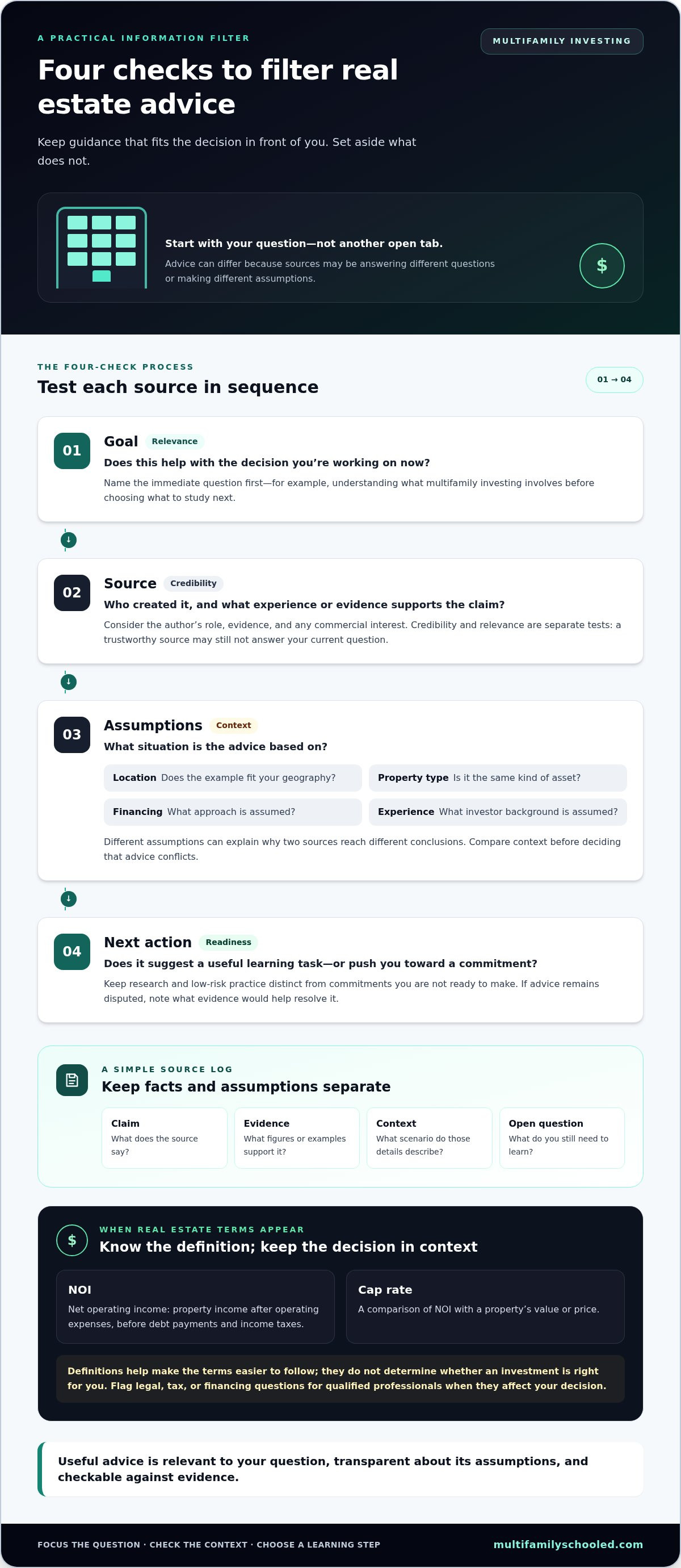
Once you’ve named the decision, apply the same filter to each article, video, or conversation. This helps you keep useful guidance in view without treating every claim as equally relevant. If you’re still wondering “feeling overwhelmed with real estate information what to do,” try these four checks:
- Goal: Does this information help with the decision you’re working on now?
- Source: Who created it, and what experience or evidence supports the claim?
- Assumptions: What location, property type, financing approach, and investor experience does it assume?
- Next action: Does it suggest a useful learning task, or push you toward a commitment you’re not ready to make?
A useful real estate source is relevant to your question, transparent about its assumptions, and checkable against evidence. Credibility and relevance are separate tests. An experienced investor may share credible information based on a market, property type, or risk tolerance unlike yours. A source can be trustworthy and still not answer your current question.
Check fit, not just credentials
Look at the author’s role and experience, the evidence behind their claims, and whether they have a commercial interest in what they’re recommending. Then check the context: Does the example involve your geography and asset type? Does it assume a particular financing strategy or level of experience? Educational examples can explain concepts, but they aren’t personalized legal, tax, or financial advice.
Keep a simple source log with four separate notes: claim, evidence, context, and unanswered question. For example, if a source explains how to evaluate a multifamily opportunity, record its claim, the figures or examples it uses, the scenario those figures describe, and what you still need to learn. Separating these details makes it easier to compare sources without blending facts and assumptions.
Compare assumptions before deciding advice conflicts
Two sources may appear to disagree because they start with different assumptions. Compare those assumptions first. If the disagreement remains, note what evidence would help resolve it rather than choosing the most confident-sounding opinion.
Define unfamiliar metrics before using them. NOI, or net operating income, is property income after operating expenses, before debt payments and income taxes. A cap rate compares NOI with a property’s value or price. Knowing the definitions makes the terms easier to follow, but doesn’t tell you whether an investment is right for you. Flag legal, tax, or financing questions for qualified professionals when they affect your decision.
For a more organized way to keep learning, explore structured real estate resources and choose only what fits your current goal.
Should You Keep Researching or Take a Small Next Step?
If you’re asking “feeling overwhelmed with real estate information what to do,” don’t assume the answer is always another article. You don’t have to master every real estate topic before making progress. Decide whether you need to clarify a key point or apply what you’ve already learned in a practice exercise.
Keep this distinction in mind: Learning to evaluate a deal builds your skills; deciding to invest in one is a separate, higher-stakes choice. Practice can help you get more comfortable with the process without turning an exercise into a purchase recommendation.
| Path | When it fits | Example |
|---|---|---|
| Useful research | A key term, assumption, or risk is still unclear. | Look up one concept using a small set of relevant sources. |
| Low-risk practice | You understand the basic idea and want to test your learning. | Review a hypothetical deal or public listing, noting questions and missing details. |
| Premature commitment | You feel pressure to act before you understand the decision or its risks. | Making a financial commitment mainly to escape uncertainty or research fatigue. |
Signs that more research will help
Keep learning when a term changes how you interpret information, an assumption doesn’t match your situation, or an important risk remains unclear. Narrow the search to one decision and a few sources that address it directly. Repeated exposure isn’t proof: seeing the same claim in several places doesn’t establish that it’s accurate, especially if those sources rely on the same example or repeat one another.
Signs that it’s time to apply what you learned
If you can explain the basic concept in your own words, try a simple exercise. Choose a public listing or create a hypothetical scenario, then outline what information you’d need to assess it. Separate known facts from assumptions, and write down what’s missing. Don’t fill gaps with guesses.
Your practice doesn’t need to end with a verdict. It can end with a short question list, a glossary of terms you want to understand, or a sample analysis showing what you can and can’t conclude. Keep the exercise educational. Evaluating an example builds judgment; it isn’t a recommendation to purchase a property.
A 7-Day Real Estate Learning Plan to Turn Noise Into Progress
If you’re searching “feeling overwhelmed with real estate information what to do,” try a short learning plan with one task per day. Set aside about 15 to 30 minutes for each task, or adjust the pace to fit your schedule. The goal isn’t to master real estate or find a deal in seven days. It’s to make your next learning step clearer.
Set one goal and choose only the information it requires
Choose a near-term goal, such as understanding one investment metric or learning what information a basic multifamily analysis uses. Put related questions on your study list. Add everything else to a parking-lot list, so you can return to it later without chasing every new topic.
- Day 1: Write your learning goal and the decision it supports.
- Day 2: Learn one core concept connected to that goal. Define unfamiliar terms in your own words.
- Day 3: Check a small number of relevant sources. Note who created each one, what evidence they provide, and what assumptions shape their examples.
- Day 4: Compare explanations of the concept. Record where they agree, where they differ, and what context may explain the difference.
- Day 5: Try a practice exercise using a hypothetical scenario or public listing. Mark missing information instead of filling gaps with guesses.
- Day 6: Review your notes and list unresolved questions. Choose which ones matter to your goal and which can wait.
- Day 7: Decide whether to continue learning, pause, or seek qualified professional advice for a legal, tax, or financial question.
Use a simple learning log to see real progress
Keep the work in one document. For each task, record the question, source, key claim, assumptions, and next action. Add unanswered questions as they come up; don’t restart your research every time you find one. At the end of the week, review your sources and remove any that no longer serve your goal. Keep useful questions in your parking lot for a future review.
Adapt the schedule. Combine days, take longer, or repeat a task if you need to. The value is in the structure, not the seven-day deadline. For an organized starting point, explore the multifamily investing toolkit and use the resources that fit your learning goal.
When Structured Real Estate Education or Mentorship Can Help
If you’re still asking “feeling overwhelmed with real estate information what to do,” structure may help when you know your learning goal but aren’t sure what to study first, how topics connect, or how to stay accountable. Education can organize your learning and strengthen your judgment. It can’t remove investment risk, guarantee an outcome, or replace qualified legal, tax, or financial advice.
Choose a format based on your goal, available time, experience, and preferred level of support. Self-study offers flexibility if you’re comfortable setting your own sequence. A workshop provides focused learning and a chance to engage with a topic. Mentorship may suit learners who want more guidance and accountability as they work through questions.
Match the learning format to the support you need
Before choosing structured education, get clear on what you want to learn and what would help you follow through. Consider whether the curriculum covers your current topic, whether the instructor’s experience is relevant, and whether the format includes practical exercises or ongoing support. Focus on learning value and fit, not an expectation of a guaranteed investment outcome.
If you’re unsure which format would help, write down what’s missing from your current learning process. Do you need a clear order of topics, context for applying concepts, or accountability to keep making steady progress? Your answer can help you decide whether to continue independently, attend a workshop, or pursue guided mentorship.
Consider a focused next step with Multifamily Schooled
Multifamily Schooled offers investor education through self-directed resources, live workshops, online challenges, and mentorship. The five-day Multifamily Challenge introduces the A-to-Z of apartment investing, while the Mentorship Program provides direct guidance for investors working to find and purchase apartment buildings. The mentorship program is designed to help participants find a deal within 90 days or provide one. These are ways to add structure after you’ve identified your goal, not guarantees of an investment outcome.
If guided learning is the support you want, explore the multifamily investing mentorship and consider how it fits your learning needs. You can also keep using your learning plan independently. Choose one next step that helps you understand the subject more clearly, then review what you’ve learned before deciding where to go next.
Choose One Clear Next Step and Keep Moving
If you’re still asking “feeling overwhelmed with real estate information what to do,” return to the decision you named. Filter new advice by your goal, check its assumptions, and focus your learning on what you need to know next. A small practice exercise or a short list of unanswered questions can move you forward without requiring you to master every topic or rush into an investment.
Your learning plan can also show you when more structure would help. Multifamily Schooled offers investor education for novice and experienced learners through mentorship, live workshops, online challenges, and deal-finding software. These resources can help you build knowledge and evaluate opportunities, but they don’t guarantee investment results or replace qualified professional advice.
If guided learning fits your goals, explore multifamily investing mentorship. Choose one focused next step, then use what you learn to decide where to go next.
Frequently Asked Questions
Why do I feel overwhelmed when researching real estate investing?
Real estate advice often reflects different goals, locations, property types, financing choices, and levels of experience. Two sources may seem to disagree while describing different situations. Add unfamiliar terms and concern about making a costly mistake, and it’s easy to keep researching without moving forward. Narrow your information to the decision you’re trying to make, then set aside topics that don’t help with it yet.
What should I do first when I want to learn about real estate investing?
Start by choosing one near-term learning goal and writing down the decision it supports. If you’re thinking, “feeling overwhelmed with real estate information what to do,” make that your first move: name the question before opening another article or video. For example, you might want to understand one property metric or learn what information a basic analysis requires. Keep unrelated questions in a separate list for later.
How can I tell whether real estate information is reliable?
Check who created the information, what experience or evidence supports it, and whether the source has a commercial interest in its recommendation. Then check relevance: does it address your location, property type, and learning goal? Record the claim, evidence, context, and assumptions separately. Reliable educational material can explain concepts, but it isn’t automatically personalized legal, tax, or financial advice for your circumstances.
Should I keep researching real estate or start analyzing a property?
Research more if a key term, assumption, or risk is still unclear. If you understand the basics, try an educational exercise with a hypothetical deal or public listing. Note what you know, what you assume, and what information is missing. Don’t fill gaps with guesses or treat the exercise as a recommendation to buy. Learning to evaluate a property and deciding to invest in it are separate steps.
Can I learn real estate investing without taking a course?
Yes. You can begin with self-study by setting a focused goal, using relevant sources, keeping a learning log, and practicing with hypothetical examples. A course, workshop, or mentorship is optional, not a prerequisite for learning. Structured education may help if you want a sequence, context, or accountability. Multifamily Schooled offers investor education through live workshops, online challenges, and mentorship.
How do I deal with conflicting real estate investing advice?
Compare the assumptions behind each recommendation before deciding that the sources truly conflict. Check whether they refer to the same location, property type, financing approach, and investor experience. Review the evidence each source uses, and don’t treat repeated claims as proof of accuracy. If the disagreement involves a legal, tax, or financing question that affects your decision, write it down and seek guidance from a qualified professional.
What real estate topics should a beginner learn first?
Begin with topics connected to your chosen investing goal, rather than trying to study everything at once. Learn the basic features of the property type you’re considering, how income and operating expenses relate, and the meaning and limitations of metrics such as net operating income and cap rate. Then explore financing, risks, and due diligence as they become relevant. Keep a list of later questions so they don’t derail your current learning.



