

Multifamily vs Single Family Investing: The 2026 Wealth-Building Blueprint
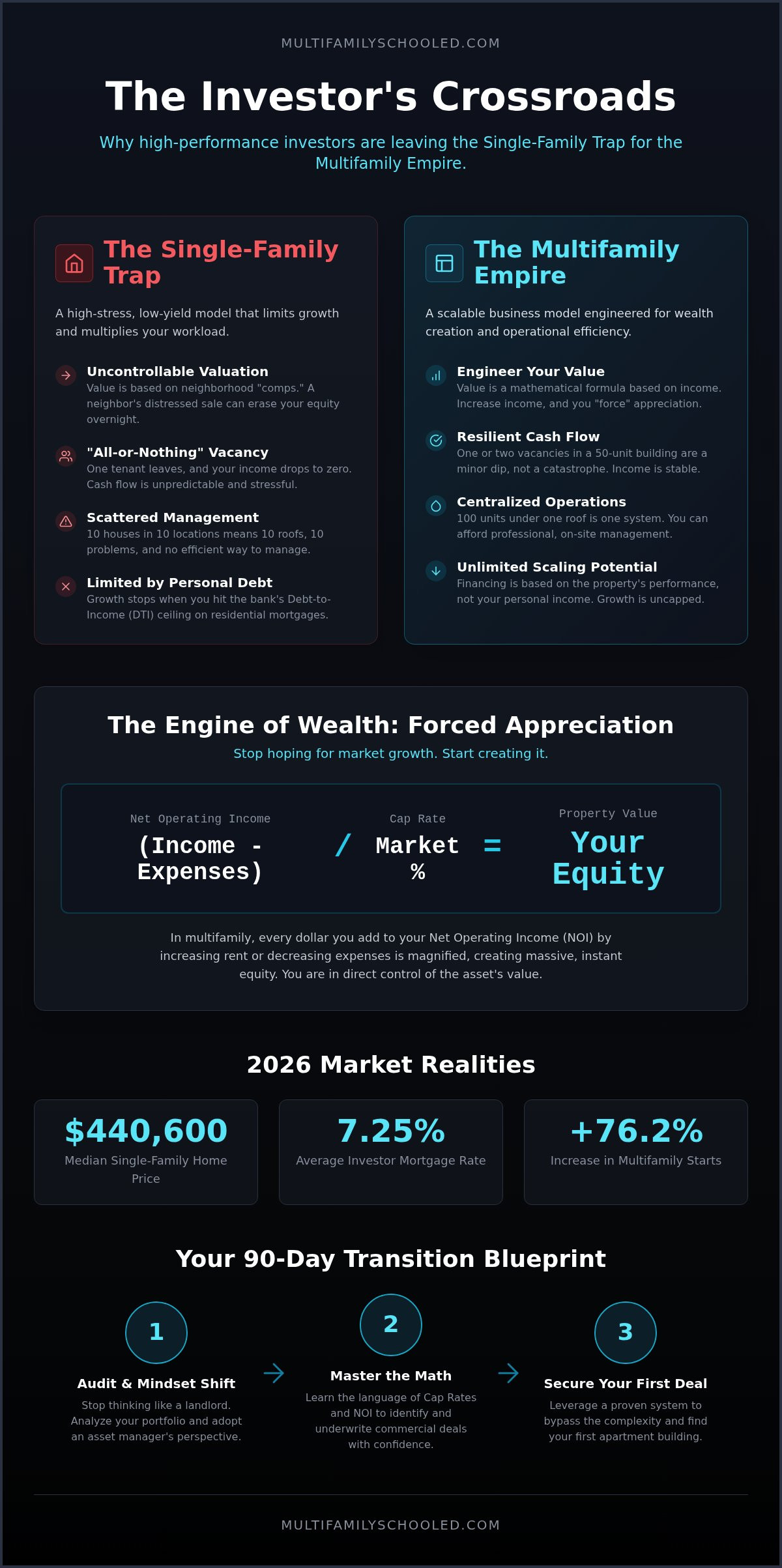
Single-family homes are not a wealth strategy; they are a high-stress, low-yield job that traps you in a cycle of trading time for pennies. With the median U.S. home price hitting $440,600 in June 2026 and investor mortgage rates hovering around 7.25%, the old "one house at a time" model is officially broken. You're likely feeling the weight of slow growth, scattered management headaches, and the constant struggle to qualify for yet another personal mortgage. It's time to stop thinking small. When comparing multifamily vs single family investing, the data is clear. High-performance investors are moving toward apartments to achieve rapid scale and forced appreciation wealth.
You want a portfolio that works for you, not a list of chores that keeps you awake at night. We agree that the traditional path to real estate success often feels more like a treadmill than a ladder. This blueprint promises to reveal exactly how to bypass the complexity gap and transition into multifamily assets that provide passive income covering your entire lifestyle. We will break down the proven frameworks used to scale to 100 units quickly, professionalize your management, and leverage the 2026 market shifts to secure your financial legacy today.
Key Takeaways
- Escape the "Single Family Trap" and learn why personal debt-to-income ratios eventually stop your growth when buying individual houses.
- Master the math of multifamily vs single family investing to unlock forced appreciation, where increasing your net operating income creates massive, instant equity.
- Streamline your operations by shifting from scattered, time-draining single-family rentals to professionalized management in a single apartment building.
- Follow a clear 90-day blueprint to audit your portfolio and use the language of Cap Rates to secure your first commercial deal.
- Leverage a proven system and proprietary software to bypass the complexity gap and find your first apartment building in just 90 days.
Scaling Your Future: Why Single Family Homes Are Just the Starting Line
Stop chasing houses. Start building empires. You've been told that buying one single-family rental at a time is the safe path to retirement. That's a lie. It's the "Single Family Trap." When you own 10 houses in 10 different zip codes, you don't have a portfolio. You have 10 separate problems. You're managing 10 roofs, 10 driveways, and 10 sets of neighbors. This isn't scaling; it's just multiplying your workload. When evaluating multifamily vs single family investing, the biggest hurdle isn't the capital. It's the mindset shift from being a landlord to becoming an asset manager. The core difference in multifamily vs single family investing is how you scale your time and your wealth simultaneously.
To better understand this concept, watch this helpful video:
The Limitations of One-at-a-Time Investing
Single-family rentals suffer from "all-or-nothing" vacancy. If your tenant leaves, your income is zero. You're still paying the 7.25% investor mortgage rate out of your own pocket. This creates lumpy, unpredictable cash flow that keeps you stuck. With the median single-family home price reaching $440,600 in June 2026, the barrier to entry for a single house is higher than ever. Managing scattered properties is a logistical nightmare. You'll never find a professional property management firm that cares about one house as much as they care about a 50-unit complex. The inefficiency drains your time. Eventually, you'll hit the "debt-to-income" ceiling. Banks will stop lending to you personally because you've reached your limit on residential mortgages. You're stuck at the starting line while others are finishing the race.
Multifamily as a Business, Not a Hobby
Multifamily allows you to treat real estate like a high-performance machine. You aren't relying on a subjective real estate appraisal based on what the house next door sold for. You're building a business where value is driven by income. Multifamily starts increased by 76.2% in June 2026 for a reason. High-performance investors know that concentration is the key to surviving high financing costs. You can afford dedicated on-site or regional management because the units are concentrated under one roof. Stop thinking about "doors" and start thinking about systems. The psychological transition to larger numbers is where true wealth begins. It's easier to manage 100 units in one location than 10 units in 10 locations. If you want to bypass the complexity gap, our Mentorship Program provides the blueprint to your first deal. Take control of your future now.
The Math of Wealth: Forced Appreciation vs. Market Comps
Stop letting your neighbors dictate your net worth. In the world of residential real estate, your property value is chained to "comparable sales." If the house next door sells at a discount because of a messy divorce or a job relocation, your equity takes a hit. You have zero control. This is the fundamental flaw in the multifamily vs single family investing debate for those seeking rapid scale. Single-family homes are valued based on emotion and market sentiment. Apartments are valued based on math. When you treat real estate as a commercial asset, you become the engineer of your own wealth. By switching to multifamily investing, you move from a speculative hobby to a predictable business engine.
Net Operating Income (NOI) and the Value Formula
Net Operating Income (NOI) is the heartbeat of multifamily valuation. It's a simple calculation: Total Income minus Operating Expenses. Unlike houses, commercial buildings use a "Cap Rate" to determine price. In July 2026, multifamily cap rates generally range from 6.5% to 7.5%. This creates a massive opportunity for "Forced Appreciation." If you increase a building's annual NOI by just $10,000 through better management or small rent bumps, you don't just get $10,000. At a 7% cap rate, you've added over $142,000 in instant equity. You can't "force" a single-family home to be worth $142,000 more just by cutting the landscaping bill. In multifamily, every dollar saved is a multiplier for your wealth.
Economies of Scale: Reducing Risk Through Unit Density
One roof. One parking lot. One insurance policy. When you own ten single-family homes, you're paying for ten of everything. The maintenance costs are redundant and exhausting. In an apartment building, you achieve unit density that slashes your per-unit expenses. Replacing one large roof on a 10-unit complex is significantly cheaper than replacing ten individual roofs on ten scattered houses. You gain bulk purchasing power with vendors that single-family landlords can only dream of.
Density also protects your cash flow. If one tenant leaves a single-family house, your vacancy rate is 100%. Your income vanishes, but your 7.25% mortgage payment remains. In a 10-unit building, one vacancy only drops your occupancy to 90%. You're still profitable. You're still scaling. This mathematical safety net is why high-performance investors prioritize multifamily vs single family investing. If you want to stop playing defense and start attacking your financial goals, our Deal Finding Software can help you identify these high-margin opportunities in seconds. Don't wait for the market to give you permission to be wealthy. Calculate it yourself.
Operational Realities: Managing 10 Doors vs. 10 Locations
Stop acting like a landlord. Start acting like a CEO. If you own ten houses, you're paying a "travel tax" every single week. You're driving across town to check a leaky faucet in one zip code and then racing to show a vacancy in another. This scattered approach doesn't just drain your gas tank; it drains your life. Your time is your most valuable asset. Why waste it on the logistics of ten different locations when you could centralize everything under one roof? The operational debate between multifamily versus single-family properties isn't just about money. It's about freedom. High-performance investors don't trade their hours for rent checks. They build systems that run without them.
Operational Efficiency in Apartment Buildings
Apartments allow for centralized maintenance and leasing. When you have 20 units in one building, you can justify a dedicated maintenance person. You aren't calling ten different plumbers for ten different houses. You're building a streamlined machine. Use technology like Real Estate Radar to find these high-density opportunities without leaving your desk. This shift allows you to move from the "hands-on" chaos of houses to the "hands-off" potential of commercial assets. Professional property management firms actually want your business when you bring them a large building. They'll often ignore your single house, but they'll compete for your complex. This competition gives you better service and lower rates.
Financing Differences: Personal Credit vs. Asset Performance
Stop begging banks for personal loans. In the world of multifamily vs single family investing, the financing rules change completely. Residential loans focus on your personal W-2 and your debt-to-income ratio. Commercial lenders care about the building's performance. They look at the income the asset generates. This opens the door to non-recourse debt, where the lender's only collateral is the property itself. You aren't putting your family's home on the line for every deal.
You can also leverage "Sponsors" or "Key Principals" who bring the balance sheet requirements you might lack. This is the foundation of "Syndication." You can use other people's money to buy $10 million assets while you manage the deal. In 2026, navigating new regulations like the FinCEN reporting rule for all-cash entity purchases is much easier with a professional commercial team behind you. It's a business loan, not consumer debt. Ready to master these commercial-grade systems? Check out our Online Challenges to start your 90-day sprint toward your first deal. Don't let your personal credit limit your legacy.
The 90-Day Transition: From House Hacking to Apartment Buildings
You've outgrown the starter properties. House hacking was a great beginning, but it's time to graduate. The 90-day transition isn't about luck. It's about a systematic audit. Look at your current portfolio. If you have equity sitting in three separate houses, you're wasting potential. A 1031 exchange allows you to roll that equity into a single apartment building tax-deferred. This is the fastest way to win the multifamily vs single family investing game. Stop managing doors and start managing an asset.
Finding the Deal: Using Modern Data Tools
Wait for the MLS, and you'll wait forever. In 2026, the best deals never see a public listing. You need to identify motivated sellers before they call a broker. Use Real Estate Radar to pinpoint owners who are ready to exit. Once you find a lead, don't guess the value. The Multifamily Tool Kit gives you the exact spreadsheets needed to analyze Cap Rates and IRR with professional precision. Off-market hunting is the only way to bypass the competition and secure high-margin assets.
Raising Capital and Building Your Syndicate
Stop letting a lack of personal cash stop your growth. Multifamily is a team sport. Learn to use OPM, or Other People's Money. There are thousands of passive investors with capital who lack the time to find deals. Position yourself as the "Deal Finder." You provide the expertise; they provide the funding. If you're nervous about your first large project, look into the Co-GP model. Partner with an experienced sponsor to share the General Partnership responsibilities. You gain the track record, and they gain a high-quality asset. It's a win-win for everyone involved.
Don't pay the "rookie tax" by going it alone. One underwriting error on a commercial building can wipe out years of profit. Secure your first deal with a mentor who has already walked the path. Master the language of commercial real estate and build your power team of brokers, lenders, and managers today. Ready to take the leap? Our Mentorship Program is the bridge that takes you from house hacker to apartment owner in 90 days. Seize the opportunity.
Multifamily Schooled: Your Accelerated Path to Commercial Mastery
Stop reading and start doing. Theory alone won't buy you an apartment building. In the fast-moving 2026 market, hesitation is the most expensive mistake you can make. You've seen the math. You understand the operational freedom. Now, you need a proven system to execute. The debate between multifamily vs single family investing ends the moment you realize that one is a slow crawl and the other is a high-speed elevator to wealth. You don't need more information; you need a blueprint and a mentor who has already crossed the finish line.
The 90-Day Guarantee: Action Over Theory
Our Mentorship Program is designed for one thing: speed. We take you from zero to your first apartment deal in exactly 90 days. This isn't a passive course. It's an intensive, result-driven journey. We remove the number one fear holding you back by providing a "Found Deal" promise. We help you find a deal that fits your criteria, or we provide one ourselves. You'll join a community of high-level investors who are all pushing toward the same goal. This network is your safety net. It's your board of directors. It's the engine that powers your transition from a small-scale landlord to a commercial authority.
Your Next Step: Start the Transformation
The path to 100 units starts with a single decision. You can keep collecting scattered houses and dealing with lumpy cash flow, or you can start building an empire today. Your legacy depends on the assets you acquire now. Don't let the complexity gap stop you. We've simplified the entire professional process into systematic, achievable steps. Whether you're auditing your current portfolio for a 1031 exchange or looking for your very first commercial asset, we provide the tools you need to win.
Ready to ignite your growth? Visit the Multifamily Store to grab essential resources and toolkits. If you're ready for immediate action, join our next 5-Day Challenge. This is your entry point into a new life of economic empowerment. Thousands of investors have already used our proprietary methodology to escape the single-family trap. It's your turn. Stop thinking small. The 2026 market is waiting for leaders. Be one.
Build Your Legacy with Commercial Assets Today
The choice is yours. You can keep fighting for scraps in the single-family market or you can step into the arena of commercial mastery. We've shown you why the math of forced appreciation beats market comps every time. You now understand that managing 100 units in one location is simpler than chasing ten houses across town. When you weigh multifamily vs single family investing, the winner is the asset that scales your freedom. Stop letting the "Single Family Trap" dictate your financial ceiling. You have the blueprint. You have the drive. Now you need the system to cross the finish line.
Don't let another 90 days slip by while you wait for the "perfect" time. Our multi-generational experts are ready to guide you. We provide the proprietary Real Estate Radar software to find off-market gems before anyone else. We even guarantee you'll find a deal in 90 days, or we will provide one for you. This is your moment to transition from a landlord to an empire builder. Take the leap.
Secure Your First Apartment Deal in 90 Days; Join the Mentorship Now!
Frequently Asked Questions
Is multifamily investing better than single family in 2026?
Multifamily is superior for rapid scaling in the current market. With single-family home prices reaching $440,600 and investor rates at 7.25 percent, the individual house model is stagnant. Multifamily allows for forced appreciation through income control. This makes multifamily vs single family investing a clear choice for anyone wanting to build an empire instead of just a hobby.
How much money do I need to start investing in multifamily?
You don't need millions of your own dollars to get started. While commercial down payments are higher, the use of other people's money and syndication models means your personal contribution can be minimal. We teach you how to position yourself as the deal finder. This attracts passive investors who provide the capital while you provide the expertise.
Can I invest in multifamily real estate with no experience?
Experience isn't a barrier if you have a system. Most successful apartment owners started exactly where you are. The key is to leverage a proven framework and a mentor's track record. This allows you to skip the rookie mistakes and speak the language of brokers and lenders from day one. Our mentorship provides the authority you lack starting out.
How many units is considered a multifamily property?
Any property with more than one unit is technically multifamily. Residential multifamily covers duplexes, triplexes, and fourplexes. Properties with five or more units are classified as commercial. These larger assets use income-based valuation. That valuation method is the secret to the rapid wealth accumulation described in this blueprint.
What is the 90-day deal guarantee from Multifamily Schooled?
It's our commitment to your speed. We designed a systematic approach to take you from zero to your first deal in 90 days. If you follow the system and don't find a deal through your own search, we provide one for you. We remove the fear of "no deals" so you can focus entirely on execution and scaling.
What is a good cap rate for an apartment building?
In the July 2026 market, a good cap rate generally falls between 6.5 percent and 7.5 percent. This varies significantly by region. Sun Belt markets might see different compression than the Northeast. Higher cap rates offer better immediate cash flow. Lower cap rates often signal higher stability and long-term demand in supply-constrained markets.
Is it harder to manage an apartment building than a house?
Managing a building is actually more efficient than managing a house. Centralized maintenance and leasing save you hours of travel time. You can hire professional management firms that specialize in apartments. They handle the daily chores while you focus on high-level asset management. You're building a business rather than performing a series of manual tasks.
How does commercial financing differ from a residential mortgage?
Commercial financing prioritizes the property's income over your personal paycheck. Lenders look at the debt service coverage ratio and net operating income rather than just your W-2. This is why multifamily vs single family investing is so powerful for growth. You aren't limited by your personal debt-to-income ratio like you are with standard residential mortgages.



