

Multifamily vs. Single Family Investing Pros and Cons: The 2026 Wealth Guide
Collecting single-family houses is a slow-motion strategy that keeps you chained to a 9-to-5 while your competition builds empires in 90 days. You've likely felt the frustration of managing scattered rentals and watching your bank account grow at a snail's pace. It's time to stop thinking small. When you weigh the multifamily vs single family investing pros and cons, it becomes clear that scaling with apartment buildings is the only way to replace your income this year. You want consistent cash flow. You want a business that doesn't feel like a second job.
This guide reveals why multifamily investing is your ultimate shortcut to financial freedom. With 2026 tax laws now offering permanent 100% bonus depreciation, the math has never been more in your favor. We'll show you how to navigate current 6.59% average interest rates and use a proven system to secure your first commercial deal. You'll learn to choose the right path for your 90-day breakthrough. Move from management headaches to massive, scalable wealth. Stop settling for slow progress. Start building your legacy now.
Key Takeaways
- Identify why 2026 market dynamics favor high-density assets. Stop building a job and start building an empire today.
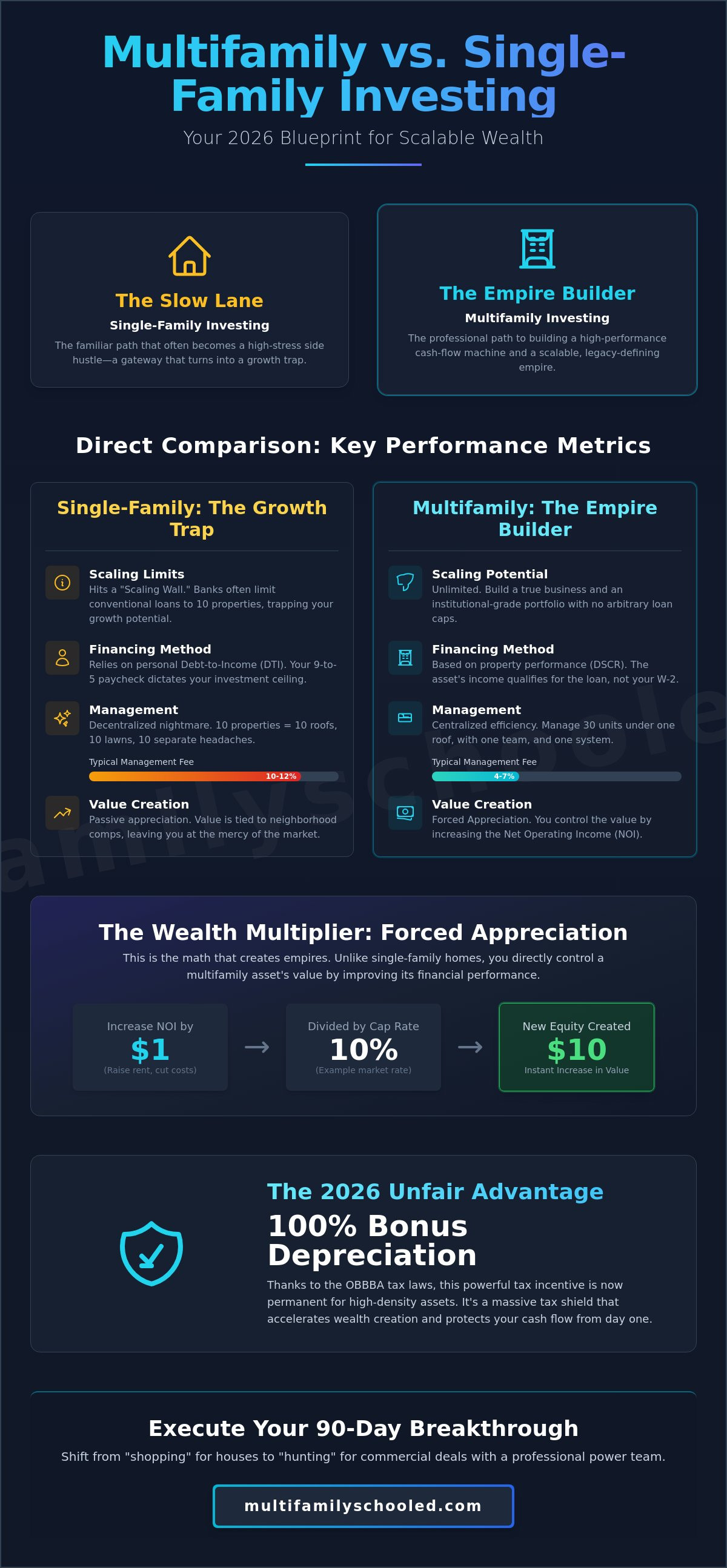
- Master the "Forced Appreciation" mechanism. Learn how a single dollar of net income creates ten dollars of immediate equity through math.
- Evaluate the multifamily vs single family investing pros and cons. Bypass the debt-to-income trap and scale using professional DSCR financing.
- Leverage 2026 tax benefits like 100% bonus depreciation. Protect your cash flow and build a tax-free legacy starting now.
- Execute your 90-day breakthrough. Shift from "shopping" for houses to "hunting" for commercial deals with a professional power team.
The Real Estate Crossroads: Multifamily vs. Single-Family Investing in 2026
Stop playing small. Most investors get stuck in the single-family trap because it's familiar. But in 2026, the gap between "getting by" and "getting rich" is widening. Multifamily investing offers a velocity that single-family rentals can't match. It's the difference between collecting a few hundred dollars and building a high-performance cash-flow machine. You must decide today if you want a hobby or a legacy.
You need to decide if you want to be a landlord or a business owner. A landlord chases rent checks and fixes leaky faucets. A business owner scales systems and builds equity. Understanding Real estate investing through a commercial lens changes your entire financial trajectory. It's about asset density. Why drive across town to manage three different properties when you can control thirty units under one roof?
To better understand this fundamental shift in strategy, watch this helpful video:
What Defines a Single-Family Investment?
Single-family investments include detached homes, townhouses, or condos. Most people start here out of habit. It feels safe. But 2026 interest rates for these properties are hovering between 7.12% and 7.62% for prime borrowers. That eats your margin fast. While these homes are liquid, they're a nightmare to scale. Managing ten scattered houses means ten roofs, ten lawns, and ten different neighborhoods to monitor. New FinCEN reporting rules effective March 1, 2026, also add paperwork for all-cash LLC purchases. It's a growth trap that keeps you busy but not necessarily wealthy.
The Multifamily Advantage Defined
Multifamily means two or more units. Residential is 2-4 units, but the real power lies in commercial assets with 5 or more units. This is where you centralize your wealth. When you weigh the multifamily vs single family investing pros and cons, the efficiency of "One Roof" wins every time. Institutional investors don't buy houses. They buy apartment complexes. They want the 4-7% property management fees that come with scale. They don't want the 10-12% fees common in single-family rentals. In multifamily, you control the value by increasing the Net Operating Income, not just waiting for the neighbor to sell their house.
2026 is your year for a 90-day breakthrough. The OBBBA tax laws now provide permanent 100% bonus depreciation. This is a massive gift for those who choose high-density assets. If you want multi-generational wealth, you must choose the professional path. Stop shopping for houses. Start hunting for deals that change your life. Join our Mentorship Program to master this transition and secure your future now.
Single-Family Investing: The Gateway or the Growth Trap?
Most beginners start with a single house. It feels accessible. It's the "safe" play. But you aren't here for safe; you're here for freedom. In 2026, relying on single-family rentals (SFHs) often turns into a high-stress side hustle rather than a wealth-building machine. You hit a wall. Banks limit your conventional loans based on your personal debt-to-income ratio. Once you reach ten properties, the paperwork becomes a mountain. You become a glorified property manager instead of a CEO. This is the "Scaling Wall" where most dreams go to die.
When analyzing multifamily vs single family investing pros and cons, the financing constraints are a major factor. Conventional lenders focus on your personal paycheck. This limits how fast you can grow. If you want to scale, you need to understand the fundamental differences in financing and upkeep that separate the amateurs from the pros. Don't let the low barrier to entry lure you into a decade of slow progress. You can bypass this trap by starting with a professional mindset from day one.
The Pros of the Single-Family Path
- Lower Entry Cost: You can often start with less capital compared to a large apartment complex.
- Exit Strategy Flexibility: You can sell to a family or another investor. This provides high liquidity if you need to cash out quickly.
- Simplified Concept: It's easier to explain to a spouse or partner. Most people understand how a house works.
The Cons: Why SFH Can Stunt Your Wealth
One move-out in a single-family home means 100% vacancy. Your income drops to zero instantly while the mortgage, taxes, and insurance keep coming. This is a massive risk that many beginners ignore. You also lack economies of scale. If you own ten houses, you have ten different roofs to worry about and ten different lawns to mow. You spend your weekends driving across town to handle minor repairs. If you feel stuck in this cycle, grab our Multifamily Tool Kit to see how to break free.
The biggest drawback is the lack of control over value. A single-family house is worth what the neighbor's house sold for last month. You can't "force" appreciation just by running the property better. You're at the mercy of the market. In 2026, with home price growth projected to stall at 0% to 2.2% according to major forecasters like J.P. Morgan and Realtor.com, waiting for market appreciation is a losing game. You need a strategy that creates wealth through math, not luck. Stop buying jobs and start acquiring assets that work for you.
Multifamily Investing: The Professional Path to Scalable Wealth
Stop guessing and start calculating. Multifamily investing isn't just about owning more units; it's about a fundamental shift in how wealth is created. While single-family homes rely on "comps" and what the neighbor's house sold for, apartment complexes are valued on pure math. This is the power of Net Operating Income (NOI). When you weigh the multifamily vs single family investing pros and cons, the ability to control your asset's value is the ultimate game-changer. You don't wait for the market to rise. You force it to rise by running a better business.
The "Forced Appreciation" mechanism is your high-velocity wealth machine. In the commercial world, every dollar you save in expenses or add in rent is multiplied by the market capitalization rate. A simple $1,000 increase in monthly NOI can add over $150,000 in property value almost instantly. This is how you achieve financial independence in months, not decades. You can also leverage Other People's Money (OPM) to close these larger deals. By bringing in partners or investors, you can control a 50-unit building with the same amount of personal capital you'd use for a single house. It's about working smarter, not harder.
The Pros: Why the Pros Choose Apartments
- Cash Flow Stability: If one tenant leaves a 20-unit building, your income only dips by 5%. In a single-family house, your income hits zero.
- Economies of Scale: You manage one roof, one parking lot, and one insurance policy. Property management fees for multifamily assets typically range from 4% to 7%, which is significantly lower than the 10% to 12% often charged for scattered single-family homes.
- Commercial Financing: Loans are based on the asset's performance. The bank cares more about the building's profit than your personal debt-to-income ratio.
The Cons: Challenges of the Big Leagues
The barrier to entry is higher, requiring more capital or creative deal-making skills. You can't just walk into a commercial deal with a standard home inspector. You need a professional team to audit financial records and conduct deep due diligence. Management is also more intense. You need robust systems to handle multiple tenant profiles and maintenance schedules simultaneously. This complexity is actually a competitive advantage. It keeps the amateurs out. If you're ready to master these systems, our Mentorship Program provides the exact blueprint for your 90-day breakthrough. Start hunting for real assets today.
Direct Comparison: ROI, Financing, and Risk Mitigation
Stop letting your personal credit score dictate your financial ceiling. Most people stay stuck in the single-family trap because they think like consumers, not CEOs. When you buy a house, the bank looks at your personal Debt-to-Income (DTI) ratio. Your growth is literally capped by your 9-to-5 paycheck. Commercial multifamily investing flips the script. Lenders use the Debt-Service Coverage Ratio (DSCR), focusing on the property's ability to pay for itself. If the deal makes money, the bank says yes. This is how you scale to 50 units while your peers are still struggling to get a second mortgage.
When you compare the multifamily vs single family investing pros and cons, the 2026 tax landscape provides an undeniable edge for high-density assets. Under the One Big Beautiful Bill Act (OBBBA), real estate investors now enjoy permanent 100% bonus depreciation. By using cost segregation, you can front-load your deductions and keep your cash flow tax-free. You aren't just making money; you're keeping it. Use the Multifamily Tool Kit to run these numbers and see exactly how much you can save on your next acquisition.
Financing the Dream: Residential vs. Commercial Loans
Commercial financing offers tools that residential buyers can't access. Agency debt from Fannie Mae and Freddie Mac provides long-term stability and non-recourse options. This means your personal assets are protected if the deal goes sideways. In a high-interest environment where residential rates hit 7.62%, professional investors use seller financing as a secret weapon. Negotiate your own terms, bypass the bank, and lock in cash flow that others can't see. Your personal credit matters less than your ability to find a high-performing asset.
Risk Management: Vacancy and Maintenance
The "Rule of 5" is your safety net for professional stability. Five units is the tipping point where one vacancy becomes a minor 20% dip instead of a 100% disaster. Single-family portfolios suffer from a "Single Point of Failure" every time a tenant moves out. In multifamily, you have the scale to budget for predictable maintenance and capital expenditures across the entire building. Multifamily diversification protects your downside in any economy because housing is a fundamental necessity, not a luxury.
Ready to stop playing defense with your portfolio? Join our Mentorship Program and learn the exact frameworks we use to secure commercial financing and dominate the 2026 market. Your 90-day breakthrough starts with one professional decision.
Transitioning to Multifamily: Your 90-Day Breakthrough
Stop browsing Zillow for houses like you're shopping for a pair of shoes. It's time to start hunting for assets that generate real power. Transitioning from scattered rentals to a concentrated apartment portfolio requires a total strategy shift. You've already weighed the multifamily vs single family investing pros and cons, so stop hesitating. The next 90 days will define your financial decade. You need a "Power Team" of commercial brokers, lenders, and managers who speak the language of Net Operating Income. Most people waste years trying to figure this out alone. You don't have to. You can bypass the "trial and error" phase entirely by joining our Mentorship program today.
Step 1: The Mindset Reset
Unlearn the "fixer-upper" mentality immediately. In the commercial world, we don't care about the color of the kitchen cabinets or the curb appeal of a single porch. We care about the Cap Rate. We care about the Yield. If you're still stuck in the landlord mindset, commit to our 5-Day Online Challenge. It's the foundation you need to stop thinking like a consumer and start acting like a CEO. Build your foundation now.
Step 2: Leveraging Technology and Systems
Use elite technology to find what others miss. Our Real Estate Radar software identifies off-market apartment deals before they hit the public market. Stop waiting for a realtor to call you. Automate your lead flow so you only spend time talking to motivated sellers. A professional system allows you to analyze a 20-unit deal in under 10 minutes. If you can't do that, you aren't an investor; you're a spectator. Speed is your greatest weapon in the 2026 market.
Step 3: Closing the Deal
Structuring a multifamily offer is an art form. You need to present a Letter of Intent (LOI) that commands respect and shows you mean business. If you lack the capital for a large down payment, find partners. Many people have the cash but lack the knowledge you're gaining right now. They want your expertise and the returns you can provide. Your first deal is always the hardest. Once you close it, the rest become inevitable. The momentum of a single large asset far outweighs the slow crawl of ten separate houses. Start your 90-day sprint today and secure the lifestyle you deserve.
Secure Your Financial Empire Today
You've seen the clear data. You understand the math behind the movement. The choice between multifamily vs single family investing pros and cons isn't just about property types; it's about the velocity of your freedom. While others wait for interest rates to drop or home prices to rise, you can leverage the power of forced appreciation and commercial financing to build a legacy. Stop collecting scattered houses. Start acquiring high-velocity assets that pay for your lifestyle. Your 90-day breakthrough starts the moment you decide to stop playing small.
Success in 2026 requires a proven system. We've helped hundreds of investors bypass the scaling wall and buy their first apartment building. You get immediate access to proprietary deal-finding software to skip the line and find motivated sellers. We are so confident in our methodology that we offer a 90-day performance guarantee. We help you find a deal, or we provide one for you. There is no more room for excuses or hesitation.
Ready to find your first multifamily deal in 90 days? Join our Mentorship Program now!
Take control of your future and join the movement of professional investors today. Your empire is waiting for you to claim it. We'll see you on the inside. You have the tools; now take the action.
Frequently Asked Questions
Is it better to start with a duplex or go straight to a 10-unit building?
Go straight to the 10-unit building if your goal is rapid wealth. A duplex is often just a single-family house with an extra door and an extra headache. Commercial assets with five or more units allow you to use professional property management and commercial financing. This bypasses the debt-to-income limits that stall most beginners. Don't waste your first move on a property that won't replace your income.
How much money do I actually need for a multifamily down payment in 2026?
Expect to put down 20% to 25% for a traditional commercial loan in the current market. However, you don't have to use all your own cash. Professional investors use partnerships and Other People's Money (OPM) to close large deals. Analyzing the multifamily vs single family investing pros and cons shows that while the entry cost is higher, the ability to pool capital makes larger buildings more accessible than you think.
Can I invest in multifamily properties if I have a full-time job?
Absolutely. You don't need to be the one fixing toilets or chasing rent. By leveraging third-party property management, which typically costs between 4% and 7% for multifamily assets, you can remain the CEO of your portfolio. Use systems to analyze deals during your lunch break. Your job provides the stable income lenders love to see while you build your exit strategy.
What is the 1% rule, and does it still apply to multifamily investing?
The 1% rule suggests monthly rent should equal 1% of the purchase price. In the 2026 market, this rule is a rare find and often ignores the power of Net Operating Income. Focus on the Cap Rate and cash-on-cash return instead. Math is your best friend. A building that fails the 1% rule but has massive "Forced Appreciation" potential is a much better deal than a "safe" house.
How do I find multifamily deals that aren't on the MLS?
Stop waiting for public listings and start hunting off-market opportunities directly. The best deals are found by building relationships with commercial brokers and using proprietary software to target motivated sellers before they list. Most large apartment complexes never hit a public website. They are sold through "pocket listings" to investors who have a track record and a professional power team ready to move.
Is multifamily real estate a good hedge against inflation in 2026?
Yes, it is one of the most powerful hedges available today. As inflation rises, you can adjust rents to match the market, protecting your margins and your cash flow. Unlike fixed-income investments, your asset's value typically increases alongside the cost of living. With 2026 tax laws like the OBBBA providing 100% bonus depreciation, you are also protecting your earnings from the "inflation tax" of higher brackets.
Do I need a special license to buy a commercial apartment building?
No, you don't need a real estate license or a special certification to buy commercial property. You simply need a legal entity, like an LLC, and a strategic plan. Focus on building your knowledge base through specialized training rather than chasing unnecessary licenses. Lenders care about the deal's performance and your team's experience, not a piece of paper from a state board.
What happens if a multifamily property has high vacancy when I buy it?
High vacancy is a massive opportunity for "Forced Appreciation." You buy the property at a discount because the current owner can't manage it effectively. By filling those units and increasing the Net Operating Income, you create instant equity that didn't exist before. This is the ultimate shortcut to wealth. Use a 90-day sprint to stabilize the asset and watch your net worth explode.