

Multifamily vs. Self-Storage Investing: Pros and Cons
What if the better investment isn’t the one with the strongest headline return, but the one whose day-to-day demands fit your strategy? The multifamily vs self-storage investing pros and cons become clearer when you look beyond claims that one asset class is always more resilient or profitable. Multifamily typically involves longer leases and more resident-facing management. Self-storage often has shorter rental arrangements and potentially leaner operations, but income can shift faster as occupancy and market rates change.
If you’re weighing both, start with the same assumptions for financing, vacancy, expenses, and your own time. Then test how each deal performs under pressure. This article breaks down income drivers, operating workload, key risks, and decision criteria so you can assess opportunities against your resources and goals. If multifamily fits your plan, you’ll also find practical ways to build your understanding with education, deal analysis, and investing tools before pursuing a property.
Key Takeaways
- Compare how each property earns income, then account for vacancies, repairs, turnover, and staffing to see what may affect net operating income.
- Use the multifamily vs self-storage investing pros and cons to weigh leasing, workload, capital needs, and market sensitivity against your priorities.
- Assess your goals and preferred level of involvement before comparing local markets and specific properties.
- Underwrite both opportunities with the same time horizon and financing assumptions, then stress-test how changing conditions could affect each deal.
- If multifamily fits your strategy, use education and deal-analysis tools to build your understanding before deciding whether to pursue a property.
Multifamily vs. self-storage investing: what you are actually comparing
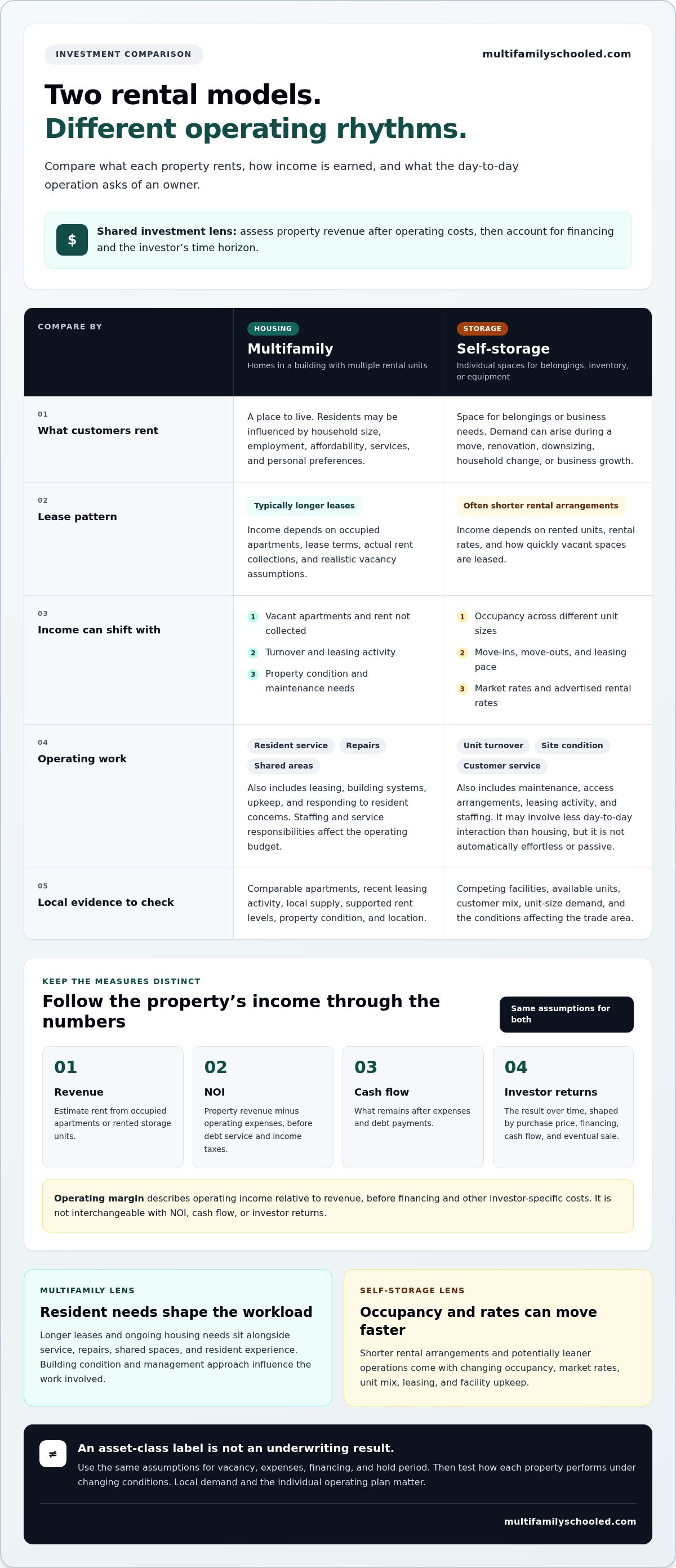
Multifamily properties provide housing, typically in apartment buildings with multiple rental units. Self-storage properties rent individual spaces to people or businesses that need somewhere to keep belongings, inventory, or equipment. The assets serve different needs, attract different customers, and require different operating systems. That distinction matters more than a broad claim that one category is always safer, easier, or more profitable.
In short: multifamily earns rental income by providing homes; self-storage earns rental income by providing space for belongings. That difference shapes customer expectations, maintenance, leasing, and day-to-day decisions. For a concise overview of how the storage model is organized, explore Self-storage as an industry before comparing individual opportunities.
For a concise overview of the two property types, watch this video:
Who rents each property type, and why?
Apartment residents rent for an ongoing need: a place to live. Household size, employment, affordability, access to services, and personal preferences can all influence demand, and those factors differ by neighborhood and market. A strong national housing story doesn’t prove that a particular building will attract residents at the rents an investor has projected. Review the local supply of comparable apartments, recent leasing activity, and the rent levels supported by the property’s condition and location.
Storage customers may need space during a move, renovation, downsizing, change in household circumstances, or business growth. These situations can create demand, but they don’t guarantee steady occupancy at any specific facility. Treat them as broad demand drivers, then examine local evidence: competing properties, available units, customer mix, and the conditions affecting that trade area. The property and its market must support the investment case.
Why the operating model changes the investment experience
Multifamily is resident-facing. The owner or operator must support people living in the building, coordinate repairs, maintain shared areas and building systems, handle leasing, and respond to resident concerns. A property’s condition and management approach influence how much work those responsibilities require. Even a well-run building needs systems for service and upkeep.
Self-storage focuses on renting and maintaining units and serving customers who use them. It may involve less day-to-day interaction than housing, but that doesn’t make it effortless or automatically passive. Leasing activity, unit turnover, maintenance, site condition, and customer service still matter. The workload depends on the property’s scale, condition, and management model. Assess the multifamily vs self-storage investing pros and cons at the property level by comparing the asset, local demand, financing, and operating plan rather than relying on an asset-class label.
How multifamily and self-storage generate income, and what operations require
To compare income fairly, use the same property-level framework for both assets. Estimate rent from occupied units, account for vacancy and operating expenses, and use consistent assumptions for the hold period and financing. A headline occupancy rate or operating margin cannot tell you what an individual property will earn. What matters is how its actual revenue holds up after the costs of running it.
Keep four measures distinct. Operating margin describes operating income relative to revenue, before financing and other investor-specific costs. Net operating income (NOI) is property revenue minus operating expenses, before debt service and income taxes. Cash flow is what remains after expenses and debt payments. Investor returns measure the result for an investor over time, shaped by the purchase price, financing, cash flow, and eventual sale. One measure cannot stand in for another.
Multifamily income and resident-facing operations
A multifamily rent roll lists units, lease terms, rents, and occupancy. Use actual collections and realistic vacancy assumptions rather than treating every unit as continuously occupied. A vacant apartment can mean lost rent, leasing effort, and turnover work. A repair or deferred maintenance can add expense or affect a resident’s experience. Staffing and service responsibilities also influence the operating budget.
Property condition and execution matter. A well-maintained building may require fewer urgent repairs than one with neglected systems, but the operating plan still needs to account for routine upkeep, leasing, and resident needs. Rent increases and appreciation may affect a deal’s results, but neither should be treated as assured. For apartment investors assessing opportunities, off-market apartment property data from RealEstateRadar.ai offers access to 27 million+ off-market apartment buildings. Each property still needs its own underwriting.
Self-storage income and facility operations
For storage, revenue depends on rented units, their rental rates, and how quickly vacant spaces are leased. Unit mix and occupancy matter: a facility can have strong demand for some sizes and weaker demand for others. Leasing may involve move-ins, move-outs, customer questions, and changes in advertised rates. Access arrangements, maintenance, site condition, and staffing also contribute to operating costs, even if the facility’s customer interactions differ from apartment management.
Shorter or more flexible rental arrangements can allow rates to respond to market conditions, but they can also make revenue change more quickly. That flexibility is not automatically an advantage; outcomes depend on local demand, competition, occupancy, and execution. Treat reported self-storage margin figures as claims that need a named, verifiable source, not as a forecast for a facility or a measure of investor returns.
When weighing the multifamily vs self-storage investing pros and cons, compare each property’s projected income and expenses line by line. Include vacancy, repairs, turnover, leasing, staffing, and financing consistently. Then test whether the resulting NOI and cash flow still fit your investment goals if occupancy or operating costs differ from the base assumptions.
Multifamily vs. self-storage pros and cons: compare risk, workload, and fit
Compare the trade-offs across both property types, not just a single headline metric. Lower staffing needs can reduce one part of a facility’s operating burden, but they don’t remove risks tied to occupancy, financing, property condition, or valuation. Likewise, recurring housing demand doesn’t guarantee that a particular apartment property will lease well or produce the returns an investor expects.
| Factor | Multifamily | Self-storage |
|---|---|---|
| Income drivers | Apartment rents, occupied units, and collected rent, offset by vacancies and operating costs. | Rented units, rental rates, unit mix, and occupancy, offset by vacancies and facility expenses. |
| Operating workload | Resident service, leasing, repairs, shared spaces, and building systems can demand active coordination. | Leasing, site upkeep, access, unit maintenance, and customer service remain necessary, even with lean staffing. |
| Leasing | Resident leases and turnover shape how quickly units can be re-rented and at what terms. | Shorter rental arrangements may allow rate changes sooner, while also exposing revenue to faster changes in occupancy or pricing. |
| Capital needs | Building condition, deferred maintenance, and shared systems influence capital planning. | Facility condition, site features, and unit upkeep influence capital planning. |
| Market sensitivity | Local housing supply, affordability, employment, and resident demand affect leasing and rent collection. | Local competition, supply, customer demand, and achievable rates affect occupancy and revenue. |
Property-level underwriting matters more than sector slogans because a specific asset’s income, expenses, financing, and condition determine its potential performance. Keep operating risk separate from other investment risks. A property that needs fewer staff isn’t necessarily easier to finance, easier to sell, or less exposed to changes in value. Debt terms, purchase price, local conditions, and the availability of buyers all matter, and each deal deserves its own analysis.
Where multifamily may fit, and where it can be demanding
Multifamily may suit investors focused on housing and prepared to oversee resident-facing operations. Housing demand can support leasing, but it doesn’t prove that a building will attract residents at projected rents. Vacancies, repairs, resident service, and turnover all require attention. A larger property may need more coordination, while strong management systems can help organize the work without removing responsibility for performance.
Where self-storage may fit, and what still needs scrutiny
Self-storage may appeal to investors seeking a facility model with potentially leaner staffing. Still, occupancy, nearby competition, achievable pricing, and physical condition can materially affect results. Storage demand may hold up during some economic disruptions, but “recession-resistant” is an observation, not a promise for every market or asset. Fewer staff doesn’t automatically mean lower risk, simpler financing, or higher investor returns.
The multifamily vs self-storage investing pros and cons depend on your resources and the evidence behind each opportunity. Compare properties using consistent assumptions, then ask whether the operating responsibilities, capital plan, and risks fit your investment strategy.
How to decide between multifamily and self-storage investments
Make the decision with a repeatable process, not a sector slogan. The right fit depends on what you want from an investment, the work you can oversee, and whether a specific property’s numbers hold up under realistic assumptions. Use these steps to compare opportunities on equal terms.
- Define your goals. Decide whether you prioritize ongoing income, potential long-term value growth, portfolio diversification, or another objective. Set your intended hold period and clarify how much uncertainty you can accept.
- Assess your involvement. Consider the time, expertise, and oversight you can contribute. Resident-facing operations and facility operations create different responsibilities, and neither should be treated as hands-off by default.
- Compare local markets. Examine relevant supply and demand evidence, competing properties, and achievable rents or storage rates. Review actual occupancy information where available rather than assuming broad demand translates into leasing strength for a particular asset.
- Underwrite specific properties. Compare purchase assumptions, financing terms, vacancy, operating expenses, and the expected hold period consistently. Review NOI, cap rate, and cash-on-cash return using the same definitions and calculation method for both opportunities.
- Stress-test the downside. Model weaker occupancy, slower leasing, higher expenses, and less favorable exit assumptions. Check whether the investment still fits your goals if performance falls short of projections.
Match the investment to your resources and operating preferences
Be candid about the work you’re equipped to oversee. Multifamily can involve resident communication, repairs, leasing, and ongoing building oversight. Storage operations have different demands, including unit leasing, customer service, facility upkeep, and occupancy management. Your available time and experience matter. So do your capital resources and actual financing terms, which are specific to each deal rather than guaranteed by an asset category.
Underwrite both opportunities on the same basis
Use equivalent assumptions for financing structure, vacancy, expenses, hold period, and exit scenario. Keep documented operating history separate from projections, and label estimates clearly. A cap rate describes a property’s NOI relative to its price; cash-on-cash return compares cash flow with invested cash. Neither metric alone captures every risk or establishes what an investor will earn.
Due diligence also means examining property condition, local competition, market supply, and evidence of demand. Identify which local rules and requirements apply to each property type in the specific jurisdiction; don’t assume they’re uniform across markets. Record the source and date of key assumptions so you can distinguish verified information from estimates and revisit uncertain inputs.
The multifamily vs self-storage investing pros and cons become clearer when the comparison reflects your resources and the evidence behind the deals. If your analysis points toward apartments, explore multifamily investing mentorship to build knowledge around evaluating that path.
Choosing multifamily? Build your next step around education and deal analysis
Choose multifamily only if its operating model suits your resources and a specific property’s evidence supports the investment case. A decision framework can help you narrow the asset class, but it can’t replace learning how to read a rent roll, test expenses, assess financing, and question projections. Build those skills before treating any opportunity as a fit.
Education and analysis tools can make the learning process more structured. They don’t guarantee that a deal is financeable or profitable. Keep the goal clear: understand the assumptions, identify what needs verification, and make an independent decision about each property.
Use education and tools to explore apartment opportunities
MFScout.ai provides deal-finding, analysis, and capital-raising capabilities. The Light Deal Analyzer can analyze a deal in one minute and deliver IRR, cash-on-cash, and other metrics. Use tools like these to organize an initial review, then examine the underlying data and assumptions yourself. A quick analysis is a starting point, not a substitute for detailed due diligence. MFScout.ai is free to start.
RealEstateRadar.ai provides access to 27 million+ off-market apartment buildings and 130 million+ off-market single-family properties likely to sell within 90 days. It offers free trial access. Use the data to explore potential opportunities, then assess each property’s local market, financials, and operating requirements independently.
If you’re looking for live coaching, community, downloads, and resources as you learn the apartment-investing process, explore the Multifamily Mentorship Program. The deal-finding guarantee applies to the Multifamily Mentorship Program only. See refund policy for details.
Turn a multifamily decision into a focused next step
Make your next move practical. Choose a target market, define the property profile that matches your goals, and practice evaluating opportunities using consistent assumptions for income, expenses, financing, and hold period. Keep a record of which inputs are verified and which remain estimates. That discipline helps you compare deals without confusing attractive projections with established operating history.
Multifamily Schooled is led by Justin Brennan, a third-generation multifamily investor with 1,200+ units and $200 M+ in multifamily properties across 5 states. The company has helped 1,000+ students. Use experience as context for education, not as evidence that any individual property will perform a certain way.
The multifamily vs self-storage investing pros and cons should lead to a decision about fit, not a prediction based on an asset-class label. If the operating responsibilities and deal evidence point toward apartments, explore multifamily mentorship as a focused next step. Keep underwriting each opportunity independently, and move forward only when its assumptions and risks make sense for your plan.
Turn your investment preference into a clear next move
Turn what you’ve learned about your priorities into a decision rule you can use again. Write down the level of involvement you’re prepared to take on, the risks you can accept, and the evidence a property must show before it earns further consideration. That gives you a practical way to stay focused when an appealing pitch or confident return projection makes you want to move quickly.
The multifamily vs self-storage investing pros and cons aren’t a shortcut to choosing a property. They’re a starting point for asking better questions, building your investment knowledge, and testing whether a specific opportunity matches your plan. If multifamily is the path you want to explore, take the next step at your own pace and keep every deal grounded in its own numbers.
Explore Multifamily Schooled’s multifamily investing resources and keep building the judgment to move forward with purpose.
Frequently Asked Questions
Is self-storage investing recession-proof?
No. “Recession-proof” is too absolute for any property investment. Some industry commentary describes storage demand as resilient across economic cycles, but results can still shift with local conditions, new supply, pricing, and customer activity. When weighing the multifamily vs self-storage investing pros and cons, treat resilience as a hypothesis to test, not a promise. Compare a facility’s market evidence and downside scenarios rather than assuming a downturn will support occupancy, income, or returns.
Can I invest in self-storage without owning a facility?
Yes. Direct ownership isn’t the only way to gain exposure to a real estate sector. Pooled investment vehicles and publicly traded real estate investment trusts (REITs) may provide alternatives, though their structures differ from owning a facility. Compare control, fees, liquidity, and risk before choosing a route. An investor in publicly traded shares, for example, may be able to sell shares more readily than a direct property interest, but doesn’t make facility-level decisions.
Can multifamily and self-storage belong in the same portfolio?
Yes, they can be considered together, but holding both doesn’t automatically protect you from loss. Each can be affected by financing conditions, local supply, and wider property-market changes. Before combining them, look at how much of your capital is already tied to real estate, how much cash you may need, and your intended holding period. Underwrite each asset independently, then decide whether the combined exposure fits your overall strategy.
Is self-storage demand seasonal?
It can vary, but there’s no universal seasonal pattern that applies to every facility. Local moving activity, business needs, and the facility’s customer mix may shape when people rent or leave units. For a specific opportunity, review historical occupancy, leasing activity, and rate changes across different periods, then compare them with local market conditions. A national trend can offer context, but it can’t establish how one facility performs through the year.
How do real estate investment trusts provide exposure to self-storage?
A real estate investment trust, or REIT, is a company or trust structure that owns, operates, or finances income-producing real estate. Some REITs focus on self-storage, allowing investors to gain exposure by buying shares rather than owning a facility directly. Public shares differ from direct ownership in control, liquidity, and how investment value is assessed. Review the specific vehicle’s disclosures and risks instead of assuming all REITs work alike.
What happens if a self-storage facility has high occupancy but weak income?
High occupancy alone doesn’t prove a facility is generating strong income. Low realized rates, discounts, a less profitable unit mix, unpaid balances, operating expenses, or debt payments could affect cash flow. Reconcile the reported occupancy with collected revenue and operating statements. Then examine whether advertised prices differ from actual rents and whether discounts or unpaid accounts are material. The records, not occupancy alone, are needed to understand a particular property’s results.



