

Multifamily Underwriting: The 2026 Blueprint for Buying Apartment Buildings Right
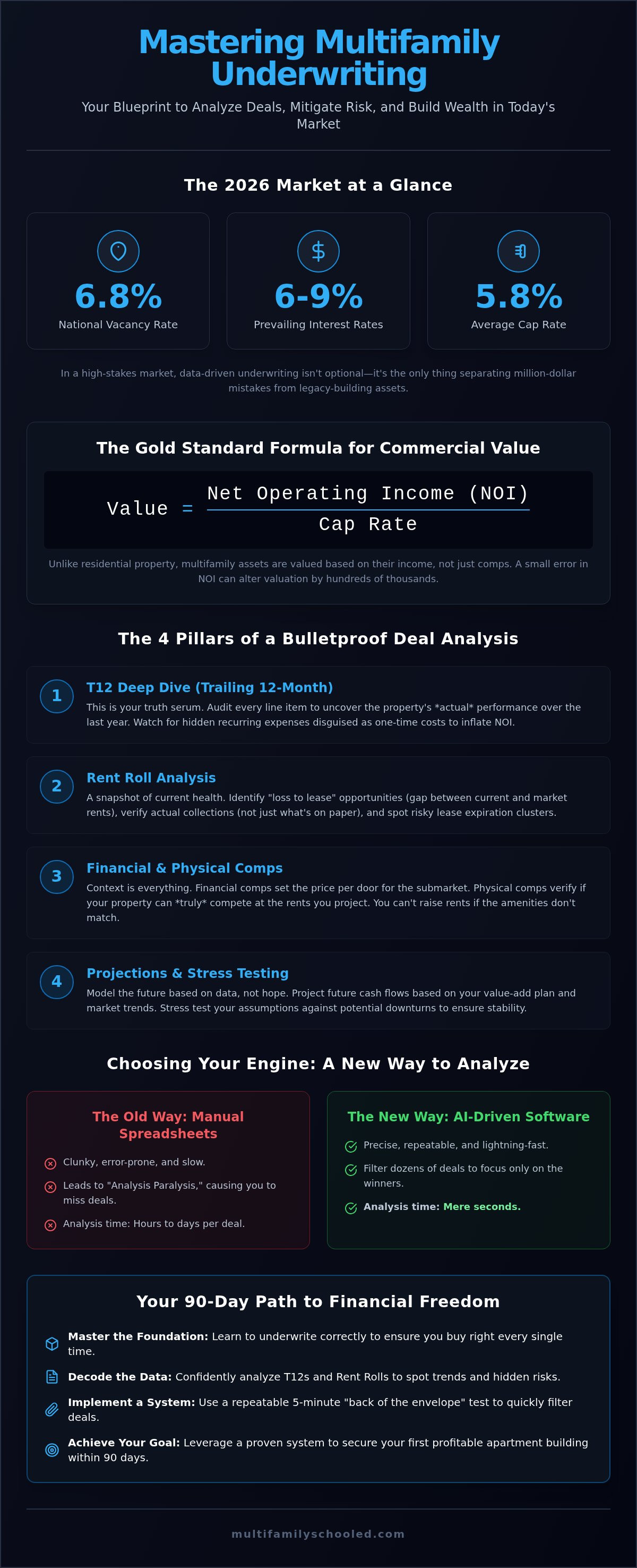
In a 2026 market where vacancy rates have hit 6.8 percent, your ability to master multifamily underwriting is the only thing standing between a million dollar mistake and a legacy building asset. You've likely felt the sting of analysis paralysis. You watch deals disappear while you're still stuck on line 42 of a spreadsheet that doesn't seem to make sense. It's frustrating to see interest rates between 6 percent and 9 percent and wonder if any property will ever pencil out again. You aren't alone in that fear; it's the primary hurdle for every investor trying to find their footing today.
Stop guessing and start winning. This guide gives you the exact blueprint to identify profitable deals and mitigate risk with total precision. You'll learn how to achieve financial freedom through cash flowing assets within the next 90 days. We're moving past the theory. We're diving into a repeatable system that lets you analyze deals in minutes and provides the confidence you need to stand before any lender or partner. From navigating the current 5.8 percent average cap rate to mastering debt coverage, this is your path to becoming a high energy closer.
Key Takeaways
- Master the foundational skill of multifamily underwriting to verify a property's true financial health and ensure you buy right every single time.
- Learn to decode Trailing 12-Month (T12) statements and Rent Rolls to spot lease trends and hidden risks before they become costly mistakes.
- Ditch clunky spreadsheets for AI-driven deal finding software that slashes analysis time from hours to mere seconds.
- Implement a repeatable 5-minute "back of the envelope" test to filter dozens of deals and focus your energy only on the winners.
- Secure your first profitable apartment building within 90 days by leveraging a proven system built for the 2026 market.
What is Multifamily Underwriting and Why Does it Determine Your Success?
Stop trusting your gut. In the high-stakes world of 2026 real estate, intuition is a liability that leads to million dollar mistakes. Multifamily underwriting is the rigorous process of verifying a property's financial health to uncover its true market value. It is the filter that separates a winning deal from a financial disaster. When you master this skill, you stop being a spectator. You become a professional who buys right every time. Buying right is the only way to guarantee long-term, risk-adjusted returns in a market where the national vacancy rate has climbed to 6.8 percent.
This process transforms hundreds of disparate data points into a clear go or no-go signal. It removes the emotion. It silences the noise. You aren't just looking at a building; you're looking at a cash flow machine. If the machine is broken, underwriting tells you before you sign the contract. In today's economy, data-driven decisions are your only path to safety and scale.
The Difference Between Guessing and Underwriting
Many new investors try to use residential "comps" to value apartment buildings. That's a rookie move. Single family homes are valued based on what the neighbor's house sold for, but commercial assets live and die by their income. The gold standard formula is simple: Value equals Net Operating Income (NOI) divided by the Cap Rate. With the 2026 average cap rate for apartments hovering around 5.8 percent, even a small error in your NOI calculation can swing the valuation by hundreds of thousands of dollars. Proper multifamily underwriting protects you from market euphoria and ensures you never overpay for a property just because it looks good on a brochure.
Underwriting as a Wealth Creation Tool
Mastering the numbers gives you more than just a price. It gives you the absolute confidence to raise capital from partners. Investors don't put money into "hopes"; they put money into proven systems. If you can't explain the debt coverage ratio to a lender, you won't get funded. Lenders like Fannie Mae and Freddie Mac have updated their standards as of August 3, 2026, making it harder to secure debt without ironclad financials. You need to show them you've done the work. Underwriting is the shield that protects you from catastrophic loss and the sword you use to carve out massive profits in any market cycle. If you want to move faster, using proprietary deal finding software can help you process these numbers before the competition even opens their email.
The 4 Pillars of a Bulletproof Multifamily Deal Analysis
Successful multifamily underwriting rests on four non-negotiable pillars. If one is weak, the entire investment collapses. You're looking for stability, growth, and a clear exit. Stop looking at the "asking price" and start looking at the bones of the deal. You need a financial fortress, not a house of cards. Each pillar requires a different lens, moving from what happened yesterday to what will happen five years from now.
Pillar 1 & 2: T12 and Rent Roll Deep Dive
The Trailing 12-Month (T12) statement is your truth serum. It reveals exactly how the property performed over the last year. Sellers often try to hide recurring expenses as "one-time" capital improvements to inflate the Net Operating Income. Audit every line. If you see a sudden drop in utility costs or a spike in "other income" right before the sale, ask why. A healthy rent roll also reveals lease expiration clusters. If 40 percent of your leases expire in the same month, you're facing a massive vacancy risk that needs to be modeled into your cash flow.
The Rent Roll is your current snapshot. It shows who lives there and what they pay today. Identify "loss to lease" opportunities immediately. This is the difference between current rents and what the market actually supports. Don't trust the broker's pro-forma promises. Verify actual collections. If the rent roll says $1,200 but the T12 shows people are only paying $1,000, you have a collections problem, not a rent growth problem. You must bridge this gap before you can claim any "value-add" upside.
Pillar 3 & 4: Comps and Projections
Market context requires both financial and physical comps. Financial comps tell you the price per door in your submarket. Physical comps tell you if your building actually matches the competition. If you plan to raise rents by $200, your property must physically compete with buildings already achieving those rates. Do they have better amenities? Is the curb appeal superior? If you can't match the physical quality, your rent growth projection is just a fantasy.
Future projections must account for the 2026 reality. Model a 5 to 10 year hold period with a conservative exit strategy. With the average apartment cap rate at 5.8 percent, you should project an exit cap rate that is at least 50 basis points higher. This "cap rate expansion" protects your Internal Rate of Return (IRR). Projections aren't just about rent; you must also forecast expense growth. In 2026, insurance premiums and property taxes are volatile. Use a 3 percent to 4 percent annual expense escalator to stay safe. To simplify this complex math, grab a multifamily tool kit to streamline your analysis and avoid manual errors.
Manual Spreadsheets vs. Deal Finding Software: Choosing Your Engine
Speed is the ultimate currency in 2026. If you're still using the "Old Way" of multifamily underwriting, you've already lost the deal. Manually entering data into clunky Excel templates takes three to five hours per property. By the time you finish your first analysis, a faster investor has already submitted their Letter of Intent (LOI). You cannot achieve financial freedom if you only analyze one deal a week. To find a winner within 90 days, you must scale your output and move with conviction.
The "New Way" leverages AI-driven tools to parse financial statements in seconds. This isn't just about saving time; it's about eliminating the "fat-finger" mistakes that kill your credibility with lenders. One wrong decimal point in an Excel cell can turn a dog into a "diamond" on paper, leading to a million dollar disaster. High-energy investors use software to move from being data entry clerks to becoming strategic deal architects. Scalability is the bridge to your new life.
The Pitfalls of Traditional Excel Modeling
Excel is a powerful tool, but it's often the graveyard of real estate ambitions. Broken formulas and outdated tax assumptions are rampant in shared templates. Most investors quit because the math feels like a grueling second job. When you spend four hours fighting a spreadsheet, you lose the mental clarity needed for high-level decision-making. You stop looking for growth opportunities and start looking for an exit from the screen. Don't let a spreadsheet be the reason you miss out on generational wealth. It's time to upgrade your process.
Leveraging Real Estate Radar for Instant Insights
Stop drowning in PDFs. Our proprietary Real Estate Radar finds the signal in the noise instantly. It allows you to upload documents and receive a comprehensive analysis before your coffee gets cold. This tool shifts your focus from "Data Entry" to "Deal Architect." You spend your time negotiating and finding value-add plays instead of hunting for cell errors. When you integrate this software with the Multifamily Tool Kit, you create a complete system for rapid acquisition. This is how you analyze ten deals a week without burning out. Mastery isn't about working harder; it's about using a better engine to drive your success.
How to Underwrite 10 Deals a Week Without Burning Out
Underwriting is not a static math problem. It's a dynamic speed to market advantage. If you treat every broker's PDF like a deep dive, you'll burn out before Friday. You need a workflow that filters the noise and highlights the gold. High volume is the only way to find deals that actually pencil out in 2026. This is the exact process we use to analyze high volumes without losing focus or making a million dollar mistake.
The 5-Minute Filter: Don't Waste Time on Duds
The 5-Minute Filter is the investor's most valuable time saving habit. Start with a Rough Cap Rate calculation. Take the broker's stated Net Operating Income, adjust it by a standard 35 percent to 45 percent expense ratio, and divide it by the asking price. If that number isn't within striking distance of the 5.8 percent market average, stop. Do a quick Price per Unit reality check against recent comps. If the seller wants $220,000 per door but the submarket average is $175,000, the deal is a dud. Kill it fast so you can move to the next opportunity.
Stress-Testing for the 2026 Economic Climate
Once a deal passes the filter, move to Step 2: the deep dive into the T12 and Rent Roll. You're looking for green lights, but you must verify every claim. Step 3 is where you find the truth by stress testing your assumptions. Interest rates for Fannie Mae and Freddie Mac Small Balance Loans are currently ranging from 6.08 percent to 8.18 percent as of August 2026. If your multifamily underwriting model only works at 5 percent interest, you're setting yourself up for failure.
Model a worst case vacancy scenario. The national average is 6.8 percent, so test your deal at 10 percent to see if it still breathes. You must also account for property tax resets and the volatile insurance premiums of 2026. Ensure your Debt Service Coverage Ratio (DSCR) remains above 1.25 even under these pressures. If the projected Internal Rate of Return (IRR) still hits your target after this stress test, you have a Go decision. This systematic approach gives you the confidence to present deals to partners with absolute certainty.
Ready to stop guessing and start closing? Join our Mentorship Program to master this workflow with expert guidance and secure your first deal in 90 days.
Master the Numbers and Secure Your Deal in 90 Days
Information without execution is just noise. You've seen the pillars of multifamily underwriting. You understand the power of automated software. Now, it's time to turn that knowledge into a cash flowing asset. Mastery doesn't happen by reading a blog post once. It's a skill built through guided repetition and real world application. Stop analyzing from the sidelines. The 2026 market is moving fast, and those who hesitate are left with the duds.
The Multifamily Schooled promise is simple. We help you find a deal in 90 days or we'll find one for you. This isn't just education; it's a results driven engine designed to get you into the game. You don't need another decade of "experience" to start. You need a repeatable system that works. It's time to make offers with total confidence and secure the financial freedom you deserve.
From Theory to Reality: The Mentorship Path
A mentor is the "fast forward" button for your real estate career. Why spend years making expensive mistakes when you can follow a proven blueprint? Our Mentorship Program takes you from zero to deal ready by providing the structure you lack. You'll participate in real world deal labs where you underwrite live deals alongside experts. You get instant feedback on your assumptions. You'll join a community that speaks the language of multifamily math, ensuring you're never analyzing in a vacuum. This is how you bridge the gap between learning and owning.
Your Next Step: The 5-Day Challenge
If you're ready to get your feet wet, start with the A to Z of apartment investing. Our online challenge gives you access to the exact templates and tools used by the most successful investors in the industry. You'll learn the foundational mechanics of multifamily underwriting in a high energy, action oriented environment. We strip away the complexity and give you the strategic frameworks needed to win. Don't let another month pass without taking action toward your financial independence. Ready to stop guessing? Join the 5-Day Multifamily Challenge today! Your future self will thank you for starting now.
Your 90-Day Roadmap to Multifamily Mastery
You have the blueprint. You know that multifamily underwriting is the offensive weapon you need to win in 2026. By mastering the four pillars and leveraging AI-driven speed, you've already moved ahead of 90 percent of the market. Stop letting analysis paralysis dictate your future. The difference between a spectator and a successful owner is the courage to take the final step toward execution.
Our Mentorship Program is led by multi-generational investor Justin Brennan. It's built to give you a massive advantage. You get immediate access to our proprietary Real Estate Radar AI software to find the signal in the noise instantly. We are so confident in our system that we offer a 90-day deal guarantee. We help you find a deal in three months or we'll find one for you. This is your moment to claim the economic empowerment you've been searching for.
Secure Your Financial Future: Join Our 90-Day Mentorship Program
You have the tools and the team. Now, go get the deal. Success is waiting for those who act.
Frequently Asked Questions
What is a good Net Operating Income (NOI) for a multifamily property?
A good NOI is one that comfortably covers all operating expenses and debt service while leaving a healthy surplus for investors. It isn't a single fixed number but a ratio that must support the 2026 average cap rate of 5.8 percent. If your NOI doesn't produce positive cash flow after accounting for current interest rates, the deal simply doesn't work for a professional portfolio.
How do interest rate changes in 2026 affect my underwriting?
Higher interest rates directly reduce your purchasing power and require a more conservative approach to multifamily underwriting. With bank loan rates between 6.63 percent and 7.63 percent as of August 2026, your debt service costs are significantly higher than in previous years. You must ensure your Net Operating Income is strong enough to maintain a healthy spread over these borrowing costs to avoid a cash-in refinance later.
What is the difference between a T12 and a T3 operating statement?
A T12 shows the last 12 months of performance, while a T3 focuses only on the most recent three months. The T12 provides a long term view of seasonality and recurring expenses. The T3 is a snapshot that reveals if the property's performance is trending up or down right now. Use the T3 to spot recent rent increases or sudden spikes in utility costs that a T12 might smooth over.
Can I underwrite a multifamily deal without a professional software tool?
You can use manual spreadsheets, but you risk fat-finger errors and losing deals to faster competitors. In a market where apartment investment volume reached $170.4 billion for the 12 months ending in March 2026, speed is a competitive necessity. Professional software eliminates broken formulas and allows you to move from data entry to strategic decision-making in seconds. It's the difference between being a hobbyist and a high-energy pro.
How much should I budget for capital expenditures (Capex) in my model?
Budget at least $300 to $500 per unit annually for recurring replacement reserves, plus specific costs for planned renovations. If you're executing a value-add play, your Capex budget must be detailed and based on real 2026 construction quotes. Don't guess. Underestimating the cost of roofs or HVAC systems will destroy your Internal Rate of Return and leave you short on capital when you can least afford it.
What is a 'Debt Service Coverage Ratio' and why do lenders care?
The Debt Service Coverage Ratio (DSCR) measures a property's ability to pay its mortgage using its Net Operating Income. Lenders like Fannie Mae and Freddie Mac typically require a DSCR of 1.25 or higher to mitigate their risk. If your ratio falls below this threshold, you won't get funded. It's the primary metric lenders use to determine if a building can survive a vacancy spike or an unexpected expense reset.
How do I verify if the seller's expense numbers are actually real?
Demand two years of tax returns and actual utility bills to cross-reference against the T12 statement. Sellers often understate their payroll costs or forget to include property management fees to inflate the building's value. Use multifamily underwriting best practices by comparing their numbers to industry benchmarks for your specific submarket. If their repairs and maintenance costs look too low, they're likely deferring expenses that you will have to pay later.



