

Multifamily Underwriting Spreadsheet: The Ultimate Guide to Analyzing Deals in 2026
A single math error in your financial model can cost you $50,000 before you even collect your first rent check. Most aspiring investors are drowning in complex formulas and "analysis paralysis" because they don't have a proven system. You're likely tired of staring at confusing cells and wondering if the numbers actually work. It's frustrating to watch others build wealth while you're stuck wondering if your math is right. You need a reliable multifamily underwriting spreadsheet that gives you a clear "Yes" or "No" in minutes, not hours.
Stop playing small and start thinking like a pro. We've helped students analyze over 1,200 deals this year alone using this exact framework. In this guide, you'll master the art of deal analysis and discover how to use a professional multifamily underwriting spreadsheet to find your first apartment deal in 90 days. We're going to show you how to generate reports that lenders love and how to speed through 10 properties a day without breaking a sweat. Your journey to financial freedom starts with mastering the numbers today. Take the challenge and unlock your mastery now.
Key Takeaways
- Stop relying on "back of the napkin" math and master the professional financial due diligence required to win in the 2026 market.
- Master the foundational metrics of NOI and Cap Rate to accurately assess market value and minimize your investment risk.
- Discover how to select a high-performance multifamily underwriting spreadsheet that features the "must-have" T12, Rent Roll, and Pro Forma tabs.
- Avoid the "Garbage In, Garbage Out" trap by learning to spot overly optimistic rent growth and dangerous expense under-estimations.
- Execute our proven 90-day roadmap to transform raw property data into a closed deal using the high-speed 1-Minute Green Light Analyzer.
What is a Multifamily Underwriting Spreadsheet and Why Do You Need One?
Multifamily underwriting is the ultimate financial due diligence and risk assessment process. It's the exact moment you transform from a dreamer into a professional investor. In the high-stakes 2026 commercial real estate market, sloppy math is your fastest ticket to bankruptcy. You need a robust underwriting process to survive. This isn't just about crunching numbers; it's about uncovering the hidden truth behind a property's performance. Stop guessing and start verifying every cent.
To better understand this concept, watch this helpful video:
A professional multifamily underwriting spreadsheet acts as the critical bridge between a raw lead and a funded deal. If your model doesn't hold up under scrutiny, you won't get the keys. Stop relying on "back of the napkin" estimates that ignore the volatility of the 2026 market. You need a "Green Light" analysis to filter through hundreds of bad deals in seconds. This speed allows you to focus only on the 1% of opportunities that actually build wealth. If you're ready to scale, you need the Multifamily Tool Kit to access the exact systems the pros use to dominate.
The Core Purpose of Underwriting
Underwriting is the absolute truth-teller of real estate. Your spreadsheet must project future cash flow by meticulously analyzing three to five years of historical T-12 data and rent rolls. Lenders won't even look at your deal without a clear, defensible model. They use these projections to determine loan-to-value (LTV) ratios, often capping them at 65% or 70% in today's tighter credit environment. You must prove the debt coverage ratio works before you ever sign a contract.
Why Excel Still Rules in 2026
Excel remains the undisputed king of underwriting because rigid, proprietary software can't keep up with your unique deal structures. You need the flexibility to pivot when a seller throws a curveball. A multifamily underwriting spreadsheet lets you perform deep stress testing on every assumption. Consider these factors:
- Vacancy Rates: What happens if vacancy hits 10% instead of 5%?
- Interest Rates: Can the deal survive another 50 basis point jump?
- Expense Ratios: Are your tax estimates based on 2026 assessments?
A professional model builds instant credibility with sophisticated sellers and brokers. It shows you aren't just playing games; you're a serious closer with a proven system. Mastery of your spreadsheet is the fastest way to unlock financial freedom and build a legacy of passive income.
The Essential Metrics Every Multifamily Spreadsheet Must Calculate
Your multifamily underwriting spreadsheet is the engine of your financial freedom. It isn't a mere document. It's a proven system to unlock massive wealth. You can't guess your way to success in this game. You need precision. You need mastery. If you want to own apartments in 90 days, you must command these metrics now. Stop treating your investments like a hobby and start treating them like a business.
The "Big Three" Profitability Metrics
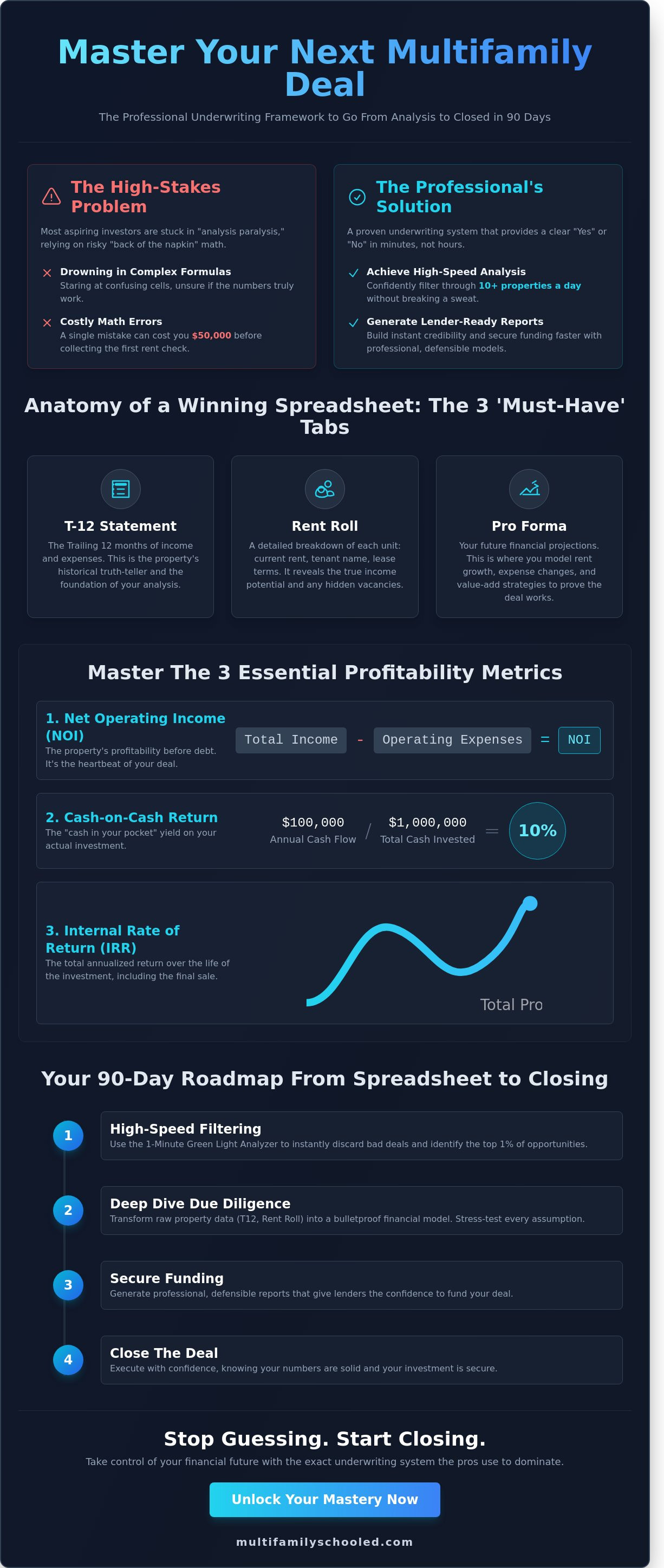
Start with Net Operating Income (NOI). This is the foundation of every commercial valuation. Calculate it by taking your total annual income and subtracting all operating expenses. Don't include your mortgage payment here. NOI tells you exactly how much cash the property generates on its own merit. It's the heartbeat of your deal. A rising NOI directly increases the property value through the power of cap rates.
Next, focus on Cash-on-Cash Return. This measures the actual "cash in your pocket" yield. Define your Cash-on-Cash as the annual pre-tax cash flow divided by the total invested cash. If you put down $1,000,000 and get $100,000 back in year one, that's a 10 percent return. This metric cuts through the noise. It shows you the immediate power of your capital and how fast you'll get your initial investment back.
Finally, you must track the Internal Rate of Return (IRR). IRR is the ultimate metric for exit strategy planning because it factors in the time value of money and total profit over the entire hold period. You need a tool that handles these complex formulas automatically. Grab the Multifamily Tool Kit to get these ready-to-use formulas instantly.
Lender Requirements and Risk Metrics
Lenders don't care about your dreams. They care about getting paid. The Debt Service Coverage Ratio (DSCR) is what they watch closest. A 1.25x ratio is the standard industry benchmark for most traditional loans. This means the property's NOI must be 25 percent higher than the annual debt payment. If your ratio is lower, your deal is dead. Review the NJHMFA Multifamily Underwriting Guidelines to see how government agencies and institutional lenders view these risk thresholds and operating standards.
You also need to calculate your Break-Even Occupancy. This number tells you exactly how many units must be full to cover every single expense, including the mortgage. It's your safety margin. If your break-even is 82 percent and the market average is 94 percent, you have a strong buffer. A professional multifamily underwriting spreadsheet highlights this risk before you sign the contract.
- Cap Rate: The property's yield in an all-cash purchase. It helps you understand market value and risk.
- Operating Expense Ratio: Total expenses divided by gross income. High ratios often signal management inefficiency.
- Equity Multiple: The total cash returned to you divided by your initial investment. It's a simple way to see how many times you multiplied your money.
Master these numbers today. Stop overthinking and start analyzing. You can see if you qualify today for our advanced training and fast track your journey to passive income.
How to Evaluate a Multifamily Underwriting Template
Stop wasting your most valuable asset, time. You need a system that filters junk fast. A professional multifamily underwriting spreadsheet isn't just a calculator. It's a gatekeeper. If you spend 4 hours analyzing a deal that fails on the first page, you're losing money. You must distinguish between a quick-look tool and a deep-dive acquisition model to stay competitive in today's market.
The 1-Minute Analyzer vs. Deep Dive Models
Speed is your edge. Most deals are losers. You shouldn't spend half a day on a property that fails the 1-minute test. Use a "Lite" analyzer for the first look. We use the Fast 5 Method to filter MLS and broker leads instantly. This method checks the cap rate, cash-on-cash return, and debt coverage ratio in seconds. Feed your model with high-quality data from Real Estate Radar to find leads that actually have meat on the bone. Once a deal passes this initial hurdle, move it into your full acquisition model for a granular review.
Structural Integrity of the Model
A robust multifamily underwriting spreadsheet needs three pillars to support your investment thesis. Without these, you're just guessing.
- The T12 Tab: This represents the Trailing 12 Months of actual income and expenses. It's the ground truth of how the property currently operates.
- The Rent Roll: This is where you spot the "Value-Add" goldmine. If 35% of units are $250 under market rent, you've identified a clear path to forced appreciation.
- The Pro Forma: This is your 5-year or 10-year wealth plan. It projects exactly how your management strategy transforms the asset into a passive income machine.
Dynamic Inputs and Sensitivity Analysis
Look for the "Blue Cell" rule. Professional models use blue text for manual inputs and black text for formulas. Never hard-code numbers into a formula cell. It breaks the logic and leads to catastrophic errors. Your model must also feature built-in sensitivity analysis. You need to see how your internal rate of return (IRR) shifts if the exit cap rate expands by 0.5% or if vacancy climbs to 10% during a recession. Mastery means knowing your downside before you ever commit a single dollar of capital. Build your wealth on data, not hope.
Common Underwriting Pitfalls: Garbage In, Garbage Out
Your multifamily underwriting spreadsheet is only as powerful as the data you feed it. If you input "fantasy numbers," you'll get a "fantasy IRR" that disappears the moment you close. The #1 mistake is blind optimism regarding rent growth. While 2021 saw record-breaking increases, the 2024 market demands reality. In many metros, rent growth has flattened or even turned negative. Stick to a conservative 2% or 3% annual growth. Anything higher is a gamble, not a strategy. You can't bank your investors' capital on a hope that the market stays white-hot forever.
Stop relying on the "50% rule" for expenses. It's a myth that kills deals. Older Class B and C properties often see expense ratios hitting 55% or 60% due to rising insurance premiums and labor costs. In states like Florida or Texas, insurance costs have spiked by 30% or more recently. If you under-estimate these costs, your cash flow evaporates. Real investors look at the trailing 12-month (T12) actuals and then add a 10% buffer for inflation. Precision wins; guesses lose. Your spreadsheet must reflect the hard truth of the current economic climate.
Overcoming Analysis Paralysis
Stop staring at the screen and start making offers. Once your "Green Light" appears, pull the trigger. A proven system replaces fear with mathematical certainty. Use your multifamily underwriting spreadsheet to "Kill the Deal" in sixty seconds. If the core numbers don't work, move on to the next one. You don't need to analyze 50 variables to find a winner. Focus on the 3-5 key drivers: effective gross income, total operating expenses, and debt service coverage ratio. Master these, and the rest follows. Action is the only thing that builds wealth.
The Exit Strategy Delusion
The "Exit Cap Rate" trap is where most beginners lie to themselves. They assume they'll sell the property at the same cap rate they bought it. Market cycles don't work that way. Always assume an exit cap rate at least 0.5% to 1.0% higher than your entry point. This accounts for interest rate volatility and aging physical plants. If you buy at a 5.5% cap, model your exit at 6.0% or 6.5% to stay safe.
Don't forget to model a "Year 1" vacancy spike. If you're renovating 20% of the units, your income will drop before it goes up. Accounting for this temporary dip prevents a liquidity crisis. To avoid these costly errors and master the game, See If You Qualify for our elite mentorship program today. Stop guessing and start building your empire with data-backed confidence.
Ready to dominate your market? Get the Multifamily Tool Kit now and start underwriting like a pro.
Master the Math: From Spreadsheet to Closing in 90 Days
Stop guessing. Start closing. You need a repeatable process to turn a raw lead into a deed in your hand within 90 days. A reliable multifamily underwriting spreadsheet is the difference between a massive win and a costly mistake. It's the engine that powers your investment machine. If you want to build a portfolio that creates real legacy wealth, you must master the math and follow a proven system.
- Step 1: Source the deal data. You can't analyze what you don't have. Demand the Trailing 12 (T12) and the most recent Rent Roll from the broker. These documents show you exactly how the property performed over the last 365 days.
- Step 2: Run the 1-Minute Green Light Analyzer. Speed is your greatest asset. Use this high-level filter to see if the deal meets your minimum cash-on-cash return requirements. If it doesn't work in 60 seconds, it won't work in 60 hours.
- Step 3: Perform deep-dive underwriting on the winners. This is where the heavy lifting happens. Open your multifamily underwriting spreadsheet and scrutinize every expense. Look for "other income" opportunities and verify that the property taxes will reset correctly after the sale.
- Step 4: Present the "Investor Deck." Your spreadsheet should do the work for you. A professional deck builds trust with private money partners. It shows you're a pro who understands the risks and the rewards.
- Step 5: Close the deal with confidence. When the math is solid, the fear disappears. You'll sign those closing documents knowing your financial freedom is secured.
The Multifamily Schooled Advantage
You don't have to do this alone. Our Mentorship Program provides the exact tools and hands-on guidance you need to scale. We're so confident in our system that we offer a bold promise: we'll help you find a deal in 90 days or we'll give you one. Stop reinventing the wheel. Visit the Multifamily University today to download the same proprietary templates used by 3rd generation investors to dominate the market.
Your Fast Track to Financial Freedom
Wealth isn't a result of luck. It's the result of systems. Every day you spend watching from the sidelines is a day of lost passive income and missed opportunities. The market moves fast, and the best deals go to those who can underwrite with speed and precision. It's time to stop dreaming and start taking action. Don't let another month pass you by. Join the 5 Day Multifamily Challenge Today!
Stop Analyzing and Start Owning Today
Mastering your multifamily underwriting spreadsheet is the first step toward true financial freedom. You now understand the essential metrics and how to avoid the fatal "garbage in, garbage out" trap that stalls most rookie investors. Knowledge without action is just wasted potential. In 2026, speed is your greatest competitive advantage. You need a system that cuts through the noise and delivers actionable results. Justin Brennan uses 3rd generation multifamily expertise to simplify the complex math for you. We've already empowered over 10,000 students to build real wealth through apartment investing. You don't have to do this alone. Our proven methods turn raw data into closed deals. It's time to stop overthinking and start building your legacy. We've helped thousands of people transition from employees to owners. Your journey to passive income starts with a single click. Take the lead and secure your future right now.
Unlock the "Fast 5 Method" and Get Your Deal Finding Software Today!
We're so confident in our system that we offer a 90 days promise to help you own apartments. Your time is now. Let's get to work.
Frequently Asked Questions
Where can I find a free multifamily underwriting spreadsheet?
You can download a professional-grade multifamily underwriting spreadsheet for free directly from the Multifamily Schooled website. Stop wasting your time building tools from scratch when you can use a proven system that thousands of successful investors trust. Grab your copy today to start analyzing deals in under 5 minutes. This is your first step toward total financial freedom and mastering the apartment game.
Is Excel or Google Sheets better for real estate underwriting?
Excel is the superior choice because it handles complex calculations and massive datasets much faster than Google Sheets. While Google Sheets allows for easy sharing, Excel's advanced processing power is essential for high-level mastery. Most institutional lenders and brokers expect files in .xlsx format. Learn Excel to ensure your data remains accurate and secure during your rapid-fire deal analysis sessions.
What is the "50% Rule" in multifamily investing and is it still valid?
The 50% Rule suggests that half of an apartment building's gross income goes toward operating expenses, excluding the mortgage payment. It's a great 1-minute green light test for initial screening. However, 2024 data from the National Apartment Association shows expense ratios often fluctuate between 45% and 55%. Always verify these numbers in your multifamily underwriting spreadsheet to ensure your projections are bulletproof.
How do I calculate the "Value-Add" potential in my spreadsheet?
Calculate value-add potential by subtracting the current Net Operating Income from your projected Pro Forma Net Operating Income after renovations. Divide this difference by the market capitalization rate to see your instant equity gain. If you increase monthly rent by $150 across 20 units, you add $36,000 to your annual income. At a 6% cap rate, that's $600,000 in forced appreciation for your portfolio.
What is a good IRR for a multifamily deal in 2026?
Target an Internal Rate of Return between 15% and 18% for value-add multifamily projects in 2026. This range accounts for projected interest rate shifts and market stabilization. Investors seeking financial freedom should look for deals that hit these specific benchmarks over a 5 year hold period. Don't settle for mediocre returns. Use your system to find high-performing assets that provide the passive income you deserve.
Can I use a single-family spreadsheet for an apartment building?
No, you cannot use a single-family tool because it lacks critical fields for commercial valuations like cap rates and T-12 expense data. Apartment buildings are valued based on their income, not just comparable sales. Single-family tools don't track unit mixes or RUBS income correctly. You need a specialized multifamily underwriting spreadsheet to analyze a 20-unit deal accurately. Using the wrong tool is a fast way to lose money.
How long should it take to underwrite a 20-unit apartment deal?
You should complete a first-pass underwriting of a 20-unit deal in less than 10 minutes using a 1-Minute Green Light Deal Analyzer. Speed is your greatest advantage in this competitive market. Once a deal passes the initial test, spend 60 to 90 minutes on a deep-dive analysis. High-energy investors don't over-analyze junk deals. They use a proven system to filter opportunities rapidly and move straight to the closing table.
What data do I need from a broker to start underwriting?
You must request the Trailing 12-Month profit and loss statement and the current Rent Roll from the broker immediately. These two documents provide the raw data needed to populate your analysis software. Ensure the Rent Roll includes move-in dates and security deposit amounts. Without this specific 12-month history, your projections are just guesses. Demand this data today so you can take action on your next VIP investment.