

Multifamily Purchase and Sale Agreement: 2026 Guide
Your Letter of Intent is a handshake, but the multifamily purchase and sale agreement is where your legacy is secured or lost. Stop treating this document like a boring legal formality. In 2026, with national vacancy rates hovering around 8.5 percent and interest rates still tightening the bid-ask spread, a single weak clause can cost you everything. You've worked too hard to find a deal just to let a legal loophole or an earnest money risk wipe out your progress.
It's completely normal to feel a sense of anxiety when moving from a simple LOI to a complex contract. You want to know your assets are bulletproof and your deposit is safe. I've spent years refining the systems that allow investors to close deals in 90 days, and it all starts with total contract mastery. You deserve the confidence that comes from knowing exactly what you're signing before the ink even dries.
This guide provides the ultimate framework to dominate your next negotiation. We'll break down the critical clauses you need to win in today's market, the strategies to keep your earnest money protected, and the exact steps to move from contract to closing with total authority. Let's turn that uncertainty into your greatest competitive advantage.
Key Takeaways
- Master the transition from a non-binding LOI to a binding multifamily purchase and sale agreement to lock in your deal and stop competitors from poaching it.
- Protect your capital by structuring tiered earnest money deposits and securing a robust feasibility period that allows for deep due diligence.
- Use the inspection period as a strategic window to uncover hidden property issues and renegotiate terms from a position of absolute strength.
- Build a multi-million dollar safety net with ironclad financing and title contingencies that allow you to walk away without penalty if the deal sours.
- Stop guessing and start closing by leveraging proven deal-finding software and mentorship frameworks designed to move you from contract to cash flow in 90 days.
What is a Multifamily Purchase and Sale Agreement?
The multifamily purchase and sale agreement is the definitive legal engine that moves your deal from a concept to a closing. It is not a suggestion. It is a binding contract that transforms your vision into a high-stakes transaction. While many beginners get stuck in the "maybe" phase, successful investors use the PSA as their primary rulebook. This document dictates every move you make during the feasibility period. It sets the timeline, the expectations, and the legal consequences for both parties. If you want to close deals in 90 days, you must master this document as a tool for economic empowerment.
PSA vs. LOI: Know the Difference
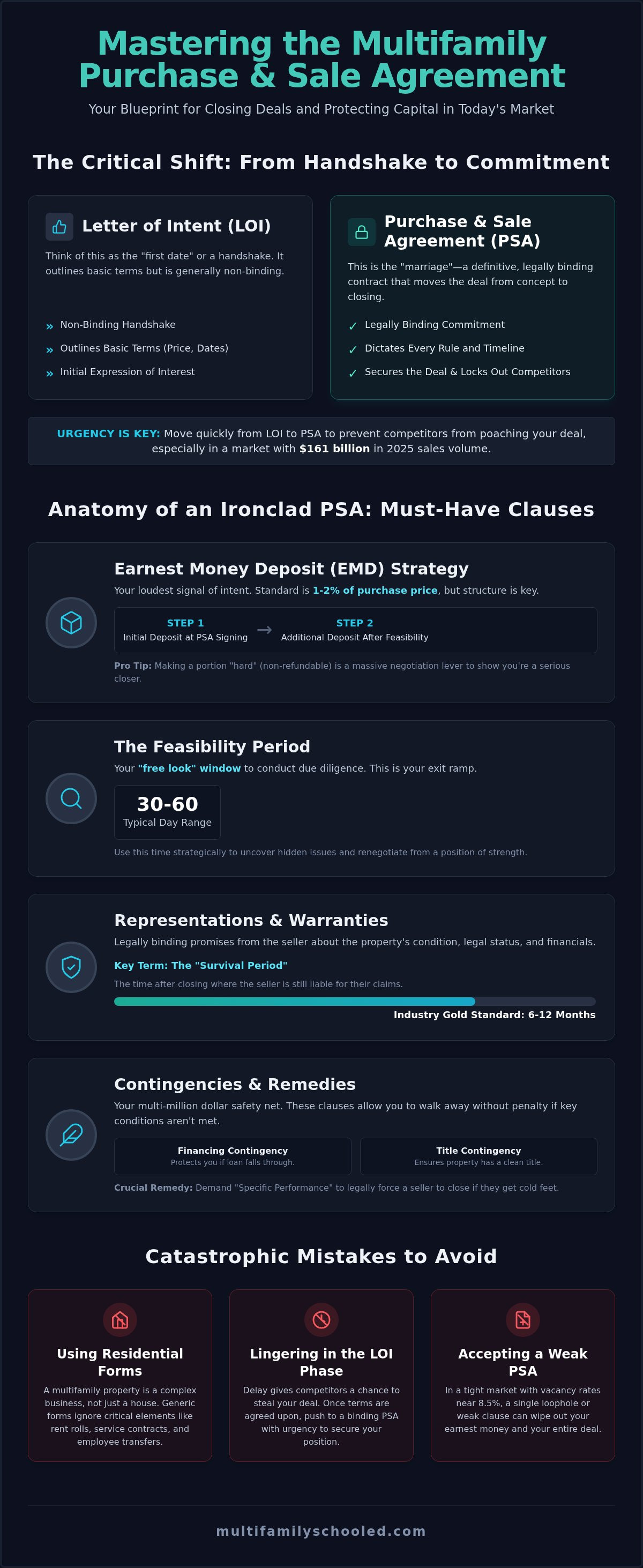
Think of the Letter of Intent (LOI) as the first date. It’s a non-binding handshake that outlines basic terms like price and closing dates. The PSA is the marriage. Once you sign the multifamily purchase and sale agreement, you are legally committed to the terms. In a competitive 2026 market where multifamily sales volume in 2025 hit $161 billion, you cannot afford to linger. Move with urgency from LOI to PSA to lock out other hungry buyers. This is also when your earnest money becomes a factor. Depositing these funds makes the deal "hard." It signals to the seller that you are a serious operator who follows a systematic path to success.
Why Standard Residential Forms Won't Work
Attempting to use a standard residential contract for an apartment complex is a catastrophic mistake. Commercial deals involve layers of complexity that generic forms simply ignore. You aren't just buying a roof; you're buying a cash-flowing business. A professional PSA must address updated rent rolls, existing service contracts, and even employee transfers. You need to balance "as-is" clauses with strong seller representations to protect your capital. Our Multifamily Tool Kit provides the investor-focused templates you need to clear these hurdles. Following a professional framework ensures you aren't leaving your future to chance. It's about moving from a generic mindset to a mastery-driven strategy that secures long-term independence.
Critical Clauses Every Multifamily PSA Must Include
Your multifamily purchase and sale agreement is the blueprint for your financial freedom. It is the document that separates the amateurs from the elite investors who close deals in 90 days. In a market where national vacancy rates are projected to hit 8.2 percent by the end of 2026, you cannot afford a single weak clause. Every word must serve your mission to protect assets and build wealth. You aren't just signing a contract; you're setting the terms of your success.
The Earnest Money Deposit (EMD) Strategy
Your EMD is your loudest signal of intent. While 1 to 2 percent of the purchase price is standard, how you structure it determines your leverage. Successful investors often use a tiered approach: an initial deposit at signing and an additional deposit once the feasibility period ends. In competitive markets, making a portion of that money "hard" or non-refundable immediately can be a massive negotiation lever. It tells the seller you are a closer. Just ensure your due diligence is backed by proven systems before you let that cash go hard.
The feasibility period is your "free look" window. This timeline, typically 30 to 60 days, is when you verify every rent roll and service contract. It's the rulebook for your due diligence. If you find a deal-breaker, this clause is your exit ramp. If you want to master these clauses with a pro by your side, check out our Mentorship Program to see how we navigate these high-stakes windows.
Representations and Warranties (Reps & Warranties)
You must demand that the seller makes specific promises about the property's health. These aren't just polite requests. They are legal guarantees. You need confirmation that the seller owns the property free and clear, has no pending litigations, and is aware of no environmental hazards. These promises must have a "survival period," which is the timeframe after closing where the seller is still liable for their claims. In 2026, a 6 to 12 month survival period is the industry gold standard for investor protection.
Closing conditions and remedies for default are your final safety nets. Closing conditions specify exactly what must happen, such as receiving estoppel certificates from tenants, before money changes hands. If the seller backs out, your remedies clause should allow for "specific performance," which legally forces the sale. You are in this to win. Don't let a seller's cold feet derail your path to multi-generational wealth.
Negotiating Your PSA for Maximum Leverage
The ink on your Letter of Intent is barely dry. Do not get complacent. The real negotiation begins now. Your multifamily purchase and sale agreement is a living document. Every clause is a chance to tilt the scales in your favor. In a year where multifamily mortgage rates start at 5.70 percent for larger loans, every dollar saved at the closing table is a win for your long-term independence. You must use the transition from LOI to PSA to tighten terms that the seller glossed over during the handshake phase.
Leverage the inspection period as your primary weapon. This is not just a time to look at leaky pipes. It is your opportunity to uncover deferred maintenance that becomes a credit back to you. Demand an Access Agreement that allows your team on-site before the official clock starts. If you find a roof that needs $50,000 in work, you have a choice: a price reduction or a seller credit. In 2026, take the credit. Seller credits preserve your cash-on-cash return. They keep your IRR high because they offset your closing costs directly. Keep your capital in your pocket.
Winning the 'Due Diligence' Battle
Secure a feasibility period that actually works for you. Aim for at least 45 to 60 days in the current market. This gives you time to navigate the regulatory landscape, including the FinCEN rule changes from August 11, 2026, regarding beneficial ownership reporting. Ensure the PSA grants you absolute access to every unit, lease, and utility bill. Always negotiate a Right to Extend clause. This allows you to buy an extra 15 or 30 days for a small, additional deposit if your lender needs more time. It is your ultimate insurance policy against a blown deal.
Allocating Closing Costs
Stop accepting standard splits. Everything is negotiable. Who pays for the ALTA survey or the owner's title policy? In a buyer's market, push these costs onto the seller. If they refuse a price drop, demand they cover the transfer taxes instead. Aggressive cost-splitting strategies can save you tens of thousands of dollars. Use these savings to fund your initial renovations or to bolster your reserves. This is how you move from a simple participant to a master of the multifamily ecosystem. If you need the exact templates to win these battles, the Multifamily Tool Kit has everything you need to dominate the negotiation table.
Contingencies: Your Multi-Million Dollar Safety Net
Your multifamily purchase and sale agreement is a weapon for building wealth, but your contingencies are the shield that protects your legacy. Never treat these as boilerplate legal text. They are your "get out of jail free" cards. In a high-stakes environment, you must have the power to walk away if the property doesn't meet your standards. From environmental Phase 1 nightmares to hidden title clouds, these clauses ensure you only close on winners.
Physical and environmental contingencies are non-negotiable. You need to inspect everything from the roof to the sewer lines. A "Phase 1" environmental report can uncover historical contamination that could bankrupt an unprepared investor. Similarly, the title and survey contingency allows you to clear ownership "clouds" before you take title. If the seller can't provide a clean title, you keep your cash and move to the next deal. This is how you maintain total control over your financial future.
The Financing Contingency in a Volatile Market
Approval is not enough. You need specific language regarding your loan terms. As of August 2026, commercial mortgage rates start at 5.70 percent for loans over $6 million and 6.11 percent for smaller deals. If interest rates spike during your escrow, your debt service coverage ratio could fail. Protect your earnest money by tying your financing contingency to specific interest rates and LTV ratios. Don't just promise "best efforts" to find a loan. Require terms that actually make the deal cash flow. If the market shifts, your safety net must catch you.
The 'Books and Records' Contingency
Verify every cent. The "Books and Records" contingency is where you prove the seller's math. Trust the rent roll, but verify it against bank statements and tenant estoppels. This is your chance to analyze service contracts. Many sellers are locked into overpriced trash or landscaping deals that you can cancel to immediately boost your Net Operating Income. Review three years of historical utility bills. Finding efficiency gaps in water or electricity is the fastest way to force appreciation. If you want to learn how to spot these hidden gems during due diligence, join our Mentorship Program and master the art of the close.
Master the Deal Flow with Multifamily Schooled
Mastery of the multifamily purchase and sale agreement is your foundation, but a foundation without a building is just a slab of concrete. You need a property. You need a deal that justifies the legal work. Most investors fail because they can't bridge the gap between learning and doing. We provide the bridge. It's time to stop playing small. You deserve a system that turns your ambition into a tangible asset. Your 2026 strategy for the multifamily purchase and sale agreement must be backed by real-world expertise and a proven framework.
Our Mentorship Program is designed to take you from a curious observer to a confident owner. We don't just teach theory. We provide the Multifamily Tool Kit. This includes the exact templates, checklists, and calculators used by elite operators. Stop guessing about your contract terms. Use the proprietary methodologies that have helped our students find and close deals in 90 days. This is about total economic empowerment through asset accumulation.
From Contract to Closing: The 90-Day Sprint
Speed is your competitive advantage. While others are stuck in analysis paralysis, our students move through the due diligence phase with precision. We fill your pipeline using proprietary Deal Finding Software. This technology identifies off-market opportunities before your competitors even know they exist. You get access to a high-energy community of serious investors. These are people who are actually closing. You aren't doing this alone. You are joining a fast-moving movement of leaders who value results over excuses.
Your Next Step Toward Financial Freedom
Don't let the complexity of a legal document scare you away from multi-generational wealth. The risks of earnest money and legal loopholes are real, but they are manageable with the right blueprint. We provide the tools for a guaranteed path to success. Start your transformation today. Take the 5-Day Multifamily Online Challenge to kickstart your journey. It's time to stop dreaming and start executing. Apply for Mentorship Today and let's find your first deal. Your future depends on the actions you take right now.
DOMINATE THE CLOSING TABLE
You now hold the blueprint for total contract mastery. The multifamily purchase and sale agreement is no longer a source of anxiety; it's your primary weapon for asset protection and wealth creation. By leveraging ironclad contingencies and negotiating credits that preserve your cash flow, you've positioned yourself ahead of 90 percent of the market. The 2026 real estate landscape doesn't reward the hesitant. It rewards the decisive.
Stop letting legal jargon or fear of the unknown stall your progress toward financial independence. You deserve a mentor who has already cleared the path. Get expert guidance from Justin Brennan and gain immediate access to the proprietary Multifamily Tool Kit. Our system is built for results. We guarantee you'll find a deal in 90 days or we find one for you. This is your moment to move from the sidelines to the closing table.
Apply for the Multifamily Mentorship Program today and start building your legacy. Your future self will thank you for the courage you show right now. Let's get to work.
Frequently Asked Questions
Is a Multifamily PSA legally binding?
Yes. A multifamily purchase and sale agreement is a fully binding legal contract. Unlike the Letter of Intent; this document creates a mandatory obligation for both buyer and seller. Once signed; you are legally committed to the purchase price and timelines. It serves as the ultimate rulebook for the transaction. Violating these terms can lead to the loss of your earnest money or a lawsuit for specific performance. Treat it with absolute seriousness.
How much earnest money is typical for an apartment building?
You should expect to put down 1 to 2 percent of the total purchase price as earnest money. For a $5 million deal; that means $50,000 to $100,000 in skin in the game. In competitive 2026 markets; savvy investors use a tiered deposit system. You might put half down at signing and the other half once the feasibility period ends. This strategy shows you are a serious closer while managing your initial risk.
Can I back out of a PSA after it is signed?
You can walk away without penalty only if you are within your active contingency periods. These include the feasibility; financing; or title windows. If you find a deal breaker during due diligence; you can terminate the contract and recover your deposit. However; once you pass the "hard money" date; backing out usually means forfeiting your earnest money. Always ensure your safety nets are clearly defined in the initial contract to protect your capital.
What is the 'Hard Money' date in a multifamily contract?
The "Hard Money" date is the specific deadline when your earnest money becomes non-refundable. This usually occurs immediately after your feasibility or due diligence period expires. After this moment; the seller keeps your deposit if you fail to close for any reason not covered by remaining contingencies. It is the point of no return. Mastery of your deal flow ensures you only let your money go hard on properties that are guaranteed winners.
Who typically drafts the Purchase and Sale Agreement?
The buyer's attorney typically provides the first draft of the multifamily purchase and sale agreement. This gives you the strategic advantage of setting the initial terms and protections. However; some institutional sellers insist on using their own forms. Regardless of who drafts it; you must control the narrative. Use a proven framework like our Multifamily Tool Kit to ensure your specific investor protections are included before the first version is even sent to the seller.
What happens if a seller breaches the PSA?
If a seller defaults; your primary remedy is "specific performance." This is a legal action that forces the seller to complete the sale as agreed. You don't just want your money back; you want the asset. Most contracts also allow you to recover your earnest money and any third party costs like inspection fees. Never let a seller's cold feet derail your path to wealth. Demand strong default clauses that hold them accountable.
How long is a typical due diligence period in 2026?
A typical feasibility period in 2026 lasts between 30 and 45 days. This window gives you enough time to verify rent rolls; inspect physical units; and secure a Phase 1 environmental report. In complex deals; you might negotiate for a 60 day window. Speed is vital; but accuracy is mandatory. Our 90 day system teaches you how to maximize every hour of this period so you can move from contract to closing with absolute confidence.
Should I use a template or hire an attorney for my PSA?
You should start with a high quality; investor focused template and then hire an attorney to finalize it. A generic lawyer doesn't understand your specific investment strategy. Use the templates in our Multifamily Tool Kit as your foundation. This saves you thousands in legal fees because your attorney is just fine tuning a document that is already optimized for your success. It is about being strategic with your resources to maximize your long term earnings.



