

Multifamily Property Analysis Template: The Street-Smart Guide to Apartment Wealth
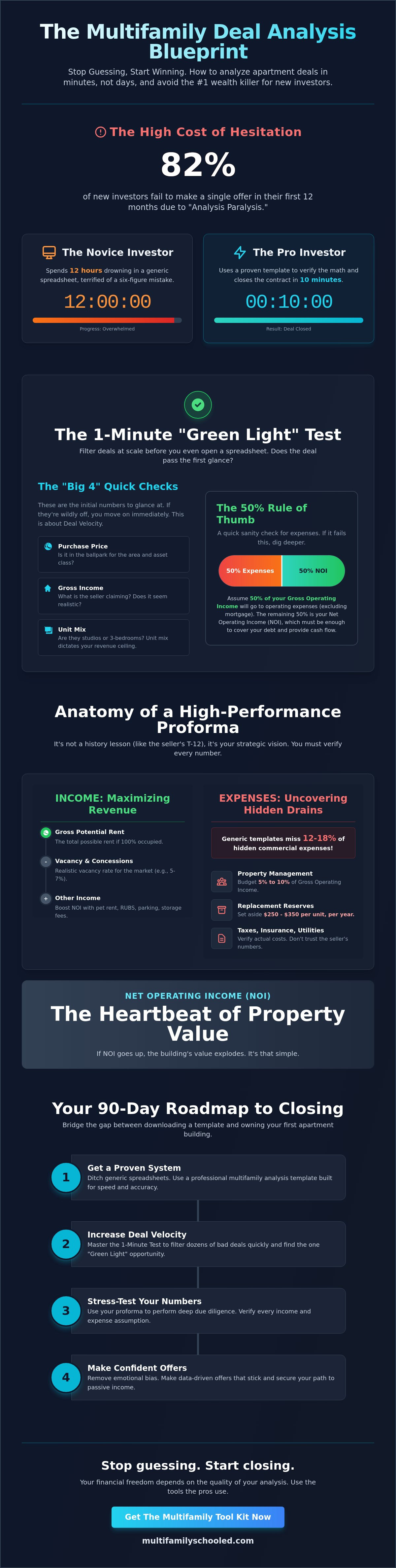
Most investors lose their first deal not because they lack capital, but because they spend 12 hours drowning in a spreadsheet while a pro closes the contract in 10 minutes. You know the feeling of staring at a screen for hours, terrified that one wrong cell will lead to a six-figure mistake. Analysis paralysis is the #1 wealth killer for aspiring landlords. According to industry surveys, 82% of new investors fail to make a single offer in their first 12 months because they lack a proven multifamily property analysis template to verify the math. It's time to stop guessing and start winning.
You're about to master the exact framework used to filter and green-light apartment deals in minutes. I'll show you how to gain the confidence to make offers that stick and secure the passive income you've been chasing. This guide breaks down the "Green Light" system to spot winners instantly, the street-smart metrics that actually drive wealth, and the steps to avoid overpaying for a bad deal.
Key Takeaways
- Stop guessing and start winning with a financial blueprint that predicts apartment performance with street-smart precision.
- Ditch broken spreadsheet formulas and unlock the power of a modern multifamily property analysis template built for speed and accuracy.
- Master the "1-Minute Green Light Test" to filter deals at scale using the "Big 4" numbers and the 50% Rule.
- Follow a proven 90-day roadmap to bridge the gap between downloading a template and closing your first apartment deal.
What is a Multifamily Property Analysis Template and Why Do You Need One?
Stop guessing with your future. A multifamily property analysis template isn't just a spreadsheet. It's your financial blueprint for predicting exactly how an apartment building will perform. In the high-stakes world of commercial assets, guessing is a fast track to bankruptcy. You can't rely on the "gut feelings" that might work for a single-family house. You need data-driven mastery to transform a building into a wealth-generating machine. This tool is your key to financial freedom, turning complex math into a clear path for your 90-day ownership journey.
Mastering Real estate investing principles requires moving beyond basic calculations. You're not just buying brick and mortar; you're buying a cash-flow engine. If you don't have a proven system to stress-test your assumptions, you're flying blind. Use a professional template to unlock the confidence you need to pull the trigger on big deals.
To better understand how a professional model functions, watch this helpful video:
The Problem with Generic Real Estate Spreadsheets
One-size-fits-all templates are a trap for the unwary investor. They often miss 12% to 18% of hidden commercial expenses like utility bill-backs, specialized insurance, or professional management fees. Using a generic sheet in 2026 is dangerous because it relies on outdated cap rate assumptions that don't account for modern market volatility. These basic tools fail to track value-add "forced appreciation" strategies. Without a specific multifamily property analysis template, you'll overlook the massive profit potential hidden in operational efficiencies and rent optimization. Grab the Multifamily Tool Kit to ensure your numbers are street-smart and accurate.
The 90-Day Ownership Mindset
Speed is the ultimate predictor of investment success. If you want to own an apartment building in 90 days, your analysis must be rapid and ruthless. A standardized template removes emotional bias from your buying decisions. It stops you from "falling in love" with a property that doesn't actually cash flow. You need to filter through dozens of deals to find the one "Green Light" opportunity. Deal Velocity is the rate at which an investor filters bad properties to find a winning investment. When you increase your velocity, you decrease your risk and accelerate your path to building legacy wealth.
The Anatomy of a High-Performance Multifamily Proforma
Your multifamily property analysis template is more than a spreadsheet; it is a crystal ball. A proforma is not a history lesson. It is your strategic vision for the property’s future. While a seller provides a Trailing 12-Month (T-12) statement to show what they did, your job is to project what you will do. Don't take the seller's word for it. Use your street smarts to verify every figure. If the current owner claims utility costs are low, check the 2023 rates with the local provider. Sellers often "forget" to include the full impact of upcoming property tax reassessments or necessary repairs.
Your revenue ceiling is dictated by the unit mix. A 50-unit building with 40 studios has a completely different profit profile than a 50-unit building with 40 three-bedroom apartments. Analyze the bedroom counts and square footage. This mix determines your target demographic and your ability to push rents in a competitive market. If you want to master these calculations, you can explore this comprehensive guide to multifamily investing to see how property classes impact your proforma assumptions.
Income & Expense Breakdown (The NOI Pillar)
Net Operating Income (NOI) is the heartbeat of your property value. If the NOI goes up, the building's value explodes. It is that simple. You must account for the "hidden" drains on cash flow that rookies overlook. Budget 5% to 10% for professional property management. Set aside $250 to $350 per unit every year for replacement reserves. To maximize your return, implement a Ratio Utility Billing System (RUBS). This allows you to bill utility costs back to the tenants, which directly increases your NOI. Look for "Other Income" opportunities like pet rent, reserved parking, or storage fees. These small additions often boost ROI by 1.5% or more without requiring major renovations.
The Big Three Metrics: Cap Rate, Cash-on-Cash, and IRR
You need three specific metrics to determine if a deal deserves a "Green Light." The Cap Rate is the market's temperature. It tells you the expected return if you paid all cash. Cash-on-Cash Return is the most important number for lifestyle design. This is the actual mailbox money hitting your bank account after the mortgage is paid. Finally, the Internal Rate of Return (IRR) measures the total wealth generated over the entire hold period. It includes monthly cash flow, principal paydown, and the massive profit from the eventual sale. If you are ready to stop guessing and start winning, download the Multifamily Tool Kit to automate your deal analysis today.
Excel Templates vs. Deal-Finding Software: Which Wins in 2026?
The gap between the wealthy investor and the hobbyist is widening. If you're still relying on a manual multifamily property analysis template, you're operating on borrowed time. 2026 demands more than just basic math; it requires instant intelligence. Manual data entry is slow, prone to disaster, and keeps you trapped in the "analysis paralysis" loop. To build real wealth, you need a system that works faster than the market moves. Technology isn't just a convenience anymore. It's your ultimate unfair advantage in a hyper-competitive landscape.
The Limits of Static Spreadsheets
Manual entry is a wealth killer. A single "fat-finger" typo in a 2026 spreadsheet can miscalculate your Net Operating Income by 12% or more. That tiny slip costs you $75,000 at the closing table. Excel simply can't keep up when you need to compare 50 deals across three different states simultaneously. Static templates are also blind to the 0.25% interest rate fluctuations that occur monthly. If your multifamily property analysis template doesn't update its debt assumptions automatically, your projected cash flow is a fantasy. You're making million-dollar decisions based on frozen, historical data while the pros use live feeds.
- Error Risk: One broken formula in a shared file can ruin your entire underwriting process.
- Scaling Issues: Tracking 50+ properties in separate tabs leads to massive oversight and missed opportunities.
- Market Lag: Static files don't account for real-time shifts in utility costs or local tax assessments.
Unlocking the Power of Real Estate Radar AI
Stop playing small and start winning. Real Estate Radar represents the total evolution of the traditional analysis tool. It doesn't just crunch numbers; it finds the numbers for you. While other investors wait for LoopNet leftovers, this AI identifies off-market gems that haven't hit the public eye yet. It's the difference between chasing deals and having them delivered to your screen.
The "1-Minute Green Light" feature is a total game-changer for the modern investor. It allows you to vet any property instantly, giving you a "go" or "no-go" signal based on your specific criteria. You get precision, speed, and real-time market data that static files can't touch. Don't let a broken formula or a slow response time stand between you and your financial freedom. Use the tools that the top 1% use to dominate the apartment market. Take the leap from manual labor to automated wealth creation right now.
The choice is yours: stay stuck in the cells of a spreadsheet or master the software that builds empires. Get the edge today.
The 1-Minute Green Light Test: Analyzing Deals at Scale
Stop wasting hours on every flyer that hits your inbox. Speed is the ultimate advantage in real estate. You need a multifamily property analysis template that filters out the noise in sixty seconds or less. This isn't about being perfect yet. It's about being fast enough to catch the winners before someone else does. Use these five steps to triage every deal you see.
- Step 1: Input the "Big 4" numbers. Grab the Purchase Price, total Units, Net Operating Income (NOI), and the local Market Cap Rate. These four metrics form the foundation of your initial screen.
- Step 2: Apply the "50% Rule." Brokers often underestimate expenses to make a deal look better. If their numbers show expenses at 30%, ignore them. Assume 50% of gross income goes to operating costs for a quick reality check.
- Step 3: Check the Rent Delta. Look for the gap. If current rents are $1,100 but market comps are $1,450, you've found a potential goldmine.
- Step 4: Verify the Debt Service Coverage Ratio (DSCR). Banks usually require a DSCR of at least 1.25. If the property doesn't generate 25% more income than the mortgage payment, the bank won't fund it.
- Step 5: Decide. It's either "Trash it" or "Deep Dive." Never stay in the middle.
Filtering for "Value-Add" Opportunities
Success in this game comes from spotting what others miss. Look for "lazy owners" who haven't raised rents since 2019 or don't care about "economic vacancy," which is the money lost to uncollected rent or concessions. You want properties where "physical vacancy" is high because of poor management, not a bad location. Forced Appreciation is the intentional increase of NOI through management or renovation. If you can't see a clear path to force that value, move on to the next deal.
The Power of the Multifamily Tool Kit
Consistency kills analysis paralysis. You need a standardized workflow to evaluate fifty deals a week without burning out. The Multifamily Tool Kit is your essential starter pack to automate this process. It helps you move from a raw spreadsheet to a professional "Pitch Deck" that investors actually want to fund. By using a proven multifamily property analysis template, you ensure your numbers are bank-ready from day one. This system takes the guesswork out of the equation and gives you the confidence to make offers fast.
Ready to stop guessing and start closing? Get the Multifamily Tool Kit today and master your market.
Beyond the Template: Closing Your First Deal in 90 Days
A multifamily property analysis template is a powerful tool, but it's just a map. It shows you the path, but it doesn't provide the engine. Industry data shows that 90% of people who download an analysis tool never actually buy a building. They get stuck in a loop of endless data. They let fear disguised as "research" stop them from taking action. You don't want to be a spreadsheet expert; you want to be an apartment owner.
At Multifamily Schooled, we don't just give you tools; we give you results. Our guarantee is the boldest in the industry. Find a deal in 90 days or we give you one from our own pipeline. We're looking for individuals who are tired of "playing" real estate and are ready for real ownership. If you want to join the ranks of the elite, our VIP Mentorship program is the only logical choice for your future.
Why Mentorship Trumps Self-Teaching
Self-teaching is the most expensive way to learn. You pay for it in lost time and "rookie mistakes" that can cost you $50,000 or more on your very first acquisition. Justin Brennan isn't just a coach. He's a 3rd Generation investor with street-smart experience that can't be found in any textbook. Having an expert look over your shoulder changes your entire risk profile. Justin brings decades of hands-on knowledge to your deal flow, ensuring you don't trip over hidden due diligence items or financing traps.
Information is everywhere, but mastery is rare. Our community provides the high-level support you need to move from reading about wealth to actually building it. You gain instant access to a network that has already navigated the high-stakes world of commercial financing and property management. When you're surrounded by investors closing 50-unit and 100-unit deals, your "impossible" quickly becomes your "normal."
Your Blueprint for Financial Freedom
The journey to passive income is simple when you follow our proven blueprint. It's a three-step process designed for speed and safety:
- Learn the Math: Master the fundamentals using your multifamily property analysis template.
- Use the Software: Leverage our proprietary technology to automate the heavy lifting and find the winners.
- Join the Mentorship: Scale your portfolio with the guidance of a 3rd Generation pro.
This isn't a theory; it's a systematic path to financial freedom. If you're ready for a fast start, join the 5-Day Multifamily Challenge right now. This is your moment to break the cycle of endless research and start the process of acquisition. Every day you wait is a day of lost cash flow. The market doesn't wait for the hesitant; it rewards the decisive. Stop analyzing and start owning. Your legacy starts today.
Stop Analyzing and Start Owning Your Future Today
You've now seen how a high-performance multifamily property analysis template separates the amateurs from the pros. By 2026, relying on outdated spreadsheets alone won't cut it when you can use the 1-minute green light test to filter deals at scale. Speed is your greatest asset in this competitive market. Justin Brennan, a 3rd generation investor, has refined these systems through decades of hands-on experience to ensure you're only chasing winning numbers.
Don't let another 90 days pass without a deed in your hand. Our mentorship program has been featured on major real estate platforms because it delivers results. We're so confident in this street-smart system that we offer a 90-day "Find a Deal or We Give You One" guarantee. This is your chance to move beyond the proforma and secure true financial freedom. Your journey to apartment wealth starts now.
Apply for the 90-Day Mentorship and Own Your First Apartment Building!
Frequently Asked Questions
What is the best multifamily property analysis template for beginners?
The best multifamily property analysis template for beginners is a "Green Light" style analyzer that simplifies the 5 key metrics: NOI, Cap Rate, Cash-on-Cash, Debt Coverage Ratio, and IRR. You need a system that allows you to input basic data in 60 seconds to get an immediate go or no-go signal. This prevent analysis paralysis and keeps you focused on taking action to build wealth today.
How do I calculate the Net Operating Income (NOI) for an apartment building?
Calculate NOI by subtracting all annual operating expenses from your total realized income. You must exclude mortgage payments and capital expenditures from this specific calculation to see the property's true performance. For example, if a 20 unit building generates $240,000 in annual rent and costs $108,000 in taxes, insurance, and maintenance, your NOI is $132,000. This number represents the pure profit potential before you factor in your specific financing costs.
Can I use a free Excel template to analyze 100+ unit deals?
You can use a basic Excel tool for initial screening, but 100+ unit deals require a more robust multifamily property analysis template to handle complex rent rolls. Large deals involve 12 month trailing statements and sophisticated tax depreciation schedules that basic spreadsheets often miss. Professional investors use integrated systems to ensure 100% accuracy during the 30 day due diligence period to protect their capital.
What is a "good" cash-on-cash return for multifamily real estate in 2026?
A 2026 target for a strong cash-on-cash return is 8% to 12% for stabilized assets in high-growth markets. While historical averages fluctuate, aiming for a double-digit return ensures you have a 2% to 3% safety margin against interest rate volatility. Focus on properties where you can increase value through 15% rent bumps or utility bill-backs to hit these financial freedom targets quickly.
Do I need special software to find off-market apartment deals?
You need specialized data tools to access the 80% of deals that never hit the public market. Software like PropStream or Reonomy allows you to filter for "tired landlords" who have owned properties for 10 or more years. Combine these lists with a proven outreach system to secure deals directly from owners. This strategy cuts out the middleman and saves you the 3% to 6% broker commission on every transaction.
How long does it take to analyze a multifamily deal using your system?
You can complete a preliminary analysis in exactly 60 seconds using the "Fast 5" method. This rapid screening process determines if the deal meets your 1.25 debt coverage ratio requirement before you waste hours on deeper research. If the initial numbers pass the test, you can then spend 20 minutes performing a full underwriting to finalize your offer price and secure the property.
What are the most common mistakes when using a property analysis spreadsheet?
The most common mistake is underestimating the 35% to 45% expense ratio typical in most apartment markets. Investors often forget to include a 5% vacancy factor or fail to account for the property tax reassessment that occurs after the sale. These errors can overstate your annual cash flow by $10,000 or more. Always verify every line item against the actual T-12 financial statements provided by the seller to ensure your multifamily property analysis template is accurate.
Is it possible to buy an apartment building with no money down using these templates?
Yes, you can use these templates to structure "no money down" deals through syndication or private money partnerships. Your analysis template proves the 15% to 20% internal rate of return to potential investors, which convinces them to provide the equity. By bringing the deal and the expertise, you can earn a 20% to 30% "carried interest" stake in the building without using your own cash.



