

Multifamily Pro Forma: Master the Math and Close Your First Deal in 2026
Your multifamily pro forma is not a math project; it is the definitive roadmap to your first apartment building. Stop treating your spreadsheets like a chore. Most investors fail because they lack a proven system to handle the numbers. If you are tired of staring at messy Excel files and fearing you might overpay, it is time to take control of your financial future.
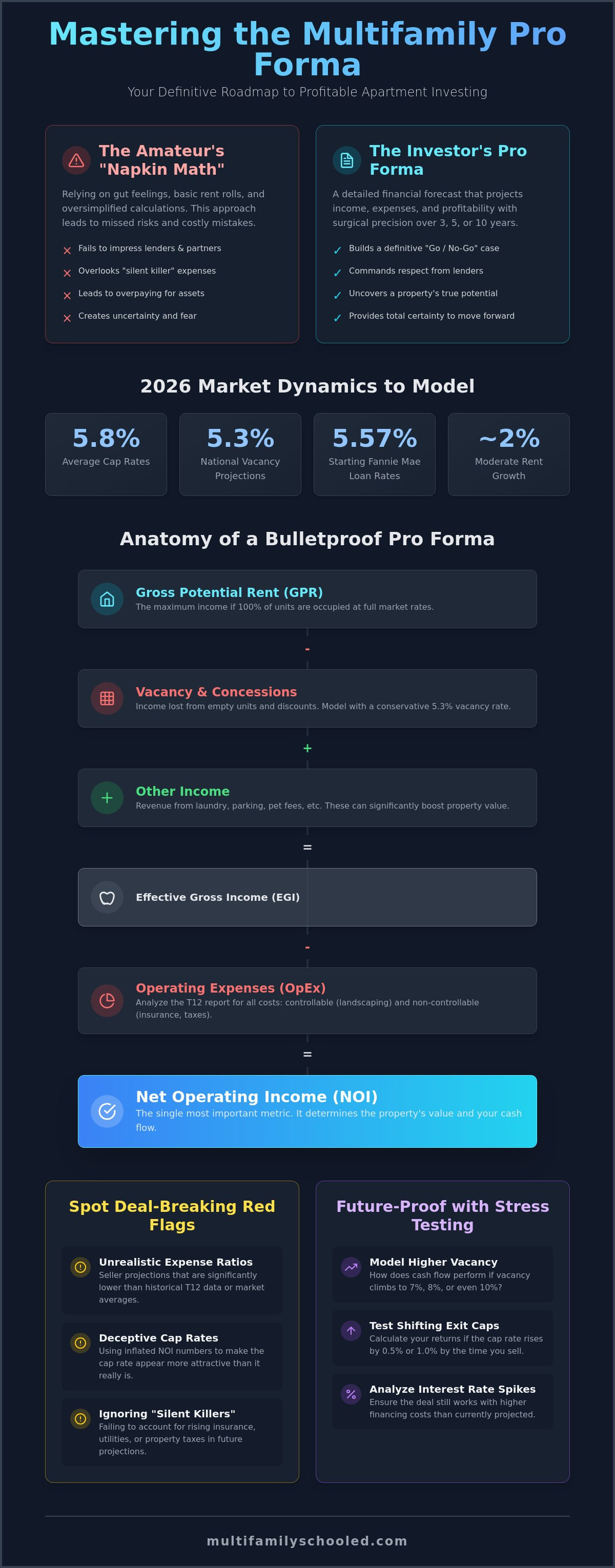
You likely feel the pressure of shifting 2026 market dynamics. It is normal to worry about 5.8% average cap rates or rising insurance costs while trying to make sense of complex IRR calculations. I will show you how to build a model that commands respect from lenders and gives you a definitive 'Go' or 'No-Go' decision on any deal in minutes. You deserve to move forward with total certainty.
We are breaking down the exact framework to stress-test your assumptions against current 5.3% national vacancy projections. You will gain the confidence to present to partners and the tools to close your first deal in 90 days or less. Let's get to work and master the math that changes everything.
Key Takeaways
- Replace manual "napkin math" with a professional financial roadmap that secures lender trust and institutional backing.
- Master the 5 essential pillars of income and expenses to identify "silent killers" before they drain your cash flow.
- Spot deal-breaking red flags in under 15 minutes by auditing unrealistic expense ratios and deceptive cap rates.
- Future-proof your investment by stress-testing your multifamily pro forma against high vacancy and shifting exit cap rates.
- Implement a proven 90-day system to analyze deals with lightning speed and move from "maybe" to a confident "Go."
What is a Multifamily Pro Forma? Your Roadmap to Wealth
Think of your multifamily pro forma as a crystal ball that actually works. It is a detailed financial forecast of how your apartment building will perform over the next three, five, or ten years. While amateurs rely on "napkin math" and gut feelings, elite investors use pro forma financial statements to project every dollar of income and expense with surgical precision. This document is the absolute foundation of your 90-day mission to secure a property and build your legacy.
Relying on a basic rent roll is a recipe for disaster. A structured multifamily pro forma allows you to see the future of an asset before you ever risk a dime of your own capital. It bridges the gap between a property's current reality and its ultimate potential. If you want to close a deal in 2026, you must stop guessing and start calculating. Speed of analysis is your greatest weapon, and a professional model gives you the power to say "yes" or "no" with total conviction.
To see exactly how a professional handles a high-stakes value-add deal analysis, watch this breakdown:
You must master the distinction between "As-Is" and "Stabilized" numbers. The "As-Is" pro forma reflects the current, often inefficient, management of the property. The "Stabilized" version is your blueprint for success; it shows what happens after you renovate units, reduce vacancies, and optimize operations. This transition is where wealth is created. Without a clear roadmap between these two points, you are flying blind in a competitive market.
Why Every Apartment Investor Needs a Pro Forma
Visualizing cash flow before you sign a contract is the only way to protect your financial future. Lenders do not care about your passion; they want to see a rigorous multifamily pro forma that accounts for 2026 interest rates, which are currently starting as low as 5.57% for Fannie Mae loans. When you present professional numbers, you secure lender approval and partner trust. This is how you shift from "hoping" for a return to "knowing" your ROI. It is a psychological transformation that turns fear into decisive action.
Static vs. Dynamic Pro Formas
A static spreadsheet is a dangerous trap. Your model must be dynamic to survive 2026 market shifts, where national vacancy rates are expected to settle near 5.3%. If your assumptions do not change when insurance costs surge or rent growth moderates to 2%, your investment will fail. You need a system like the Multifamily Tool Kit to automate these complex variables. The pro forma is a living document of property potential that must evolve as you gather real-world data and market intelligence. Don't settle for a snapshot when you need a movie of your property's performance.
The 5 Essential Pillars of a Multifamily Pro Forma
Speed is your ultimate edge in a competitive market. To close your first deal in 90 days, you need a bulletproof multifamily pro forma that stands up to the scrutiny of any lender. This is not just a spreadsheet; it is a strategic breakdown of five critical pillars that determine if a property will build your legacy or drain your bank account. You must master these components to move with the confidence of a seasoned pro.
Mastering the Income Statement
Start with Gross Potential Rent (GPR). This represents the absolute maximum income the building could generate if every unit was occupied at full market rates. However, you cannot take this number to the bank. You must subtract concessions and non-revenue units to find your Net Rental Income. Boost your bottom line by calculating "Other Income" from laundry, parking, and pet fees. These small streams can increase property value by hundreds of thousands of dollars when capitalized at a 5.8% cap rate. Remember, a 0% vacancy rate is a dangerous myth. In 2026, you should model for a national vacancy rate near 5.3% to remain conservative and credible.
Expense Underwriting: The T12 Deep Dive
The Trailing 12 Months (T12) report is your best friend. It reveals the actual historical performance of the property, not just the seller's optimistic projections. Divide these into "Controllable" expenses like landscaping and "Non-Controllable" costs like utilities and insurance. National average insurance costs have surged to $68 per unit per month, so do not rely on outdated figures. To verify property taxes, always calculate the new assessment based on your purchase price and the local effective tax rate rather than relying on the seller's historical bill. This ensures your multifamily pro forma reflects the true cost of ownership from day one.
Debt service is your next hurdle. With the 10-Year Treasury at 4.56% and Fannie Mae loans starting around 5.57%, your loan structure dictates your monthly profit. Don't forget Capital Expenditures (CapEx). You must plan for roofs, HVAC systems, and parking lot repairs today so they don't bankrupt you tomorrow. Finally, your valuation and exit strategy define your final payday. Use a professional Real Estate Pro-Forma structure to estimate your exit cap rate and total return. If you want to automate this data gathering and focus on closing, Real Estate Radar AI can pull market comps and expense data in seconds.
These pillars are the backbone of every successful apartment investment. When you master the math, you eliminate the fear of overpaying. You stop being a spectator and start being a deal-maker. Let's move to the red flags that could sink your investment before it even starts.
Pro Forma Red Flags: How to Spot a Bad Deal in 15 Minutes
Don't let a glossy broker brochure blind you to financial reality. Most sales packages are designed to sell a property; not to protect your bank account. You must develop the "X-ray vision" to see through the fluff in any multifamily pro forma. If you want to close your first deal in 90 days, you cannot afford to waste time on "zombie" properties that look alive on paper but are financially dead. Master these red flags to filter out the losers and focus on the winners.
The first red flag is a "Too Good to Be True" cap rate. If a seller is pushing a 4% cap rate in a market where the national average is 5.8%, they are selling you a dream or a disaster. Low cap rates often mask high-risk environments or massive structural issues. Similarly, watch for aggressive rent growth. National rent growth is forecasted to be around 2-3% in 2026. If a multifamily pro forma relies on 5% annual increases just to make the math work, it's a gamble; not an investment. You are buying a business, not a lottery ticket.
Analyzing the Debt Service Coverage Ratio (DSCR)
Your safety margin is non-negotiable. Lenders won't touch a deal with a DSCR below 1.25. This ratio measures your property's ability to cover its mortgage payments with its own income. To calculate it, divide your Net Operating Income (NOI) by your annual debt service. If your NOI is $125,000 and your debt is $100,000, you are exactly at the 1.25 limit. In a market with Fannie Mae rates around 5.57%, you must leave room for volatility. A thin DSCR means one bad month of vacancy could lead to foreclosure. Protect yourself by stress-testing your model against higher rates today.
Spotting 'Fluff' in the Seller's Pro Forma
Broker pro formas are famous for "forgetting" expenses to inflate the bottom line. They often omit property management fees by assuming the owner will manage the units for free. They might "underestimate" utility costs or ignore the reality of $68 monthly insurance premiums per unit. This "fluff" artificially boosts the NOI and tricks you into overpaying. You must audit every single line item against real-world data. Use the Multifamily Tool Kit to verify broker claims and build a model based on objective reality. Don't let a seller's optimism become your financial nightmare.
Finally, beware of the deferred maintenance trap. If the CapEx budget is zero but the roof is 20 years old, the pro forma is a lie. Hidden repairs will ruin your cash flow faster than a high vacancy rate. Stop guessing and start auditing. Your financial future depends on your ability to spot these red flags in 15 minutes or less. Now that you know what to avoid, let's look at how to stress-test your assumptions for maximum safety.
Advanced Underwriting: Stress-Testing Your Assumptions
Stop treating your spreadsheet like a static document. In the 2026 market, a professional multifamily pro forma must be a dynamic battle plan. You need to know exactly where your deal breaks before you ever sign a contract. Amateurs hope for the best; pros plan for the worst. By stress-testing your assumptions, you build the ironclad confidence required to lead partners and secure institutional debt.
Start with a sensitivity analysis on vacancy. While national vacancy is expected to settle near 5.3% in 2026, you must ask: what happens if it hits 15%? This "break-even" analysis tells you how much pain your property can endure before it fails to cover the mortgage. Next, run an "Exit Cap Rate" stress test. Don't assume cap rates will stay at the current 5.8% average. Model a market downturn by increasing your exit cap by 1% or more. If the deal still produces a strong Internal Rate of Return (IRR) under those conditions, you've found a truly resilient asset.
You must also balance your IRR with your Cash-on-Cash Return. Cash-on-Cash tells you if the property can pay your bills today. IRR tells you if the investment is actually building long-term wealth. Presenting a "worst-case scenario" that still shows profitability is the fastest way to win investor trust. It proves you aren't just chasing a payday; you are protecting their capital.
The Power of Value-Add Modeling
Wealth in this industry isn't just found; it is manufactured. Model "forced appreciation" by calculating the exact ROI on specific unit upgrades. For example, if installing stainless steel appliances costs $2,500 but allows for a $100 monthly rent bump, you are looking at a 48% annual return on that specific capital. Use Real Estate Radar to analyze market trends and ensure your projected rent increases align with verified 2026 comps in your specific submarket.
Preparing the 'Lender Package'
Your commercial loan officer doesn't want to dig through a 50-tab Excel file. They want a concise, 1-page executive summary that proves you understand the risks. Use your multifamily pro forma to show you've accounted for 5.57% Fannie Mae rates and rising insurance premiums. This level of preparation gives you the leverage to negotiate a lower purchase price if the seller's "as-is" numbers don't survive your stress tests. You aren't just asking for a loan; you're presenting a bulletproof business case.
Ready to build these models with an expert mentor by your side? Apply for our Mentorship Program today and close your first deal in 90 days or less.
Stop Guessing: The Multifamily Schooled Way to Pro Forma Success
Speed of analysis is the number one predictor of your success. In a market where $170.4 billion in apartment volume traded over the last year, the best deals don't wait for you to finish a weekend spreadsheet. You need to move with the speed of a professional. Our 90-day system takes you from total confusion to a confident closing. We provide the blueprint to build a multifamily pro forma that lenders actually respect. You are no longer just a student; you are an owner in training.
We've stripped away the noise. You don't need academic theories. You need a repeatable system that tells you "Go" or "No-Go" in minutes. This is how you secure your financial future. Our approach combines Justin Brennan’s multi-generational industry heritage with cutting-edge tools. We don't just teach you the math. We provide the "Done-For-You" deal promise. If you follow the system, you find the deal. It is that simple.
Join the 5-Day Multifamily Challenge
Start your journey with a high-impact sprint. The 5-Day Multifamily Challenge is your A-Z roadmap. Day one: Find the market. Day two: Source the deal. Day three: Master the numbers. Day four: Talk to lenders. Day five: Make the offer. This staccato pace prepares you for the high-stakes reality of apartment investing. It is the perfect bridge to our deep-dive workshops. Start the 5-Day Challenge today and stop watching from the sidelines.
The Mentorship Advantage
A single mistake in your underwriting can cost you millions. Having an expert mentor review your multifamily pro forma is the ultimate insurance policy. We provide more than just advice. You get direct access to proprietary deal-finding software like Real Estate Radar AI to automate your data gathering. This ensures your projections for things like the 5.3% national vacancy rate are backed by real-time market intelligence. Don't gamble with your retirement. Apply for our Mentorship Program now and close your first deal in 90 days. Your new life as a successful investor starts the moment you decide to take action. Seize this opportunity today.
TAKE COMMAND OF YOUR FINANCIAL FUTURE
You now possess the blueprint to evaluate any apartment building with surgical precision. Mastery of the multifamily pro forma is the difference between a high-stakes gamble and a strategic investment. You've learned to identify hidden red flags, stress-test for 2026 market volatility, and build a model that lenders cannot ignore. This is your foundation for generational wealth.
Stop waiting for the "perfect" time to enter the market. Over 10,000 students have already used this system to escape the rat race and build real assets. With proprietary access to Real Estate Radar AI and our proven 90-day framework, you have everything you need to succeed. We are so confident in this methodology that we guarantee you'll find a deal in 90 days or we'll provide one for you.
The numbers don't lie; they are currently pointing toward your success. It's time to stop guessing and start closing. Find Your First Deal in 90 Days – Join the Mentorship! Your journey to independence begins today. You have the tools, the math, and the drive. Now go out and claim your future.
Frequently Asked Questions
What is a good IRR for a multifamily investment in 2026?
A target Internal Rate of Return (IRR) between 15% and 20% is considered strong for value-add deals in the current market. With the 10-Year Treasury at 4.56%, you must demand a risk premium that justifies your capital commitment. Don't settle for mediocre returns when you can manufacture higher equity through strategic renovations.
How do I calculate Net Operating Income (NOI) for an apartment building?
Subtract all operating expenses from your Effective Gross Income to find your NOI. Do not include mortgage payments or capital expenditures in this specific calculation. Your NOI is the pure engine of your property's value; it tells you exactly how much cash the business generates before debt enters the equation.
Should I use Excel or specialized software for my pro forma?
Master the mechanics in Excel first to understand every variable in your multifamily pro forma. Once you know the math, use proprietary tools like Real Estate Radar AI to automate the data-gathering phase. This combination of fundamental knowledge and high-speed technology allows you to analyze deals in minutes rather than hours.
What is the difference between a pro forma and a budget?
A pro forma is a forward-looking projection of what the property can achieve under your leadership. A budget is a rigid, tactical plan for managing actual monthly expenses. One is your roadmap to wealth creation; the other is your day-to-day operational checklist. You need both to succeed as an owner.
How much should I allocate for property management in my pro forma?
Allocate between 4% and 8% of your Effective Gross Income for professional management fees. Even if you plan to manage the asset yourself, you must include this line item to satisfy lender requirements. Banks want to know the property can survive and thrive even if you are not the one answering the midnight maintenance calls.
Can I use a pro forma for a small 4-unit property?
Yes, you should treat every multifamily pro forma with the same level of professional rigor, regardless of unit count. Analyzing a 4-unit property as a commercial business prepares you for the jump to 40 or 400 units. It builds the analytical muscles required to close larger, life-changing deals in the future.
How do I estimate property taxes for a new acquisition?
Multiply your projected purchase price by the local effective tax rate to get an accurate estimate. Never rely on the seller's historical tax bill, as most properties are reassessed upon sale. With the national average effective tax rate at 0.99%, failing to account for a reset can instantly kill your projected cash flow.
What is a 'stabilized' cap rate and why does it matter?
The stabilized cap rate is the projected yield once your renovations are complete and occupancy has reached market levels. This number represents the "finish line" for your value-add strategy. It allows you to calculate the final valuation of the property and determines the size of your ultimate payday when you exit or refinance.