

Multifamily Pro Forma: Investor's 2026 Blueprint
With $162 billion in multifamily loans maturing in 2026, the greatest wealth transfer of the decade is officially here. You see the opportunity, but staring at a blank spreadsheet feels like looking into a black hole. It's natural to feel overwhelmed by spreadsheet paralysis or the fear that a hidden expense will kill your deal. You want to move fast, but you can't afford to be wrong when explaining the numbers to a lender. Learning how to build a multifamily pro forma is the only way to move from hesitation to a closed deal.
I agree that the math shouldn't be the thing holding you back from financial freedom. That's why I'm giving you the exact blueprint to master the numbers so you can identify winners and protect your capital. You'll learn to turn raw data into a high-octane engine for your 90-day acquisition plan. We'll break down the specific steps to input 2026 interest rates, account for rising vacancy trends, and use the Real Estate Radar system to build a bulletproof case for every property you analyze. Success is a system, and your new pro forma is the key to unlocking it.
Key Takeaways
- Transform your deal analysis by using the pro forma as a "Truth Meter" to expose the real performance of any apartment building.
- Discover how to build a multifamily pro forma that protects your capital by validating T-12 data against actual bank statements.
- Calculate Net Operating Income with precision to ensure your property valuations are based on 2026 market realities rather than broker projections.
- Master the Cap Rate formula to identify undervalued winners and understand exactly how every dollar of income impacts your asset's total value.
- Shift into high gear with a 90-day underwriting system designed to help you analyze deals in under 15 minutes and beat the competition to the closing table.
What is a Multifamily Pro Forma and Why Does It Matter?
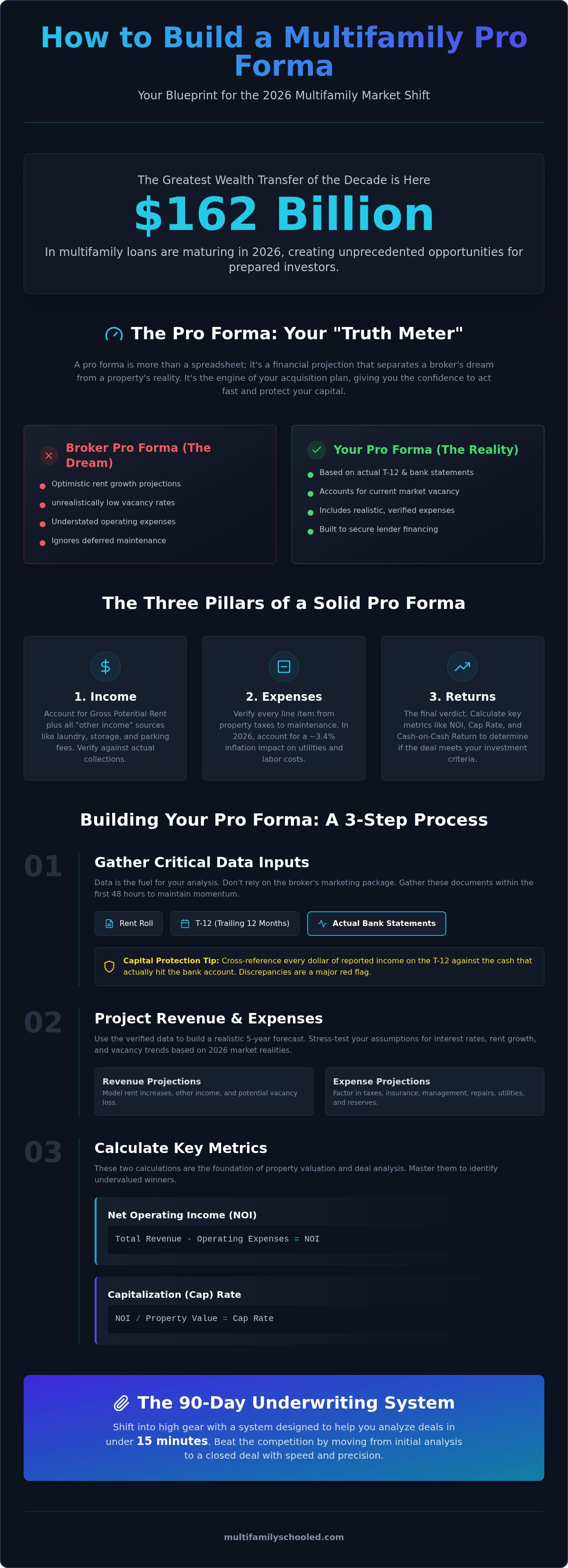
A multifamily pro forma is your strategic roadmap. It isn't just a collection of numbers; it's a financial projection of how a property will perform under your leadership. Think of it as the "Truth Meter" for your investment. Brokers are paid to sell a dream. They often present a "Broker Pro Forma" filled with optimistic projections and low vacancy rates that don't reflect the ground reality. Your job is to create a "Reality Pro Forma" that exposes the truth. Pro forma financial statements allow you to model the future before you ever sign a contract, ensuring you only hunt for winners.
With $162 billion in multifamily loans maturing in 2026, the stakes have never been higher. You need to know exactly how to build a multifamily pro forma to survive this massive market shift. This document acts as the engine of your 90-day acquisition plan. It gives you the confidence to walk away from bad deals and the speed to strike when a distressed opportunity appears. The "higher-for-longer" interest rate environment means your debt assumptions must be flawless. If you can't explain your numbers to a lender, you won't get the keys. Stop guessing. Start underwriting with precision.
To visualize this process in action, watch this tutorial on professional modeling:
The Three Pillars of a Solid Pro Forma
Every successful model rests on three foundations. First is Income. You must account for Gross Potential Income and the "other income" like laundry, storage, or parking. Second is Expenses. These are the leaks that kill value. You need to verify every line item from property taxes to maintenance. In 2026, you must account for the 3.4% inflation impact on utility and labor costs. Finally, there are Returns. This is the final verdict on whether your capital is working hard enough for you. If the returns don't beat your hurdle rate, the deal is dead.
Acquisition vs. Development Pro Formas
New investors should focus on acquisition models first. Development models include massive risks like rising construction costs, which can reach $700 per square foot in some 2026 markets. Acquisition pro formas are cleaner. They allow you to trade complexity for clarity during your first five deals. When you master how to build a multifamily pro forma for existing assets, you can use tools like Real Estate Radar to find properties with immediate upside. Focus on assets with a proven track record of collections so you can stabilize the property within your first 90 days of ownership.
Step 1: Gathering the Critical Data Inputs
Data is the fuel for your investment engine. You cannot build a winning strategy on a foundation of guesses. Understanding how to build a multifamily pro forma starts with gathering the right raw materials: the Rent Roll and the T-12 (Trailing 12 Months). These documents tell the story of the property's past and present. Your job is to use them to project its future. This data gathering phase should be completed within the first 48 hours of your 90-day acquisition plan to maintain momentum.
Never take a broker's marketing package at face value. Brokers are paid to sell; you are paid to protect your capital. Learning how to build a multifamily pro forma with accurate data is the only way to secure institutional-grade financing in today's market. Demand the actual bank statements from the last year. Cross-reference every dollar of reported income against the cash that actually hit the account. If the numbers don't align, you've found a red flag that could save you from a million-dollar mistake.
In 2026, market data is your shield. With the national median rent sitting at $1,390, you must know if your target property is underperforming. Gather local tax and insurance estimates early. Property insurance costs have shifted drastically, and assuming old rates will kill your cash flow. If you're ready to stop guessing and start winning, our Mentorship Program shows you exactly how to vet these documents in minutes.
The Rent Roll Deep Dive
A Rent Roll is more than a list of names. It's a map of your immediate risk. Scan for "ghost tenants" who are listed but haven't paid in months. Look for lease expirations that cluster in a single quarter, which could create a massive vacancy spike. In 2026 underwriting, Loss to Lease represents the gap between your current under-market rents and the higher rates you'll capture once you optimize the asset. Identifying this gap is how you find the hidden value others miss.
The T-12: Your Expense Roadmap
The T-12 shows you every penny spent over the last twelve months. You must normalize these numbers. A $50,000 one-time roof replacement shouldn't be treated as a recurring monthly expense. Conversely, look for "management fluff" where a seller might be hiding personal costs or deferred maintenance. Use Real Estate Radar to pull comparable market data and verify if the seller's operating costs are realistic for the neighborhood. Speed is your advantage. Get the data, verify the truth, and move to the next step.
Step 2: Projecting Revenue and Operating Expenses
Your blueprint is taking shape. Once you've verified the historical data, it's time to project the future performance of the asset. This is where you separate the amateurs from the pros when learning how to build a multifamily pro forma. Start with Gross Potential Income (GPI). This represents the maximum rent you'd collect if every unit was occupied at market rates. Don't get greedy here. National rent growth is nearly flat in 2026, forecasted at just 0.5%. Use that conservative figure to keep your model grounded in reality rather than broker fantasy.
Apply a realistic vacancy factor next. The national apartment vacancy rate reached 8.6% in the first quarter of 2026. Unless your specific submarket shows massive demand, underwrite at 7% to 10% to protect your downside. You must also account for the "Big Three": property taxes, insurance, and utilities. With U.S. inflation at 3.4% for the year ending July 2026, your operating costs are rising. Finally, include a Capital Expenditure (CapEx) reserve. Setting aside a few hundred dollars per unit annually ensures you have the cash to handle major repairs without begging partners for more capital when an HVAC unit fails.
Calculating Effective Gross Income (EGI)
EGI is the actual cash flowing into your property. You calculate this by taking your GPI, subtracting vacancy and concessions, and adding "Other Income". These secondary revenue streams, like pet rent, reserved parking, and coin-operated laundry, often represent the difference between a mediocre deal and a home run. In a year where rent growth is stagnant, these "other income" lines are your best friends. Be aggressive in finding these opportunities but remain conservative with your 2026 growth assumptions. The goal is to build a project that wins even if the local market stays flat for the next twenty-four months.
Managing the "Silent Killer" Expenses
Property taxes are the ultimate silent killer in multifamily investing. In many jurisdictions, taxes reset based on the new purchase price. If you underwrite using the seller's current tax bill, your profit margin could vanish the moment the county reassesses the building after the sale. Budget for professional property management fees between 4% and 10% of EGI. Larger properties (10+ units) typically see fees in the 4% to 7% range, while smaller assets might cost more. To make sure you aren't missing a single line item like pest control or landscaping, use the checklists in our Multifamily Tool Kit. Precision here is what gives you the confidence to close your first deal in under 90 days.
Step 3: Calculating Net Operating Income (NOI) and Returns
You've projected your income and trimmed the fat from your expenses. Now, you arrive at the most critical number in your entire analysis: Net Operating Income (NOI). This is the holy grail. It's the total income remaining after all operating expenses are paid, but before you pay your mortgage or income taxes. Mastering how to build a multifamily pro forma means understanding that NOI is the only number that truly determines a property's market value. If you increase the NOI, you aren't just making more monthly profit; you're forcing the property's appreciation regardless of what the broader market does.
In the 2026 market, where taxable multifamily loans are trading near 6.788%, your debt service will be a significant hurdle. This makes your NOI calculation even more vital. You use the NOI to determine the property's value through the Cap Rate. Think of the Cap Rate as the expected rate of return for an all-cash purchase. If a property generates $100,000 in NOI and the market Cap Rate is 5%, that building is worth $2 million. If you can bump that NOI by just $10,000 through better management or "other income" streams, you've just added $200,000 in equity. This is how you build real wealth in under 90 days.
The NOI to Value Equation
Every dollar you save on expenses or gain in rent has an exponential impact on your net worth. For example, in a 6% Cap Rate environment, every $1,000 increase in annual NOI adds over $16,000 to the property's value. In 2026, Class B and C assets in the Midwest are seeing stronger rent growth than the oversupplied Sun Belt. This geographic nuance changes the "exit cap" you should use in your model. Be conservative. Always project an exit Cap Rate at least 0.5% higher than your entry point to account for future market shifts and protect your capital.
Return Metrics Every Investor Needs
- Cash-on-Cash (CoC) Return: This is the actual cash in your pocket today. It's your annual pre-tax cash flow divided by the total cash you invested.
- Equity Multiple: This tells you how many times you doubled your money over the hold period. A 2.0x multiple means you turned $100k into $200k.
- Internal Rate of Return (IRR): This is the annualized percentage rate earned on each dollar invested for the period it is invested.
While institutional players obsess over IRR, new investors must prioritize Cash-on-Cash return to ensure the property pays for itself from day one. Net Operating Income is the foundation of wealth in multifamily because it's the only metric that directly scales your equity through operational excellence. If you're ready to master these metrics and close your first deal, join our Mentorship Program and get the exact frameworks we use to identify winners and protect your legacy.
The 90-Day Underwriting System: From Analysis to Closing
Speed is your greatest weapon in the 2026 market. With $162 billion in multifamily loans maturing this year, distressed opportunities are hitting the market daily. If you spend three days analyzing a single property, you've already lost. Learning how to build a multifamily pro forma is about more than just accuracy; it's about developing the muscle memory to filter deals at lightning speed. Use professional templates to underwrite a potential winner in under 15 minutes. This efficiency allows you to scan fifty properties to find the one that truly fits your 90-day acquisition goal.
Your pro forma is also your primary sales tool. Lenders and potential equity partners don't just want to see your enthusiasm. They want to see your math. In an environment where taxable loans are hovering around 6.788%, your ability to demonstrate a clear path to debt coverage is non-negotiable. Presenting a "Reality Pro Forma" that accounts for 2026 vacancy trends and tax resets shows you're a sophisticated operator. It moves the conversation from "what if" to a signed contract. Mastery of the numbers gives you the authority to lead.
Scaling with Professional Mentorship
DIY underwriting is the fastest way to make a million-dollar mistake. A single missed expense line or an overly optimistic rent growth assumption can turn a supposed winner into a capital-killing nightmare. A mentor provides the second set of expert eyes you need to verify your assumptions before you put money on the line. Our Mentorship Program is built to move you from spreadsheet paralysis to ownership. We don't just teach you how to build a multifamily pro forma; we provide the ecosystem and software to help you find and purchase a building within 90 days.
Your Call to Action
Stop dreaming about financial freedom and start calculating it. The window of opportunity in 2026 will not stay open forever. Build your first pro forma this week. Test your assumptions. Run the numbers on a real property in your target market today. If you're ready to stop guessing and start building a legacy of assets, take the next step. Apply for the Mentorship Program and let us hand you a deal in 90 days. Your future self is waiting for you to take action.
Master Your Financial Future Today
You now have the blueprint to dominate the 2026 multifamily market. You've mastered how to build a multifamily pro forma that cuts through broker noise to identify real cash flow. By focusing on verified data, conservative growth, and the power of forced appreciation through NOI, you aren't just guessing at deals anymore. You're building a legacy of assets with precision and speed.
Don't let spreadsheet paralysis stop you from seizing the current wealth transfer. Success is a system, and we've already built it for you. Get expert guidance from Justin Brennan and gain exclusive access to our proprietary Real Estate Radar tech to find the winners others miss. It's time to stop dreaming and start closing.
Join the Mentorship Program: Find Your First Deal in 90 Days!
The numbers are ready. The market is moving. Take the first step toward your new life today.
Frequently Asked Questions
What is the most important number in a multifamily pro forma?
Net Operating Income (NOI) is the holy grail of your financial model. It dictates the property's market value and your ability to service debt. Every dollar of NOI adds exponential equity through the cap rate. If you don't nail this number, your entire analysis is a house of cards. Focus on verifying every income stream and expense line to ensure your NOI reflects reality rather than a broker's dream.
How do I estimate expenses if the seller won’t provide a T-12?
Walk away if they won't show the money, or use market comparables to build a "shadow" pro forma. You can use proprietary tools like Real Estate Radar to pull data-driven expense averages for similar assets in that zip code. Contact local property managers to get quotes on insurance and taxes. Never guess. If the seller hides the T-12, they're likely hiding a problem you shouldn't buy.
Should I include my mortgage in the pro forma calculations?
You must include debt service to calculate your Cash-on-Cash return and total profitability. While NOI is calculated before mortgage payments to determine property value, your actual bank account depends on what's left after the lender gets paid. In 2026, with taxable loans near 6.788%, your debt coverage ratio is the difference between a successful acquisition and a financial disaster. Don't ignore the cost of capital.
What is a "good" IRR for a multifamily deal in 2026?
A strong Internal Rate of Return (IRR) typically ranges between 15% and 20% for value-add deals in 2026. However, don't chase a high IRR at the expense of immediate cash flow. Institutional investors love IRR, but you need to prioritize the Cash-on-Cash yield to protect your capital during the hold period. Aim for a balanced return profile that rewards you for the specific risk of the asset class.
Can I build a pro forma in Google Sheets or do I need Excel?
You can use either, but Excel remains the gold standard for institutional-grade modeling. Most lenders and partners expect Excel files for their internal underwriting reviews. Google Sheets is great for quick collaborative filtering during your initial 15-minute screen. Once you're serious about how to build a multifamily pro forma for a contract, move the data into a robust Excel template for deeper sensitivity analysis and professional presentation.
How often should I update my pro forma after buying the building?
Update your model every single month during the first year of ownership. This allows you to track your actual performance against your 90-day acquisition plan. If your utility costs are higher than projected, you need to know immediately to adjust your management strategy. Regular updates turn your pro forma from a static document into a living engine for wealth creation. Stay on top of the numbers to stay profitable.
What is the difference between a pro forma and a budget?
A pro forma is a long-term financial projection used to justify an investment decision. A budget is a short-term operational plan used to manage daily cash flow. Think of the pro forma as the map for your entire journey and the budget as the turn-by-turn directions for the next twelve months. Both are essential, but the pro forma is the tool that identifies the winner before you ever buy.
How do I account for property tax increases in my model?
Budget for a full reassessment based on your purchase price. Many new investors fail because they underwrite using the seller's outdated tax bill. Contact the local county assessor to understand their specific reassessment triggers. If the property value resets to your purchase price, your taxes could double overnight. Modeling this correctly is a vital step in learning how to build a multifamily pro forma that survives a post-sale audit.



