

Multifamily Loan Application Checklist: Your 2026 Roadmap to Funding
What if the only thing standing between you and a 50-unit apartment building isn't your bank balance, but your presentation? Most investors freeze when lenders demand a 1.25x DSCR or a personal net worth equal to the loan amount. You've likely felt that same knot of anxiety while staring at a mountain of confusing financial jargon. It's time to stop guessing and start executing. You deserve a seat at the table.
The year 2026 is a massive window for growth, with $176 billion in fresh capital ready for deployment. This guide is your ultimate multifamily loan application checklist designed to help you master these benchmarks and scale your portfolio in just 90 days. We'll simplify the complex requirements, show you how to bridge the experience gap through strategic mentorship, and provide the exact document roadmap you need to walk into any bank with total confidence. From LTV limits to liquidity rules, we're giving you the professional blueprint to secure the funding and transform your financial future right now.
Key Takeaways
- Learn how to master the "3 Cs" of lending to transform confusing bank requirements into a professional blueprint for economic empowerment.
- Identify the specific 2026 net worth and liquidity benchmarks required to position yourself as a high-authority borrower.
- Utilize our comprehensive multifamily loan application checklist to ensure your property's DSCR and LTV ratios meet strict lender standards.
- Follow a precise 90-day roadmap to audit your financials, recruit a power team, and bridge any experience gaps through expert mentorship.
- Leverage proprietary deal-finding software to automate the complex math lenders demand, allowing you to scale your portfolio with speed and efficiency.
The Fundamentals: Understanding the "3 Cs" of Multifamily Lending
Stop viewing loan requirements as a barrier. A lender's multifamily loan application checklist isn't a hurdle designed to trip you up; it's a professional blueprint for your success. Banks want to give you money. They just need to know you've built a foundation strong enough to carry it. When you master these fundamentals, you stop being a "borrower" and start being a professional partner in a multi-million dollar venture. Success in this industry starts with Understanding Multifamily Properties and how banks perceive their risk.
To better understand this concept, watch this helpful video:
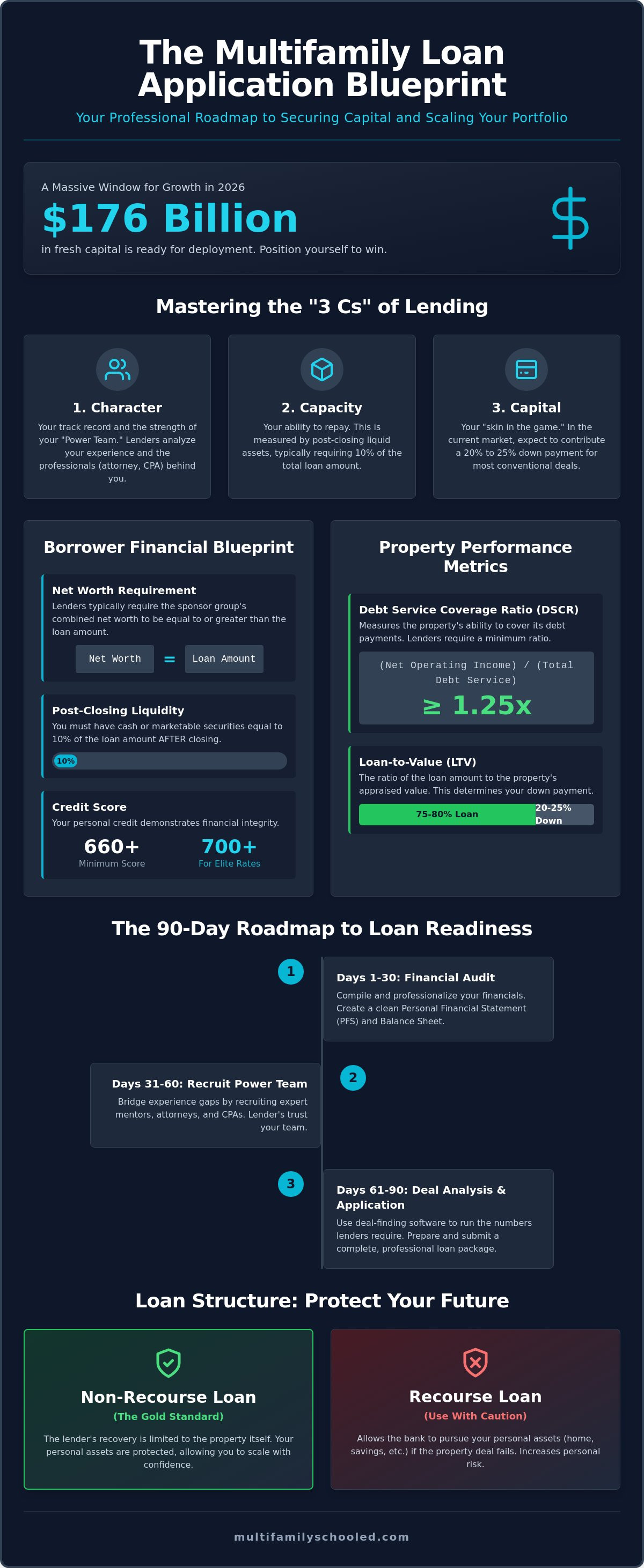
Your personal credit score still matters in the commercial world. While the building's income does the heavy lifting, your score proves your financial integrity. Aim for a minimum of 660. If you want the elite 5.57% rates seen in early 2026, you'll need a 700 or higher. Cash flow is the next pillar. In the residential world, banks look at your W2. In multifamily, they look at the property's Net Operating Income (NOI). Finally, there's collateral. Lenders view the asset's physical condition as their primary safety net. If the roof is failing, the deal is failing. Protect your collateral to protect your funding.
The 5 Cs of Commercial Credit
- Character: This is your track record and the strength of your "Power Team." Lenders look at your experience and the professionals, like your attorney and CPA, standing behind you.
- Capacity: This measures your ability to repay. Banks want to see liquid assets, typically 10% of the loan amount, sitting in your account after the deal closes.
- Capital: This is your "skin in the game." In the 2026 market, expect to bring a 20% to 25% down payment to the table for most standard deals.
Commercial vs. Residential: The Major Shift
The shift from residential to commercial is a mindset revolution. Banks care far more about the building's performance than your personal salary. They want to see a professional operation. This is why using an LLC entity is mandatory for your multifamily loan application checklist. It separates your personal life from the business asset, providing the legal structure lenders require. Net Operating Income is the lifeblood of multifamily investing, representing the total income generated after all operating expenses but before debt service. Master the NOI, and you master the bank.
Borrower Financial Standards: Net Worth and Liquidity Requirements
Don't let your personal bank account stop you from dreaming big. Many investors fear rejection because they don't have a multi-million dollar net worth. Here is the truth: lenders look at the strength of the entire sponsor group. If you're chasing a $5 million deal, the bank typically wants to see a combined net worth of $5 million. They also require "post-closing liquidity." This means having 10% of the loan amount in cash or marketable securities after you've paid the down payment. It's a safety net. It ensures you can handle the unexpected. This financial transparency is a non-negotiable item on your multifamily loan application checklist.
Experience is the final piece of the borrower puzzle. Lenders in 2026 are disciplined. They want to see a track record of managing similar assets. If you're a first-time investor, don't panic. You can solve this by bringing an experienced operator onto your team. You also need to understand personal guarantees. Non-recourse loans are the gold standard for scaling. They limit the lender's recovery to the property itself. Recourse loans, however, allow banks to pursue your personal assets if the deal fails. Aim for non-recourse to protect your future.
Calculating Your Investable Liquidity
Underwriters are precise. They want to see "clean" liquidity. Cash in checking accounts, savings, and even certain brokerage accounts counts. Retirement accounts like a 401(k) usually don't count unless you can withdraw the cash immediately without penalty. Use a professional Balance Sheet to present this data. A messy spreadsheet signals a messy investor. Create a Personal Financial Statement (PFS) that lists every asset and liability clearly. This document proves you have the staying power to weather market shifts.
Bridging the Gap: The Power of Partnerships
You don't have to do this alone. If your balance sheet is light, find a "Key Principal" or a "Sponsor." These are high-net-worth individuals who join your team to satisfy bank requirements. They provide the institutional credibility you need to secure the best 2026 rates. In exchange, you do the heavy lifting of finding and managing the deal. It's a win-win strategy for rapid growth. You can learn exactly how to attract these high-level partners through our Multifamily Mentorship program. Stop waiting for your bank account to grow and start building your power team today.
If you want to ensure your property's financials are as strong as your partnership, check out our Multifamily Tool Kit to automate the underwriting process.
Property Performance: The Math That Wins the Loan
Lenders don't care about your passion. They care about the property's performance. While your personal financials get you through the door, the building's math closes the deal. In the 2026 market, volatility is fading, but underwriting remains disciplined. You must prove the asset can breathe under its own weight. This is the most critical phase of your multifamily loan application checklist. If the numbers don't talk, the deal walks. It's that simple.
Mastering the DSCR Calculation
The Debt Service Coverage Ratio (DSCR) is the king of metrics. It's a simple formula: Net Operating Income (NOI) divided by Total Debt Service. If your building makes $125,000 and the mortgage is $100,000, your DSCR is 1.25x. This 1.25x ratio is the typical industry floor for 2026. Some elite lenders might accept 1.20x in primary markets, but 1.25x is your safe zone. A simple $50 monthly rent increase across a 50-unit building can unlock millions in additional financing by boosting the property's value and coverage.
Don't forget Loan-to-Value (LTV) and Loan-to-Cost (LTC). Most banks currently demand 25% down, which means a 75% LTV. For properties with strong cash flow in primary markets, Fannie Mae and Freddie Mac may still go up to 80% LTV. Valuation follows the "Income Approach." In 2026, average cap rates for apartment transactions have hovered around 5.8%. Divide your NOI by the market cap rate to find your building's worth. Lenders also demand stabilization. They typically want to see at least 90% occupancy before they'll consider your application a "stabilized" deal.
The Lender’s Due Diligence Checklist
Once the math works, the deep dive begins. Lenders use a rigorous multifamily loan application checklist for the asset itself to verify every claim you've made. They aren't just checking your math; they are checking the reality of the building.
- Rent Roll Analysis: Underwriters hunt for "bad debt," uncollected rent, and looming lease expirations that could tank your income.
- Phase I Environmental Reports: Banks must ensure the ground is clean. If there's a history of a dry cleaner or gas station on-site, expect a longer road to approval.
- Property Condition Assessments (PCA): An engineer will inspect the roof, plumbing, and HVAC. You must budget for future CapEx based on their findings to prove the building's longevity.
Precision wins. Guesswork loses. Use our Real Estate Radar software to ensure your property's DSCR meets bank criteria before you ever submit an application. By automating the math, you present a professional package that lenders can't ignore.
The 90-Day Roadmap to Loan Readiness
Success loves speed. You don't need years to prepare for your first deal. You need 90 days of focused, strategic action. This isn't just about paperwork. It's about transforming yourself into the type of borrower that banks fight to fund. Follow this roadmap to turn your multifamily loan application checklist into a closed deal and start building your legacy today.
Phase 1 (Days 1-30): The Financial Audit. Stop guessing about your standing. Pull your credit reports today. Clean up any errors immediately. You need to know your exact net worth and liquidity numbers. If you're short on cash, this is the month to identify potential partners or "Key Principals" who can strengthen your balance sheet. Financial integrity starts with your personal numbers. Don't hide from the data.
Phase 2 (Days 31-60): The Power Team Assembly. You can't win this game alone. Recruit an attorney who specializes in commercial real estate. Find a CPA who understands the massive tax advantages of large-scale assets. Most importantly, secure a mentor. A mentor provides the "experience" that lenders demand. They turn your rookie status into institutional credibility overnight. This is the fastest way to bridge the gap between where you are and where you want to be.
Phase 3 (Days 61-90): The Hunt. This is where the rubber meets the road. Use professional software to find and underwrite bankable deals. Don't look for "maybe" deals. Look for "definitely" deals. Your goal is to produce an Executive Summary. This is a one-page pitch that highlights the NOI, the DSCR, and your team's ability to execute. It's the ultimate professional calling card. Walk into the bank with a deal they can't refuse.
Assembling Your Loan Submission Package
Organization is your greatest weapon. Gather three years of personal tax returns and the last three years of the property's P&L statements. Lenders hate hunting for data. Use Real Estate Radar to find deals that already meet the 1.25x DSCR benchmarks we discussed earlier. Create a professional "Resume of Assets" for your entire borrower group. This document should showcase every property owned and managed by your team. It proves you are ready for the responsibility of a multi-million dollar asset. This is a core part of your multifamily loan application checklist.
Interviewing Lenders: Finding a Partner, Not a Gatekeeper
Stop acting like a beggar. You are providing the bank with an opportunity to deploy capital safely and profitably. Interview them. Ask: "What is your current appetite for multifamily?" Some regional banks are aggressive for 5-10 unit deals. Others, like Fannie Mae or Freddie Mac, want larger, stabilized assets. If a lender says no, don't walk away. Ask for specific feedback. A "No" today is just a "Not yet" if you follow up professionally. Persistence is the hallmark of a successful investor.
Ready to accelerate your journey and secure your first building? Join our Mentorship Program and get the exact systems you need to fund your deal in 90 days.
Scaling Faster: Navigating Complex Financing with Expert Guidance
Most first-time investors fail because they treat financing as an afterthought. They find a property they love and then scramble to fill out a multifamily loan application checklist. This is backwards. Without a proven system, you're just guessing. Professionals lead with the financing. They build the deal around the lender's appetite. This shift in strategy is what separates the hobbyists from the empire builders. You must become a master of the system before you can master the market.
Precision is your greatest asset. Our Multifamily Tool Kit automates the exact math lenders want to see. It takes the guesswork out of the complex DSCR and LTV calculations we covered earlier. You'll present a package so clean that underwriters will assume you've been doing this for decades. With nearly $90 billion in multifamily debt set to mature in 2026, many current owners will struggle to refinance. Your ability to present a "bankable" deal makes you the solution to the bank's problem. Syndication is your next level of growth. It allows you to:
- Pool capital to easily meet the 25% down payment standards of 2026.
- Combine net worth across a sponsor group to satisfy million-dollar loan requirements.
- Leverage the experience of "Key Principals" to bypass institutional skepticism.
Always position your deal for the future. Every acquisition should have a clear path to refinancing or asset accumulation. By mastering the multifamily loan application checklist now, you ensure you can pull your initial capital back out as the property's NOI grows, allowing you to scale with infinite velocity.
The Mentorship Advantage
Justin Brennan’s system is your fast track to authority. Lenders often look for a two-year business history or specific property management experience. We show you how to bypass these hurdles through established investment structures and institutional partnerships. You don't have to wait years to be "ready." Our mentorship helps you find and fund bankable deals within 90 days. Apply for the Mentorship Program to secure your first deal and gain the institutional credibility you need to win.
Your Future in Commercial Real Estate
Stop owning a job and start building an asset portfolio. A job requires your presence; an asset portfolio requires your leadership. The 2026 market is stabilizing. Rent growth is returning to sustainable levels. The FHFA has boosted loan caps to a combined $176 billion for Fannie Mae and Freddie Mac. The capital is waiting for you. The opportunities are everywhere. Stop waiting for permission or a "perfect" moment. Use your knowledge as a weapon for economic empowerment. Start building your legacy right now.
Claim Your Seat at the Multifamily Table
The window for massive portfolio growth in 2026 is wide open. You've mastered the fundamentals of the 3 Cs and learned how to satisfy even the strictest liquidity requirements. By following this multifamily loan application checklist, you've moved past the fear of rejection and toward institutional credibility. You possess the math, the timeline, and the strategy to win. Stop waiting for the perfect moment. Create it.
Mastery requires action. Under the guidance of multi-generational expert Justin Brennan, you'll bridge the experience gap and dominate the market. We provide the proprietary Real Estate Radar software to automate your underwriting and ensure every deal is bankable. We're so confident in our system that we guarantee results. Find a deal in 90 days or we provide one for you. Your journey to long-term independence starts with a single, decisive step.
Find Your First Deal in 90 Days: Join the Mentorship Program
The life you want is waiting on the other side of your first closed deal. Go get it.
Frequently Asked Questions
What is the minimum credit score for a multifamily loan?
You need a minimum credit score of 660 for most multifamily loan products in 2026. However, aiming for 700 or higher will unlock the most competitive interest rates, which started as low as 5.57% for Fannie Mae loans in July 2026. Regional banks often set their floor at 680. Don't let a lower score stop you. Focus on cleaning up your report during the first 30 days of your preparation to ensure you meet the highest standards.
Can I get a commercial loan with no money down?
Commercial multifamily loans typically require a down payment of at least 20% to 25%. While residential "no money down" programs exist, commercial lenders demand "skin in the game" to mitigate risk. In the current 2026 market, a 75% to 80% Loan-to-Value (LTV) ratio is standard. You can bridge this gap by partnering with high-net-worth sponsors or using syndication strategies to pool capital from other investors to meet your goals.
How much liquidity do I need for a $1 million apartment building loan?
You generally need $100,000 in post-closing liquidity for a $1 million loan. Lenders typically require you to maintain 10% of the loan amount in cash or marketable securities after the deal closes. This ensures you have the staying power to handle unexpected repairs or vacancies. Ensure these funds are in "clean" accounts like savings or brokerage accounts rather than restricted retirement funds to satisfy your multifamily loan application checklist.
What is the difference between a residential and a commercial loan?
The primary difference is how the lender evaluates risk. Residential loans focus on your personal W2 income, while commercial loans prioritize the property's Net Operating Income (NOI). Commercial deals also require you to close in an LLC entity rather than your personal name. This shift allows you to scale far beyond your personal income limits by leveraging the building's performance as the primary source of repayment for the debt.
How does a bank calculate the value of a multifamily property?
Banks use the Income Approach to determine building value. They divide the property's Net Operating Income (NOI) by the current market capitalization (cap) rate. In early 2026, the average cap rate for apartment transactions was 5.8%. If your building generates $100,000 in NOI, a bank might value it at approximately $1.72 million. Increasing your rents directly increases your building's worth, providing a massive lever for wealth creation and asset accumulation.
Do I need a business plan to get a commercial real estate loan?
Yes, a professional deal package or executive summary is essential for securing funding. Lenders don't just buy properties; they buy into the operator's vision and professional competence. Your package must include a detailed rent roll, a three-year P&L history, and a clear management strategy. Presenting a polished submission proves you are a strategic investor rather than a hobbyist, significantly increasing your chances of a "yes" from any major lender.
How long does the commercial loan approval process take?
You should expect the commercial loan process to take 60 to 90 days from application to closing. This timeline includes third-party reports like appraisals, Phase I environmental studies, and property condition assessments. Our 90-day roadmap is designed to align with this reality. By starting your preparation early and having your multifamily loan application checklist ready, you can avoid common delays and move with the speed the 2026 market demands.
What happens if the property DSCR is below 1.25?
If your DSCR falls below 1.25x, the lender will likely reduce your loan amount or reject the application. A 1.25x ratio is the industry floor, meaning the property must earn 125% of its annual mortgage payment. To fix a low ratio, you must either increase the property's income or provide a larger down payment to reduce the debt. Use professional software to verify these numbers before submitting your package to avoid a rejection from the bank.