

Multifamily Investment Strategy: The 2026 Blueprint for Rapid Execution
Waiting for the "perfect" market is the fastest way to stay stuck in your 9-5 forever. While most people are paralyzed by shifting interest rates, the most successful investors are using the permanent 100% bonus depreciation from the OBBBA to scale their portfolios at lightning speed. You've probably felt that same hesitation. It's easy to get lost in the data or fear overpaying when mortgage rates fluctuate between 5.15% and 12.75%. You want off-market deals, but finding them feels like a mystery you just can't solve.
It's time to stop guessing and start executing. This guide provides the exact multifamily investment strategy you need to find, analyze, and close deals with total confidence. We're moving past the noise of the 21st Century ROAD to Housing Act to focus on what actually works in 2026. You'll learn a systematic approach to replace your salary with apartment assets and own a large-scale property within just 90 days. Let's build your blueprint for financial freedom and master the hunt for high-yield cash flow starting right now.
Key Takeaways
- Learn why 2026 market dynamics make apartment buildings the ultimate vehicle for economic empowerment over traditional single-family rentals.
- Master a proven multifamily investment strategy that moves you from analysis paralysis to closing your first large-scale deal in just 90 days.
- Discover how to source lucrative off-market deals and underwrite them to find hidden value that institutional competitors overlook.
- Choose between active deal sponsorship or passive syndication to build a portfolio that replaces your 9-5 income for good.
- Understand why expert mentorship is the critical factor in avoiding deal-killing mistakes during your first high-stakes due diligence process.
Defining the Multifamily Investment Strategy for 2026
Multifamily investing is not just about owning real estate; it is about owning a scalable business that generates consistent cash flow. In 2026, this asset class stands as the premier vehicle for economic empowerment and long-term wealth. While single-family investors struggle to scale one house at a time, a professional multifamily investment strategy allows you to acquire dozens of units in a single transaction. This is the difference between building a hobby and building an empire. You are not just buying brick and mortar. You are securing a stream of income that can replace your 9-5 and provide a legacy for your family.
To succeed today, you must master the "Velocity of Capital." This concept focuses on moving your investment through a deal, capturing the upside, and redeploying it into the next asset as quickly as possible. Unlike residential houses that rely on market luck, apartment buildings thrive on "forced appreciation." By increasing the Net Operating Income (NOI) through better management or renovations, you directly control the property's value. Understanding these real estate investing fundamentals is the first step to dominating the current market.
To better understand this concept, watch this helpful video:
Why Apartments Beat Single Family Every Time
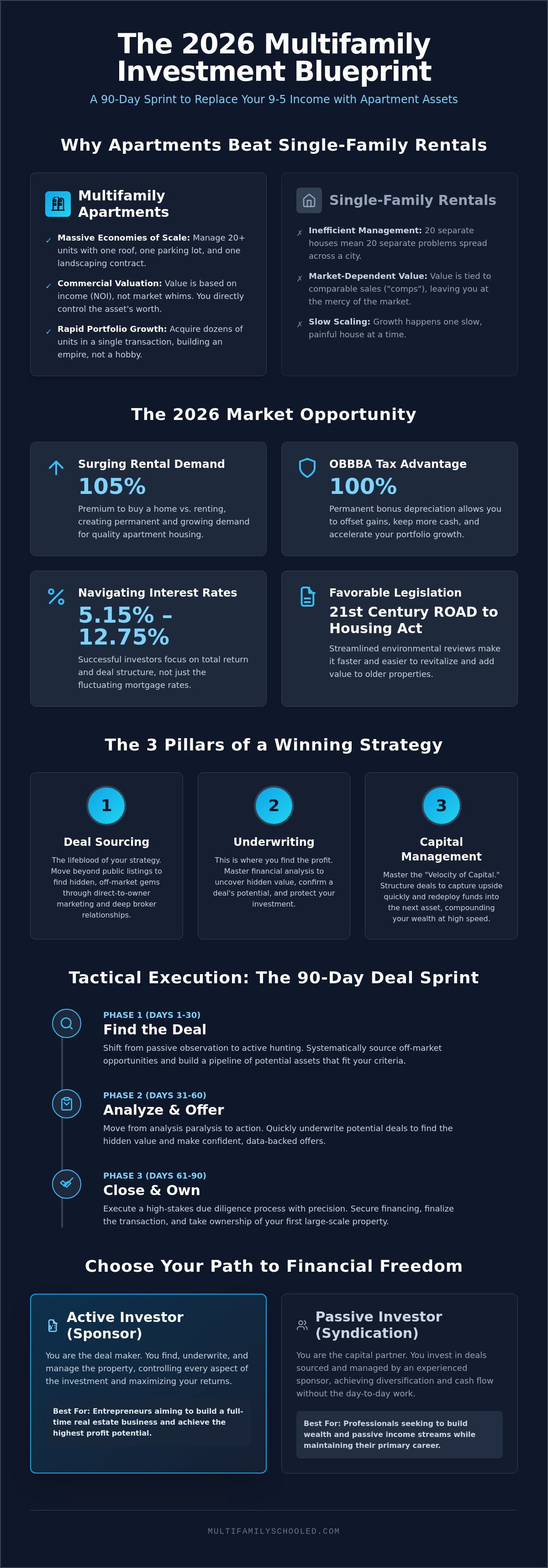
Managing 20 units under one roof is significantly more efficient than managing 20 separate houses across the city. You benefit from massive economies of scale. Maintenance is consolidated; you have one roof, one parking lot, and one landscaping contract. Commercial valuation is the real game-changer. While houses are valued based on what the neighbor's home sold for, apartments are valued on the income they produce. If you increase the monthly profit, the building's value increases exponentially. It is pure math, not market sentiment.
The 2026 Market Landscape
Stop waiting for a market crash. With a 105% monthly premium to buy a home versus renting in 2026, the demand for quality apartment housing is permanent and growing. Interest rates currently range from 5.15% to 12.75%, but the savvy investor looks at the total return. The "One Big Beautiful Bill Act" (OBBBA) has made 100% bonus depreciation permanent. This means you can offset your gains and keep more of your hard-earned cash. The 21st Century ROAD to Housing Act is also streamlining environmental reviews, making it easier to revitalize older assets. The opportunity is now, not next year.
The 3 Pillars of a Winning Multifamily Strategy
Success in this market requires more than just interest. You need a bulletproof system. A truly effective multifamily investment strategy relies on three non-negotiable pillars: deal sourcing, underwriting, and capital stack management. If one pillar is weak, your entire portfolio is at risk. Don't be the investor who spends six months staring at spreadsheets without making an offer. You must develop a "Deal Finding" mindset. This means seeing opportunity where others see problems. It means acting with speed and precision to secure assets before the competition wakes up.
The goal is rapid execution. You aren't looking for a "good" deal; you're looking for the right deal that fits your specific criteria. This requires a shift from passive observation to active hunting. When you master these pillars, you stop being a spectator and start becoming a closer. This is how you build a legacy that lasts for generations.
Sourcing: The Lifeblood of Your Strategy
Stop looking at the MLS. By the time a deal hits public listings, it's often picked over and overpriced. In 2026, you need to go straight to the source. Direct-to-owner marketing is how you find the real gems. Build a list of owners who have held their properties for over 10 years. They're often tired and ready to exit. You should also cultivate deep broker relationships. Brokers are the gatekeepers of the industry. If they know you're a serious player who can close, they'll give you the "first look" at off-market assets. To scale even faster, use Real Estate Radar to identify distressed or high-potential properties before your competition even knows they exist.
Underwriting for Maximum Profit
Underwriting is where you find the hidden "meat" in a deal. You must master Net Operating Income (NOI) because it's the primary driver of property value. Look for "Value-Add" opportunities that others miss. Can you implement a utility bill-back system? Can you add laundry services or storage units? These small operational changes create massive equity. When analyzing multifamily cap rates, understand that a stabilized asset in 2026 requires a sharp eye for efficiency. Start with a 15-minute "napkin" analysis to see if the deal has legs. If it does, move to a deep-dive analysis immediately. If you're looking for a proven framework to master these numbers, our mentorship program can help you avoid the common pitfalls that kill most first-time deals.
Finally, you must structure your capital stack for maximum ROI. This means balancing senior debt with mezzanine financing or private equity. Don't let the complexity of the numbers paralyze you. The market moves fast, and you need to move faster. Secure your debt, find your equity, and close the gap between where you are and where you want to be.
Active vs. Passive Strategies: Choosing Your Path
Deciding how you enter the market is the most critical choice you'll make this year. You have two distinct paths: the passive route or the active route. Passive investing through Real Estate Investment Trusts (REITs) or as a Limited Partner (LP) in a syndication allows you to grow wealth without managing tenants. It's the "hands-off" approach for those with significant capital but zero time. However, if you want to maximize your returns and reach financial freedom in record time, you must consider the active route. Active investing means you are the deal sponsor or the direct owner. You are the driver, not the passenger.
A common myth stops potential moguls in their tracks: the belief that active investing requires a 40-hour work week. This is false. When you implement a systematic multifamily investment strategy, you aren't trading time for money; you are managing a system. By leveraging professional property management and our proven frameworks, you can oversee a multi-million dollar asset in just a few hours a week. The goal is to work on the business, not in it. Don't let the fear of a "second job" prevent you from owning the bank.
The Power of Direct Ownership
Direct ownership is where the real wealth is created. When you own the asset, you retain 100% of the tax benefits. Thanks to the permanent 100% bonus depreciation restored by the OBBBA, you can wipe out your tax liability and keep every cent of your cash flow. You also have total control over the exit strategy. You decide when to refinance, when to sell, and how to optimize the operations. Active investors often build wealth five times faster than passive counterparts because they capture the acquisition fees, the asset management fees, and the lion's share of the forced appreciation. It's about economic empowerment through total authority.
When to Pivot to Syndication
Once you've mastered the basics with a direct deal, you can scale using other people's money. Syndication allows you to move into the 50+ unit space by acting as the General Partner (GP). You provide the expertise and the deal, while Limited Partners provide the bulk of the capital. This path is essential for rapid scaling because it removes the ceiling on your growth. However, your first deal should ideally be direct. You need to learn the ropes and understand the mechanics of a deal before you take on the responsibility of managing someone else's retirement fund. Understanding multifamily market liquidity will give you the confidence to know that capital is always looking for a home in high-quality apartment assets. If you're ready to master the active path, check out our Mentorship Program to get started today.
Tactical Execution: The 90-Day Deal Sprint
Speed to lead is the only differentiator that matters in a competitive environment. If you want to own a large-scale property this quarter, you must commit to a high-tempo multifamily investment strategy. This isn't a slow crawl; it's a 90-day sprint designed for rapid execution. While others are over-analyzing a single property for weeks, you'll be moving through a systematic process that filters out the noise and highlights the profit.
Your sprint breaks down into three distinct phases:
- Day 1-30: The Foundation. Pick your "sandbox." Don't try to master the whole country. Choose one market and learn its numbers inside and out.
- Day 31-60: The Hunt. This is the volume phase. You must analyze 100 deals to find the 10 that deserve an offer. This high-volume approach sharpens your market intuition.
- Day 61-90: The Close. Issue your Letters of Intent (LOI), begin due diligence, and secure your funding. At this stage, your focus shifts from finding to finalizing.
Building Your Deal Pipeline
Success is a numbers game. Set a daily quota for deal analysis. If you aren't looking at at least three properties a day, you aren't in the game. You don't have to do this manually. Automate your search and streamline your underwriting with the Multifamily Tool Kit. This allows you to spend your time talking to sellers and brokers rather than staring at raw data. When you find a property that fits, craft an LOI that shows you're a serious closer. Professionalism and speed often beat the highest price.
Overcoming the Funding Hurdle
Don't let a lack of personal capital stop you. Creative financing is the bridge to your first closing. Use bridge loans for quick acquisitions or master lease options to control the property while you stabilize it. Pitch your deal to private money partners by showing them the forced appreciation and cash flow potential. Seller financing is the ultimate 2026 leverage tool because it allows you to bypass traditional bank restrictions and secure better terms directly from the owner. You provide the expertise and the deal; the capital will follow the opportunity.
Ready to put this into action? Join our next Online Challenge and close your first deal before the year ends.
Scaling Your Strategy with Expert Mentorship
Solo investing is a dangerous trap. Statistics show that 95% of solo investors fail in their first year because they lack a proven system. They get paralyzed by data or make a massive financial mistake during due diligence. You don't have to be one of them. A successful multifamily investment strategy isn't built in a vacuum. It is built on the shoulders of those who have already closed hundreds of deals. Mentorship is the ultimate shortcut to economic empowerment. It turns a "maybe" into a "guaranteed" by replacing guesswork with a battle-tested blueprint.
When you have an expert in your corner, you stop guessing and start closing. You gain immediate access to a pre-vetted ecosystem of lenders, brokers, and insurance agents. These are the professionals who actually make deals happen in the 2026 market. A mentor spots the "deal-killing" red flags in a rent roll or a phase I environmental report before you sign the contract. This protection is the ultimate risk-mitigator for new investors. We even offer a 90-day deal guarantee because our execution system is that precise. We don't just teach; we provide the tools for your success.
The Multifamily Schooled Difference
Most people spend years "learning" without ever making a single offer. We move you from the sidelines into the game. Through our Mentorship Program, you get the exact roadmap used to dominate the 5-50 unit space. You aren't just watching videos. You are accessing a proprietary system designed to find and close a deal in 90 days. You also join a high-energy community of active apartment owners. Networking with people who are already where you want to be is the fastest way to scale your portfolio and your mindset.
Your Next Step Toward Freedom
Stop over-analyzing. The market moves fast, and it won't wait for you to feel ready. Register for our next 3-Day Live Workshop to compress three years of learning into one intensive weekend. If you want to build momentum right now, claim your future by taking the 5-Day Challenge. You have the blueprint. You have the 2026 market dynamics like 100% bonus depreciation on your side. Now, you just need the courage to execute. The path to replacing your 9-5 income with apartment assets is right in front of you. Take the first step today.
Execute Your Blueprint for Economic Empowerment
The path to financial independence is no longer a mystery. You've learned how to move beyond the MLS, master the art of underwriting, and execute a high-tempo 90-day deal sprint. The 2026 market landscape offers unprecedented opportunities for those who choose active ownership over passive observation. By mastering this multifamily investment strategy, you aren't just buying buildings; you're securing a legacy of cash flow and tax-free wealth for your family. The time for analysis is over. The time for execution is now.
Success requires the right tools and the right guidance. Leverage founder Justin Brennan's multi-generational industry heritage and gain immediate access to our proprietary Real Estate Radar software. We are so confident in our systematic approach that we provide a 90-day deal guarantee. You have the map, the data, and the drive. Now, you just need to take the lead and join a community of winners who are actively shaping their financial destinies.
Secure Your First Deal in 90 Days—Apply for Mentorship Now
Your future as a high-yield apartment owner is waiting. Make the decision to start your 90-day sprint today and never look back. You have everything it takes to win in this market. Let's get to work.
Frequently Asked Questions
What is the best multifamily investment strategy for beginners in 2026?
The 5-50 unit space is the ultimate multifamily investment strategy for beginners right now. This "sweet spot" offers enough scale to afford professional management while avoiding competition from massive institutional funds. You benefit from commercial valuation based on Net Operating Income (NOI). This allows you to force appreciation through operational improvements rather than waiting for market luck. Start small enough to manage, but large enough to scale your wealth rapidly.
How much money do I really need to start investing in multifamily?
You don't need millions of your own cash to close a deal. Many successful investors use syndication or private money partners to cover the down payment, which is typically 20% to 25% of the purchase price. Creative options like seller financing can even reduce your out-of-pocket costs further. Focus on finding a high-value deal first. If the numbers work, the capital will follow the opportunity every single time. Stop letting a small bank account stop your big ambitions.
Is it better to invest in 2-4 units or 5+ unit apartment buildings?
Target 5+ unit buildings if you want true economic empowerment and scalability. Buildings with 2-4 units are still considered residential and are valued based on comparable sales, just like houses. Once you hit 5 units, the property is valued as a commercial asset based on its income. This gives you direct control over the building's worth. Scale your portfolio faster by playing the commercial game from day one.
How do I find off-market multifamily deals without a broker?
Go straight to the source with direct-to-owner marketing campaigns. Use data tools to identify owners who have held properties for 10 or more years without a recent sale. Send personalized mailers or make direct calls to express interest in their specific asset. Many tired landlords are ready to exit but don't want the hassle of a public listing. This approach lets you negotiate better terms and avoid expensive bidding wars.
What are the biggest mistakes to avoid in multifamily underwriting?
Never underestimate operating expenses or assume aggressive rent growth in your spreadsheets. A common mistake is failing to account for the "expense ratio," which often sits between 35% and 50% for older assets. Always verify the actual tax bill after a sale, as it will likely jump. Be conservative with your exit cap rate. If the deal only works with perfect market conditions, it is not a deal worth doing.
Can I invest in multifamily real estate while working a full-time job?
You can absolutely build a massive apartment portfolio while working a 9-5. The key is to act as the asset manager, not the property manager. Hire professional management to handle the daily tenant issues while you focus on high-level multifamily investment strategy and deal finding. Use your nights and weekends to analyze deals and build your pipeline. Systematic execution allows you to own the bank without sacrificing your current career.
How does a real estate mentor help me find a deal faster?
A mentor provides a proven roadmap that eliminates the painful learning curve. You gain immediate access to their vetted network of lenders, brokers, and contractors. This saves you months of trial and error. A mentor also reviews your underwriting to ensure you aren't walking into a financial trap. They provide the confidence you need to pull the trigger on a deal with total certainty and speed.
What is a good cap rate for an apartment building in today's market?
A "good" cap rate in 2026 depends on the specific market and asset class. However, you should generally look for a cap rate that is at least 1% to 2% higher than your mortgage interest rate. With Fannie Mae rates hovering around 5.45% to 5.90%, targeting a 6.5% to 7.5% cap rate is a solid baseline for stabilized assets. Focus on the potential to increase that rate through active management.



